Last Updated on November 2, 2026 by unidus
Ask about fire-rated acoustic panels on a commercial project and the answer usually arrives within the first five minutes, before anyone has opened the test report. Someone asks if the panels are fire-rated, someone says yes, and the spec moves on. But “fire-rated” isn’t one thing. It covers several tests run to several standards, and the gap between what a client assumes and what a datasheet certifies is where compliance trouble starts. It tends to surface at a fire NOC stage nobody budgeted time for, well after the other acoustic panel certifications and quality standards have been ticked off.
Key Takeaways
- A “fire rating” on an acoustic panel almost always means reaction-to-fire (how a material ignites, burns and spreads flame), not fire resistance (how long an assembly holds a fire back).
- India classifies flame spread under IS 12777, while imported datasheets often quote DIN 4102, UL 94 or ASTM E84; the classes don’t convert into one another.
- A panel is a build-up of core, facing and thickness, so a rating applies only to the exact configuration that was tested.
- A fire claim is only as strong as the report behind it; check the lab, the standard, the sample and the date before it goes into a spec.
- Our 9mm polyester fibre board has an independent test report for DIN 4102 Class B1 and UL 94; other thicknesses and facings need their own reports.
What a Fire Rating Means for an Acoustic Panel
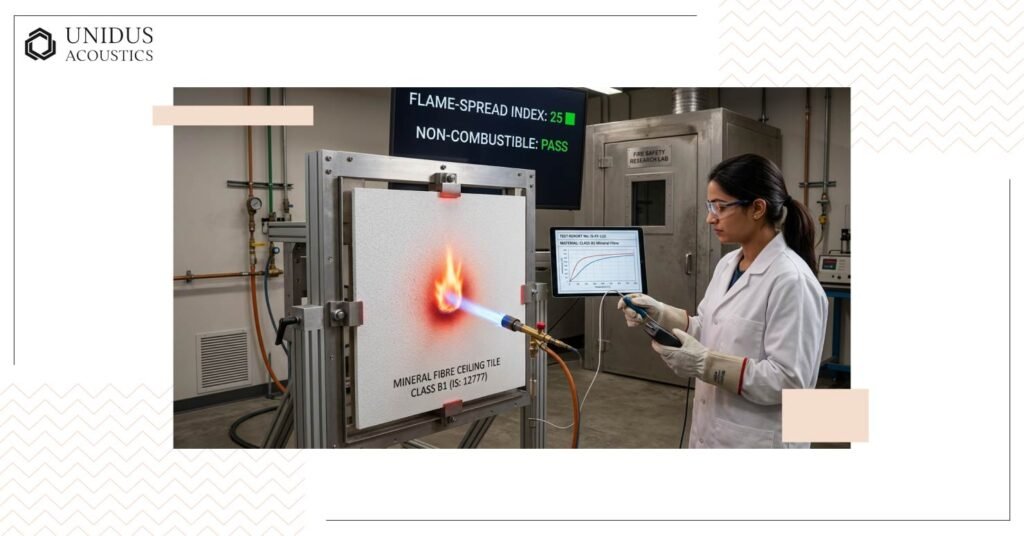
A fire rating on an interior finish like an acoustic panel is a reaction-to-fire classification: it describes how the material itself behaves when exposed to flame or heat. That covers ignitability, how far flame spreads across the surface, how much smoke is produced, and how quickly the material self-extinguishes once the flame source is removed.
Fire resistance is a different question. It’s measured in minutes (30, 60, 120) and applies to structural and compartment elements such as fire doors, rated walls and floor slabs, which are built to hold a fire inside a zone. An acoustic panel on an office wall isn’t doing that job. When a vendor hands over a “fire rating”, they almost always mean the reaction-to-fire kind. It’s worth confirming that in writing, because the two terms blur together in conversation.
The distinction matters on site. A panel with an excellent reaction-to-fire class still has to sit within a wall or ceiling assembly that meets the project’s own fire resistance requirements, worked out separately with the fire consultant and the local NOC authority. Mixing the two up is a common source of back-and-forth late in a project, usually when the consultant asks a question the panel datasheet was never meant to answer.
The Classification Systems on a Test Certificate
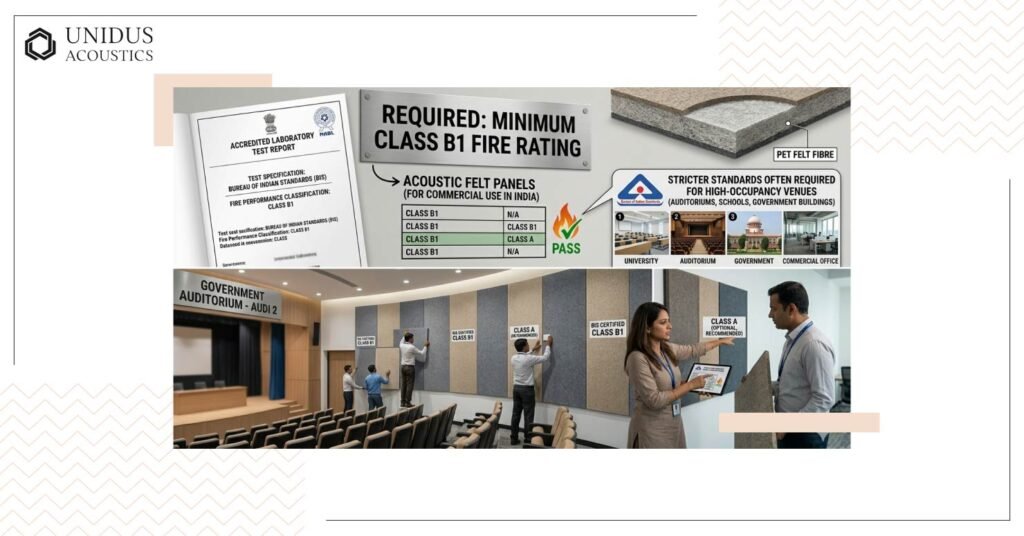
Part of the confusion is that there’s no single global fire rating. Depending on where a product was tested, you’ll see one of several systems on the certificate, and they don’t convert cleanly into each other.
In India, flame spread for building products is classified under IS 12777, which sorts materials into four classes. Which class applies to a given wall, ceiling or escape route comes from the fire safety provisions of the National Building Code and the local fire department, and the project’s fire consultant confirms it. IS 12777 looks at surface flame spread only. Fire resistance of an assembly is covered separately, for example under IS 3809.
Imported products tend to arrive with a different system on the datasheet. UL 94, for instance, comes from plastics testing in the United States. The table lists the ones you’re most likely to meet.
| Standard | Where It’s Used | What It Measures | Example Classes |
|---|---|---|---|
| IS 12777 | India | Surface flame spread | Class 1 to Class 4 |
| DIN 4102 | Germany, widely quoted on imported products | Flammability and combustibility of building materials | A1, A2, B1, B2, B3 |
| UL 94 | United States, plastics and polymers | Burn rate and self-extinguishing behaviour | HB, V-2, V-1, V-0 (most self-extinguishing) |
| ASTM E84 | United States | Flame spread and smoke development | Class A, B, C |
| EN 13501-1 (Euroclass) | European Union | Reaction to fire | A1 (best) to F |
None of these maps directly onto the IS 12777 classes. A datasheet that says “Class B1” needs a line of context before it lands in an Indian spec. B1 is a real, independently tested classification, but it’s a German one, and the fire consultant reviewing the submission should know which system they’re reading.
What a Datasheet Leaves Out
A fire classification belongs to the exact sample that was tested. Two details on a datasheet deserve a second look before you rely on it: what was tested, and what you should ask the supplier.
Why the Tested Sample Matters
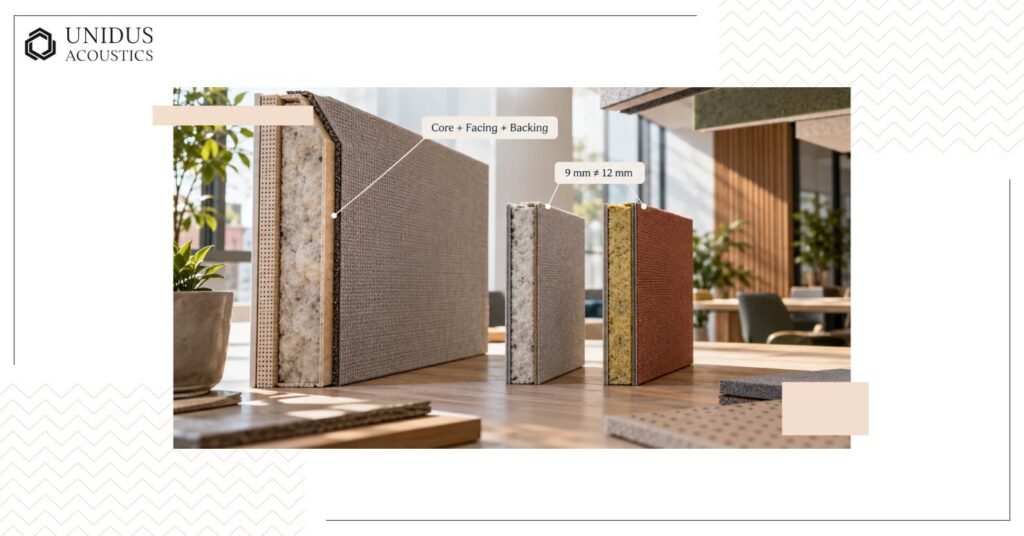
An acoustic panel is rarely one material. It’s usually a core (recycled polyester fibre, glass wool, wood wool or mineral wool) wrapped in a fabric or perforated surface, and the finished build-up is what gets tested, not the core alone. Change the facing fabric, the backing or the thickness, and the classification can change with it. A test on a 9mm board doesn’t automatically cover a 12mm version with a different fabric on it. That’s less a flaw in any one manufacturer’s product than a feature of how composite materials are tested everywhere. The same goes for acoustic ceiling baffles, where the build-up differs from a flat wall panel.
Supply chain substitutions happen. What’s specified doesn’t always match what gets installed. Quoting report numbers in the BOQ and tender documents, not only a product name, is the most reliable way to catch a mismatch before installation. That habit belongs in any acoustic panel specification for commercial projects.
What to Ask a Supplier Before You Specify
A few questions separate a tested claim from a line in a brochure:
- Confirm which lab issued the report, and whether it’s independently accredited.
- Ask for the exact configuration that was tested: thickness, facing and density.
- Check the standard it was tested against, and whether that matches what the fire consultant needs.
- Look at the test date, and ask whether it covers the current version of the product.
If each answer comes back with a report number and a date attached, you’re holding a tested claim. If it comes back as reassurance, the question is still open. Government and PSU tenders tend to ask for this kind of documentation up front.
How Unidus Acoustics Approaches Fire Testing
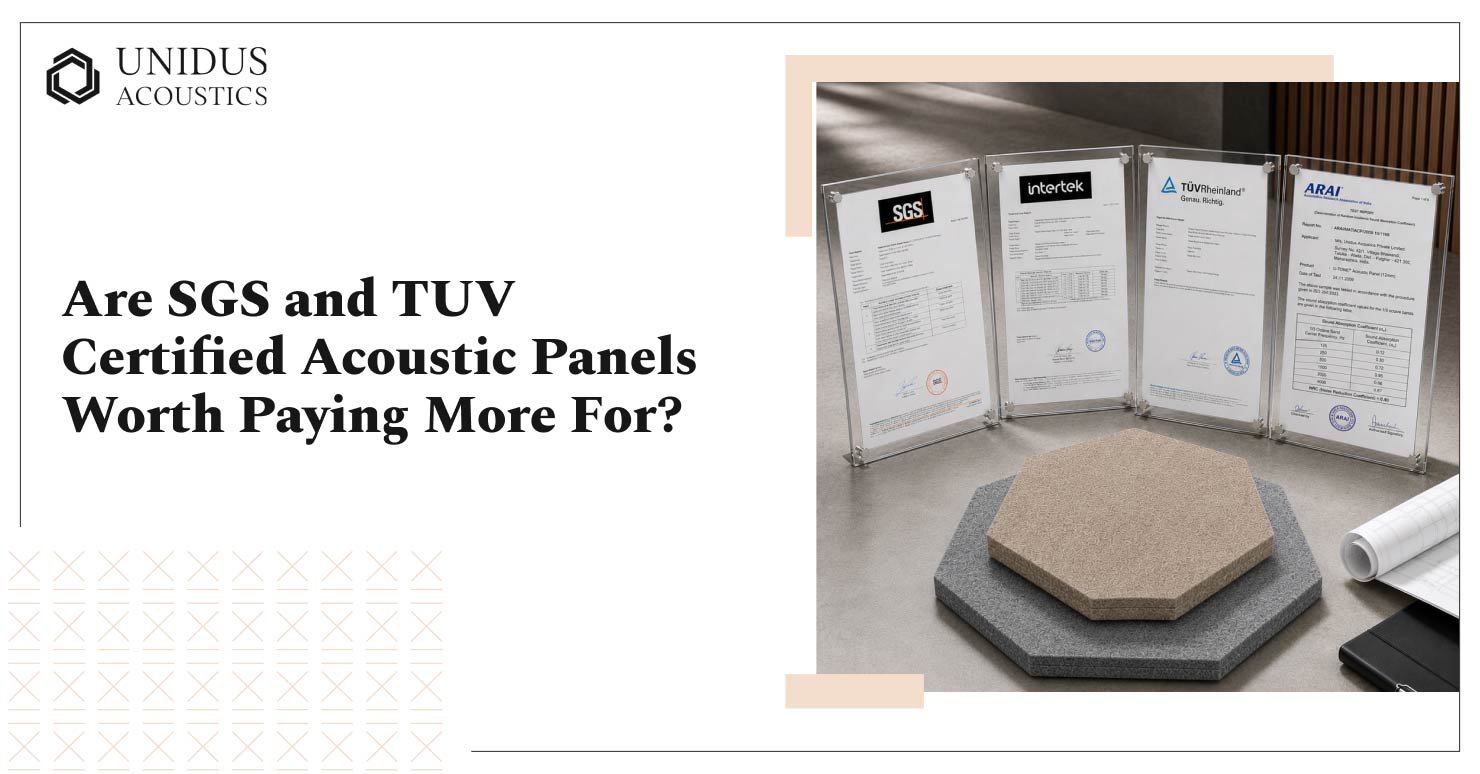
Unidus Acoustics relies on independent test reports instead of raw-material claims. Its 9mm polyester fibre board has an independent test report classifying it as Class B1 under DIN 4102-1 and DIN 4102-16, with UL 94 test results of HB/V-0 on the same material. The report number and date are printed on the certificate in the catalogue, so your fire consultant can read them for themselves. Across the range, third-party test certificates from SGS, Intertek and TÜV Rheinland are available on request for tender submissions.
Fire testing sits beside separate reports for NRC and sound absorption and for VOC emissions. A panel that performs acoustically but can’t show its paperwork is a hard sell to an architect defending a spec at a fire NOC review.
Getting the Paperwork Right Before It Becomes a Problem
Fire classification on an acoustic panel is narrower than “fire-rated” suggests in conversation. It’s a dated test result tied to one configuration and one of several standards that don’t interchange. Which system, which lab and which exact build matter as much as the headline class. Confirming those before the spec is locked saves a conversation with the fire consultant that nobody wants mid-project.
Unidus Acoustics brings 40+ years of experience in custom acoustic solutions, and shares its test reports on request. If fire classification is part of your brief, contact us and we’ll walk you through the test reports available for the configuration you have in mind.
Frequently Asked Questions
1. Is a fire-rated acoustic panel the same as a fireproof one?
No. A fire rating describes how a material reacts to fire: how easily it ignites, how far flame spreads and how fast it self-extinguishes. It doesn’t mean the material can’t burn.
2. What fire classification do commercial buildings in India require for acoustic panels?
It depends on the building’s occupancy and where the panel sits (wall, ceiling or escape route). The requirement comes through the National Building Code’s fire safety provisions and the local fire department. The project’s fire consultant confirms the class against the exact clause.
3. Can a panel be rated under both IS 12777 and an international standard like DIN 4102?
Yes. A manufacturer can test the same product against more than one system. The results are separate reports, not equivalents, and comparing them is a job for the fire consultant.
4. Does a higher NRC rating affect fire classification?
Not directly. NRC measures acoustic performance; fire classification measures combustion behaviour. They’re tested separately, though material and facing choices can influence both.
5. Why do two similar-looking panels sometimes carry different fire ratings?
Usually because of a difference in facing fabric, core density, thickness or adhesive. Any of these can change how the finished panel performs in a flame-spread test.
6. Who should confirm the fire rating requirement for a project?
The project’s fire and life safety consultant, working from the applicable National Building Code clause and the local fire department’s NOC requirements. A manufacturer’s test report feeds into that decision; it doesn’t replace it.