Last Updated on October 22, 2026 by unidus
Sustainability credentials are now a standard ask in commercial interiors briefs: LEED points, low-emission interiors, materials with a documented environmental story. Recycled polyester acoustic panels have moved into this gap, and for good reason.
But the sustainability angle can overshadow the more practical question: do these panels perform well acoustically in the spaces you’re specifying them for? At Unidus Acoustics, it’s one of the most common questions we get on sustainability-led briefs. The honest answer depends on the application and installation approach, not just the specification on paper. This article covers what recycled polyester acoustic panels deliver in Indian commercial interiors and where you might be overstating their contribution.
Key Takeaways
- Recycled polyester acoustic panels are made primarily from reclaimed PET fibres, giving them a verifiable sustainability credential without compromising acoustic performance.
- They perform best as wall-mounted panels in meeting rooms, CXO offices, conference rooms, and collaborative workspaces.
- Acoustic contribution depends on thickness, density, and mounting method. A 9mm panel on a hard wall performs very differently from a 50mm panel with an air gap behind it.
- Recycled polyester isn’t a universal replacement for every acoustic panel material. Each material class suits specific applications.
- Available in a wide range of colours, textures, and custom-cut shapes, useful where the acoustic element needs to carry design weight too.
What Recycled Polyester Acoustic Panels Are
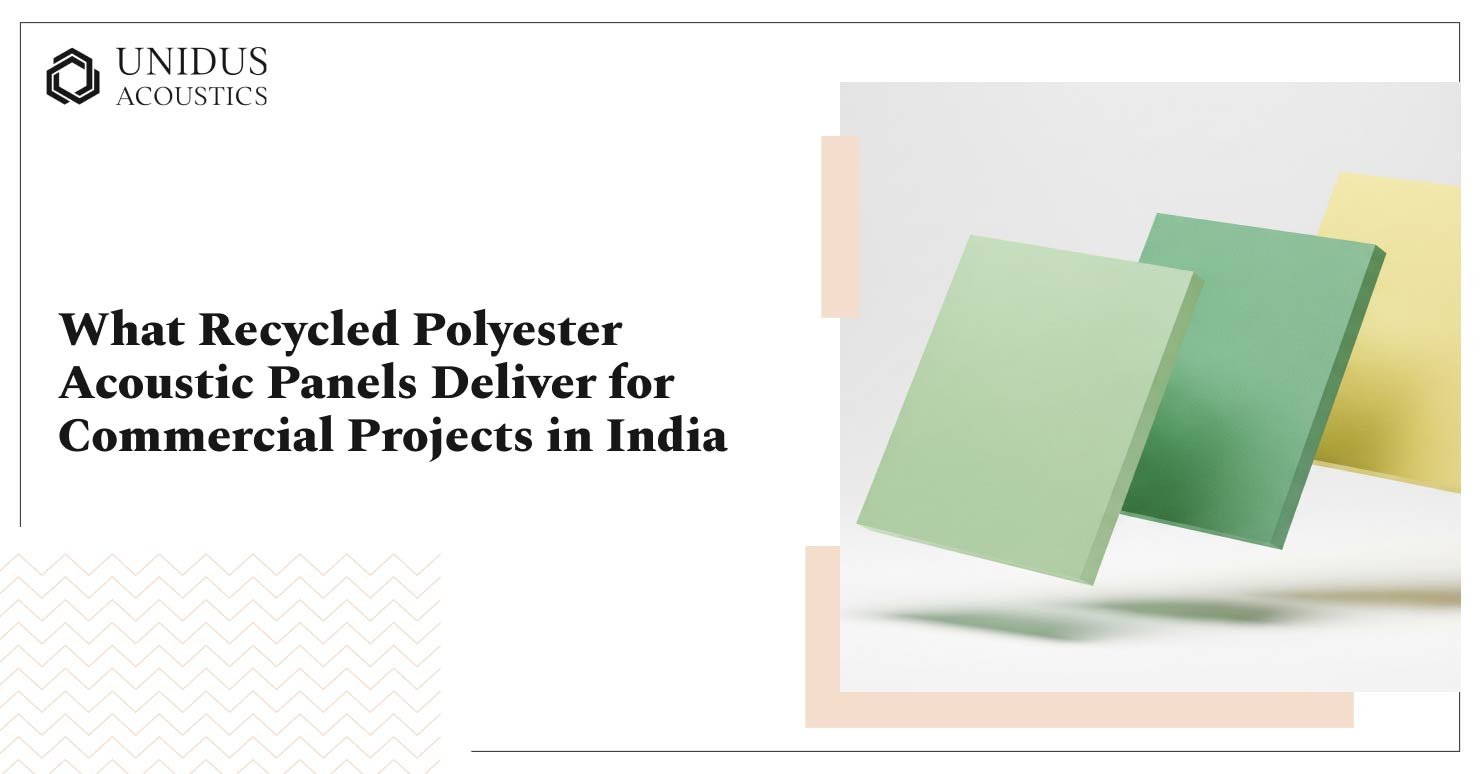
Recycled polyester acoustic panels are manufactured from reclaimed PET (polyethylene terephthalate) fibres, commonly sourced from post-consumer plastic bottles or industrial textile waste, processed into a dense, non-woven fibre board that absorbs mid-to-high frequency sound energy.
Unlike some other acoustic panel types, they contain no formaldehyde binders and produce no significant VOC emissions over the installation period, making them practical where indoor air quality matters, such as medical consultation rooms, education spaces, and corporate offices.
How They’re Made and Why It Matters
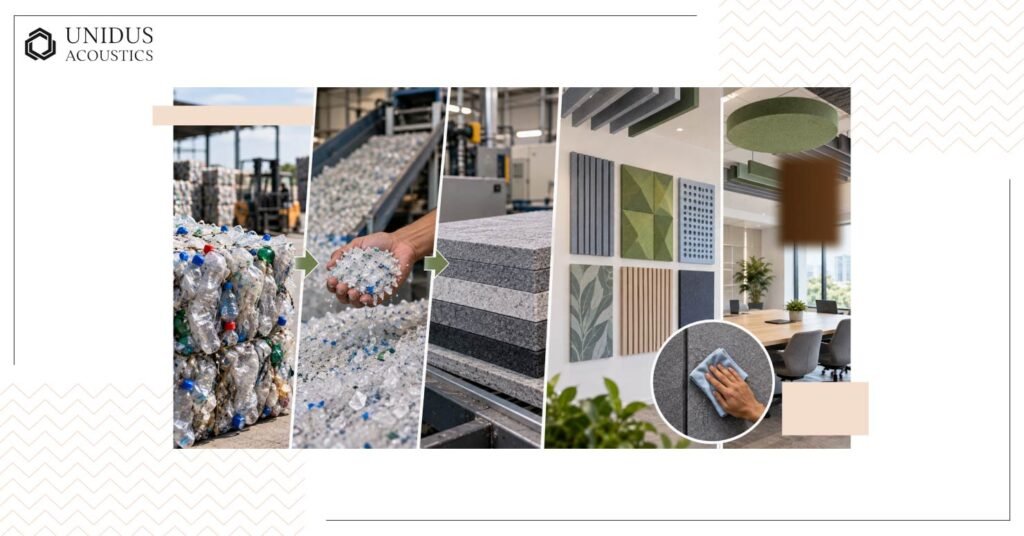
Shredded PET fibres are layered and thermally bonded under heat and pressure into a dense mat without chemical adhesives, part of why the panels are often cited as low-emission. The resulting panel is lightweight relative to its thickness, affecting both acoustic performance and ease of wall mounting. A 50mm panel weighs considerably less than a comparable stone wool panel with a facing, simplifying specification where structural loading is a constraint.
Where Recycled Polyester Acoustic Panels Perform Well
Recycled polyester panels are solid mid-frequency absorbers, contributing meaningfully in the 500Hz-2000Hz range, the range most relevant to speech intelligibility, which is why they suit spaces where conversation clarity matters most.
Meeting Rooms and Conference Rooms
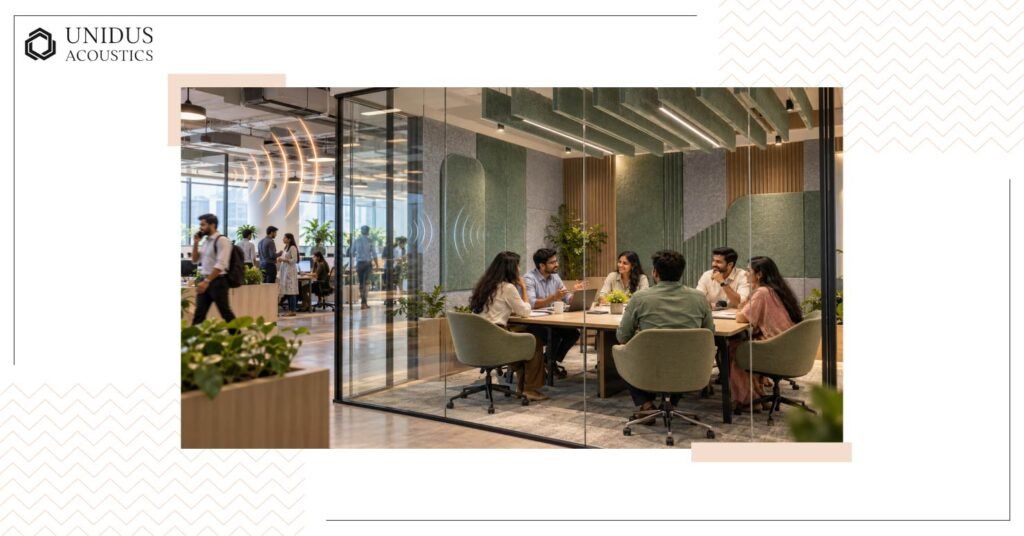
Corporate meeting rooms are the most natural fit for recycled polyester acoustic wall panels. They handle the speech frequency range well, come in fabric-wrapped finishes that look intentional, and can be specified to coordinate with the interior palette. For video conferencing rooms, panels combined with acoustic ceiling systems or a cloud system give a reasonable baseline without disrupting the design.
CXO Offices and Private Cabins
Acoustic privacy is often secondary to aesthetics and status expression in CXO office briefs. Panels with decorative finishes, inlay patterns, or custom printed surfaces satisfy both at once: the acoustic contribution comes from the core, the design brief from the surface treatment.
Collaborative Workspaces and Open Plans
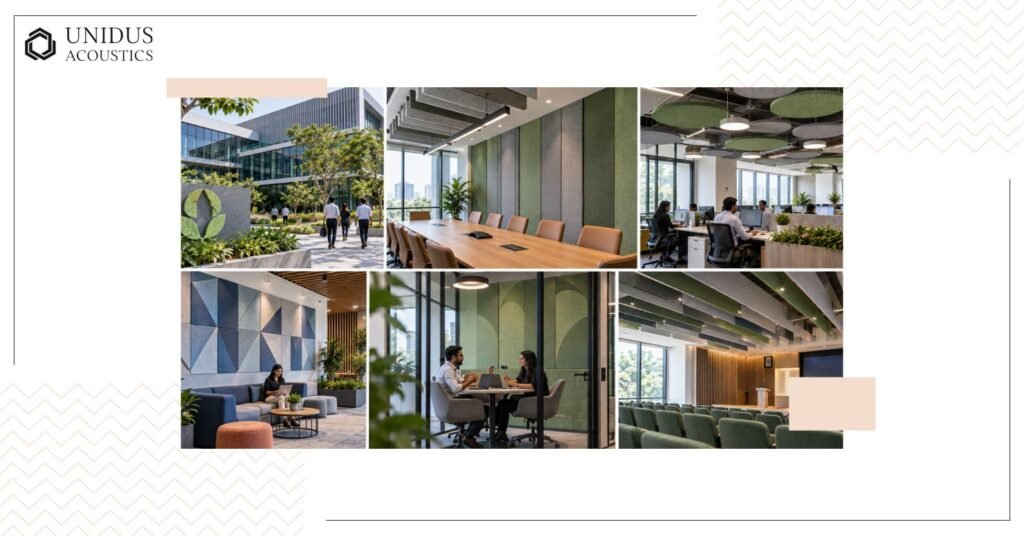
Open-plan offices are a harder brief because the problem isn’t only reverberation, it’s direct noise travel between workstations. Panels help most in desk screens and partition dividers, and suspended as acoustic baffles between zones. Wall-mounted panels alone at the perimeter won’t resolve noise in the centre of a large floor.
The Specification Variables That Determine Performance
The material alone doesn’t determine acoustic output. Two panels of similar fibre composition can perform quite differently depending on how they’re specified and installed.
Panel Thickness
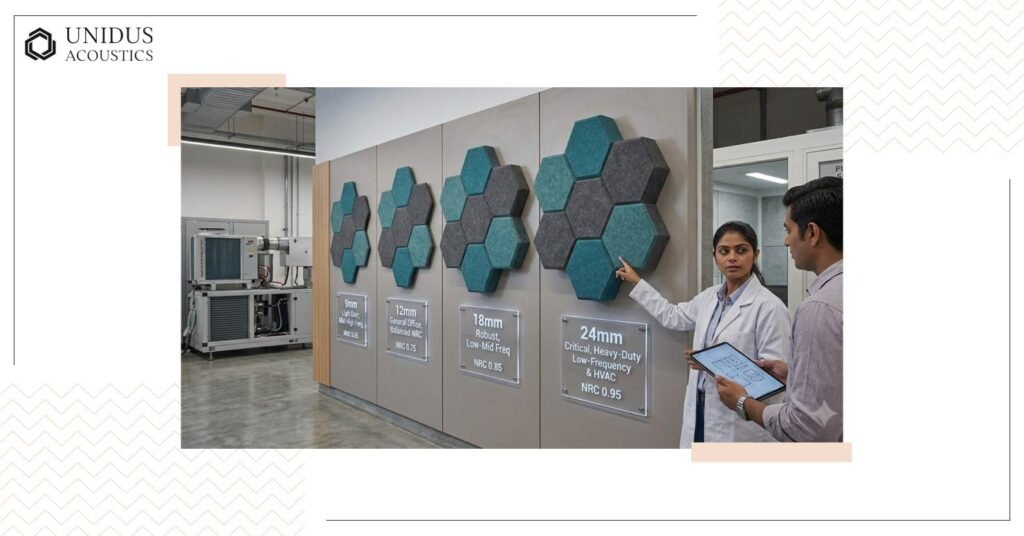
A 25mm panel contributes meaningfully at higher frequencies but not much lower-mid content. A 50mm panel absorbs usefully at lower frequencies and is significantly more effective overall. For most meeting rooms, 25-50mm is the working range; thinner than 25mm in a reverberant space is generally a specification error, not a cost optimisation.
Mounting Method and Air Gap
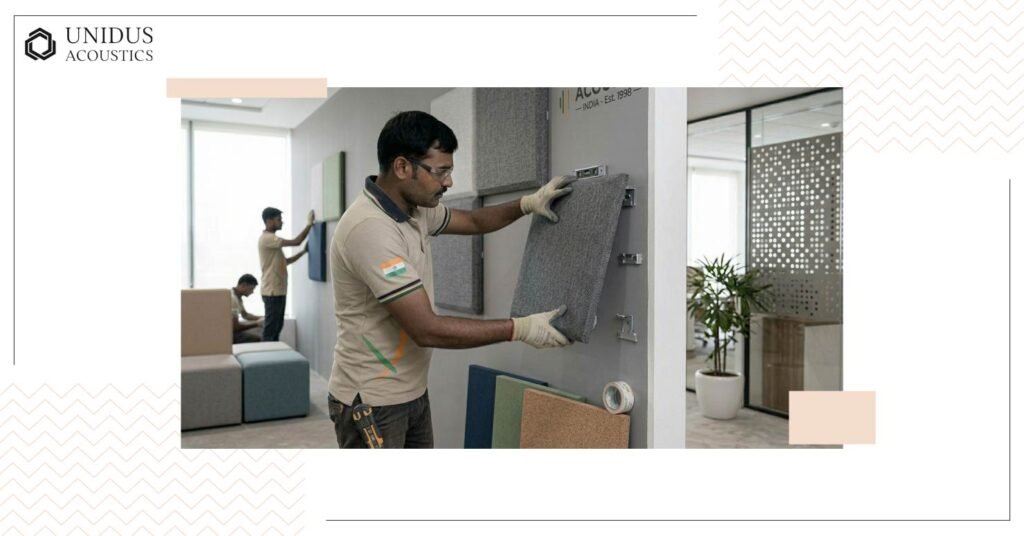
A panel mounted directly against a hard wall underperforms, since the wall reflects energy that would otherwise be absorbed. An air gap, 50-100mm off the wall, significantly improves low-frequency absorption without changing the panel itself, one of the more underutilised levers in acoustic specification.
Surface Coverage in the Room
Coverage area determines how much the room’s reverberation time falls. A few decorative panels produce a measurably different result from systematic coverage of two opposing walls. The brief should state the acoustic objective, not only what the panels should look like.
Where Recycled Polyester Has Limitations
| Application | How Recycled Polyester Performs | Consider Instead |
|---|---|---|
| High-humidity environments (kitchens, washrooms) | PET fibres can absorb moisture over time in humid conditions. | Acoustic ceiling tiles with moisture-resistant facing, or metal ceiling systems. |
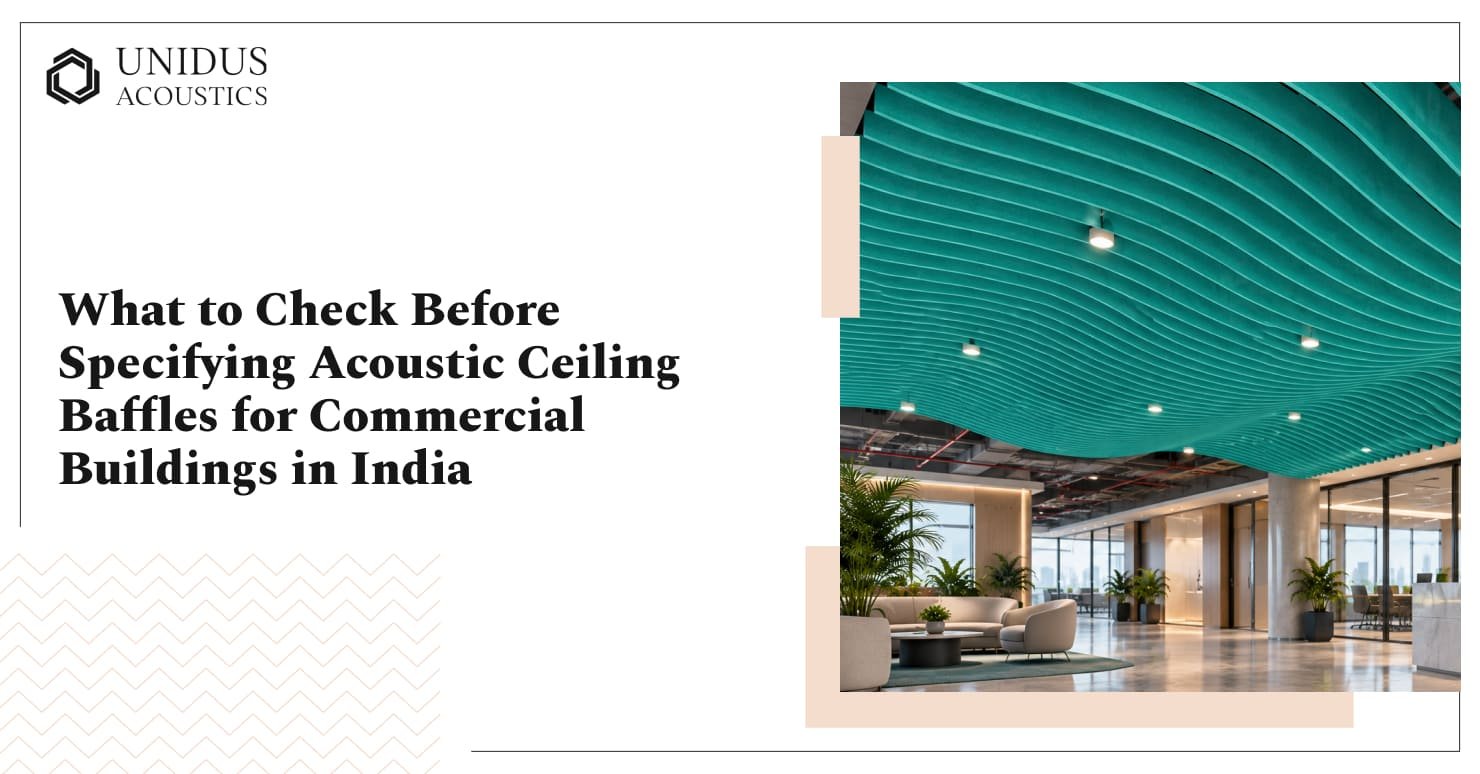
| Very large ceiling spans (auditoriums, banquet halls) | Wall-mounted panels alone won’t address volume-related reverberation at ceiling level. | Acoustic ceiling baffles, canopies, or ceiling cloud systems. |
| High-impact or high-traffic wall surfaces | Surface finishes can be damaged by repeated physical contact. | Wooden acoustic panels, fluted or grooved wall panels with harder facing. |
| Facades requiring structural rigidity or heavy cladding support | Lightweight construction limits use as structural facade material. | Wood wool or mineral fibre systems with appropriate substrate. |
Sustainability Claims: What’s Verifiable and What Isn’t
Recycled PET content is one of the easier sustainability claims to verify. Reputable manufacturers document the recycled content percentage and source material class. For LEED or IGBC certification, request this upfront during specification, not during certification.
Lifecycle impact is harder to verify: carbon footprint, end-of-life recyclability, and manufacturing energy vary between producers and aren’t always disclosed. For a sustainability framework beyond recycled content, request third-party environmental product declarations rather than marketing claims.
Conclusion
Recycled polyester acoustic panels suit a specific range of commercial applications, and the sustainability credential holds up when backed by proper documentation. But the contribution depends on how it’s specified, not only what it’s made from. Get the thickness, mounting method, and coverage area right, and a panel delivers meaningful acoustic improvement; specify it purely for the environmental story and it will underperform.
Unidus Acoustics offers custom acoustic solutions for commercial interiors across India, with over 40 years of expertise in matching material and installation approach to each project’s demands. Write to us at hi@unidusindia.com or contact us now.
Frequently Asked Questions
1. Are recycled polyester acoustic panels suitable for all commercial spaces?
They suit enclosed or semi-enclosed spaces where speech clarity and reverberation control matter most, such as meeting rooms or collaborative workspaces. They’re less suited to high-humidity environments, very large volume spaces, or high-traffic walls facing repeated impact.
2. How do recycled polyester panels compare to other acoustic panel materials?
Stone wool offers broader, more effective low-frequency absorption. Wooden panels offer harder surfaces, better for high-traffic walls. Recycled polyester sits in the mid-to-high frequency range and is lighter and easier to mount. The choice should be led by the application, not material preference.
3. Can recycled polyester panels be customised for different interior aesthetics?
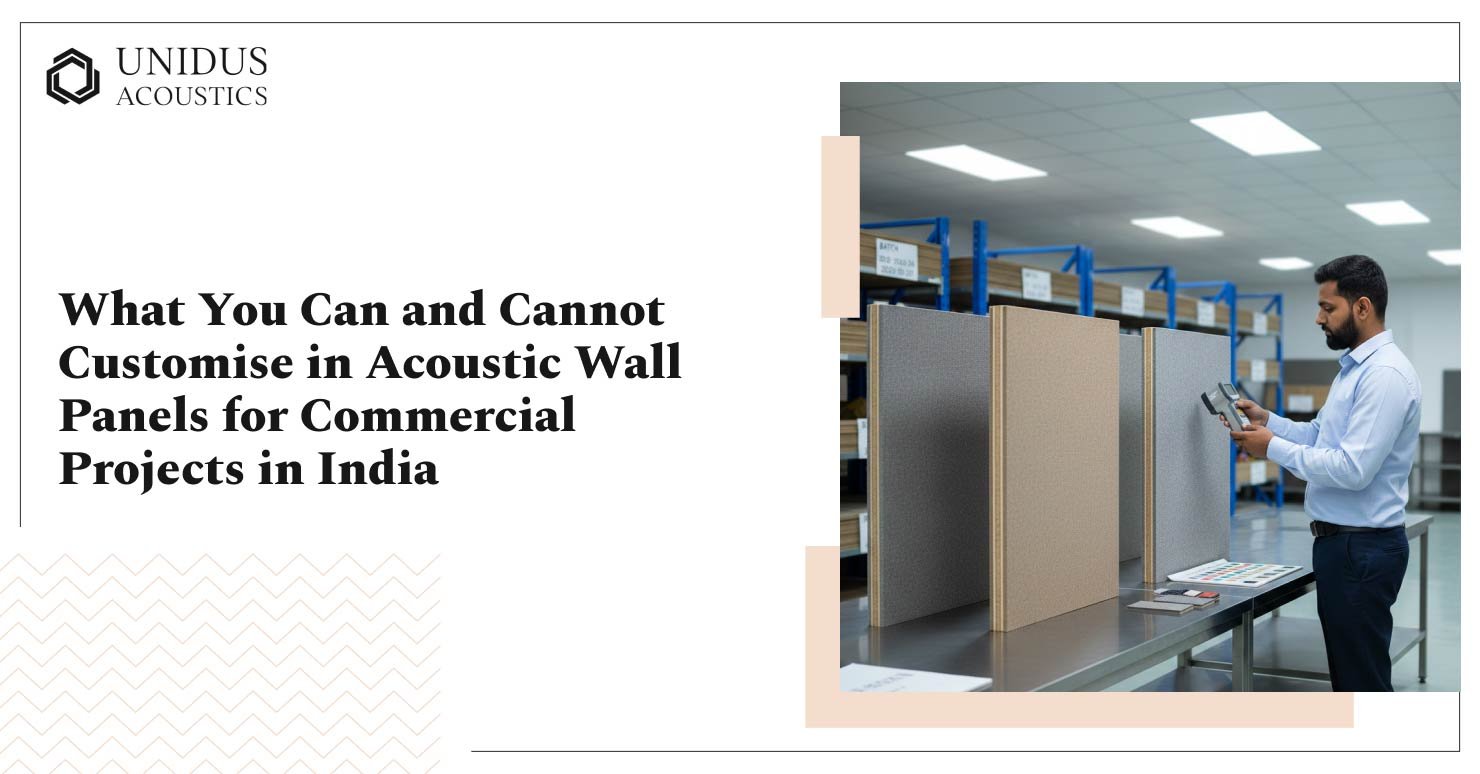
Yes. Custom shapes, printed designs, inlay patterns, and base colour options let these panels function as design elements, cut to geometric forms, used as feature walls, or fabric-wrapped to match a palette.
4. What thickness should be specified for a commercial meeting room?
25-50mm is the standard working range. For speech clarity, 25mm panels on two or three walls plus ceiling treatment typically produce a noticeable improvement. For a hard-finished, high-ceilinged room, 50mm panels with an air gap behind them work better.
5. Do recycled polyester panels contribute to green building certification?
They can, depending on the framework and documentation the manufacturer provides. Verified recycled PET content contributes to material credits under LEED and IGBC; confirmed low-VOC status may contribute to indoor air quality credits. Generic sustainability marketing isn’t a substitute for checked documentation.
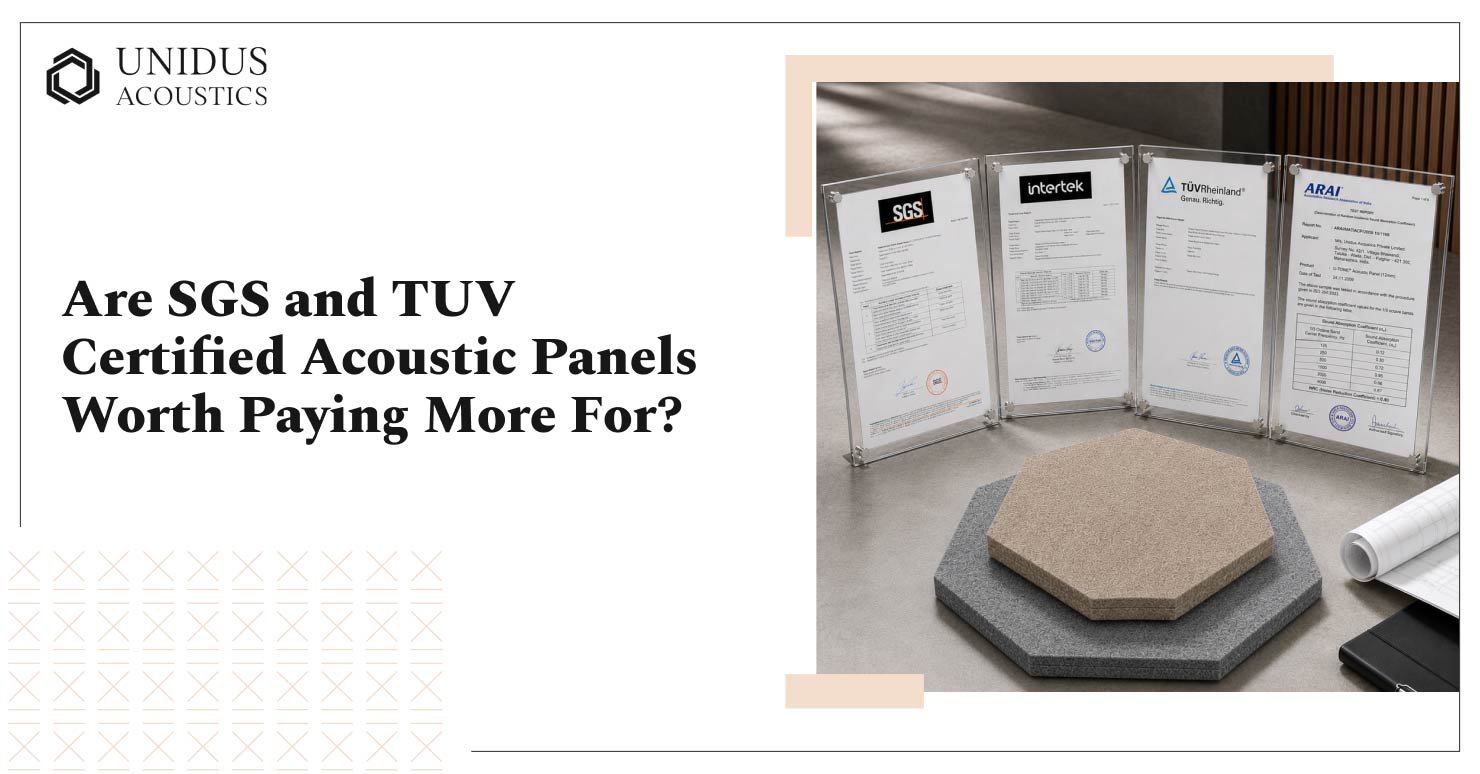
6. Are recycled polyester acoustic panels fire-rated?
Fire rating varies by product and manufacturer. For commercial projects in India requiring fire safety compliance, request test certificates from the supplier before specifying. Unidus Acoustics can provide product-level compliance documentation upon enquiry at hi@unidusindia.com.