Last Updated on November 23, 2026 by unidus
No single material treats a large auditorium. The ceiling, the side walls, the rear wall and the structure behind them each face a different acoustic problem, and the material that solves one will usually underperform on another, whatever the single absorption rating on the datasheet says.
So the useful question isn’t which acoustic materials for an auditorium perform best in the abstract. It’s what each surface is supposed to do with the sound that reaches it, and which material does that job without fighting the architecture. Treating a cinema or an auditorium starts there, not with a product list.
Key Takeaways
- Ceiling surfaces carry most of the absorption in an auditorium, simply because they hold the most area.
- The rear wall is where late reflections turn into audible echo, so it usually needs the heaviest treatment.
- Side walls near the stage often work better reflective or diffusive than absorptive, since early reflections help a voice carry.
- A large hall rarely runs on one material family, so wood, fabric, fibre and metal usually end up working together across its surfaces.
- Absorption and isolation are separate jobs; materials that handle one will not handle the other.
What Makes an Auditorium Different From Any Other Large Room
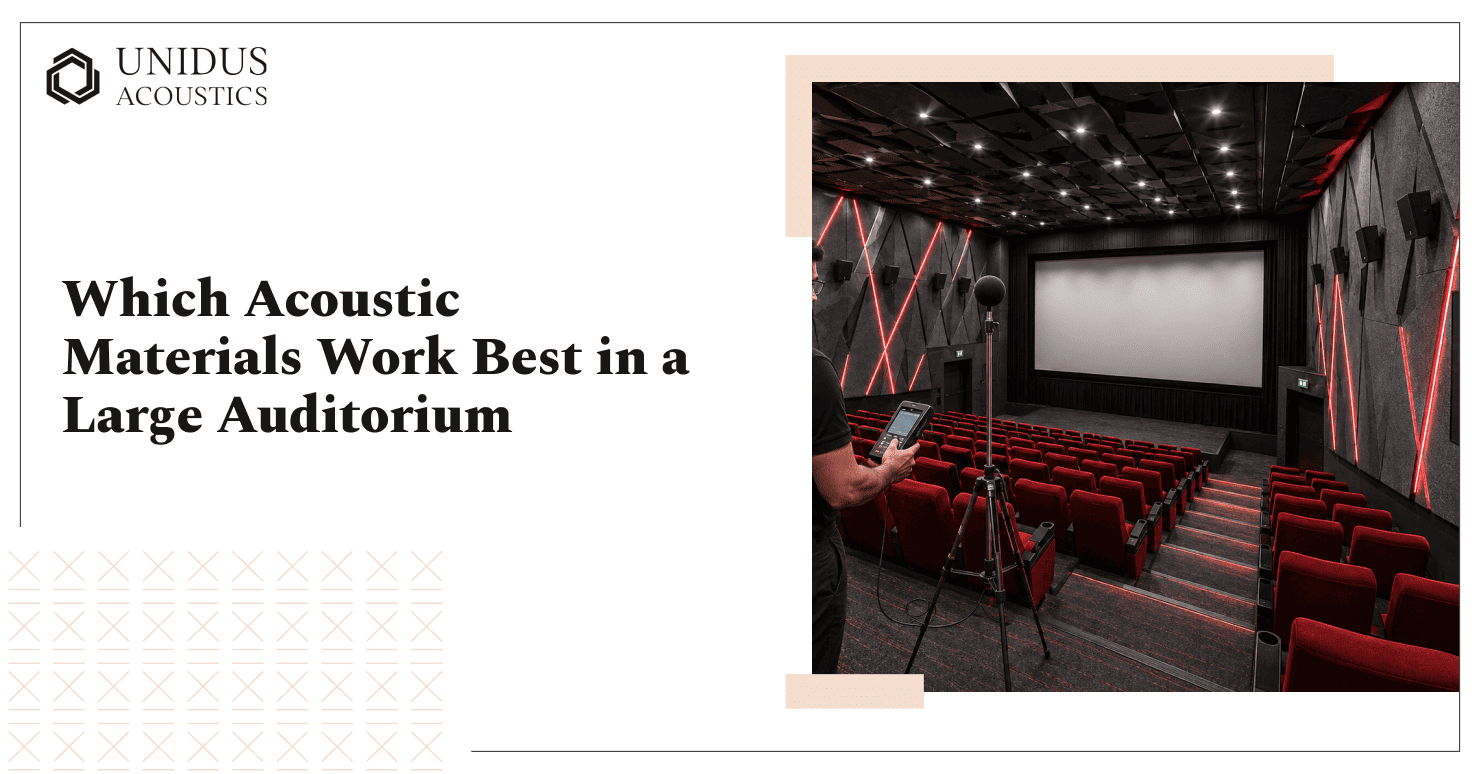
An auditorium is a room where every seat has to receive the same intelligible sound from a single source. That means the design has to control reverberation and late reflections while preserving the early reflections that make a voice carry to the back row.
Indian practice still works from IS 2526, the Bureau of Indian Standards code of practice for acoustical design of auditoriums and conference halls, reaffirmed in August 2025 and now flagged by BIS for archiving, which is worth knowing before it goes into a specification. Background noise limits and sound insulation requirements sit separately, in the acoustics section of the National Building Code of India. Between them, the specification has to land on a reverberation target and a background noise ceiling, with surfaces chosen to deliver both.
Material choice follows from that, and it helps to be clear on what an NRC figure does and doesn’t tell you, since a single-number rating says little about how a material behaves across the speech range.
Ceiling Materials Carry the Largest Share of the Work
In a hall seating several hundred people, the ceiling is the biggest uninterrupted surface, and it sits directly in the path of sound travelling from stage to back wall. Treatment splits by zone rather than running uniformly.
Soft Fibre Glasswool Ceiling Tiles
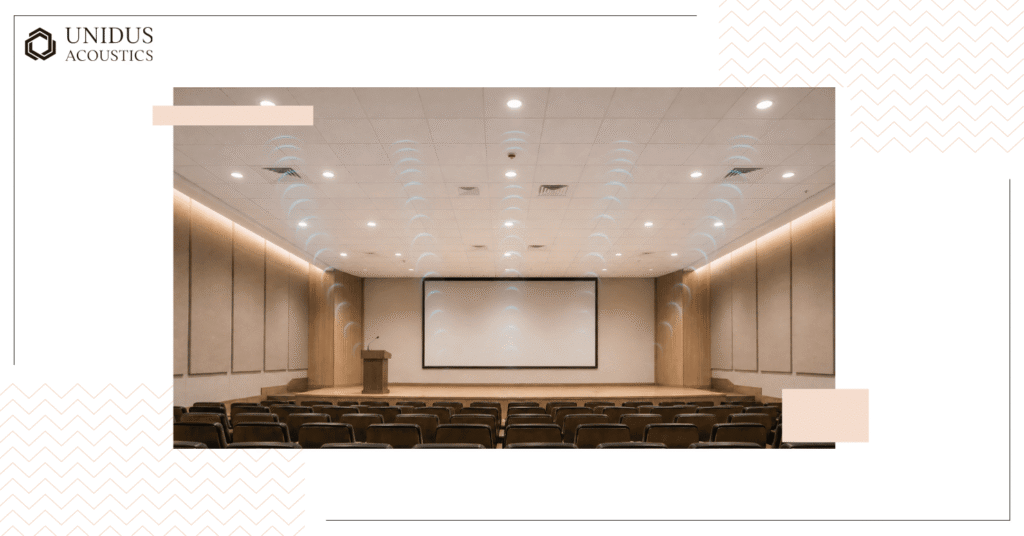
Over the seating area, soft fibre glasswool tiles are the workhorse. They absorb broadly, sit in a standard grid, cover large areas without a bespoke sub-structure, and lift out when the services above need reaching. What matters in a hall is the distinction between these and a decorative tile that happens to be called acoustic, since the performance gap between the two widens as the room gets bigger.
Baffles, Clouds and Open Cell Systems
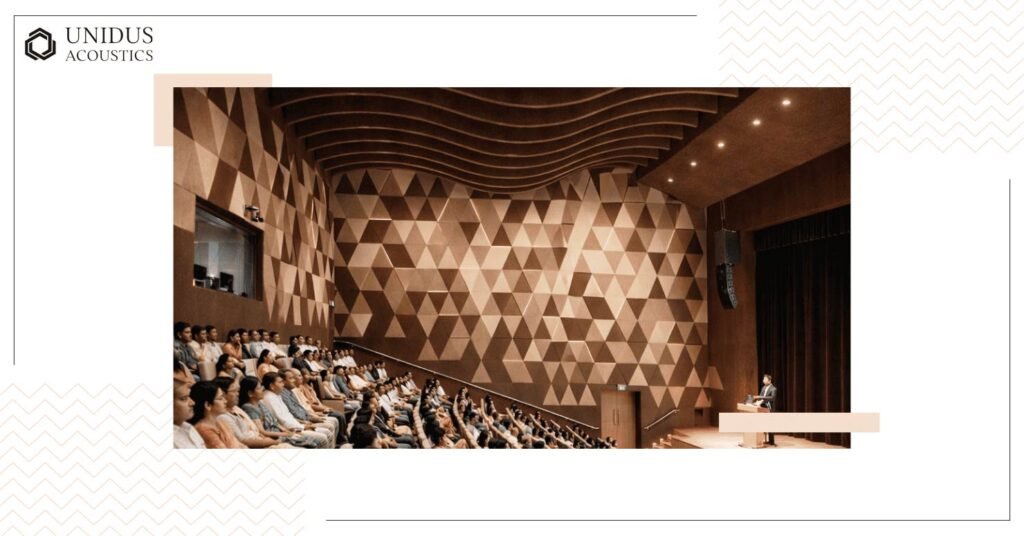
Where the ceiling is high or the services above need to stay reachable, suspended elements do the same job with more flexibility. Baffles present both faces to the sound field, so they absorb out of proportion to their footprint. Clouds suit the forward seating zone, and open cell metal systems give an exposed-services look while an absorptive layer above works.
The forward ceiling near the stage is the exception, often left reflective and angled to push early sound into the seating rather than soaking it up. Choosing between suspended elements and tiles comes down to ceiling height and access, and where the treatment sits matters as much as what it is made of.
Side Wall and Rear Wall Materials
Walls are where an auditorium needs the most careful thought, because the instinct is to treat them all alike. The rear wall and side walls need opposite things.
Fabric Wrapped and PET Fibre Panels
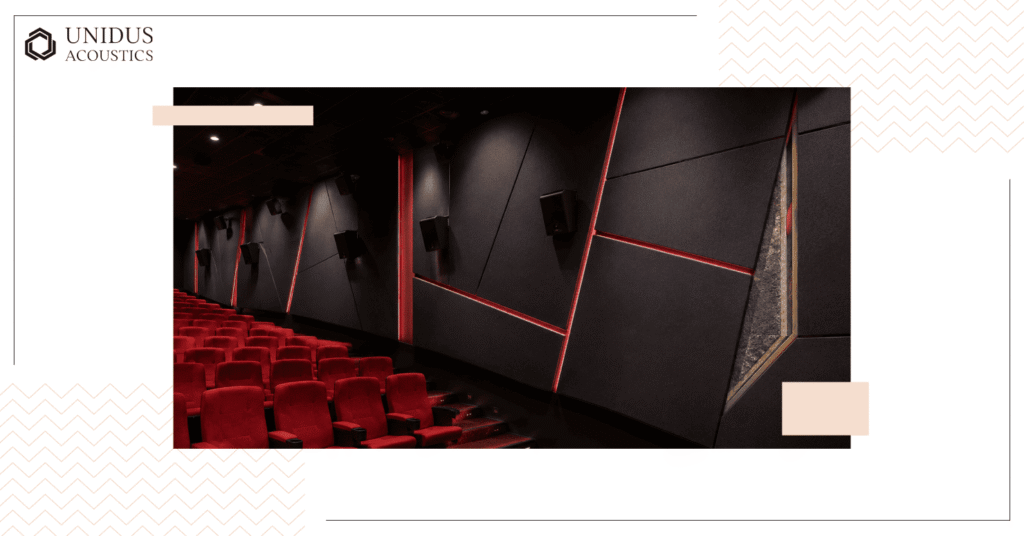
The rear wall faces the stage across the longest path in the room, so sound returning off it arrives late enough to be heard as a distinct echo. That makes it the surface which justifies deep absorption. Fabric wrapped panels over a mineral or polyester core work well here, with colour and texture chosen to balance form and function.
Recycled polyester panels are a common alternative here, since they cut cleanly into shapes and carry the recycled content and material declarations that green-rated projects ask for.
Wooden, Slatted and Perforated Panels
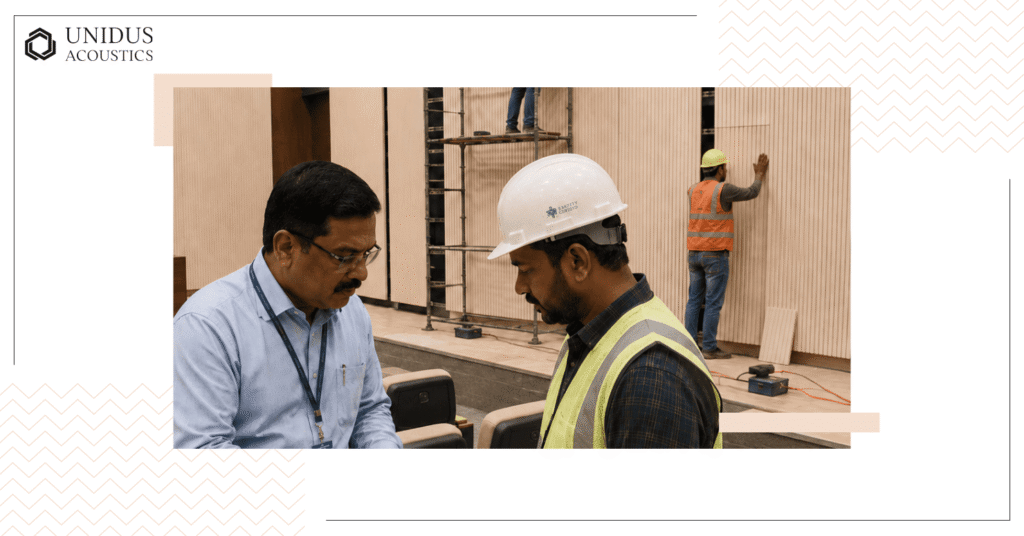
Side walls in roughly the first third of the room do useful work when they reflect or scatter rather than absorb. Slatted and grooved wooden systems suit this: the slats scatter mid and high frequencies while the cavity behind takes low-frequency energy out of the room. The different wooden panel types behave differently here, and perforation diameter and backing change the result more than timber species does.
Further back, the balance shifts toward absorption. Where a hall hosts music as well as speech, diffusion rather than absorption often works better on the upper side walls, keeping the room alive without letting flutter echo build between parallel surfaces.
Matching Acoustic Materials to Each Auditorium Surface
The table below sets out which acoustic materials suit each surface in a large auditorium, and what tends to go wrong on each one.
| Surface | Primary Job | Materials That Suit It | What to Watch |
|---|---|---|---|
| Ceiling over seating | Broadband absorption across a large area | Soft fibre glasswool tiles, baffles, clouds | Access to services above the plane |
| Ceiling near stage | Reflect early sound into the seating | Hard reflective or shaped panels | Angle matters more than material |
| Rear wall | Stop late reflections returning to the stage | Deep fabric wrapped or PET fibre panels | Depth, not just surface rating |
| Front side walls | Scatter or reflect to support loudness | Wooden slats, grooved and fluted systems | Over-absorbing kills voice support |
| Rear side walls | Absorb and break up flutter echo | Fabric panels, diffusers, perforated wood | Parallel untreated surfaces |
| Walls, slab and doors | Keep outside noise out | Mass layers, mineral infill, sound locks | Absorption cannot do this job |
The Layers That Block Rather Than Absorb
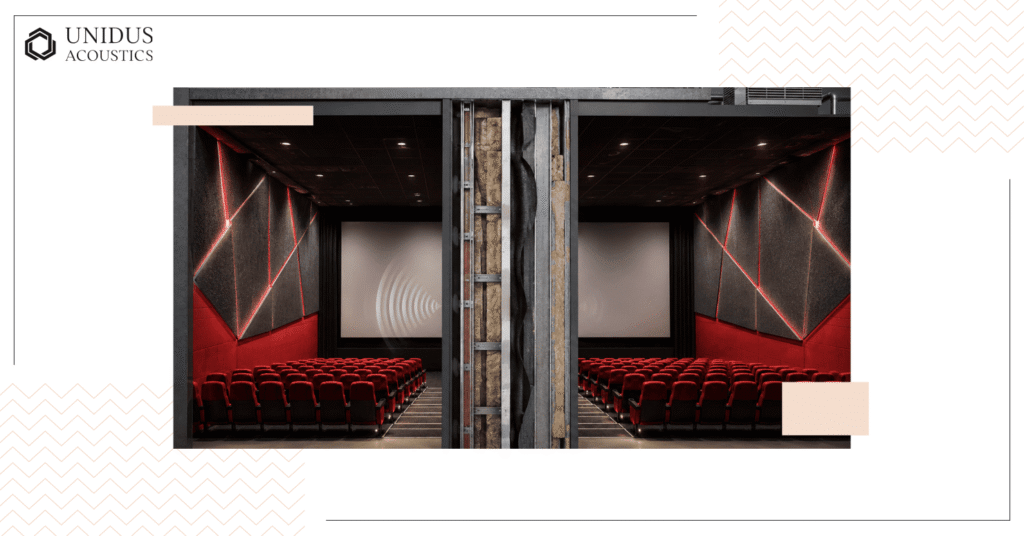
Everything above shapes sound inside the room. None of it stops noise getting in, and a hall with a well-tuned reverberation time is still unusable if traffic or air conditioning noise sits above the background limit.
Isolation is a mass and cavity problem. Dense mineral infill inside partitions does part of it, and the difference between stone wool and glasswool in that cavity comes down to density and the frequency range you are trying to stop. Where structure or an adjacent space carries the path, a limp mass layer is added, and a sound deadening membrane earns its place on those assemblies rather than across the whole build. Doors and seals deserve early attention, since one untreated leaf undoes a well-built wall.
How Unidus Acoustics Approaches Auditorium Material Selection
We start from the drawing and the use case rather than a product list. A hall built for conferences takes a different material mix from one hosting music, and a multipurpose hall needs a compromise set out deliberately rather than discovered after handover.
Because we manufacture in our own plant, panel sizes, thicknesses, perforation patterns and shades are set to the room rather than to a stock list, which makes custom acoustic solutions workable on halls where no two wall bays are identical. Our range spans wood, metal, fabric and fibre, so one hall can carry reflective timber at the front, deep absorption at the rear and a glasswool tile ceiling over the seating.
Conclusion
Choosing acoustic materials for an auditorium is a surface-by-surface exercise, not a product comparison. Work out what each plane is meant to do with the sound reaching it, then pick the material that does that job.
If you are specifying or correcting a large hall and want the material set mapped against your drawings, Unidus Acoustics can work through it surface by surface. 40 years of expertise across wood, metal, fabric and fibre sits behind that recommendation. Contact us now.
Frequently Asked Questions
1. What is the best acoustic material for an auditorium?
There isn’t one. Ceilings over seating usually call for soft fibre glasswool tiles or suspended baffles, rear walls for deep fabric wrapped or PET fibre panels, and front side walls often work better with reflective timber.
2. Should the whole auditorium be covered in absorptive material?
No. Over-absorbing a hall makes voices sound weak and forces the sound system to work harder. Early reflections from front surfaces are what carry a voice to the back rows.
3. Which surface matters most if the budget is limited?
The rear wall, followed by the ceiling over the seating area. Those two surfaces produce most of the audible echo complaints in a large hall.
4. Do auditorium ceiling materials need to be non-combustible?
Fire requirements for assembly occupancies are set by the building code and the local authority, so confirm the classification needed against the project’s approved drawings before selecting material.
5. Can an existing auditorium be corrected without civil work?
Often yes. Surface-mounted panels and a replacement tile ceiling address most reverberation problems without touching structure, though noise entering from outside usually does need built work.
6. How does seating affect the material calculation?
Heavily. Upholstered seats absorb a great deal, so bringing the seating specification into the acoustic calculation early keeps reverberation near target.