Last Updated on April 14, 2026 by unidus
A product datasheet says NRC 0.95. Another says NRC 1.05. You’re specifying acoustic panels for a 3,000 sq ft open office, and you need to make a decision. Which panel performs better?
The answer isn’t as obvious as the numbers suggest.
NRC testing is one of the most useful tools in acoustic specification. It’s also one of the most frequently misunderstood, partly because of how manufacturers present results and partly because a single number can’t capture everything that determines whether a panel works in your specific project. Understanding what NRC testing measures and what it deliberately leaves out makes you a sharper specifier.
What NRC Testing Measures
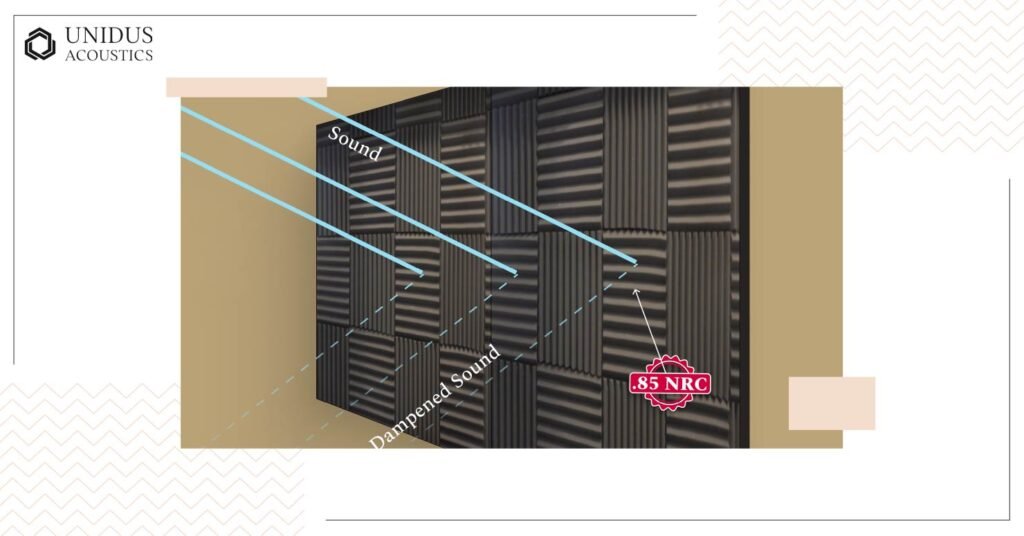
Noise Reduction Coefficient (NRC) is a single-number rating that quantifies sound absorption across four mid-range frequencies, specifically how much sound energy a material takes in rather than reflecting back into the room.
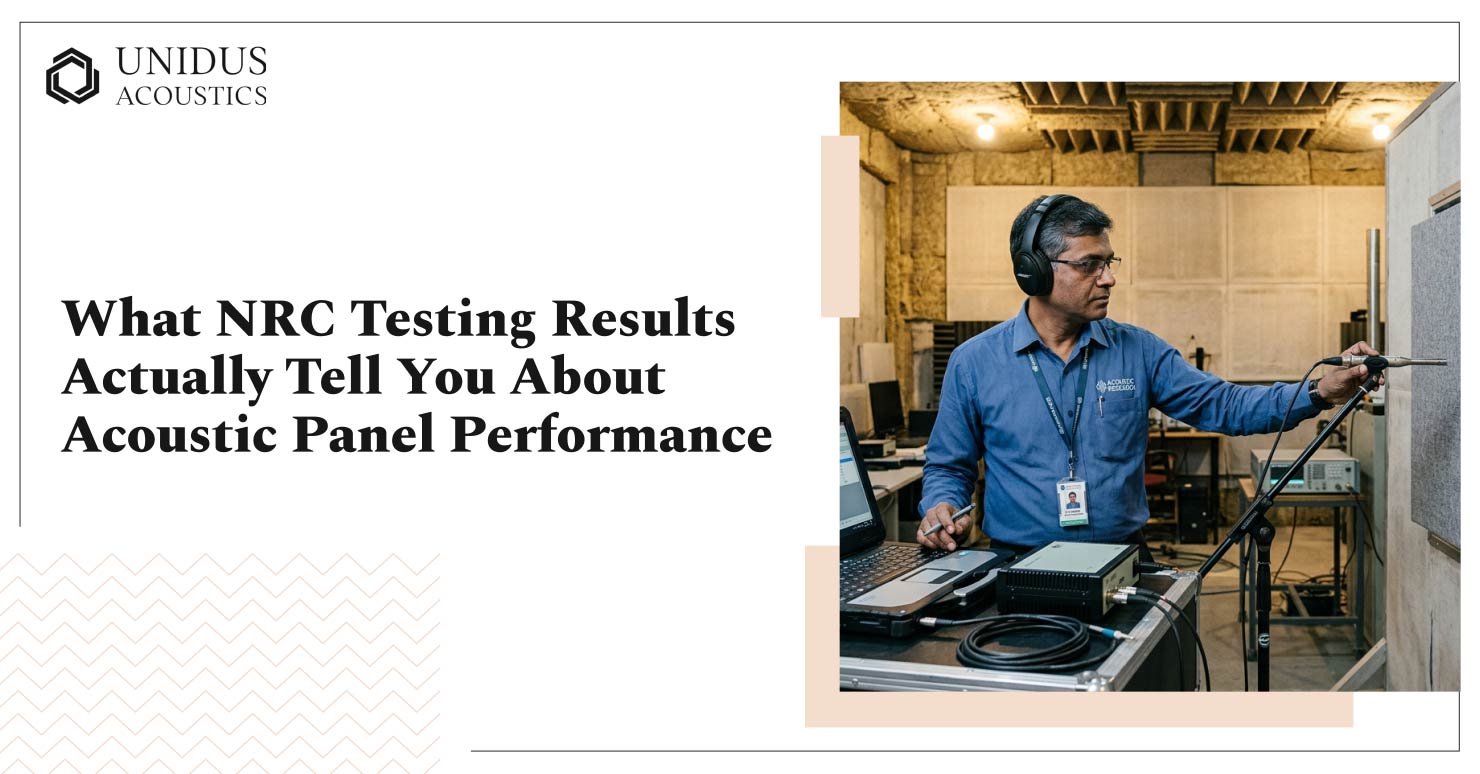
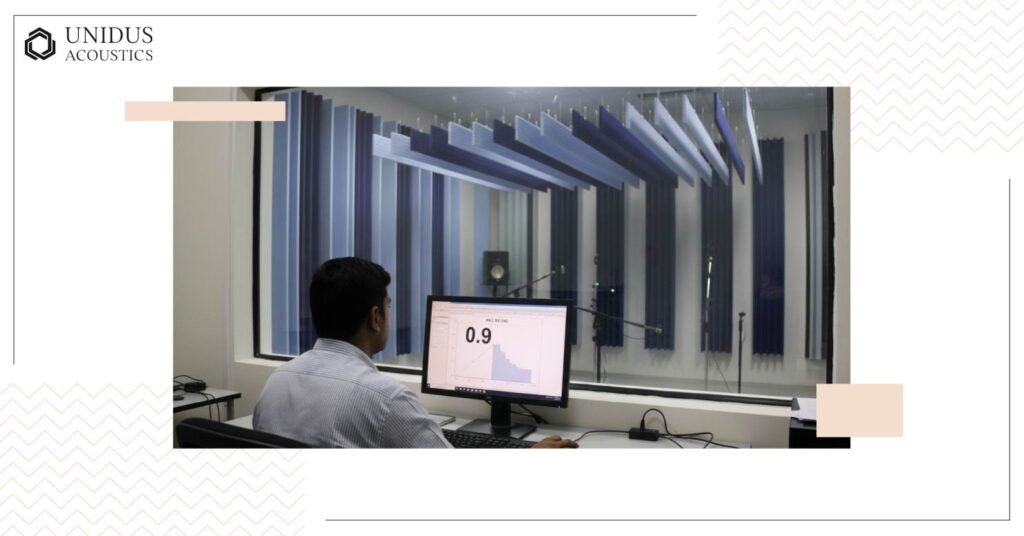
The test happens in a certified reverberation chamber. A standardised sample of the material (typically 6.7 sq metres, or roughly 8 x 9 feet) is placed in the chamber, and the room’s reverberation time is measured with and without the sample present. The difference tells you how much energy the material absorbed at each frequency. Those coefficients are averaged to produce the final NRC figure, rounded to the nearest 0.05.
An NRC of 0.85 means the material absorbs 85% of the sound energy striking it. An NRC of 0.00 means it reflects everything back, like bare concrete. An NRC of 1.00 theoretically absorbs everything.
The Four Frequencies and What They Reveal

The choice of 250–2,000 Hz is deliberate, but it creates a limitation worth understanding. Human speech sits in this range, so NRC is well-suited for offices, conference rooms, and classrooms where clarity of conversation is the goal.
What it doesn’t capture is low-frequency performance. Bass rumble from HVAC systems, mechanical equipment, heavy footfall, and low voices all live below 250 Hz. A panel with an excellent NRC rating can still leave a space feeling “boomy” if it doesn’t address those lower frequencies. For spaces with significant low-frequency challenges, the individual octave-band absorption coefficients give a more complete picture than the single averaged figure.
Why Some Results Exceed 1.0

NRC values above 1.0 appear on datasheets occasionally, and they’re not a misprint. They’re an artefact of the testing method. In a reverberation chamber, edge diffraction (sound bending around the edges of the test sample) can make it appear that more sound was absorbed than struck the surface.
Some datasheets present these figures without noting the edge-diffraction effect behind them. If a supplier is using NRC 1.05 to argue superior performance over a panel rated 0.98, the distinction isn’t acoustically meaningful, and it’s worth asking them to explain it. Credible manufacturers will.
What a High NRC Actually Means in Practice
An acoustic panel’s NRC rating tells you about its absorption potential under controlled test conditions. What happens in your project depends on several additional factors that no test certificate can capture. Four of them determine whether a well-specified panel delivers in the field.
Coverage Area
Coverage area matters more than the individual panel NRC. A panel rated NRC 0.90 covering 15% of a room’s total surface area will have less acoustic impact than a panel rated NRC 0.75 covering 35%. The overall absorption in the room is the product of the material’s performance and how much of it you use. Skimping on coverage while chasing the highest-rated panel is a common specification error, and it routinely produces disappointing results despite strong NRC figures on paper.
Mounting Condition
How a panel is installed changes its acoustic behaviour, particularly at lower frequencies. A panel tested in direct wall contact (Type A mounting) will perform differently from the same panel mounted on standoffs with an air gap behind it. The standoff configuration generally improves low-frequency absorption. If the datasheet doesn’t specify the mounting condition used during NRC testing, that’s a question worth asking before specifying.
Installation Quality
Gaps around panel edges, inconsistent mounting, or poor surface contact can reduce real-world NRC by a meaningful margin. The number on the datasheet assumes a controlled installation. Site conditions rarely replicate the test chamber, which is why specification support through the installation phase matters as much as product selection.
Room Geometry
High ceilings, parallel hard walls, and mixed surface materials all influence how sound behaves before it reaches your panels. A space with very high ceilings may need a combination of wall panels and suspended ceiling baffles to address reflections at different heights, and a long, narrow room creates flutter echoes that panel placement needs to account for.
NRC by Space Type
Different spaces have different targets, and knowing the range for each helps you specify with purpose.
Open-plan offices generally perform best with NRC 0.70–0.85 on wall surfaces. Above this range, the space can feel over-dampened, which affects speech dynamics and can make the environment feel unnatural. The goal is to control reverberation without deadening the room.
Conference rooms and meeting spaces benefit from NRC 0.80 and above, particularly where speech privacy and clarity are both requirements. Ceiling treatment in these spaces, whether tiles, acoustic clouds, or suspended baffles, should match or exceed the wall treatment’s performance. Unidus Acoustics’ acoustic baffles are available in custom sizes and finishes, which makes it easier to hit performance targets without compromising the ceiling’s visual language.
Educational facilities and training halls need high speech clarity across varied configurations. NRC 0.75–0.90 is a sensible target for primary treatment surfaces, with attention to low-frequency control in larger rooms.
Hospitality environments, lobbies, and reception areas involve more nuance. Some reverberation contributes to a lively atmosphere, and NRC 0.60–0.75 often hits the right balance with strategic placement rather than blanket coverage.
Once you know the target range for your space type, the next question is what NRC testing can’t tell you about whether you’ll hit it.
What NRC Testing Doesn’t Tell You

NRC does one thing: it quantifies average mid-frequency sound absorption. It does not tell you how a panel performs at low or high frequencies, how it behaves in a real room with competing reflective surfaces, how durable the material is in high-traffic environments, or whether it meets fire safety standards for commercial use.
For specifiers, NRC is a starting point, not a conclusion. Final selection needs to consider the full datasheet, including frequency-band performance data, mounting specifications, density, and relevant compliance certifications.
It also doesn’t tell you anything about aesthetics, which is its own constraint in commercial projects. A panel that tests at NRC 0.90 but only comes in institutional grey is not a useful specification for a hospitality fit-out. Good acoustic specification has to balance form and function, and a number on a datasheet can’t do that work for you. This is where custom acoustic solutions create real value: performance matched to the visual language of the project, not a compromise between the two.
Acoustic Performance Starts Before the Panel Ships
With 40 years of expertise in custom acoustic solutions for commercial spaces across India, Unidus Acoustics treats NRC testing as one input in a broader acoustic design conversation, not a final specification decision made on a number alone.
Our products are tested through accredited processes, and we share full frequency-band data with specifiers who want it. When a project has specific acoustic performance targets, we help translate those targets into panel selection, coverage calculations, and placement recommendations that deliver the result on site. We turn noise into harmony, and that work starts long before installation day.
To discuss acoustic panel specifications for your project, connect with us. We’re happy to share test data, review your brief, or walk through a space’s acoustic challenges in detail.