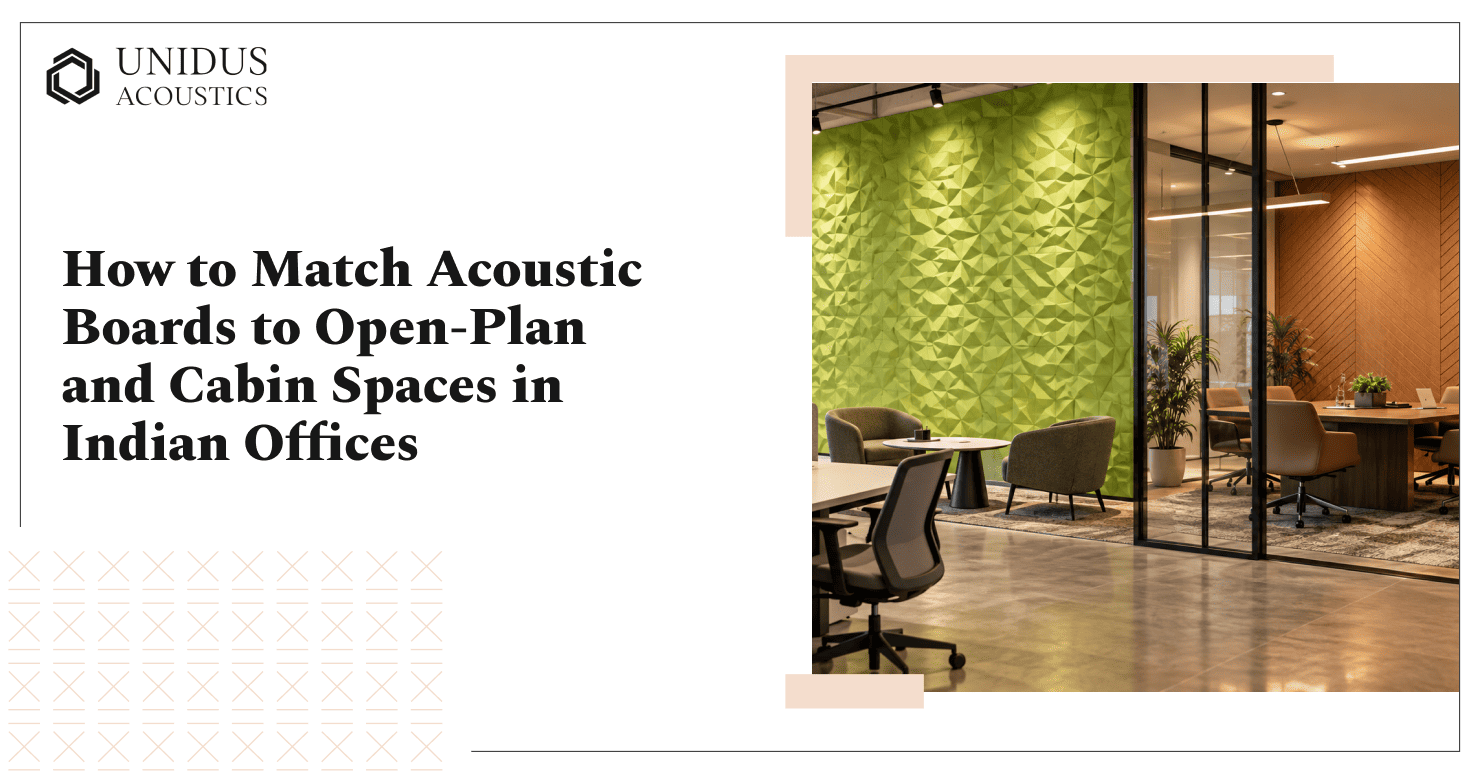
Open-plan areas and enclosed cabin offices are acoustically different problems. They sit on the same floor, often share a material palette, and both need acoustic treatment, but what works for one tends to underperform for the other.
The post-handover feedback from these projects follows a consistent pattern: “the open area is still too noisy” from one team, “the meeting room sounds echo-y on video calls” from another. The fix is nearly always the same: the wrong board in the wrong zone. This guide draws on Unidus Acoustics’ 40+ years specifying acoustic boards for offices across India, and breaks down what each space type needs from boards and how material and placement decisions map to those needs.
Key Takeaways
- Open-plan floors need boards that reduce reverberant noise buildup across the floor; the problem is cumulative and spatial.
- Cabin offices and meeting rooms need boards that reduce echo and early reflections within the enclosed space; the problem is fast and directional.
- Acoustic boards for offices in India address sound absorption within a room, not sound transmission through walls or partitions.
- CXO offices and boardrooms have acoustic requirements that go beyond what absorption boards alone can deliver.
Why Open-Plan and Cabin Spaces Are Different Acoustic Problems
There’s a meaningful difference between sound absorption and sound insulation. Soundproofing and acoustic treatment address fundamentally different problems: absorption controls how long sound lingers in a room (measured as reverberation time by the Acoustical Society of America), while insulation controls whether sound passes between rooms. Acoustic boards address absorption. Sound insulation materials and construction detailing address insulation.
In an open-plan office, the problem is cumulative. Sound from conversations, phones, keyboards, and HVAC diffusers builds up across the floor; every hard surface reflects it back. As the day progresses and more people are on calls, the ambient level rises. People compensate by speaking more loudly, which pushes it higher again.
In a cabin office or meeting room, the problem is fast and directional. Sound reflects almost immediately from the nearest wall or ceiling before it can dissipate, creating flutter echo. Remote participants pick up a hollow or doubled quality to the speaker’s voice that no microphone upgrade can fix.
What Open-Plan Offices Need from Acoustic Boards
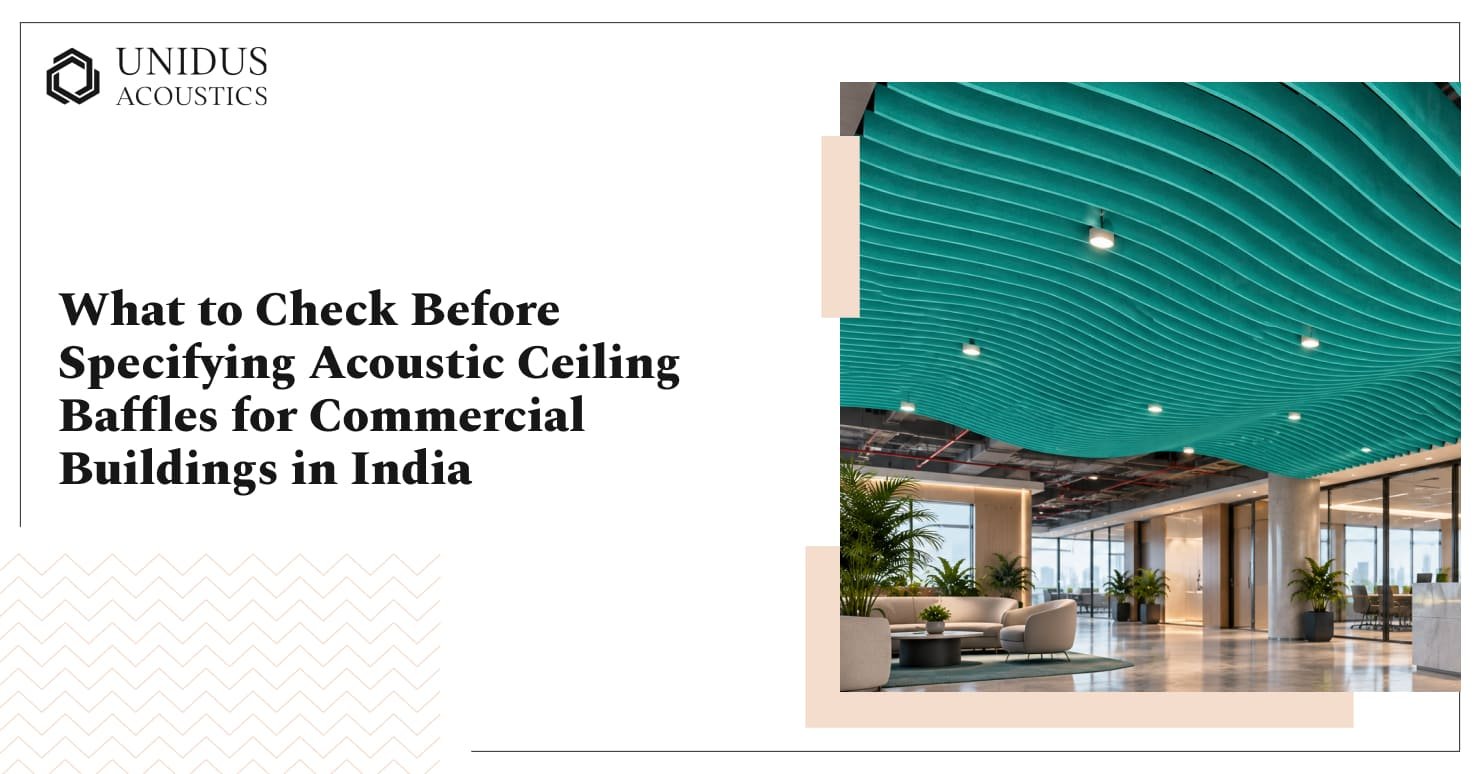
The ceiling is the most efficient surface to treat first: the largest uninterrupted plane in an open floor. Ceiling clouds and acoustic sound baffles absorb from above, reducing the reverberation time of the floor as a whole. Ceiling tiles do the same when they replace gypsum tiles in the grid. Wall-mounted boards supplement treatment along longer parallel walls.
For open-plan specifications, check:
- Area coverage. How much of the ceiling is being treated? A few boards at one end have limited effect. The reverberation time target per ISO 3382-3 determines how much surface is needed.
- Placement relative to workstation clusters. Boards above busy collaboration and call zones contribute more to speech clarity than boards above circulation paths.
- NRC at the specified thickness. Thicker boards absorb better at lower frequencies, which matters in floors with heavy HVAC noise. See the NRC ratings guide to compare specifications.
- Supplementary wall treatment. Wall panels along longer parallel walls address standing wave problems that ceiling treatment alone won’t resolve.
What Cabin Offices and Meeting Rooms Need
Meeting rooms in India are used intensively for video calls. The acoustic problem is usually flutter echo and a room that sounds “live” on the call, which the camera microphone amplifies rather than corrects.
Wall-mounted boards on at least two opposing surfaces make a noticeable difference to speech clarity. The wall behind the table and the wall opposite is the standard starting point. Corners are worth addressing too: low-frequency sound builds up in them, and thicker boards improve the overall acoustic character significantly.
The ceiling is worth treating if it’s a hard gypsum surface. Acoustic false ceiling solutions that replace standard tiles with acoustic ones work well here without requiring additional framework.
If sound from an adjacent room is audible through the partition, boards inside won’t fix it. That’s a construction detail problem.
| Acoustic Requirement | Open-Plan Office | Cabin / Meeting Room |
|---|---|---|
| Primary problem | Reverberant noise buildup across the floor | Echo and early reflections within the room |
| Most effective placement | Ceiling (clouds, baffles, tiles), wall supplement | Two opposing walls, ceiling supplement |
| Coverage priority | High percentage of ceiling area | Key wall surfaces, corners |
| NRC priority | Higher NRC for larger absorption per unit area | Moderate to high NRC; placement matters more |
| What boards won’t fix | Sound transmission through partitions | Sound transmission through partitions |
Matching Material to Space Type
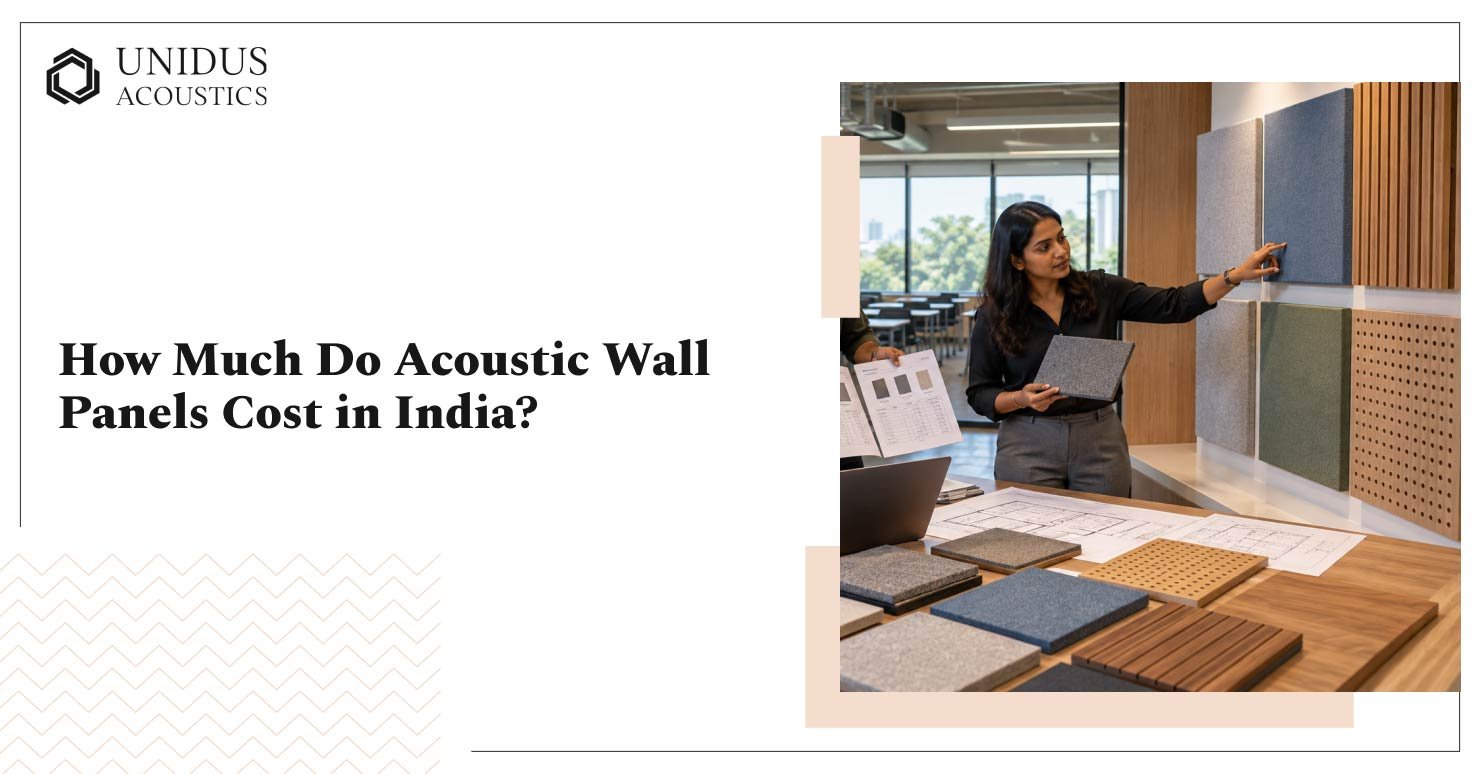
Indian office specifications draw on a handful of board materials. The most common are recycled polyester fibre and soft fibre glasswool boards; wood wool shows up less often but has a distinct place in certain project types.
1. Recycled Polyester Fibre (PET) Boards
Polyester fibre boards are the most widely specified for acoustic boards in Indian offices. Lightweight with a wide shade range (Unidus Acoustics offers 84+ options), they perform well at mid-high frequencies where speech sits. Thicker boards (25–50mm) absorb better at lower frequencies than thinner versions (9–12mm), which matters in rooms with HVAC noise or bass from audio equipment.
2. Soft Fibre Glasswool Boards
Soft fibre boards with a glasswool core offer broader frequency absorption, including stronger low-frequency performance. They’re commonly used behind fabric wrapped acoustic panels in meeting rooms and boardrooms where the acoustic requirement is more demanding, and tend to outperform standard PET boards in those enclosed spaces.
3. Wood Wool Boards
Wood wool acoustic panels bring a visible natural texture suited to biophilic design schemes and café-style collaboration areas. Less common as the primary open-plan treatment, they appear in reception spaces and breakout areas on the same brief without issue.
CXO Offices and Boardrooms: A Different Brief Entirely
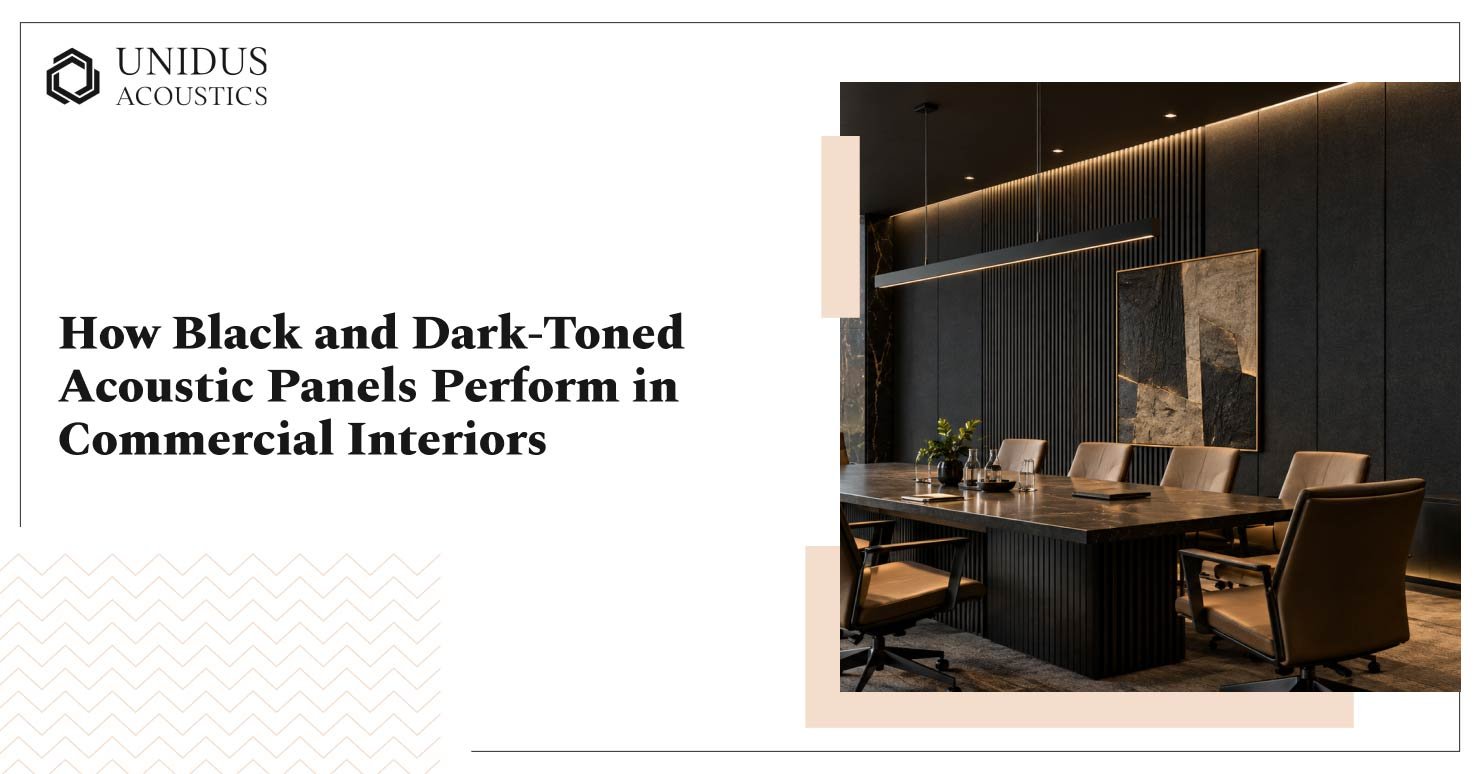
CXO offices and boardrooms have an acoustic requirement distinct from open-plan and standard meeting rooms: speech privacy.
Acoustic boards address comfort and echo reduction. Construction detailing addresses transmission: door seals need to be specified to the same standard as the partition, and the junction between partition and slab is where most boardroom speech-privacy failures occur.
Boards alone don’t achieve boardroom-grade speech privacy. Getting acoustic consultancy involved before the partition details are locked makes a meaningful difference. AV-integrated boardrooms add another specification layer, particularly where video conferencing systems are embedded in the design.
Conclusion
Applying a uniform specification to both open-plan floors and enclosed cabins is the most common reason office acoustic treatment underdelivers. Matching board type and placement to the actual problem in each zone is what separates an office that works from one that’s been treated.
With 40+ years of expertise in commercial acoustic solutions, Unidus Acoustics helps architects and designers specify acoustic boards for offices across India, from large open-plan floors to high-privacy CXO suites. For a project consultation, contact us now.
Frequently Asked Questions
1. How much of the ceiling should be covered with acoustic boards in an open-plan office?
A common working guideline is 25–40% of total surface area, but this depends on room volume, ceiling height, and the reverberation time target. An acoustic consultant can calculate a more precise figure for the specific floor.
2. Do acoustic boards work in offices with a false ceiling installed?
Yes, but the ceiling tile material matters. A gypsum tile reflects sound; replacing some tiles with acoustic ones, or adding wall-mounted boards, improves acoustic behaviour. The combination of ceiling and wall treatment tends to outperform either alone.
3. Why does a meeting room still sound echo-y even after installing acoustic boards on one wall?
One wall is unlikely to be sufficient. Flutter echo between two parallel hard surfaces needs both surfaces treated. If one wall is treated and the opposite remains gypsum or glass, the echo path between them hasn’t been broken.
4. What thickness of acoustic board works for a standard meeting room in India?
For speech clarity and video call quality, 25–50mm is the most common specification. Thinner boards at 9–12mm contribute some absorption but less at lower frequencies, where HVAC systems and projection equipment produce most of their noise.