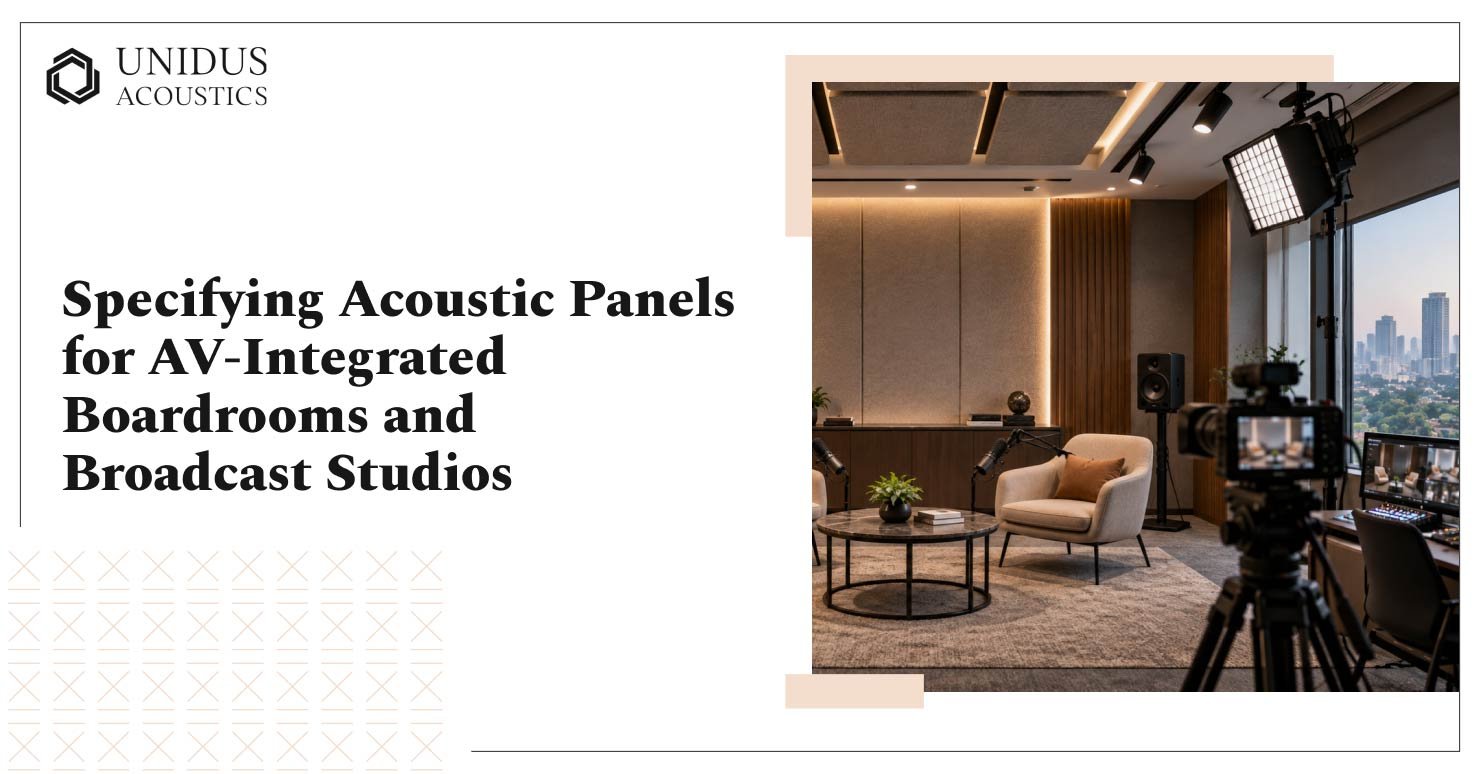
A boardroom with a video wall and three cameras behaves differently, acoustically, from one with a whiteboard and a phone. Add microphones and speakers, then a camera picking up every voice, and the acoustic tolerance drops. What passed as good enough in a regular meeting room shows up as echo on recordings or a camera frame with a visible acoustic tile nobody wanted there.
This is where acoustic panels for AV-integrated boardrooms need a sharper brief than standard office acoustics. Unidus Acoustics works with architects and AV integrators specifying rooms that need to sound right and look right on screen, often with a lighting plan and client walk-through scheduled.
Key Takeaways
- Acoustic panels for AV-integrated boardrooms solve two problems together: room sound and camera appearance.
- Panel placement at first reflection points and camera-facing walls matters more than total coverage.
- NRC between 0.70 and 0.90 covers most boardroom and studio needs, but material choice depends on which surface faces the camera.
- Fire rating and wipeable finishes matter for boardrooms that double as media or recording spaces.
- Panels manage sound inside the room; they don’t stop it moving into the next one. That’s a separate specification.
Why Standard Acoustic Specs Fall Short in AV Rooms
A regular conference room only has to sound comfortable to the people in it. An AV-integrated boardroom has to sound comfortable to a microphone array picking up speech from three metres away, and look presentable to a camera pointed at the same wall the panels are mounted on. Add a glass partition and a video wall that absorbs nothing, then factor in an HVAC unit sized for a room full of running equipment, and the acoustic problem gets harder while the mounting surface gets smaller.
Architects rarely get told this at the design stage. The AV integrator’s spec sheet usually covers cameras and codecs, along with screen brightness, not how a hard video wall changes the room’s reverberation time, or why a beamforming microphone picks up HVAC hum a person nearby would ignore.
That gap between the acoustic brief and the AV brief is where treatment gets added late or skipped, more a documentation problem than a design one. Industry guidance increasingly treats acoustics as a specified line item on the AV brief, not an afterthought fixed on-site once the room is already built.
What to Get Right When Specifying Panels
Four decisions cover most of what goes wrong: where panels go, what NRC they carry, what they look like on camera, and what happens when the room needs wiping down before the next call.
Panel placement over panel coverage
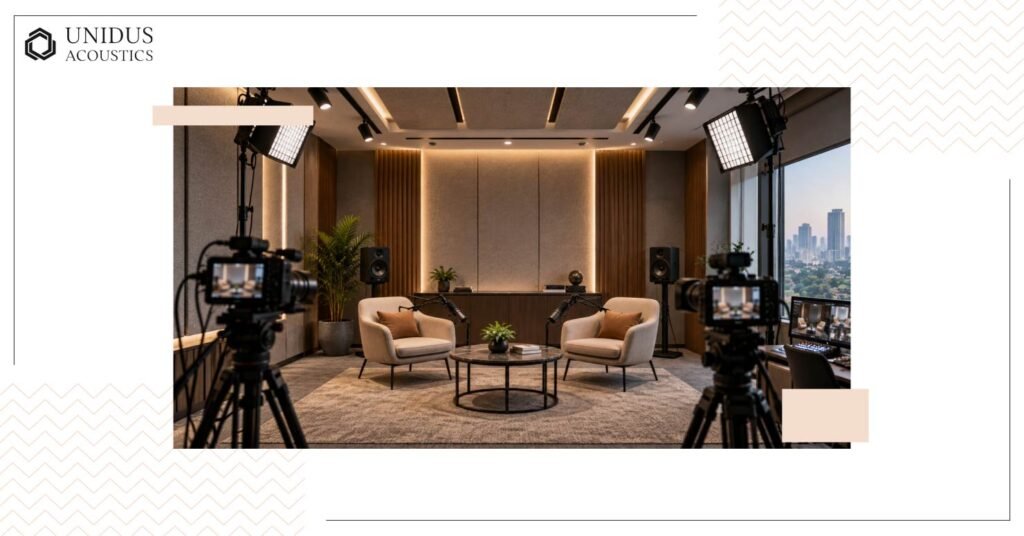
For most conference rooms, covering roughly 15 to 25 percent of surface area with absorption gets close to a comfortable reverberation time. AV rooms need that coverage concentrated at specific points, not spread evenly. Standard conference room guidance points to first reflection points as the priority for placement, and that holds even more once a camera is in play. The wall behind the primary camera and the surface facing the main microphone pickup zone matter more than the wall nobody looks at. A boardroom with one full glass wall usually needs the opposite wall treated more heavily than standard guidelines suggest, since glass reflects what the panel across from it would otherwise absorb.
NRC and material by surface, not by room
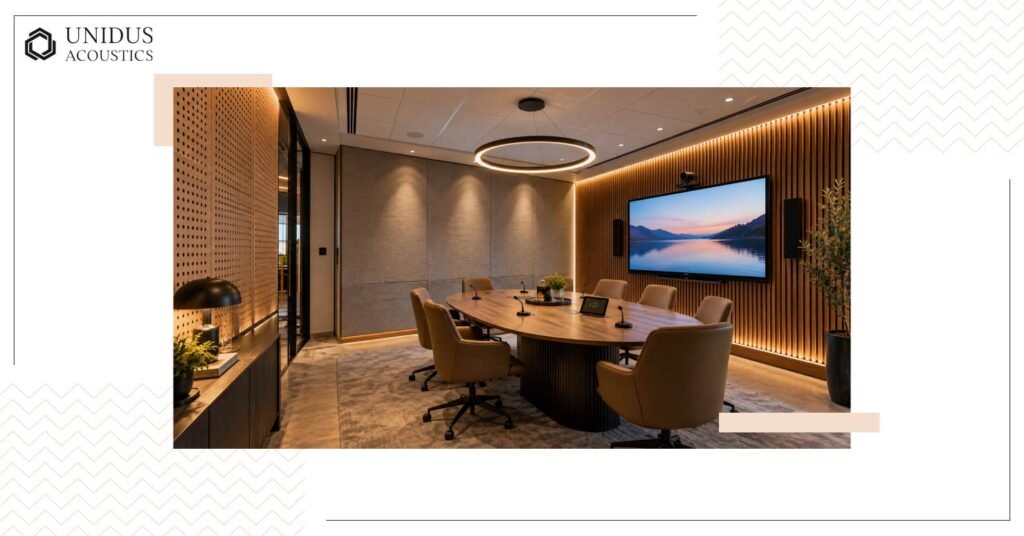
U-TONE Acoustic Panels carry an NRC of 0.70 to 0.90, covering most boardroom and studio absorption needs on a standard wall or ceiling drop. AcoustiSoft ceiling tiles go up to NRC 0.90 with a Class A fire rating, and work well above the camera line, where a fabric finish would show seams on screen. For walls that need to read as a design feature rather than an acoustic add-on, AcoustiPlanks wood panels bring NRC up to 0.70 in a finish that photographs as architecture, not treatment.
Perforated and slat panel finishes sit between the two, giving texture without reading as an acoustic surface on camera. The choice isn’t which product performs best alone; it’s which surface is doing the acoustic work and which is doing the visual work, since in a broadcast studio or camera-facing boardroom, those are rarely the same wall.
| Product | NRC | Where It Works Best | Camera Appearance |
|---|---|---|---|
| U-TONE Acoustic Panels | 0.70 – 0.90 | Standard wall or ceiling drop | Fabric finish, most versatile |
| AcoustiSoft ceiling tiles | Up to 0.90* | Above the camera line | Flat finish, no visible seams |
| AcoustiPlanks wood panels | Up to 0.70* | Feature walls | Reads as architecture, not treatment |
| Perforated and slat panels | Varies | Walls needing texture | Reads as design detail, not an acoustic surface |
Fire rating and cleanability for rooms that double as media spaces
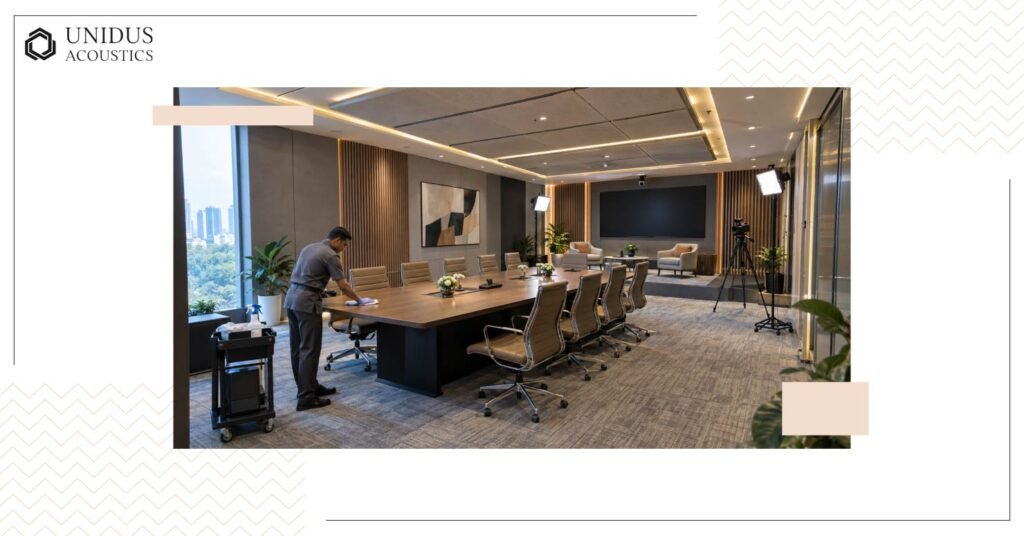
Boardrooms used for client recordings or town halls get cleaned and reset between sessions more often than a standard meeting room. Disinfectant-safe finishes (fog, spray, or wipe-clean) and a Class A or B1 fire rating are worth confirming before a panel gets specified into a room that also functions as a media set, a detail easy to miss when the acoustic spec and the facilities brief are handled separately.
A Spec Checklist Before the Panels Go on Order
Before the panel order gets locked, these are the checks that catch problems after installation rather than before it.
- Confirm first reflection points and camera-facing walls before finalising panel layout, not after the AV team mounts equipment.
- Match NRC to the surface, not the room type, since a ceiling drop and a feature wall rarely need the same rating.
- Confirm fire rating (Class A or B1) and wipeable, disinfectable finishes for rooms hosting client recordings or town halls.
- Check whether the video wall or glass partition removes absorption area the original layout assumed was available.
- Loop in the AV integrator’s spec sheet early. Treatment planned after the camera line is fixed usually means a compromise somewhere.
A broader look at panel cost and installation timelines is worth reading alongside the AV brief, so both teams work from the same room drawing.
Where Acoustic Panels Stop Doing the Work
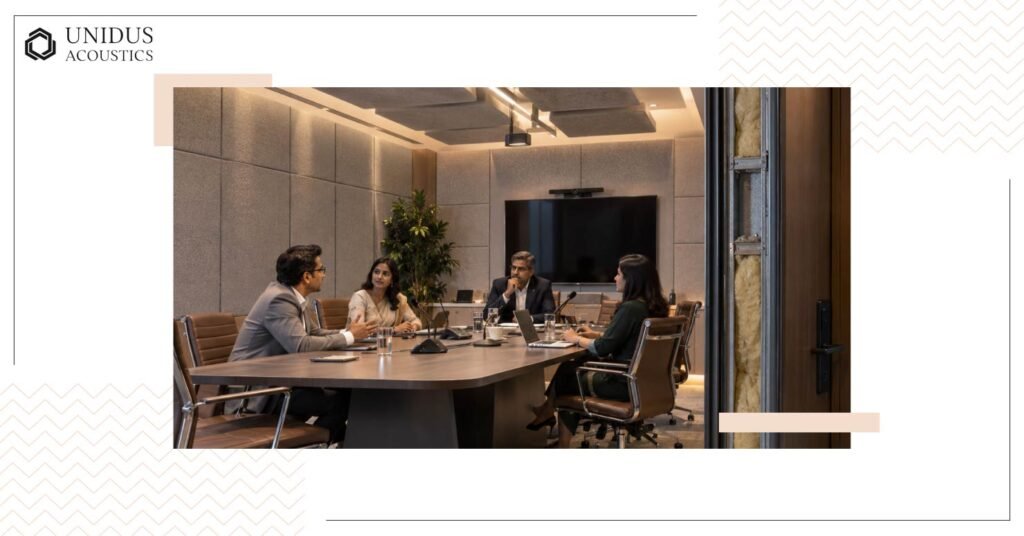
Acoustic panels manage what happens inside the room: reflections, reverberation, mic pickup, echo on a recording. They don’t stop sound moving into the next room or the corridor outside. That’s a sound transmission question, handled through the partition build and door seals, plus insulation inside the wall itself, not what’s mounted on the surface. A boardroom can carry excellent NRC-rated panels on every wall and still leak conversation next door if the partition wasn’t specified for it, worth flagging to the client separately.
The same logic holds at smaller scale. A huddle room or single-person AV booth often makes more sense as a dedicated phone booth or meeting pod than a treated open room, since isolation, not absorption, is the real need there.
Frequently Asked Questions
1. What NRC rating do boardroom acoustic panels need?
Most boardrooms land comfortably between NRC 0.70 and 0.90, depending on how much hard, reflective surface, glass and video walls especially, the room carries. Rooms with more glass or AV screens usually need panels at the higher end to compensate.
2. Do acoustic panels affect video conferencing audio quality?
Yes. Panels reduce the reflections that beamforming microphones pick up as background noise or echo, the difference between clear remote audio and a call where the room sounds like it’s talking back.
3. Can acoustic panels be installed without disrupting AV equipment?
In most cases, yes, when the panel layout is planned alongside the AV mounting plan from the start. Retrofitting after cameras and microphones are mounted is possible, but usually means working around fixed points instead of choosing the ideal ones.
4. Do acoustic panels stop sound from leaking into the next room?
No. Panels absorb sound within the room to control echo and reverberation. Stopping sound from travelling into an adjoining room is a separate spec, handled through wall insulation and partition build, plus door seals.
Getting the Brief Right Early
Unidus Acoustics works from a catalogue of panel types and NRC ratings, matched to the right finish for what a room does, camera included, before panels get ordered. For architects and AV integrators managing boardrooms and studios together, the panel spec and the AV brief work better when written at the same time, not reconciled on-site once cameras are mounted.
Get the acoustic spec right before the cameras go up. Unidus Acoustics works with architects and AV integrators on boardroom and studio panel layouts, matched to what the room and the camera both need. Contact us now.