
Wood wool acoustic panels have been around for decades. Architects and interior designers in India keep specifying them for a combination of reasons that don’t often come together in a single material: high sound absorption, visual warmth, structural rigidity, and fire compliance. For a commercial interior where the brief calls for acoustic performance without sacrificing surface durability or aesthetics, they make a strong case.
This guide covers everything a specifying architect or interior designer needs to know: what wood wool boards are made of, how they perform acoustically, where they work best (and where they don’t), and what to confirm before placing an order.
Key Takeaways
- Wood wool acoustic panels achieve NRC up to 0.90, placing them among the higher-performing options for commercial wall and ceiling treatment.
- Available in 15mm, 20mm, and 25mm thicknesses; thicker panels handle the lower frequencies that matter in conference rooms and auditoriums.
- Class B1 fire rating makes them compliant with most institutional and commercial requirements under NBC India 2016 guidelines.
- Always specify the full installation assembly (panel + air gap + backing type) in tender documents, not just the panel-alone NRC figure.
- Standard sizes are 4×2 and 2×2 feet; custom dimensions are available with lead times of 4–6 weeks.
What Are Wood Wool Acoustic Panels?
Wood wool acoustic panels (also called wood wool boards or wood cement boards) are a composite material made from long, thin wood fibres that are mineralised and bound together with a cementitious binder. The mineralisation process doesn’t simply coat the fibres; it changes the material itself, which significantly improves fire resistance and structural rigidity in the process.
The result is a dense, breathable board with an open, textured surface. Sound waves enter the panel’s irregular fibre structure and are converted to heat through friction. This mechanism is what gives wood wool boards their high NRC rating despite looking and feeling more like a structural material than a soft acoustic absorber.
How Wood Wool Boards Are Made
The key to the material’s performance is the cementitious binding process. Wood strands are mineralised before binding, which makes the final board resistant to fire, moisture, and biological decay in a way that untreated wood products aren’t. The density of the finished panel. around 400 kg/m3 for commercial-grade boards. means it can be cut with standard woodworking tools on site, fixed directly to substrates, and painted if needed, all without losing structural integrity.
Wood Wool Board vs Foam vs Fabric-Wrapped Panels
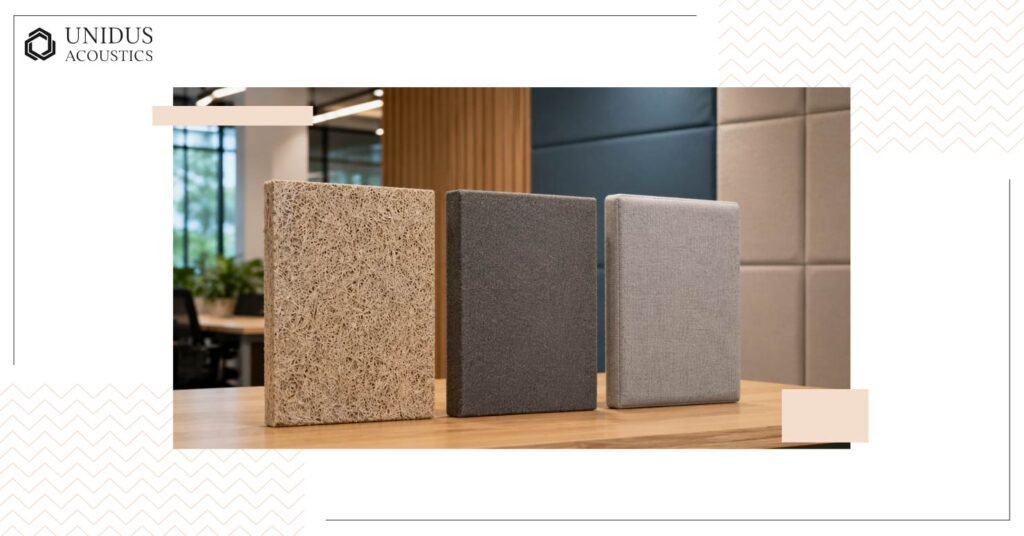
Wood wool is not foam. Foam panels are soft, lightweight, and absorb selectively at mid-to-high frequencies, they don’t do much at low end. Wood wool boards at 400 kg/m3 are rigid enough to accept paint, fix fittings to, and survive moderate impact without surface damage. The use cases are genuinely different.
Compared to fabric-wrapped panels, wood wool boards don’t require a separate decorative layer. The acoustic surface is the finished surface. This matters where the brief calls for a raw or industrial aesthetic, or where maintenance staff clean surfaces with more than a soft cloth. Fabric-wrapped panels can achieve higher NRC values (particularly in the 0.85–1.05 range) with a quieter aesthetic, which is why they tend to be preferred for high-end boardrooms where finish quality drives the specification. Wood wool is the better choice where performance is the primary brief.
🔗 Read: Acoustic Wall Panels for Office: Cost, Performance & Timeline
Wood Wool Board Specifications for Commercial Projects
Before looking at applications, it helps to understand what the specification numbers mean and how they interact with acoustic outcome.
Thickness and Its Effect on Acoustic Performance
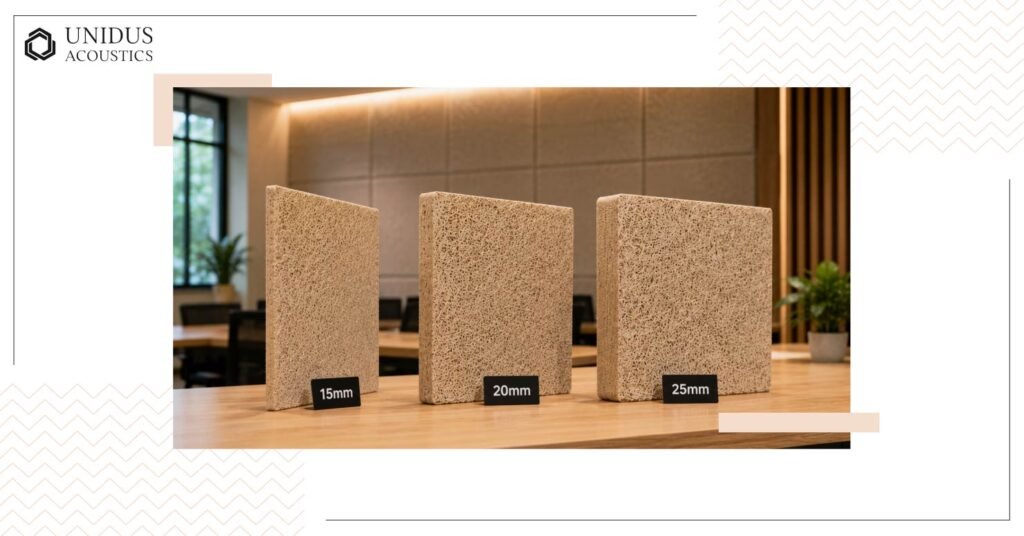
Wood wool panels are available in 15mm, 20mm, and 25mm thicknesses. Thicker panels absorb a broader range of frequencies, including lower frequencies that thinner panels don’t address. The 15mm variant is commonly used for wall applications where the goal is primarily mid-to-high frequency absorption. The 20mm and 25mm options perform noticeably better at lower frequencies, which matters for conference rooms and auditoriums where bass build-up affects speech clarity at the back of the room.
If you’re specifying for a space where RT60 control at low frequencies matters, a large boardroom, a lecture hall, an auditorium, go with 20mm or 25mm. For standard open plan wall treatment where the ceiling is doing the heavy lifting, 15mm is adequate.
🔗 Read: A Practical Guide to Noise Reduction Coefficient (NRC) Ratings
Density, Rigidity, and On-Site Handling
Commercial-grade wood wool boards run at approximately 400 kg/m3. At this density, the panel is rigid enough to fix directly to a wall substrate without a separate framing system in most applications. It can also be cut on-site with standard woodworking tools, which simplifies fitting to irregular wall lengths or the stepped soffits common in older commercial buildings.
The weight matters for suspended ceiling applications. At 400 kg/m3, a 20mm panel is heavier per square metre than PET polyester panels (which run at 180–200 kg/m3). For large suspended ceiling areas, factor the additional load into the structural brief and the suspension system specification.
Size and Installation Formats
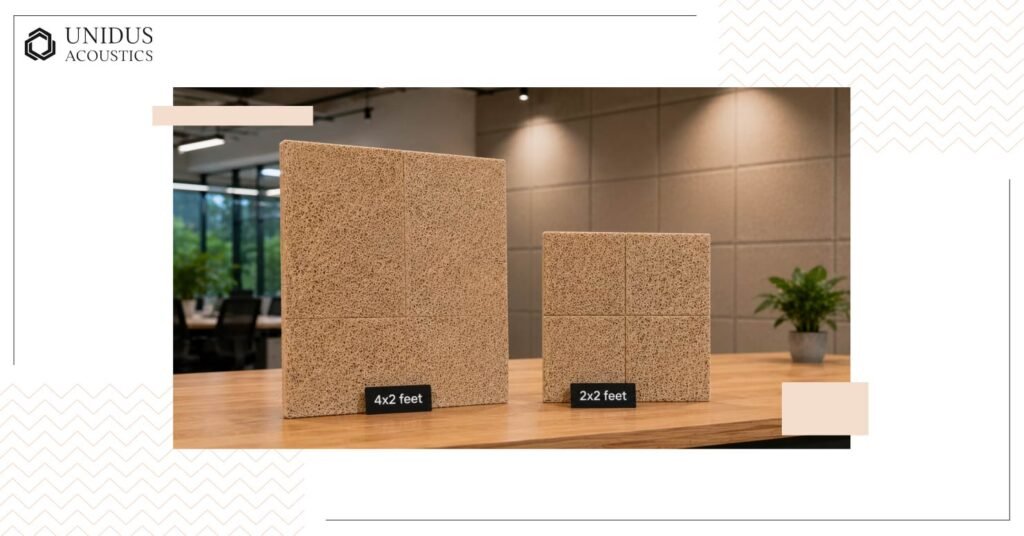
Standard commercial sizes are 4×2 feet and 2×2 feet. The 4×2 format covers more area per panel, reduces the number of visible joints on large wall runs, and generally speeds installation. The 2×2 format fits standard suspended ceiling grids and suits modular open plan ceiling installations. Both are available in square edge. If you need a rebated or kerfed edge for a specific grid system, confirm availability with your supplier before finalising the specification.
At Unidus Acoustics, wood wool boards are among our most consistently specified products across commercial and institutional projects, having been used across conference rooms, auditoriums, and open plan offices by clients including TCS, Infosys, AIIMS, and Ashoka University. The pattern holds across project types: when a brief calls for durable, high-NRC acoustic treatment that holds up visually without a decorative overlay, this material is usually what gets specified.
Acoustic Performance of Wood Wool Ceiling and Wall Panels
The NRC rating is where most specifiers start, and with good reason. It tells you how much sound the panel absorbs across the speech frequency range.
Understanding NRC for Wood Wool Panels
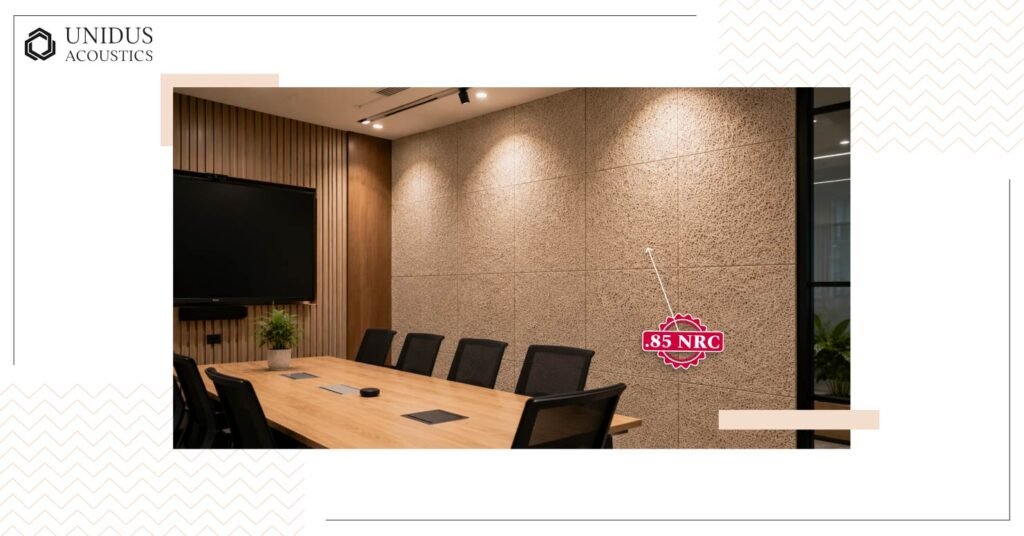
NRC (Noise Reduction Coefficient) is a single-number average of sound absorption at 250 Hz, 500 Hz, 1000 Hz, and 2000 Hz. An NRC of 0.90 means the panel absorbs 90% of incident sound energy at those frequencies. Wood wool acoustic panels can achieve NRC up to 0.90 depending on thickness and installation assembly.
To put that in context: a conference room with concrete walls and glass partitions typically has an RT60 (reverberation time) of 1.5 seconds or more. The target for speech clarity in a meeting room is 0.4–0.6 seconds RT60. Getting from 1.5 to 0.6 requires a significant absorptive area, and panels at NRC 0.90 get there faster than most alternatives.
How the Installation Assembly Affects NRC
The NRC figure quoted for a panel alone is not the same as the NRC for the installed assembly. Fixing wood wool panels directly against a hard concrete wall gives a lower effective NRC than installing them with a 50mm air gap, or with mineral wool insulation (glass wool or rock wool) behind them. At lower frequencies, the backing has a significant effect on performance.
For wall applications where bass control matters, conference rooms, auditoriums, music rooms, specify the full assembly in your tender documentation. The test certificate from the manufacturer should confirm NRC for the panel plus backing combination, not the panel in isolation. Mismatches between the tested assembly and what gets installed are one of the more common causes of post-handover acoustic underperformance.
Where Wood Wool Acoustic Panels Work in Commercial Interiors
Wood wool is versatile, but it performs best in specific environments. The right application depends on the acoustic target, the aesthetic brief, and the maintenance requirements of the space.
Open Plan Offices
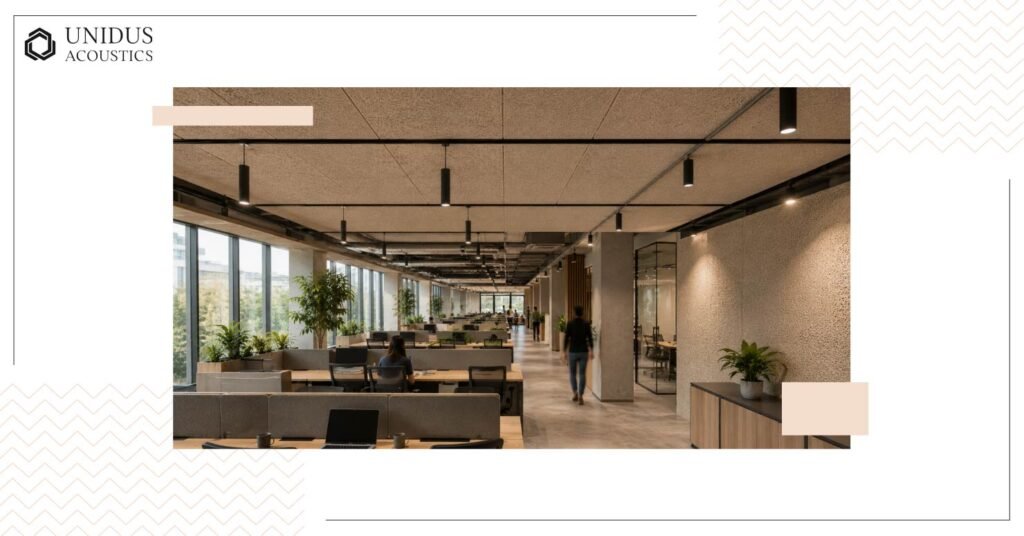
In a typical open plan office with a concrete slab ceiling, glass partitions, and hard flooring, reverberation isn’t the only problem, it’s one of several overlapping issues. Wood wool acoustic ceiling panels (as direct-fix to slab, or as suspended tiles in a grid) address the most significant surface area. For a more complete solution, pair ceiling treatment with wall panels in collaborative zones and acoustic pods or booths for high-sensitivity calls.
One thing to note: wood wool ceiling tiles in an open plan office work well where the services layout allows it. If the ceiling is heavily loaded with MEP runs, perforated metal ceilings with acoustic backing may give more coordination flexibility with comparable NRC performance.
🔗 Read: The Complete Guide to Acoustic Pods for Modern Commercial Spaces
Conference Rooms and Boardrooms
This is the strongest application for wood wool boards. The combination of structural rigidity, high NRC, and natural texture makes them a strong choice for the rear wall of a meeting room, a surface that would otherwise reflect sound directly back to the camera position on video calls.
Unidus Acoustics Wood Wool Boards in 20mm and 25mm have been specified for exactly this application across corporate fit-outs, including projects for TCS and SBI. Pair rear wall panels with acoustic ceiling treatment above the meeting table and you can bring RT60 into the 0.4–0.6 second range that speech intelligibility requires.
For premium boardrooms where finish quality drives the specification, fabric-wrapped panels are often preferred because they achieve higher NRC at lower visual weight. Wood wool is the better value choice where the brief is performance-led.
🔗 Read: Acoustic Challenges in Government Buildings: Echo, Noise, and Poor Speech Clarity
Auditoriums and Educational Spaces
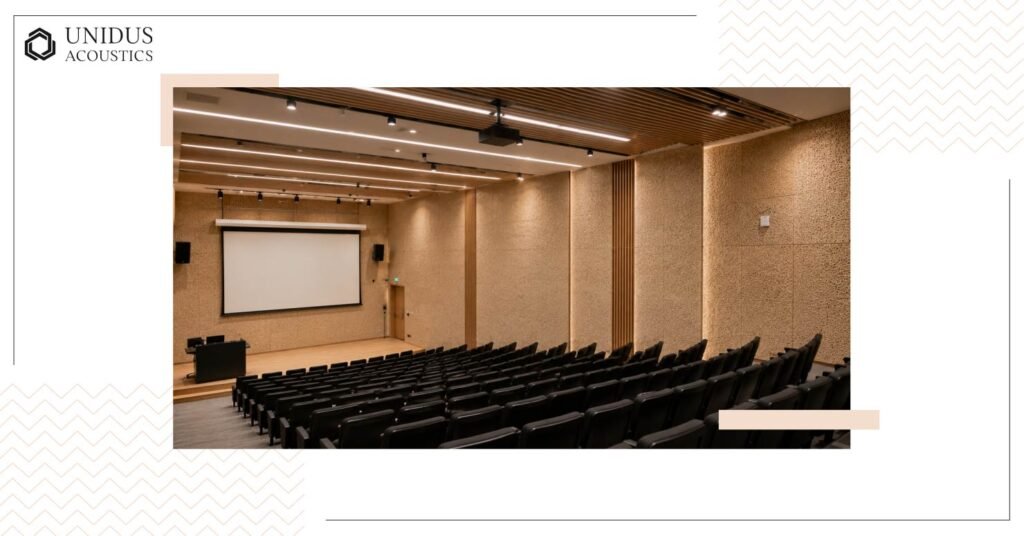
Wood wool boards have a long track record in auditoriums, lecture halls, and school common areas. They’re durable enough to withstand the incidental contact that happens in high-footfall institutional spaces, they carry a Class B1 fire rating which is the standard requirement for educational and public assembly buildings, and they don’t degrade the way fabric-covered panels can when cleaning regimes are inconsistent.
For large auditoriums, wood wool wall panels combined with a perforated metal or baffled acoustic ceiling give you both wall and ceiling absorption in a system that’s straightforward to maintain and replace without disturbing the structural fabric.
Hospitality Lobbies and F&B Spaces
Wood wool’s natural texture works well in hospitality applications where the brief asks for warmth alongside acoustic comfort. Restaurants, hotel lobbies, and co-working cafes with hard finishes typically need heavy absorption to manage the noise floor at peak occupancy. Wood wool panels on walls or as ceiling clouds do that job well, and they hold up visually in environments where aesthetics matter as much as acoustic function.
Wood Wool Acoustic Panels vs Other Acoustic Panel Materials
Different materials suit different projects. The table below gives an honest comparison across the most common commercial acoustic panel types.
| Material | Typical NRC | Fire Rating | Surface | Best For |
|---|---|---|---|---|
| Wood wool board | 0.70–0.90 | Class B1 | Textured, rigid | Walls, ceilings, auditoriums |
| PET polyester (recycled) | 0.70–0.90 | Class B1 | Smooth or patterned | Offices, hospitality |
| Fabric-wrapped glass wool | 0.85–1.05 | Varies by core | Soft, covered | Boardrooms, high-end offices |
| Perforated metal + backing | 0.60–0.85 | Non-combustible | Hard, industrial | Open plan ceilings |
| Foam panels | 0.30–0.75 | Generally poor | Soft, lightweight | Low-budget or temporary use |
Where wood wool has a real limitation: it’s heavier than PET polyester panels (400 kg/m3 vs 180–200 kg/m3), which increases the load on suspension systems for ceiling applications. For very large suspended ceiling areas, this weight difference is worth factoring into the structural brief. Wood wool is also not the right specification for areas requiring frequent wet cleaning or for external and semi-external use.
Fire Rating, Sustainability, and Compliance for Wood Wool Panels
These two criteria tend to come up together on institutional and government tenders, fire compliance as a hard requirement, sustainability as an increasingly expected one.
Fire Rating and Compliance for Indian Commercial Projects
For institutional and commercial projects in India, fire compliance is a non-negotiable specification requirement. Wood wool boards carry a Class B1 fire rating, the standard requirement for wall and ceiling finishes in most commercial interiors, institutional buildings, and public assembly spaces.
The fire resistance in a well-made wood wool board comes from the mineralisation process, not from a separate intumescent coating applied after manufacture. This makes the rating more inherent to the material itself, which is relevant when specifiers are asked to demonstrate compliance under a product substitution scenario during construction.
Sustainability and Green Building Alignment
The wood fibre content gives wood wool boards a natural alignment with biophilic design principles that synthetic alternatives can’t match visually. For projects targeting green building certifications (IGBC, LEED, GRIHA), request the manufacturer’s sustainability documentation and any certified environmental product declarations as part of your tender submission. These are increasingly expected on institutional projects, and having them ready before the submission deadline avoids delays.
How to Specify Wood Wool Acoustic Panels Correctly
Getting the specification right at design stage avoids the material substitutions that happen during procurement, and which regularly result in post-handover acoustic complaints.
What to Include in the Specification

A proper specification for wood wool acoustic panels should include: thickness (15/20/25mm), density (400 kg/m3 is the commercial standard), NRC rating with the assembly clearly stated (panel plus any backing), fire rating (Class B1), size and edge type, and surface finish or colour if the panel is exposed as the finished surface.
If the specification is for a tender submission, reference a tested assembly rather than a panel-only NRC figure. The assembly tested (panel + air gap + backing type) needs to match what will be installed. Mismatches between the tested assembly and the installed assembly are a common source of post-handover acoustic underperformance.
What to Ask Your Supplier
Ask for the actual test report from SGS, Intertek, or TÜV Rheinland, not a certificate number. The report shows the specific assembly tested, the NRC at each frequency, and the fire rating result. This documentation is increasingly required for project submissions, particularly for government and institutional tenders.
Ask about custom dimensions and lead times. Standard sizes in stock colours are generally available quickly. Custom dimensions, or custom surface finishes matched to a specific interior palette, may require 4–6 weeks. If the project is running to a tight programme or has a tender deadline, confirm availability before the specification is locked.
Frequently Asked Questions About Wood Wool Acoustic Panels
1. Can wood wool panels be painted or finished on-site?
Yes. Wood wool boards accept most standard paints including emulsion and spray finishes. Painting does reduce NRC to some degree because the coating partially fills the open surface texture. Where acoustic performance is the priority, specify the panel in the required colour from the manufacturer rather than painting on-site.
2. Are wood wool panels suitable for humid environments?
Wood wool boards have reasonable moisture resistance from the cementitious binder, but they’re not recommended for wet areas or external applications. For high-humidity indoor spaces, consult with the manufacturer about moisture-resistant variants or consider alternative materials.
3. What is the difference between wood wool board and wood fibre board?
Wood wool uses long, strand-like fibres bound with cement into a rigid panel. Wood fibre board uses shorter, finer fibres and is typically softer and more flexible — it’s more commonly used as thermal insulation than as a commercial acoustic panel. For commercial acoustic treatment, wood wool is the appropriate product.
4. How durable are wood wool panels in a commercial interior?
In a protected indoor environment with standard maintenance (vacuuming or dry wiping), wood wool panels are extremely durable. The material doesn’t degrade the way foam or fabric-covered panels can over time. There’s no practical lifespan limit under normal commercial use conditions.
Conclusion
Wood wool acoustic panels earn their place in commercial specifications for practical reasons. They perform well across the speech frequency range, survive institutional use conditions without degrading, meet fire compliance requirements out of the box, and work visually in spaces where a synthetic panel would look out of place. The tradeoff is weight, which matters for large suspended ceiling areas, and they’re not the specification for wet or external environments.
Unidus Acoustics has 40+ years of expertise in acoustic solutions and 635+ completed projects across India, ranging from corporate fit-outs for Infosys and SBI to institutional work at AIIMS and Ashoka University. Our Wood Wool Boards are available in 15mm, 20mm, and 25mm thicknesses, in standard sizes of 4×2 and 2×2 feet, tested and certified by SGS, Intertek, and TÜV Rheinland. We don’t undertake civil work and don’t require structural modifications.
To discuss your project or download our product catalogue, contact us.