There’s a conversation that happens on almost every commercial fit-out: a client walks into the finished space, frowns at the ceiling, and says, “It’s too loud. Can you soundproof it?”
Nine times out of ten, soundproofing isn’t what they need. They need acoustic treatment. And the confusion is understandable.
Both disciplines deal with sound. Both involve adding materials to a space. But they solve fundamentally different problems, and specifying one when you need the other wastes time, budget, and goodwill. Getting this distinction right early in a project separates spaces that perform from spaces that disappoint.
The Core Difference Between Soundproofing and Acoustic Treatment
Think of it this way: soundproofing is about where sound travels. Acoustic treatment is about how sound behaves once it’s already there.
A space can be tightly soundproofed and still sound terrible inside. Conversely, a space with excellent internal acoustics can still let noise bleed into the room next door. These are separate problems requiring separate interventions.
When Your Commercial Space Needs Soundproofing
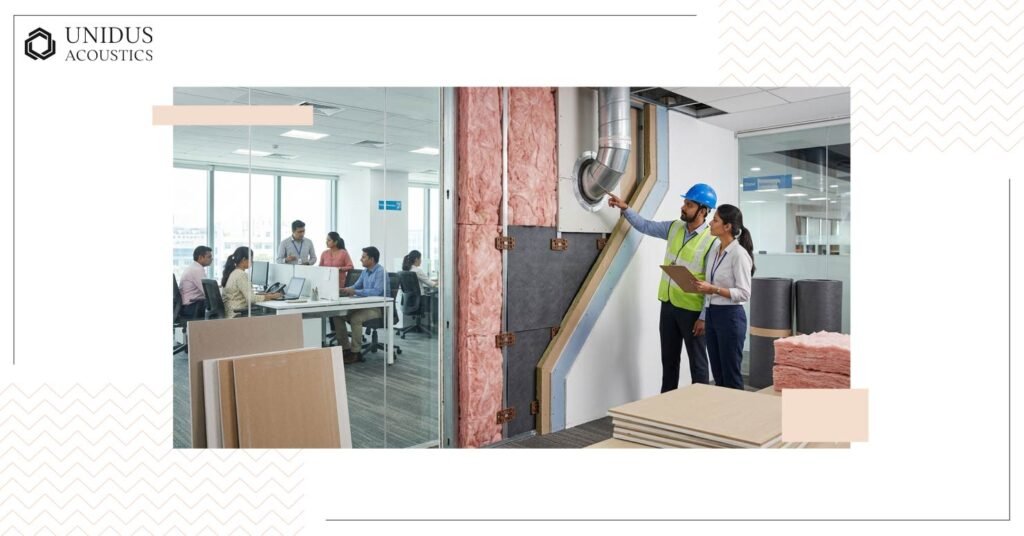
Soundproofing blocks sound transmission between spaces. The question to ask is simple: can people in adjacent areas hear what’s happening in this room, and vice versa?
If the answer is yes, the problem is structural. Sound is leaking through walls, floors, ceilings, doors, or HVAC penetrations. Fixing it requires adding mass (additional wall layers, dense insulation like glasswool or Mass Loaded Vinyl), decoupling structures to interrupt vibration paths, or sealing every gap. It’s a construction-phase solution. Retrofitting real soundproofing into a completed building is expensive and disruptive, and often only partially effective because the weak points (doors, conduit runs, false ceilings) are already locked in.
Common scenarios that actually need soundproofing: a conference room next to a trading floor, a studio recording space, a healthcare consultation room where speech privacy is a legal requirement, or a boardroom where sensitive conversations can’t afford to bleed into the open-plan area next door.
When Your Space Needs Acoustic Treatment

Acoustic treatment addresses how sound behaves inside a space. The symptoms here are different: voices are hard to understand, the room feels loud even at normal conversation levels, there’s a persistent echo after someone speaks, or the space feels fatiguing after an hour.
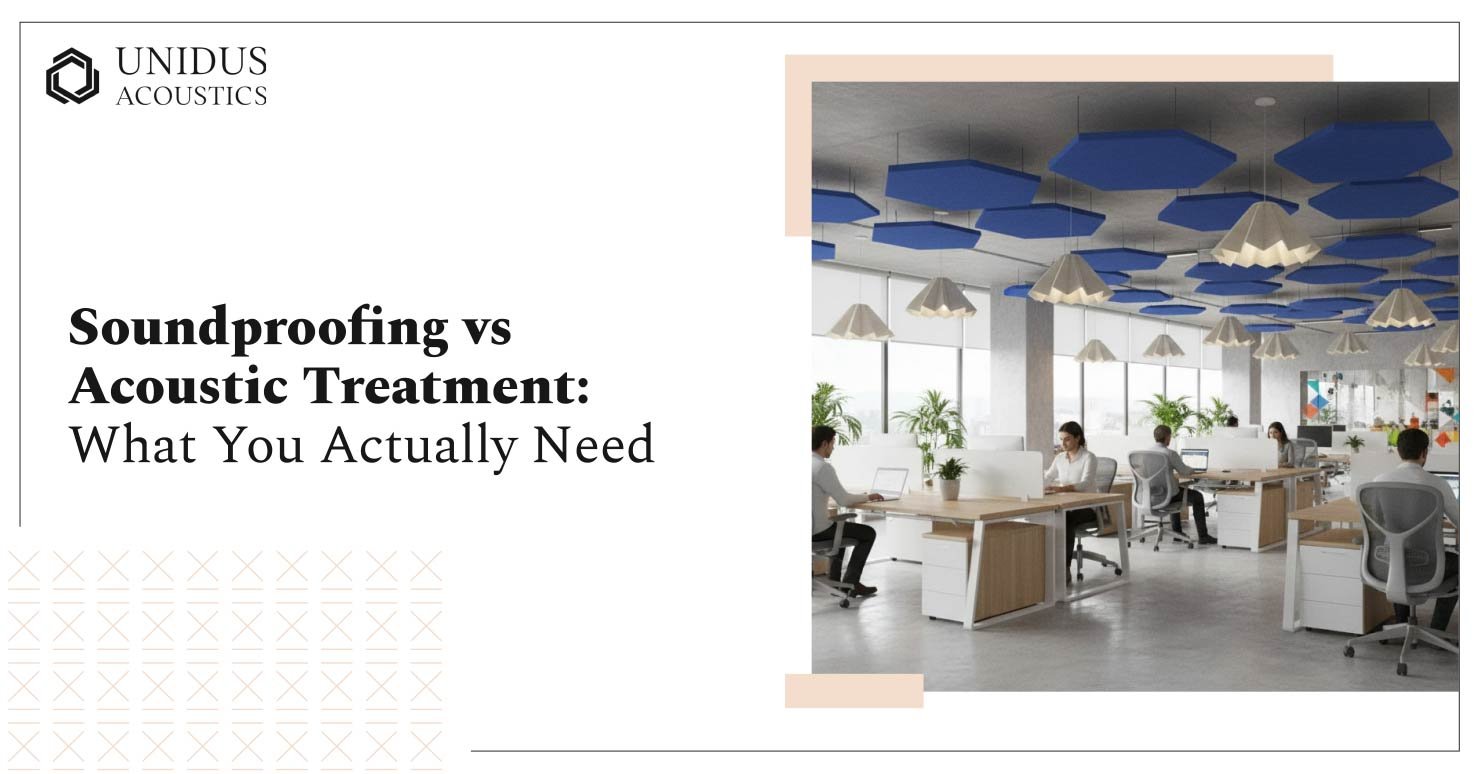
This is the problem in most commercial spaces, open offices, meeting rooms, lobbies, training halls, and restaurants. Modern interior design makes it worse. Glass partitions, polished concrete floors, hard plasterboard ceilings, and minimal soft furnishings create highly reflective environments where sound bounces relentlessly. The result is reverberation, and reverberation is what makes a space feel noisy even when nothing is particularly loud.
Acoustic treatment resolves this by adding absorptive surfaces (which convert sound energy into heat rather than reflecting it back) or diffusive ones (which scatter reflections to prevent sound from building up in one area). The result is a room that feels quieter at the same volume. Wall panels, ceiling baffles, acoustic clouds, and fabric-wrapped systems all work on this principle. Importantly, this kind of intervention requires no civil work and can be specified and installed without touching the building’s structure.
Why Soundproofing and Acoustic Treatment Get Confused

A large part of the problem is language. “Soundproof” has become a consumer shorthand for “fix the noise,” and clients use it without distinguishing between transmission and reverberation. Some vendors don’t help matters, using “soundproofing” in their marketing when they’re actually selling treatment products.
The practical consequence is this: a client who says “soundproof the meeting rooms” may actually have a room that sounds echoey and muddy, where speech clarity is poor. That’s a reverberation problem. It needs acoustic wall panels and ceiling treatment, not MLV or structural decoupling. Installing sound-blocking materials won’t help, and the client will be disappointed with the result.
The flip side also causes problems. A designer who specifies beautiful fabric wall panels throughout an office has handled the acoustics well, but if the conference rooms next to that open-plan space have paper-thin walls with no insulation fill, sensitive meetings can still be overheard. The space looks good and sounds comfortable, but it fails on privacy.
When a Project Needs Both Soundproofing and Acoustic Treatment
Frequently, yes. And in certain project types, both are necessary.
A multi-tenancy office building with collaborative zones, private meeting rooms, and executive offices will typically need structural soundproofing between enclosed spaces and acoustic treatment within each zone. A performing arts venue needs both isolation from the outside world and precise internal reverberation control. Healthcare facilities with open-plan nursing stations and private consultation rooms face both challenges simultaneously.
The key is treating each zone on its own terms rather than applying a single approach across the whole project. An open-plan area might need treatment alone; the enclosed meeting rooms adjacent to it may need both structural isolation and internal treatment to function properly.
The Sequence Matters
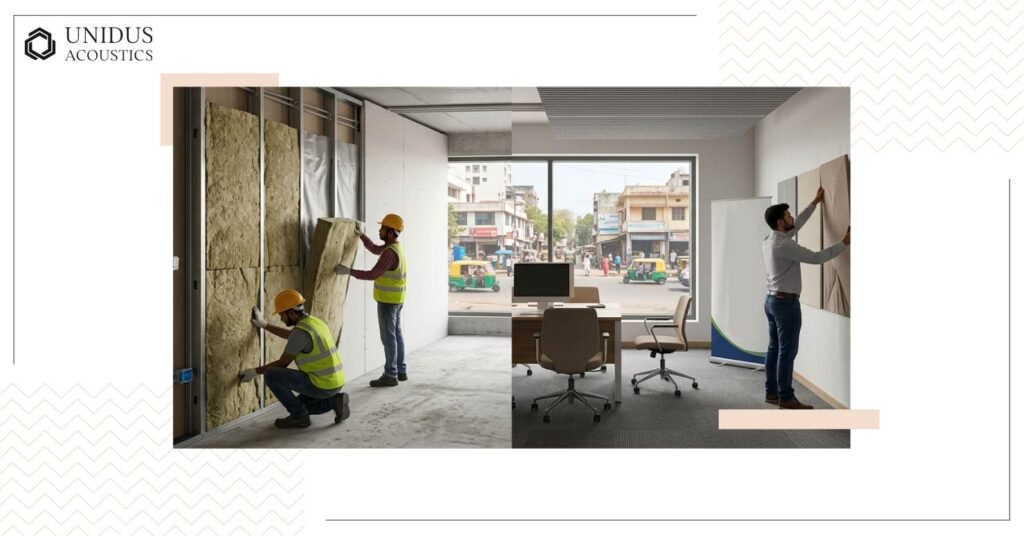
When a project requires both interventions, soundproofing must be addressed first. You cannot retrofit proper structural isolation into a finished space without significant disruption. Acoustic treatment, on the other hand, can be phased in after occupation and adjusted over time as the space’s use evolves.
What This Means for Your Project
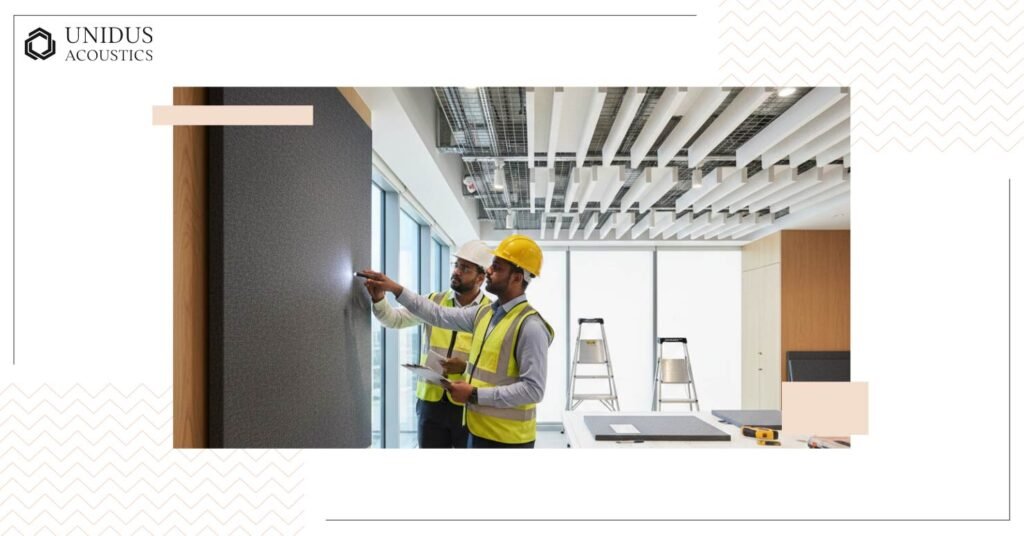
Before specifying anything, it helps to answer four questions:
- Is sound entering or leaving the space from adjacent areas? If yes, that’s a transmission problem. You need soundproofing as part of the building fabric.
- Is the problem inside the space itself, echo, reverberation, poor speech clarity, listener fatigue? That’s a reverberation problem. Treatment is what you need.
- Is the space already built, or still in design? Soundproofing is far more effective when addressed during construction. Acoustic treatment can be specified and installed at any stage.
- What’s the use case? A recording studio needs both, rigorously. A corporate open-plan office almost always needs treatment, rarely needs structural soundproofing. A confidential boardroom likely needs both at different scales.
The material selection flows from this. For transmission control, products like glasswool insulation, Mass Loaded Vinyl (MLV), and dense wall constructions are the right tools. For treatment, the choice between acoustic wall panels, ceiling baffles, suspended clouds, or fabric-wrapped systems depends on the room’s geometry, usage, and the aesthetic requirements of the project.
Turning Noise into Harmony Starts with the Right Diagnosis
Getting soundproofing and acoustic treatment confused doesn’t just lead to the wrong specification. It often leads to a client who paid for a solution and still has a problem, which is the worst possible outcome for everyone involved.
With 40 years of expertise in commercial acoustic solutions, Unidus Acoustics specialises in custom acoustic solutions for commercial spaces across India, from corporate offices and institutional buildings to hospitality venues and educational facilities. We work with architects, interior designers, and project managers from the briefing stage onward to assess what each space needs and recommend solutions that balance form and function without unnecessary cost or complexity.
If you’re at the brief stage or mid-project and need clarity on which acoustic problem you’re actually solving, get in touch. We can review the space requirements and point you toward the right specification. Connect with us and we’d rather help you specify correctly from the start than troubleshoot a finished space. Our solutions are built around value for money and on-time delivery, not one-size-fits-all recommendations.