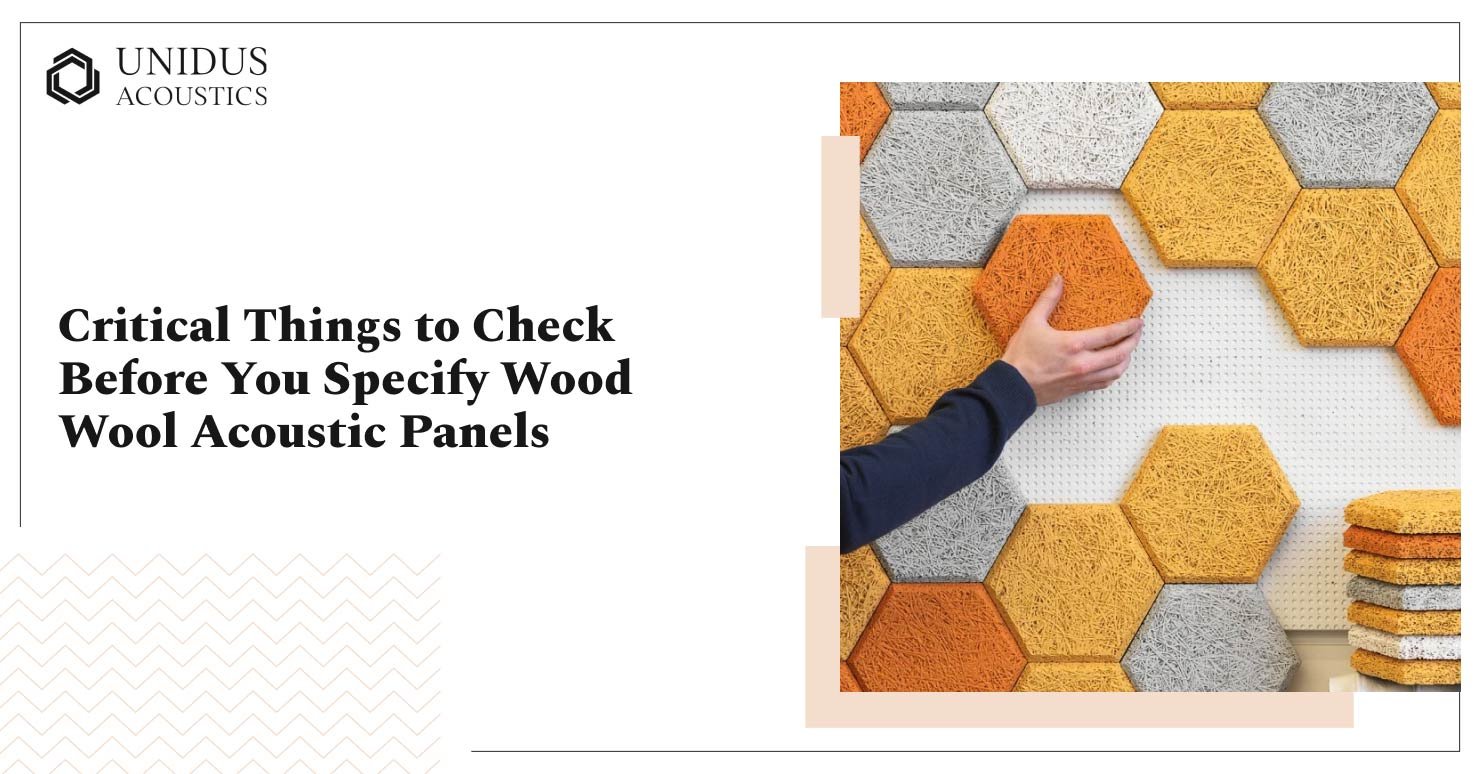
Wood wool acoustic panels look simple on a material board: a name, a texture swatch, sometimes an NRC number sitting next to it. Unidus Acoustics fields specification queries on this product most weeks, and they tend to arrive late, once the finish is locked in and the project timeline leaves little room to revisit whether it will perform and install the way the drawing assumes. If you’re still deciding whether wood wool suits the project at all, our complete guide to wood wool acoustic panels covers that ground. This article assumes you’ve made that call and walks through what to verify before it goes into your BOQ (Bill of Quantities)
Key Takeaways
- Ask which mounting condition, direct-fixed or with an air gap, the panel’s NRC figure was tested under before assuming it applies to your installation.
- Match panel thickness to the room’s reverberation problem rather than defaulting to the thickest option on the spec sheet.
- Calculate the panel’s installed weight from its density and share that number with your structural or ceiling contractor early.
- Request a fire test certificate specific to the wood wool board for government and PSU projects, or any other high-occupancy space.
- Line up material documentation in advance if the project is targeting an IGBC or similar green building rating.
Here’s what Unidus Acoustics’ Wood Wool board lists on the spec sheet, before getting into what else needs checking.
| Specification | Value |
|---|---|
| Thickness | 15mm / 20mm / 25mm |
| Panel size | 4×2 ft and 2×2 ft |
| Edge | Square |
| Density | 400kg/m³ |
| NRC | Up to 0.90 |
Things to Check Before You Specify Wood Wool
Eight checks, roughly in the order they tend to surface once a project moves from material selection to execution. Work through them before the panel goes into your BOQ, not after.
1. Confirm Which Mounting Condition Backs the NRC Number
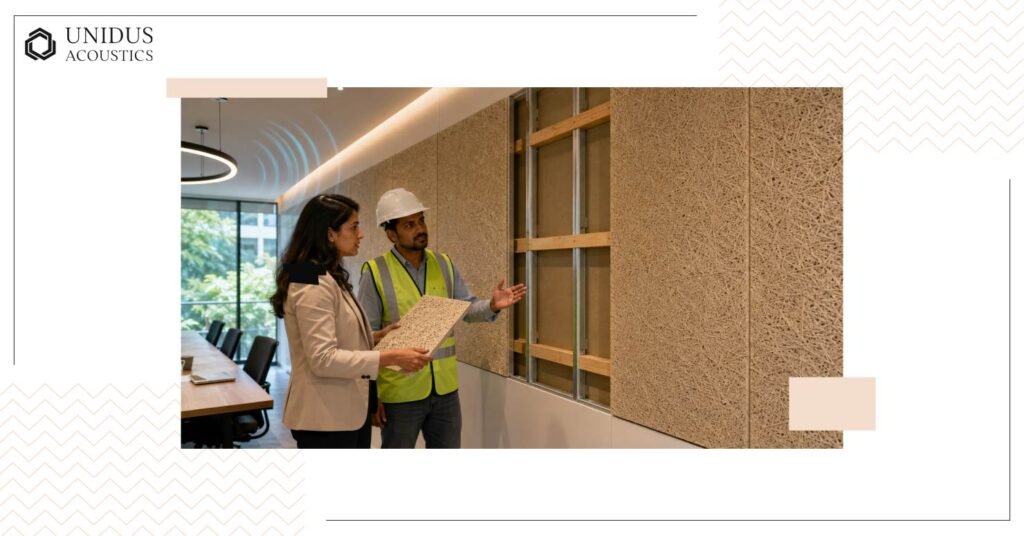
An NRC figure on its own tells you less than it looks like it does. Sound absorption is tested under a defined mounting condition, and a board mounted flat against a wall behaves differently from the same board fixed with an air gap behind it.
A panel tested with a gap can post a noticeably higher NRC than the identical panel installed direct-fixed on site. Ask the supplier which mounting condition the tested figure reflects, and confirm your installation matches it. If it doesn’t, the room won’t perform the way the drawing predicts.
2. Match Thickness to the Problem, Not the Spec Sheet Ceiling
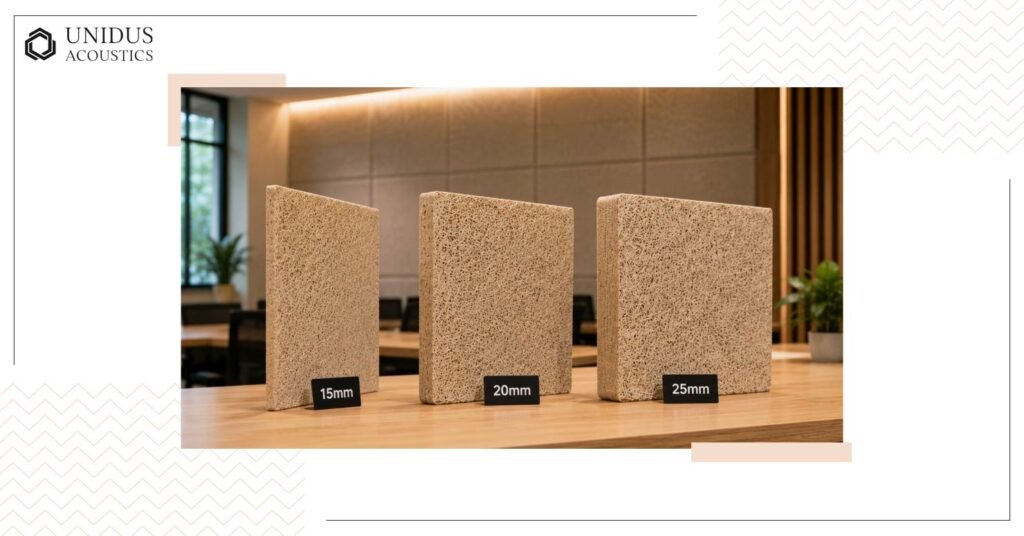
Wood Wool comes in 15mm, 20mm, and 25mm. Thicker boards generally pull more low-frequency energy out of a room, which matters more in spaces with hard floors and tall ceilings. It matters less in a small meeting room handling speech reflections.
Ask your supplier for thickness-specific absorption data rather than one NRC figure covering the whole range, then pick based on what the room is fighting. Specifying the thickest option by default adds cost and installed weight without a guaranteed acoustic gain for every application.
3. Run the Weight Math Before the Ceiling Grid Gets Finalised
Unidus Acoustics lists a density of 400kg/m³ for its Wood Wool board. The catalogue doesn’t spell out installed weight, but it’s a straightforward calculation once you have the density: multiply it by thickness.
| Thickness | Approx. Installed Weight |
|---|---|
| 15mm | ~6 kg/m² |
| 20mm | ~8 kg/m² |
| 25mm | ~10 kg/m² |
That’s the number your structural engineer or ceiling contractor needs. A false ceiling grid rated for a 3mm PET or PVC panel isn’t automatically rated for a 25mm wood wool board across the same span. Share the calculated weight before the suspension system gets locked, not after the panels arrive on site.
4. Line Up the Panel Module With Your Grid
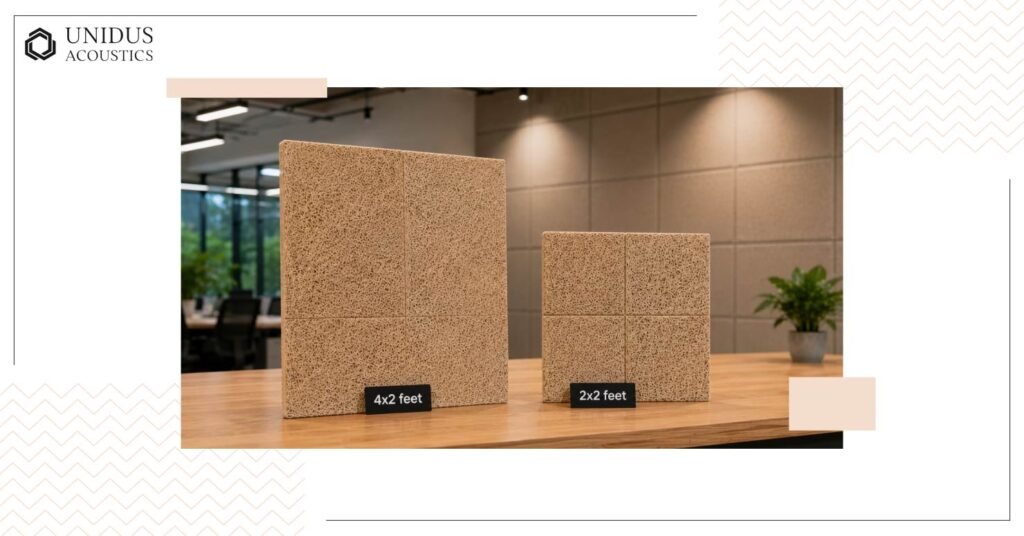
The board ships in 4×2 feet and 2×2 feet sizes with a square edge, which means a butt joint. Butt joints show as a visible line unless the layout accounts for it from the start.
Check your reflected ceiling plan or wall elevation against these two module sizes before drawings go for approval. A grid built around a different panel size will need cuts at every boundary, putting joint lines in places the designer didn’t plan for, often through a light fixture or diffuser.
5. Ask About Batch Consistency Before Approving a Sample
Wood wool is a wood-based composite, and colour or texture can shift between production batches more than it would with a printed or fabric-wrapped panel. A sample chip approved months before installation may not match what actually ships.
Ask your supplier for a sample from the batch going to your project, not a generic reference sample. This matters more on large open ceiling areas, where a shade difference is hard to hide.
6. Confirm the Application Suits the Site Conditions
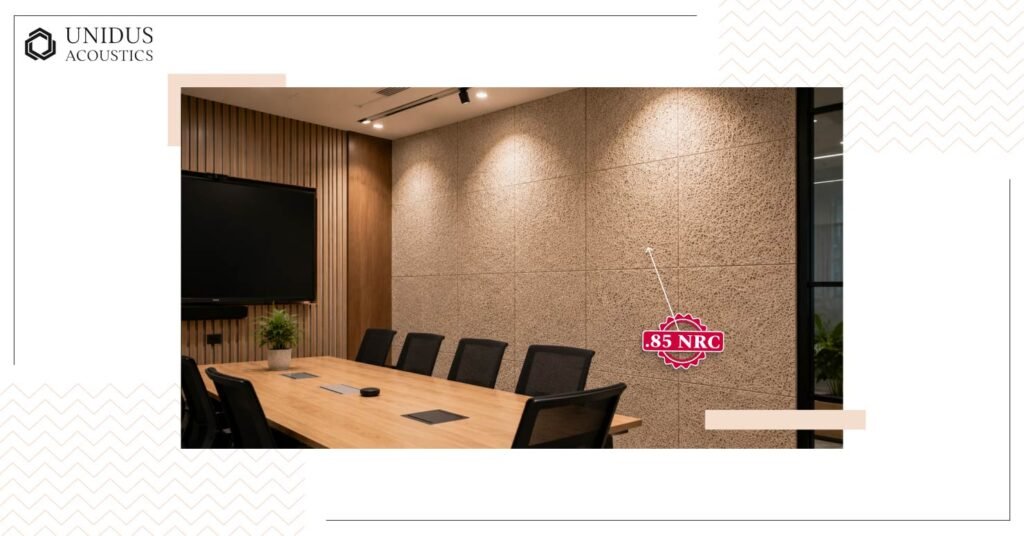
Wood Wool is built for interior wall and ceiling applications, the kind you’d find in corporate offices, conference rooms, cafeterias, and large auditoriums. It isn’t positioned for high-humidity zones, and manufacturers rarely publish a moisture rating for it either way.
If the project includes a semi-outdoor lobby or a space with regular condensation, raise it with the supplier before specifying the material there, not after installation.
7. Get Fire Rating Documentation Early for Government or Public-Occupancy Work
A standard product page for Wood Wool lists thickness, size, edge, density, and NRC. It doesn’t carry a fire class on that page, and that’s typical across manufacturers, not just this one.
For a private office fit-out, this may not hold up the project. For government and PSU work, or any of the public-occupancy projects that move on fixed approval timelines, fire performance documentation is usually part of the submission file. Request the fire test certificate for the specific board and thickness you’re specifying, and build the lead time for that document into your schedule.
8. Line Up Test Reports Early if the Project Is Chasing a Green Rating
Wood-based acoustic material fits naturally into projects targeting an IGBC Green Interiors rating or a similar certification, since material sourcing and indoor air quality both carry credits there. The paperwork needs to exist before the submission deadline, not after.
Ask for test reports and material declarations for the wood wool board at the point of finalising the spec. We’ve covered the sustainability side of this material in more detail in our piece on wood wool ceiling treatments for eco-conscious projects.
Frequently Asked Questions
1. What NRC rating should I look for in wood wool acoustic panels?
There’s no single correct number. An NRC of 0.90 suits a large auditorium or open office fighting significant reverberation, while a smaller meeting room might only need something in the 0.55 to 0.70 range. Ask for the mounting condition too; it matters as much as the number itself.
2. Is wood wool acoustic panel suitable for humid areas?
It’s built for dry interior wall and ceiling applications such as offices, conference rooms, cafeterias, and auditoriums. Manufacturers rarely publish a moisture rating for it, so confirm suitability before specifying it for washrooms or other consistently damp spaces.
3. Does wood wool acoustic panel come with a fire rating?
Fire performance data isn’t always listed on a standard product page, and it varies by manufacturer and thickness. If the project needs documented fire compliance, particularly for government and PSU work, or other public-occupancy buildings, request the specific test certificate for the board and thickness rather than assuming one exists.
4. How much does a wood wool acoustic panel weigh once installed?
Weight depends on thickness and the board’s density. At a typical density of 400kg/m³, a 15mm panel works out to about 6kg per square metre, a 20mm panel to roughly 8kg, and a 25mm panel to around 10kg. Confirm this with your structural or ceiling contractor before finalising the fixing system.
Conclusion
None of these checks are complicated on their own. The trouble is they tend to surface after drawings are approved and material is on order, when a change costs more than it would have earlier. Doing this at the specification stage keeps that cost out of the project.
Unidus Acoustics has supplied wood wool and other acoustic materials to commercial projects across India for more than 40 years, and can share test reports, sample batches, thickness-specific data, and fire certificates before you make the final call. Contact us now.