‘Noise cancelling wall panels’ is a widely used but imprecise term. These panels do not cancel noise the way headphones do. They absorb sound within a space to reduce echo and reverberation, which is a different problem from blocking sound between rooms. This article explains the distinction, what NRC ratings mean for commercial specifications, and where panels actually make a measurable difference.
Key Takeaways
- Acoustic wall panels absorb sound within a room. They do not block sound between rooms; that requires mass and structural isolation.
- NRC (Noise Reduction Coefficient) runs from 0 to 1. A score of 0.80 or above is the practical minimum for most commercial spaces.
- Coverage matters as much as panel quality. Treating 15–25% of the total wall surface area produces a measurable improvement in most offices.
- Third-party test certificates from bodies such as SGS, Intertek, or TÜV Rheinland are what to ask for, not just quoted NRC figures.
- Mounting method affects performance. Panels installed with a 25–50mm air gap behind them absorb better at low-mid frequencies than direct-adhesive mounting.
What Does ‘Noise Cancelling’ Mean for Wall Panels?

In consumer electronics, noise cancelling refers to active technology that generates an opposing sound wave to neutralise incoming noise. Wall panels do nothing of the sort. The term, as applied to architectural acoustics, is informal shorthand for sound-absorbing panels that reduce perceived noise levels within a room.
Sound waves travel through air and bounce off hard surfaces: glass, concrete, drywall, bare floors. Each reflection adds to the room’s overall noise load. In a typical open-plan office with hard finishes on every surface, a single conversation can reflect off six or seven surfaces before it fades. The result is what most people experience as ‘noisy’: not the volume of the direct sound alone, but the blur of reflected sound stacking on top of it.
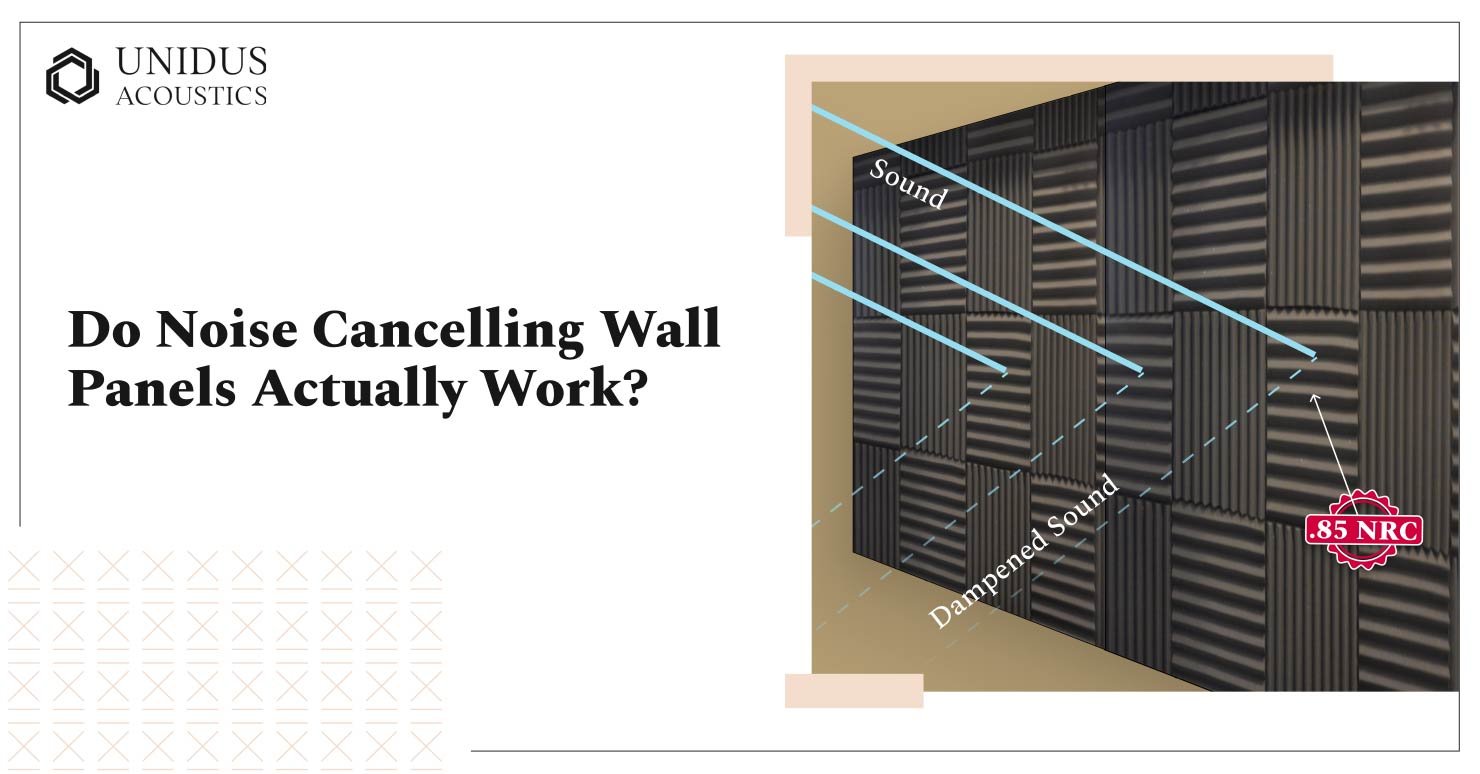
Acoustic wall panels interrupt this cycle. Their porous or fibrous surfaces convert a portion of incoming sound energy into heat through friction at a microscopic level, which prevents that sound from bouncing back into the room. Apply treatment to enough surfaces and the room’s reverberation time drops, speech becomes clearer, and the perceived noise level falls, even if the actual decibel output of the room hasn’t changed.
Noise Reduction Coefficient (NRC) for Acoustic Wall Panels

Every acoustic material is rated using a Noise Reduction Coefficient, or NRC. It runs from 0 to 1: an NRC of 0 means the material reflects all sound hitting it; an NRC of 1 means it absorbs all sound. Most real-world panels sit somewhere between 0.70 and 1.00, depending on the material, thickness, and mounting depth.
NRC is determined through standardised laboratory tests across four mid-range frequencies (250 Hz, 500 Hz, 1,000 Hz, and 2,000 Hz) which cover the bulk of human speech. A panel rated NRC 0.85 absorbs roughly 85% of incident sound energy in that range.
The practical threshold for meaningful acoustic improvement in most commercial spaces is NRC 0.80. Below that, panels may not absorb enough to produce a noticeable difference at normal coverage levels. NRC is also an average: two panels with the same score can perform quite differently across the frequency spectrum. A panel that performs strongly at low-mid frequencies (around 250–500 Hz, where office conversations live) will do more for speech privacy than one that peaks at high frequencies.
NRC Ranges by Panel Type
Here is a quick comparison to orient specification decisions:
| Panel Type | Typical NRC Range | Best For |
|---|---|---|
| Bare concrete / glass | 0.00–0.05 | Benchmark reference; untreated open-plan offices and atriums |
| Standard drywall | 0.05–0.10 | Benchmark reference; commercial fit-outs |
| Thin foam panels (12mm) | 0.30–0.50 | Home studios, minor treatment |
| Fabric-wrapped panels (50mm core) | 0.75–0.95 | Offices, boardrooms, classrooms |
| Polywool / recycled polyester panels | 0.70–0.90 | High-traffic commercial spaces, Class B1 fire compliance |
| Ceiling baffles / clouds (two-sided exposure) | 1.00+ | Large-volume spaces, atriums, sports halls |
Polywool panels, made from recycled polyester fibres, sit in the 0.70–0.90 NRC range, carry a Class B1 fire rating, and hold up in high-traffic environments where panels may need to be cleaned or replaced individually. They are a practical choice for corporate offices, institutional corridors, and educational settings where both performance and durability matter.
Do Noise Cancelling Wall Panels Block Sound Between Rooms?

Acoustic wall panels are sound absorbers, not sound blockers. Sound absorption reduces reflections within a room; panels do this well. Sound isolation prevents sound from transmitting between rooms, which requires mass: dense materials, decoupled construction, sealed perimeters. A fabric-wrapped panel does not provide this.
If the goal is to stop noise from a neighbouring office coming through a shared wall, panels on the receiving side will have limited effect. They will reduce how much of that noise reflects around the room once it gets in, but the transmission path itself is unchanged. Mass-loaded vinyl, double-leaf wall construction, and acoustic insulation within the wall cavity address that problem.
Panels make a measurable difference in conference rooms with echo problems, open-plan offices where conversations blur together, and reception areas with high ceilings and hard surfaces.
Where to Place Acoustic Wall Panels for Best Results
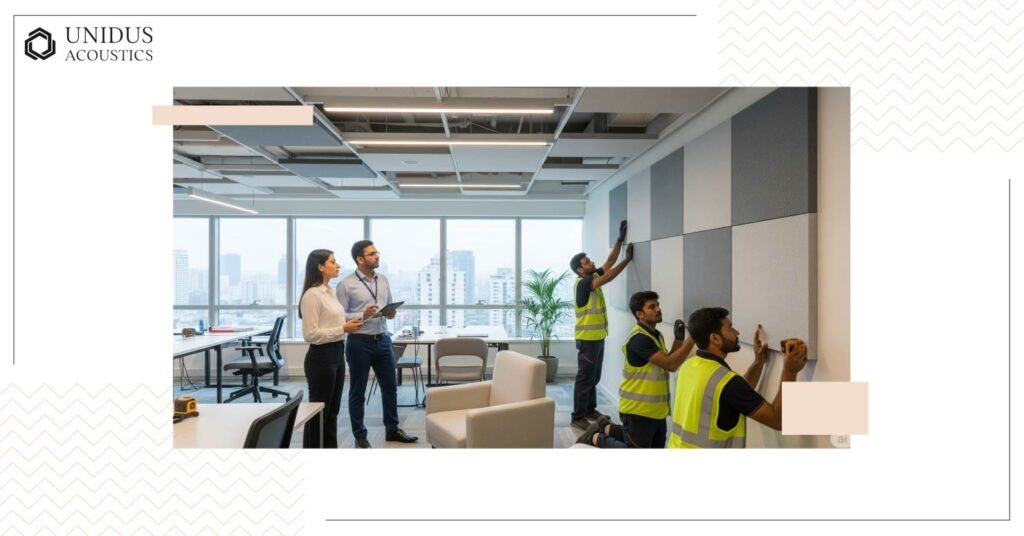
Panels work when they are placed where sound is most active, not just where they look good.
1. Start with First-Reflection Points
These are the surfaces where sound from a speaker or conversation first hits before reaching the listener. In an office, this is typically the wall behind and beside workstations, and the wall opposite a conference room’s main seating area.
2. How Much Wall Coverage Do Acoustic Panels Need?
Coverage area matters more than individual panel NRC once you pass 0.80. A room treated at 15–25% of its total wall surface with NRC 0.85 panels will typically produce a perceivable improvement in reverberation time.
3. Should You Use Ceiling Panels Alongside Wall Panels?
Ceiling treatment amplifies the effect of wall panels. Panels on walls reduce lateral reflections; baffles or clouds overhead reduce the most common reflection path. The two work together, not instead of each other.
How to Specify Acoustic Wall Panels for Commercial Projects

When writing a spec for acoustic wall panels in a commercial interior, these are the details that matter:
1. What NRC Standards Should You Ask For?
Ask for NRC ratings tested to ISO 354 or ASTM C423 standards, not manufacturer-estimated values. Panel thickness directly affects low-frequency absorption; panels at 50mm or above perform better across a broader frequency range. Third-party test certificates from bodies such as SGS, Intertek, or TÜV Rheinland verify what the spec sheet claims.
2. Which Core Material and Fire Rating Do You Need?
In India, Class B1 is the standard fire rating requirement for most commercial interiors. Core material matters too: recycled polyester (polywool), glasswool, stone wool, and wood wool each have different acoustic profiles, fire behaviour, and maintenance requirements. Before locking the spec, confirm colour, size, and finish options with the supplier; treatment that conflicts with the design scheme rarely gets approved.
Frequently Asked Questions
1. Do noise cancelling wall panels block sound completely?
No. Wall panels absorb sound within a space to reduce echo and reverberation. They do not block sound from passing through walls; that requires mass and structural isolation.
2. How much wall coverage do panels actually need?
It varies by room size, ceiling height, and surface materials. As a general guide, 15–25% of total wall surface area with high-NRC panels produces a measurable improvement in most commercial spaces.
3. What fire rating should acoustic wall panels meet for commercial interiors in India?
Class B1 is the standard requirement for most commercial interior applications in India. Ask for a test certificate from an accredited body confirming this rating, not just a supplier’s quoted figure.
4. What is the difference between soundproofing and sound absorption?
Soundproofing prevents sound from moving between rooms and requires structural mass. Sound absorption reduces reflections within a room. Acoustic wall panels do the latter. They are not a substitute for structural soundproofing.
Acoustic Wall Panels for Commercial Projects
Unidus Acoustics has been supplying custom acoustic solutions for commercial interiors across India for 40 years, from corporate offices and conference facilities to institutional spaces and large-format public buildings. Products include fabric-wrapped panels, Polywool panels with NRC 0.70–0.90 and Class B1 fire rating, printed acoustic panels, ceiling baffles and clouds, and space dividers, all available with custom sizing and finish options.
All acoustic products carry third-party test certifications from SGS, Intertek, and TÜV Rheinland. NRC documentation and fire certificates are available for tender files.
To discuss a specification or request a product catalogue, contact us now.