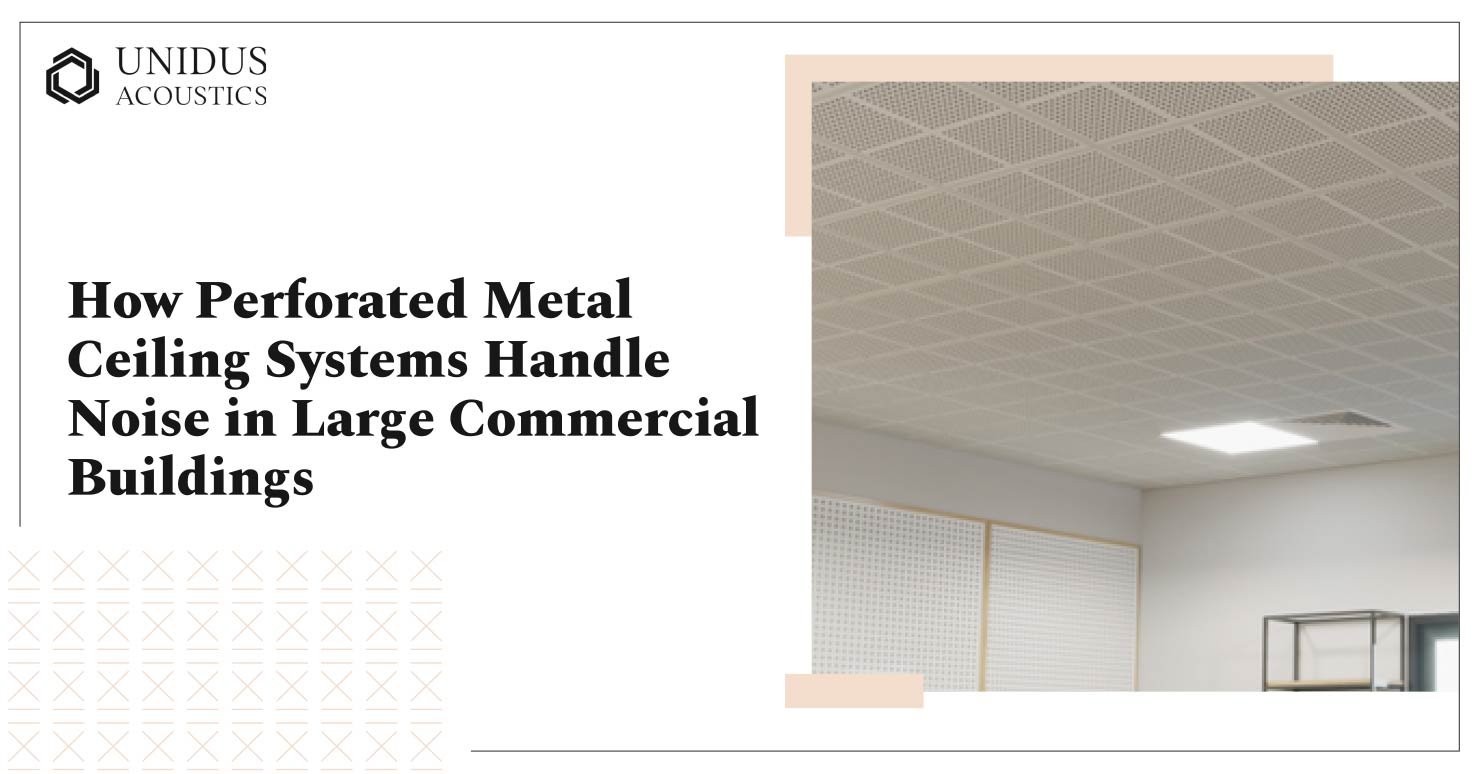
Noise management in large commercial spaces is rarely simple, and that’s why the ceiling is often the first surface a specifier looks to. Perforated metal ceiling systems have become one of the most commonly specified acoustic solutions in large-volume commercial buildings. But how they work acoustically, and when they’re genuinely the right choice, is worth understanding before committing to a specification.
Key Takeaways
- The metal face of a perforated ceiling panel does not absorb sound. The acoustic backing material does.
- NRC ratings for perforated metal ceiling systems range from 0.60 to 0.90, depending on perforation pattern and backing type.
- Always request tested NRC data for the full panel-plus-backing assembly, not the panel alone.
- Higher open area percentage improves absorption but also makes the perforation pattern more visible at close range.
- These systems are not suited for spaces requiring NRC above 0.90 or significant low-frequency noise control.
What Makes Large Commercial Buildings Acoustically Difficult
Large commercial spaces face three acoustic problems that smaller rooms don’t encounter in the same way: high ceiling volumes, hard reflective surfaces, and continuous occupancy. When room volume doubles, reflected sound takes longer to decay. Reverberation times in untreated atria or lobbies can run to four or five seconds, which makes speech intelligible only at short distances.
Surface materials compound the problem. Glass facades, polished concrete floors, and stone cladding, all common in corporate and hospitality interiors, reflect rather than absorb sound. This leaves the ceiling as one of the few large surfaces where acoustic treatment is even possible.
How Perforated Metal Ceiling Systems Work
The metal face itself does not absorb sound. The perforations create openings through which sound waves pass into a sound-absorbing backing material, typically stone wool or polyester fibre. Inside that backing layer, sound energy is converted to a negligible amount of heat through air molecule friction and fibrous resistance. The metal is structural and visual; the backing is acoustic.
This differs from mineral fibre tiles, where the tile material itself is the absorber. Separating the structural function from the acoustic function is what gives perforated metal systems their durability advantage: the metal face can be engineered purely for longevity and appearance without any trade-off against acoustic performance.
How Perforation Patterns Affect Performance
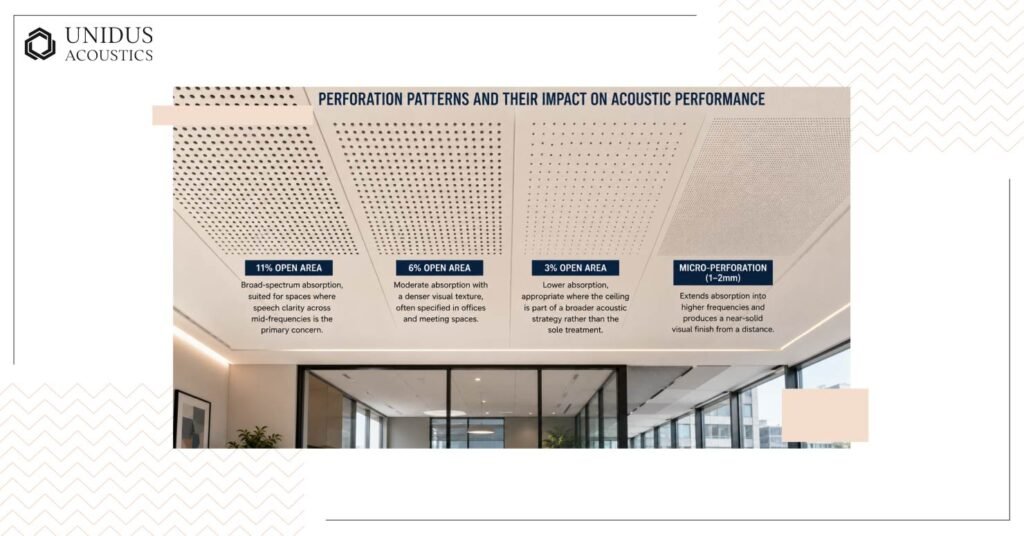
The percentage of open area in the perforation pattern directly controls how much sound reaches the backing material. Common configurations include:
- 11% open area: broad-spectrum absorption, suited for spaces where speech clarity across mid-frequencies is the primary concern.
- 6% open area: moderate absorption with a denser visual texture, often specified in offices and meeting spaces.
- 3% open area: lower absorption, appropriate where the ceiling is part of a broader acoustic strategy rather than the sole treatment.
Micro-perforation patterns (hole diameters of 1–2mm) extend absorption into higher frequencies and produce a near-solid visual finish from a distance.
Why the Backing Material Matters More Than the Metal
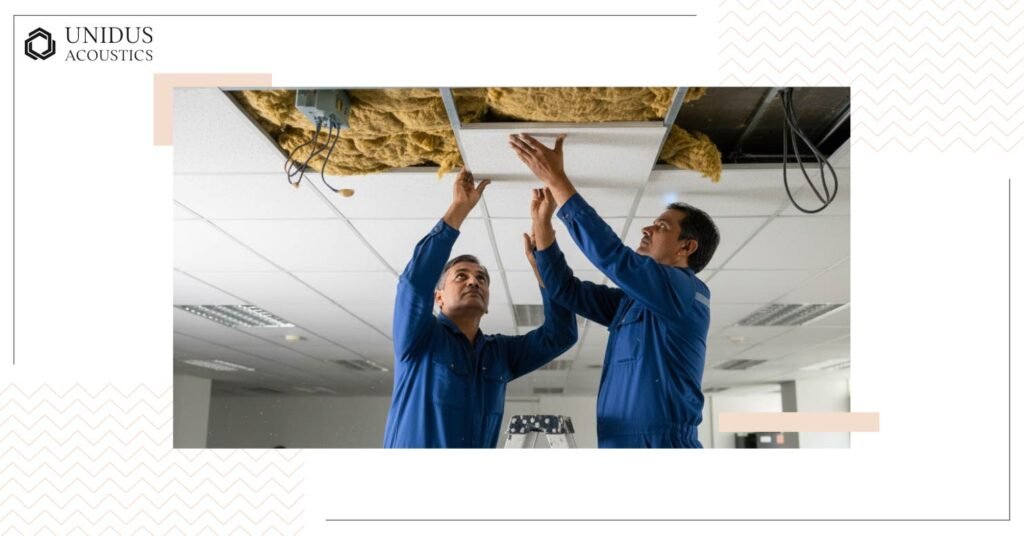
The NRC rating of the assembled system depends primarily on the backing, not the metal face. Stone wool backing can push perforated metal systems to NRC ratings of 0.70 to 0.90. Polyester fibre backing achieves comparable results with lighter weight and easier handling on site.
Without any backing material, a perforated metal panel provides negligible acoustic benefit. Always confirm that a system includes acoustic backing and request the manufacturer’s tested NRC data for the specific panel-plus-backing assembly, not just the panel on its own.
NRC Ratings for Perforated Metal Ceilings: What to Expect
For standard perforated metal ceiling systems installed with acoustic backing:
| Configuration | Expected NRC | Typical Applications |
|---|---|---|
| 11% open area + stone wool backing | 0.75–0.90 | Auditoriums, lobbies, airports |
| 6% open area + polyester fibre backing | 0.65–0.80 | Open-plan offices, boardrooms |
| 3% open area + stone wool backing | 0.60–0.75 | Corridors, breakout spaces |
| Open cell metal (no backing) | 0.40–0.55 | Mixed with other absorbers |
An NRC of 0.75 means the system absorbs 75% of incident sound energy in the speech frequency range (250 Hz to 2,000 Hz). In practice, this is sufficient to bring reverberation times within acceptable limits in most commercial spaces when the perforated metal ceiling covers a significant proportion of the total room surface area.
Design and Integration Advantages in Large Spaces
Perforated metal systems hold up well in commercial environments where surface performance, services access, and long-term finish quality all need to work together.
Durability and Maintenance
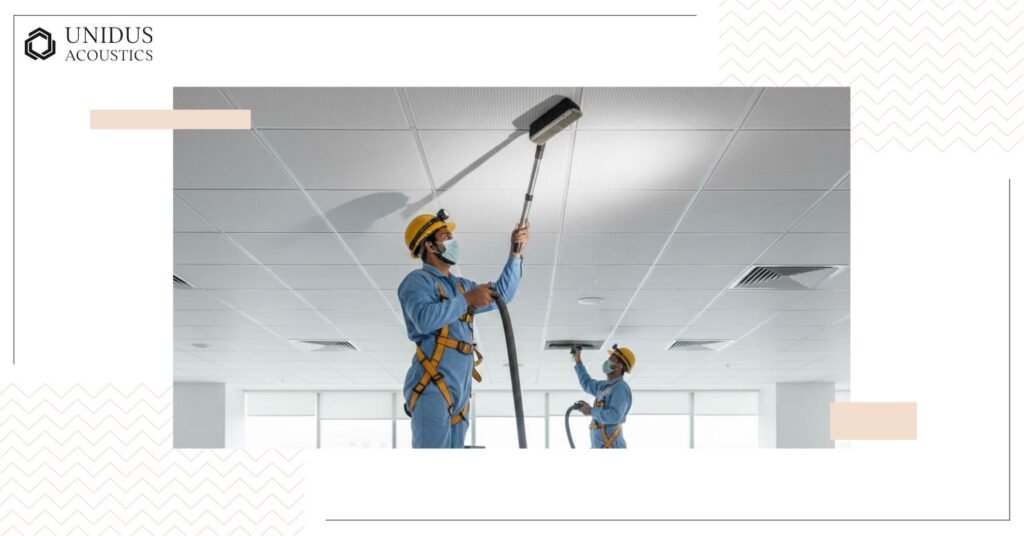
Metal ceilings don’t sag, discolour from humidity, or lose acoustic performance over time the way mineral fibre tiles can. In large commercial buildings with HVAC-driven temperature and humidity variation, this matters. Metal panels can be cleaned without damage, making them a practical choice in F&B venues, healthcare facilities, and educational institutions where maintenance standards are high and surface cleanliness is a requirement, not a preference.
Integration with Building Services
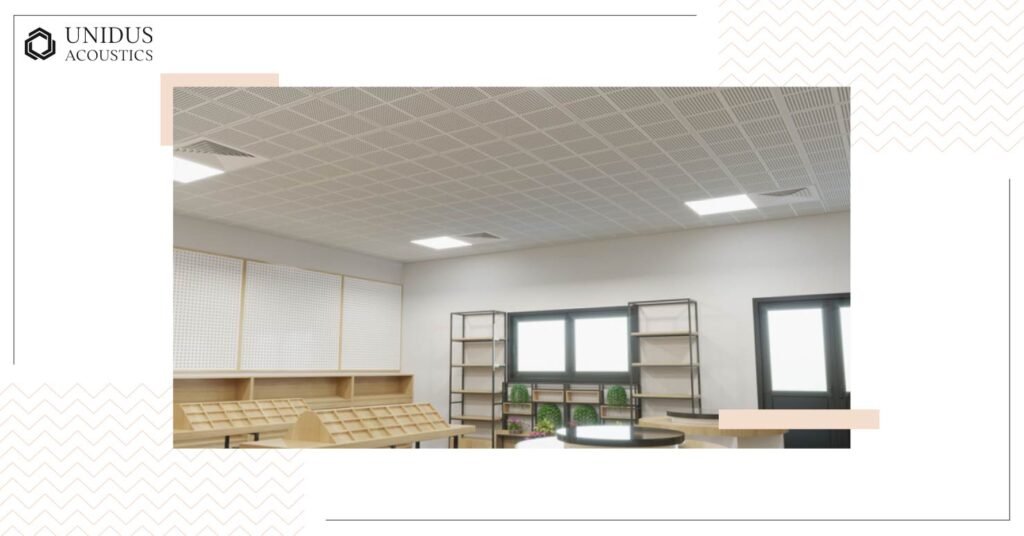
Large commercial buildings carry a heavy services load: HVAC diffusers, recessed downlights, sprinkler heads, and data conduit runs all need to coexist in the ceiling plane. Perforated metal ceilings are designed for this. Panels can be cut and fitted around services without disrupting the acoustic assembly, and the modular grid systems used in most commercial installations allow individual panels to be removed for access without disturbing the surrounding ceiling.
Aesthetic Range
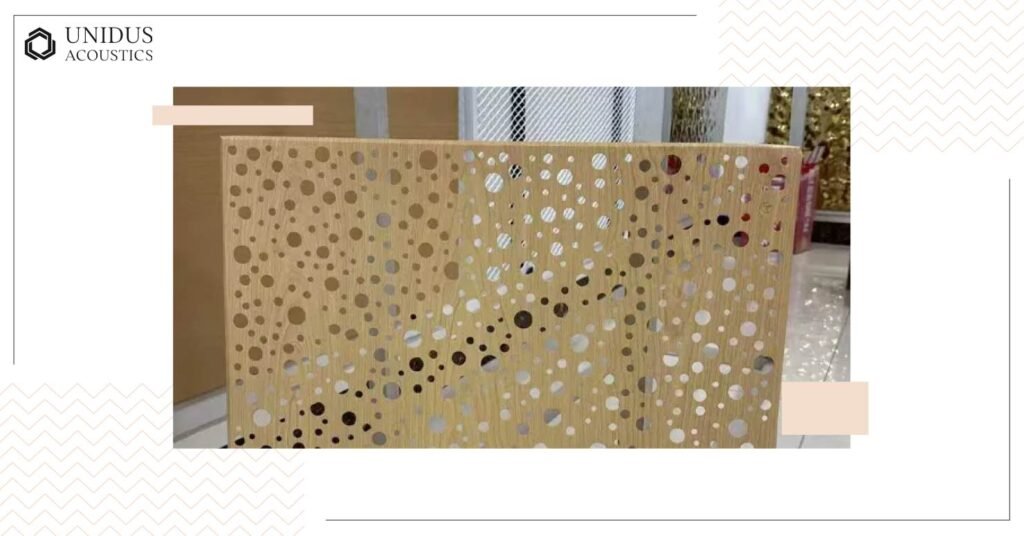
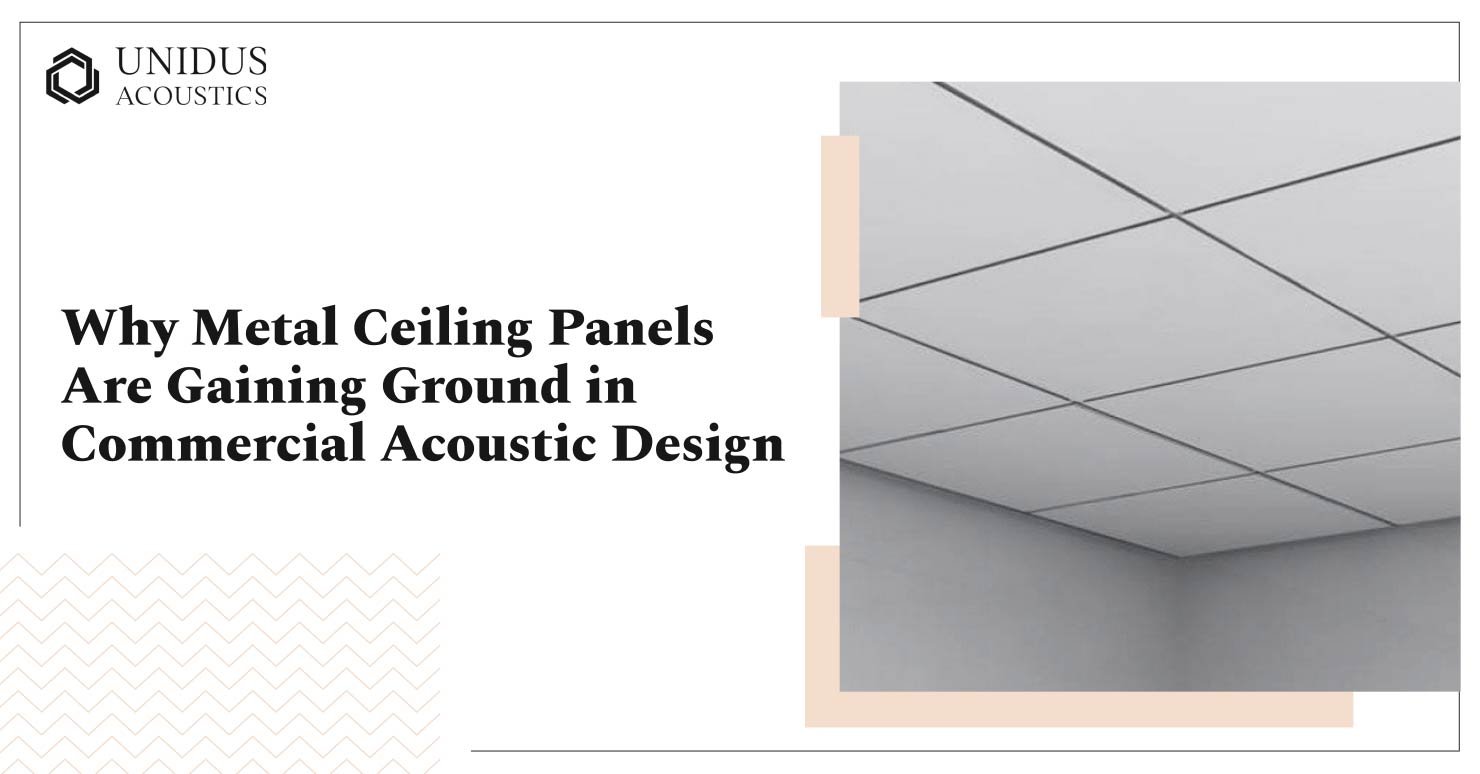
Perforated metal ceiling tiles are available in a wide range of finishes, colours, and edge profiles. Concealed grid systems eliminate visible suspension hardware and create a seamless ceiling plane. Exposed grid systems suit industrial and contemporary interiors. Floating metal panels suspended without a full grid are used in hospitality and airport spaces where the ceiling is meant to be a visual feature, not just a functional surface. Custom finishes, sizes, and edge profiles can be specified for projects where the ceiling is a deliberate design feature rather than a background surface.
Where Perforated Metal Ceiling Systems Are Typically Specified
These systems are most appropriate in spaces with at least one of the following characteristics:
- High ceiling volumes where reverberation control matters more than speech privacy between adjacent spaces.
- Environments with significant services integration requirements that demand accessible, modular ceiling systems.
- Spaces requiring washable, non-degrading ceiling surfaces over a long service life.
- Interiors where the ceiling is a design element, not a background material.
Common applications include corporate lobbies, multi-use atria, airport terminals, hotel public areas, retail anchor stores, hospital corridors, and institutional buildings such as universities and government offices.
Where Perforated Metal Ceilings Are Not the Right Fit
Metal ceiling systems are not the answer for every space. Rooms that require very high NRC values (above 0.90) may be better served by wood wool panels or deep-profile mineral fibre, which can outperform perforated metal per square metre of ceiling area. Metal systems also carry a higher material cost than standard acoustic tiles, so they tend to be reserved for client-facing or architecturally prominent areas where the specification justifies the investment.
For spaces with significant low-frequency noise from mechanical plant or building services, perforated metal ceiling panels alone are rarely sufficient. Controlling low-frequency sound requires thicker materials or resonant absorber systems, neither of which a standard perforated tile assembly provides.
Frequently Asked Questions
1. Do perforated metal ceiling tiles block sound between floors?
No. Sound absorption (reducing echo within a room) and sound transmission loss (blocking sound from passing through a floor assembly to the space below) are fundamentally different problems. Perforated metal ceilings address absorption within the room. Floor-to-floor isolation requires slab construction, decoupled flooring, and structural separation, not ceiling tiles.
2. Can perforated metal ceiling panels be installed in humid environments?
Galvanised steel and aluminium panels with powder-coated finishes can be specified for high-humidity areas. For partially outdoor or exposed locations, confirm with the manufacturer that the acoustic backing is also moisture-resistant. Standard polyester fibre backers perform well in moderate humidity but may not be appropriate for kitchens or external canopies.
3. How does open area percentage affect the visual appearance of the ceiling?
A higher open area percentage produces a coarser, more visible texture. Lower percentages create a near-solid appearance. Most perforated metal ceilings at 3–6% open area are visually indistinguishable from non-perforated panels to the naked eye under standard overhead lighting.
Conclusion
Unidus Acoustics offers the UNISTEEL Metal Ceiling range, including the Meta Tile Clip-In, Meta Tile Lay-In, and Meta Cell open cell systems. Available in multiple perforation patterns from 3% to 11% open area, with concealed edge, square edge, and microlook edge profiles, the range is designed for large commercial and institutional projects. Backed by 40+ years of expertise and 635+ completed projects across 16+ cities, Unidus Acoustics delivers custom acoustic solutions built to perform across demanding commercial environments.
Specifying acoustic ceilings for a large commercial project? Unidus Acoustics has supplied the UNISTEEL Metal Ceiling range to corporate, hospitality, and institutional projects across India. View the range or get in touch with us.