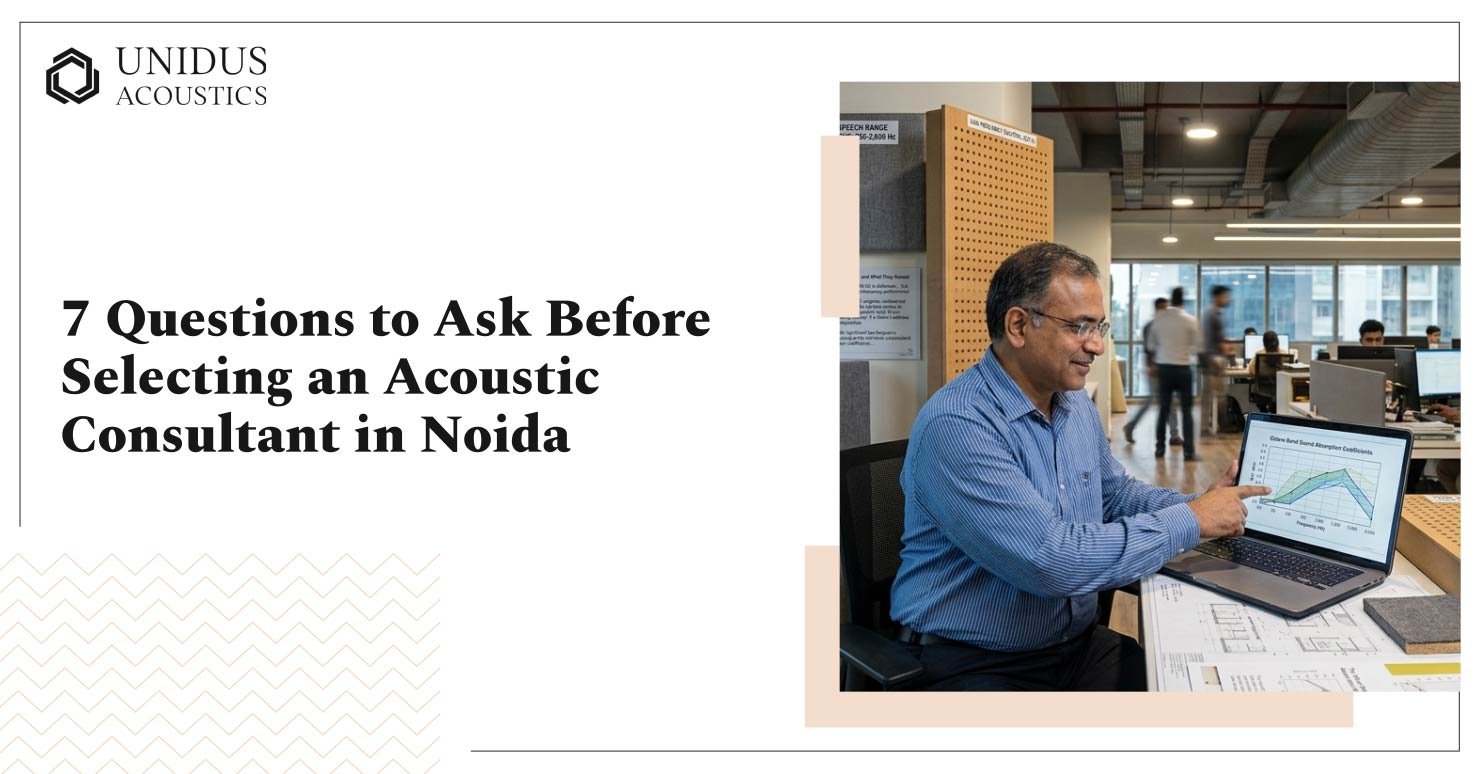
Noida’s commercial pipeline has changed considerably. New office developments along the Noida-Greater Noida Expressway, in Sectors 62, 132, and 140A, and across the emerging institutional corridor have brought in tech firms, global capability centres, and institutional tenants whose fitout briefs routinely carry acoustic performance targets. GCC leasing in Noida grew significantly through 2024, and Grade A office absorption in the region continues to rise. For architects and interior designers handling these projects, selecting the right acoustic consultant in Noida is worth more attention than it typically gets.
The problem is that “acoustic consultant” covers a wide range of capabilities, scopes, and working styles. Some firms focus on industrial noise. Others have strong backgrounds in studios or residential work. Very few have deep experience across the specific building types that dominate Noida’s current project pipeline: corporate campuses, institutional buildings, co-working developments, and mixed-use commercial towers. Getting clarity upfront saves a great deal of friction downstream.
Questions to Ask Before Hiring an Acoustic Consultant in Noida
Not every acoustic consultant in Noida has the right background for commercial and institutional briefs, and the difference usually becomes clear only if you ask the right things upfront.
These seven questions are worth asking before you bring anyone on board.
1. Does Their Experience Match Your Building Type?
Acoustic work in a corporate boardroom and acoustic work in an auditorium draw on overlapping principles but require very different practical expertise. Before you shortlist any acoustic consultant in Noida, ask directly: what percentage of their recent project work sits in the same category as your brief?
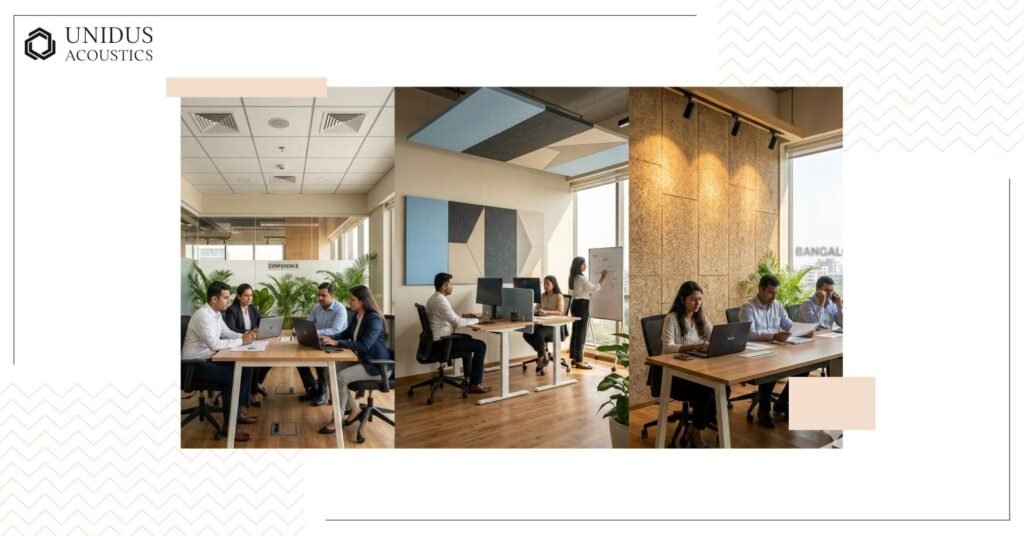
A portfolio skewed toward studios, theatres, or industrial sites is not necessarily a disqualifier, but it is worth knowing. Commercial and institutional acoustic requirements tend to involve tight programme schedules, coordination across multiple consultants, and client sign-offs that move quickly. Consultants unfamiliar with that environment often slow the process down without meaning to.
2. Is the Scope of an Acoustic Consultant in Noida Clearly Defined?
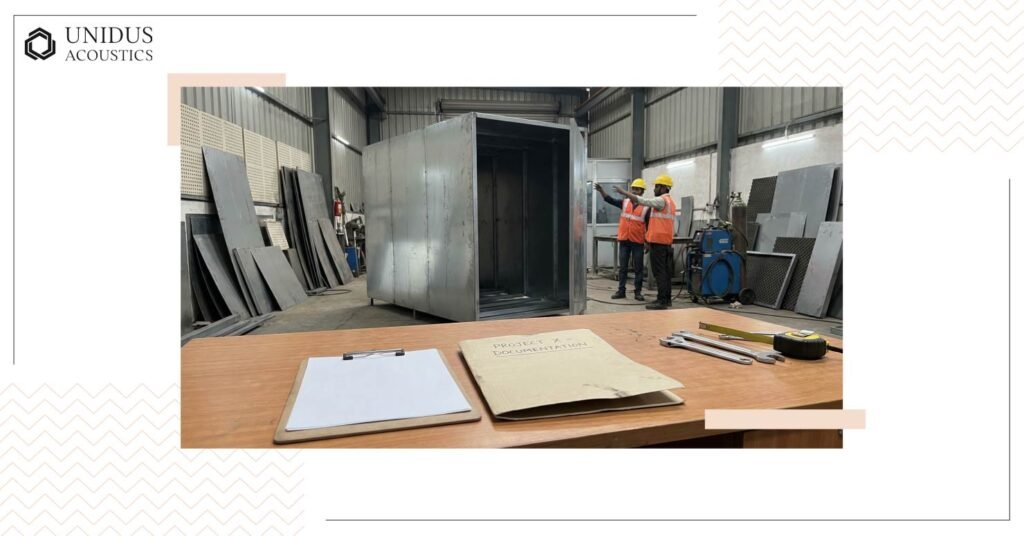
There is a consistent source of confusion on project teams about where acoustic consultancy ends and product specification begins. An acoustic consultant working on a commercial project is typically responsible for site measurement, acoustic modelling, setting reverberation time targets, reviewing construction details that affect sound transmission, and signing off on the final installation. What they generally do not do is source or supply the materials themselves. Treating these two roles as the same thing creates gaps in both the specification and the procurement process.
The distinction matters practically. If the consultant’s scope ends at specifying Noise Reduction Coefficient (NRC) targets and reverberation time goals, you will need a product partner who can match materials to those specifications, who can deliver on custom sizes, finishes, fire certifications, and programme timelines. Knowing this upfront lets you build the right team from the start rather than scramble mid-project.
3. How Do They Handle Site-Specific Measurement?
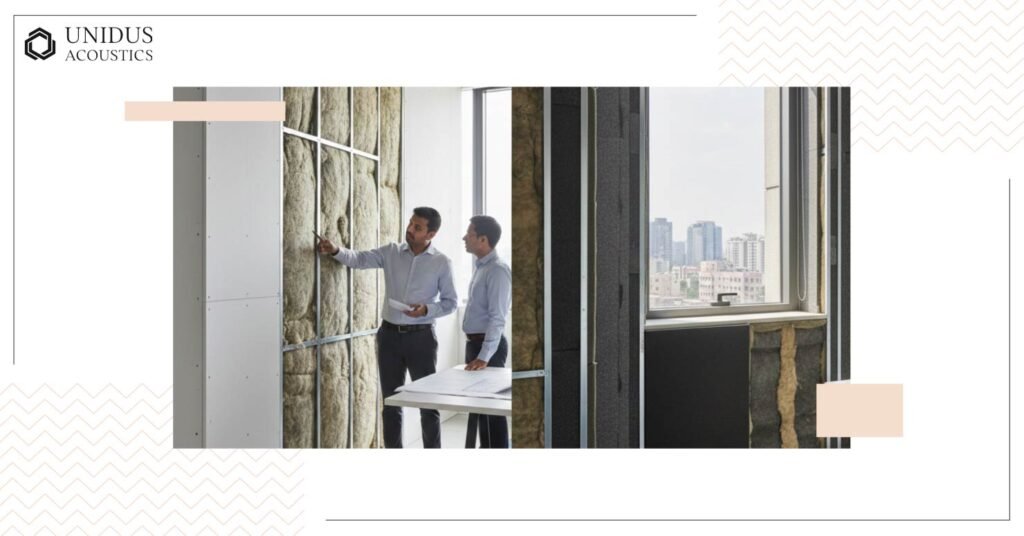
Generic acoustic calculations based on room dimensions alone are a starting point, not a conclusion. A well-run consultancy conducts actual site measurements, checking for existing noise sources, ambient sound levels, structural transmission paths, and any acoustic anomalies the drawings would not reveal.
Including at least one site visit in the consultancy process allows proper analysis and study. There are aspects of architectural acoustics hidden in a two-dimensional drawing that cannot be picked up without being physically present on site. If a consultant proposes to deliver an entire acoustic specification without a single site visit, that is worth probing.
4. Do They Coordinate with MEP Teams?

HVAC systems, ducting, and mechanical equipment are among the most common sources of unresolved acoustic problems in commercial buildings. On institutional projects, the acoustic consultant’s scope often extends to coordinating with MEP teams on duct noise, fan noise, and HVAC vibration, because these sources need to be addressed at the design stage rather than after the ceiling is closed. If MEP coordination is not in the scope, ask specifically how those noise sources will be managed.
Open-plan tech offices in Noida’s newer towers often run large centralised HVAC systems that feed into open ceiling plenum arrangements. If that describes your project, a consultant without experience managing those noise paths may leave you with a space that performs well acoustically on paper but is noticeably uncomfortable in practice.
5. Can They Produce Documentation Suitable for Tender Submissions?

For institutional clients and corporates running formal procurement processes, acoustic specifications need to be backed by verifiable documentation: NRC test certificates, fire rating data, and compliance references. Ask any prospective acoustic consultant in Noida whether they can support the product partner’s documentation at the level your client’s procurement process requires.
Third-party testing certifications from bodies like SGS, Intertek, or TÜV Rheinland carry weight in formal tender submissions and help avoid disputes during inspection or handover. A consultant who cannot name the testing basis for their product recommendations is either specifying without verification or working from vendor-supplied data that has not been independently checked.
6. What Is Their Approach to Programme Timelines

Acoustic products often end up selected under pressure or installed as a compromise. This usually happens because the acoustic consultant’s deliverables were not synchronised with the broader project programme, material approval timelines, lead times for custom finishes, and site availability all need to be factored in from the start.
The earlier an acoustic consultant is involved, the more options are available. Late entry often forces compromises: standard sizes instead of custom, available finishes instead of specified ones, and products selected to meet a deadline rather than a performance target. A consultant who positions themselves as a late-stage add-on is, by definition, working within constraints that could have been avoided.
7. How Do They Handle Post-Installation Testing
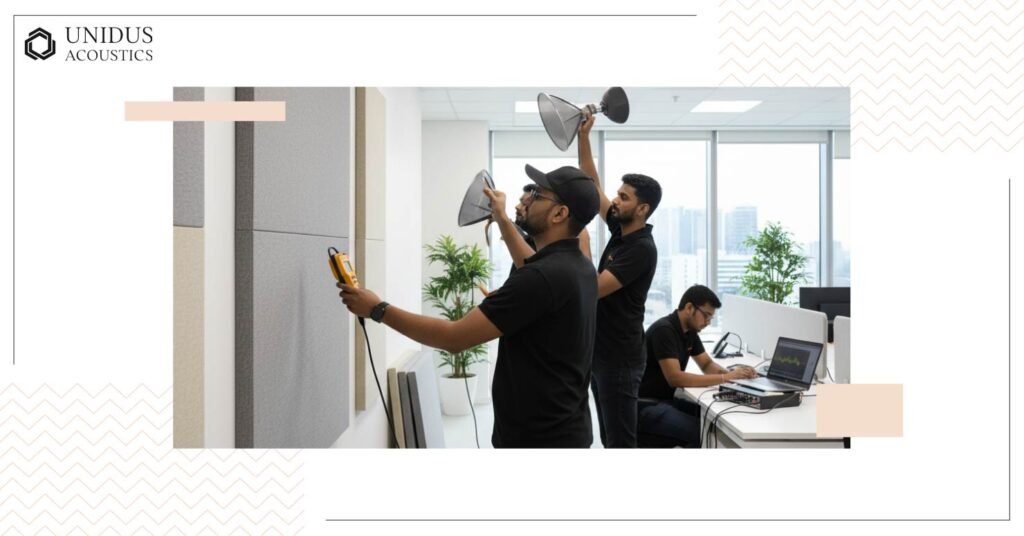
Specifying and installing acoustic treatment is the process. Verifying that the installed treatment achieves the targeted reverberation time and NRC performance is the outcome. Acoustic consultants may conduct testing to validate the effectiveness of the installed solutions, checking whether the final result meets the specified performance targets. Not all consultants include this as standard; confirm it before signing off on the scope.
A written report comparing measured performance against design targets is useful for institutional clients and corporates who need to demonstrate compliance to their facilities teams or end users. It is also useful for you as the architect of record, if a client raises acoustic performance concerns after handover, a post-installation report establishes a clear baseline.
Acoustic Consultancy and Custom Solutions for Projects in Noida
With 40 years of expertise in commercial acoustic solutions and consultancy, Unidus Acoustics works alongside architects and interior designers on projects across Noida, Delhi NCR, and 16 cities across India. Past projects include work for AIIMS, Ashoka University, Air India, TCS, Infosys, SBI, and Reliance, across commercial, institutional, and healthcare spaces. The product range covers acoustic wall panels, ceiling baffles and clouds, printed and custom-designed fabric panels, and UNIPOD acoustic pods and phone booths for open office environments. All products are customisable to match your design palette and programme requirements, and technical documentation (NRC test certificates from SGS, Intertek, and TÜV Rheinland, and fire compliance data) is part of the standard process.
We turn noise into harmony. Whether you need product recommendations that fit your design intent, NRC specifications for a tender submission, or custom acoustic solutions for a complex brief, we are ready to help you balance form and function.
If you’re working on a commercial or institutional project in Noida or the NCR region and need product specifications, NRC data for a tender brief, or custom acoustic solutions, contact our team directly.