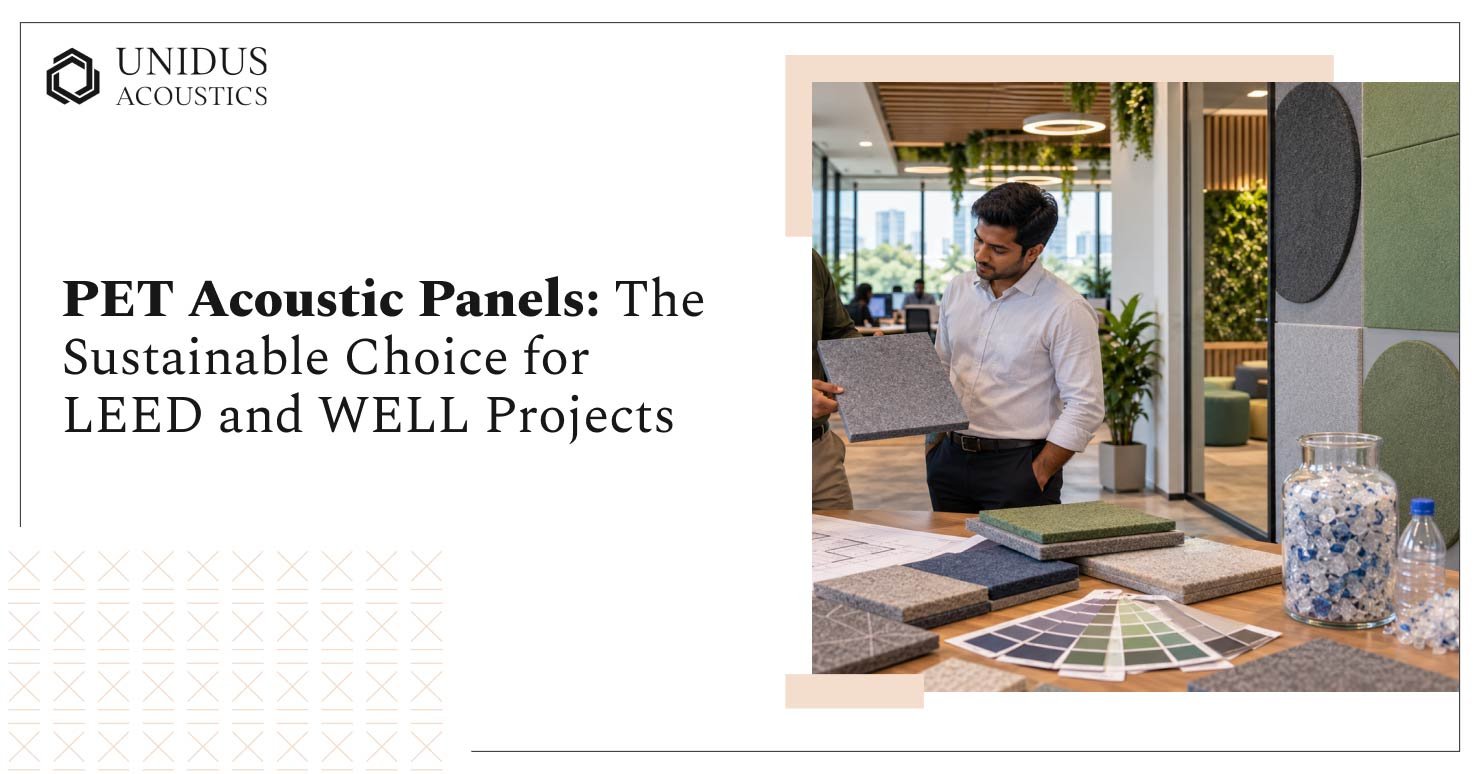
When a project is chasing LEED® or WELL® certification, every material on the specification sheet gets a second look, and acoustic treatment is no exception. PET acoustic panels, made from recycled polyester fibre, are increasingly the answer architects reach for when a wall or ceiling needs to absorb sound without adding a material the sustainability consultant will flag later. At Unidus Acoustics, this recycled-polyester range sits at the centre of the U-TONE panel line, and it’s worth understanding what makes it a sustainable acoustic panel choice rather than a marketed one.
Key Takeaways
- PET acoustic panels are built from recycled polyester fibre, which is what qualifies them as a sustainable acoustic panel option rather than a repainted version of a conventional product.
- The material carries NRC 0.70 to 0.90 and a Class B1 fire rating, so the sustainability story doesn’t come at the cost of sound absorption.
- On LEED and WELL projects, PET panels can support material-sourcing, indoor air quality, and acoustic comfort goals, though credit qualification still depends on project-specific documentation.
- Density (180 to 200 kg/m³) and thickness (9 to 24mm) flex by form, hether that’s a baffle, a ceiling cloud, a wall panel, or an open cell system.
- Disinfectability matters on WELL projects, where cleaning protocols are part of the scorecard, and these panels can be fogged, sprayed, or wiped clean.
What “Sustainable” Actually Means on a Certification Scorecard
LEED and WELL don’t reward a material for calling itself green. They reward specifics: what it’s made of, how much is recycled, what it emits into the air, and how it performs over the building’s life. A panel that’s vaguely “eco” but undocumented does nothing for a project’s scorecard. That’s the gap PET panels are built to close.
Where the Documentation Comes From
For any acoustic product to count toward a credit, the project team needs verifiable data, not a marketing line. What that means in practice: recycled content figures, current emissions test data for the product batch, and fire performance certification relevant to the building type, each documented for the project rather than assumed from a brochure.
What PET Acoustic Panels Are Made Of

The core material is recycled polyester fibre, compressed into a dense board and finished into the shape the space needs. Unidus manufactures this range as PET panel acoustic systems in several formats: vertical baffles, ceiling clouds, open cell systems, and wall panels in grooved, printed, inlay, or 3D textured finishes. Across the range, the specification holds fairly steady at NRC 0.70 to 0.90, density of 180 to 200 kg/m³, a Class B1 fire rating, and thickness between 9mm and 24mm depending on the form. Every panel can be wiped, sprayed, or fogged for cleaning, a detail that matters more on a WELL project than most people expect.
Where PET Panels Earn Their Place on LEED and WELL Projects
Material Sourcing and Recycled Content
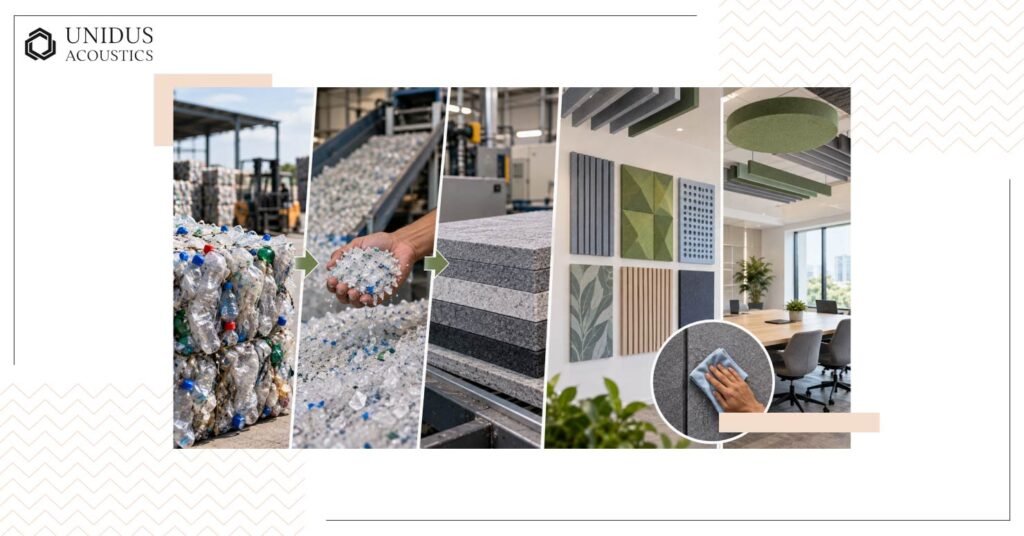
LEED’s materials credits reward recycled content and responsible sourcing. Recycled polyester fibre is diverted plastic that would otherwise sit in a landfill, which makes for a straightforward story to document, provided the manufacturer can produce the recycled-content figures the certifying body asks for.
Indoor Air Quality
WELL puts real weight on what a material releases into the air over its lifespan. Polyester fibre panels are low-emitting compared to several conventional acoustic substrates and don’t rely on binders that off-gas over time, so they tend to sit comfortably within low-VOC requirements. Project teams should still request current emissions data for the specific batch going into their building rather than rely on an old spec sheet.
Acoustic Comfort

Both LEED and WELL recognise sound as a comfort factor, not an afterthought, and this is where the panel has to perform. At NRC 0.70 to 0.90, this range covers the absorption performance most certified commercial projects are specifying for.
Acoustic Performance: No Trade-Off for Going Green
Going green with the material doesn’t mean giving up performance. NRC 0.70 to 0.90 is a strong absorption range for most commercial applications, and the Class B1 fire rating keeps these panels usable across the commercial interior types where LEED and WELL certification applies. Density in the 180 to 200 kg/m³ band is what gives the panel its structure without pushing installation weight or cost in an unreasonable direction.
Where Architects Are Specifying These Panels
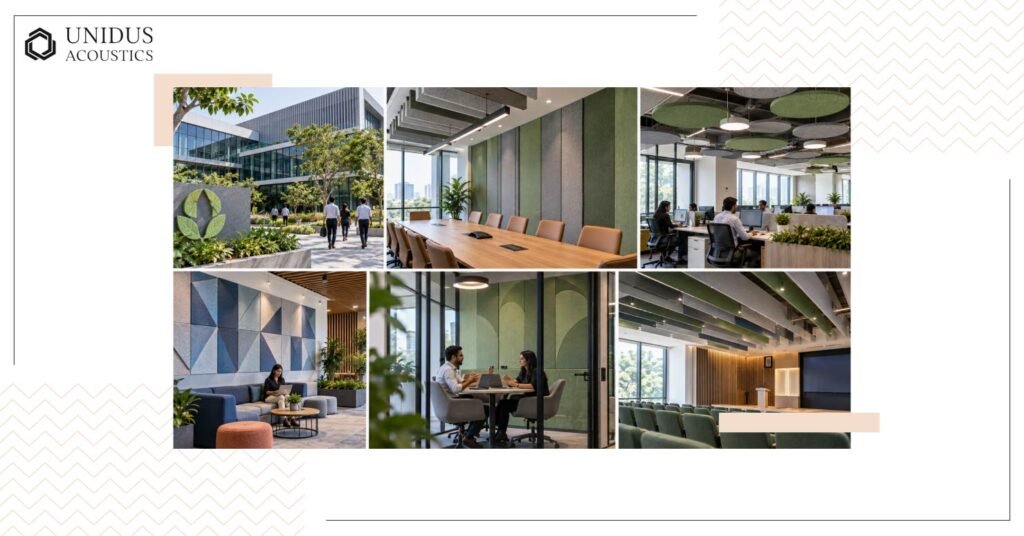
PET panels show up most often in spaces where sound and sustainability documentation matter at the same time: corporate campuses pursuing LEED, and meeting or conference rooms where WELL’s acoustic comfort requirements apply directly. The same logic that applies in AV-integrated boardrooms holds here: the acoustic requirement and the sustainability requirement aren’t competing; they’re both inputs into the same specification decision.
What to Check Before You Specify PET Panels for a Certified Project

A recycled material doesn’t automatically bank a credit. A few things worth confirming before the panel goes on the drawing:
- Recycled content percentage and supporting documentation vary by production run, so request the figures for the specific order rather than a generic spec sheet.
- LEED and WELL credit qualification depends on the certifying body’s current criteria and the project’s overall material strategy; no single product secures a credit on its own.
- Class B1 fire rating needs to be checked against the fire code requirements for the specific building type and jurisdiction, since these vary by project.
- For spaces that need sound isolation rather than absorption, PET panels address the absorption requirement only. Isolation depends on wall and partition construction; these are separate design decisions that need to be addressed independently.
None of this is a reason to avoid the material. It’s a reason to ask for documentation before the panel gets locked into a spec, which is good practice on any certified project.
Conclusion
PET acoustic panels earn their place on LEED and WELL projects for a reason that has nothing to do with marketing copy: recycled polyester fibre is a lower-impact material on paper as well as in practice, and it still delivers NRC 0.70 to 0.90 with a Class B1 fire rating across the range. The sustainability case and the acoustic case aren’t in tension here; they’re the same spec decision. Unidus Acoustics builds this range as the U-TONE panel line, in the baffle, cloud, wall panel, and open cell formats most commercial and certified projects need. We can provide recycled-content figures, current emissions data, and product specification sheets for your documentation. Get in touch with our team now.
Frequently Asked Questions
1. What are PET acoustic panels made of?
PET acoustic panels are made from recycled polyester fibre, compressed and finished into forms like baffles, wall panels, and ceiling clouds. It’s repurposed plastic fibre, not a virgin synthetic or mineral-based substrate.
2. Do PET acoustic panels help a project earn LEED credits?
They can contribute to material-sourcing and recycled-content credits, provided the figures and supporting documentation are available for the specific project. Credit qualification is decided by the certifying body against the project’s full material strategy, not by any single product.
3. How do PET panels support the WELL Building Standard?
WELL evaluates both acoustic comfort and material emissions. PET panels offer NRC 0.70 to 0.90 for sound absorption, are low-emitting compared to several conventional substrates, and can be fogged, sprayed, or wiped clean, which fits WELL’s cleaning protocol requirements too.
4. What NRC rating do PET acoustic panels typically offer?
Across the Unidus U-TONE range, PET acoustic panels carry an NRC of 0.70 to 0.90, depending on thickness and the specific form.
5. Are PET acoustic panels fire-safe for commercial interiors?
The range carries a Class B1 fire rating. Project teams should confirm this against the fire code requirements for their specific building type and jurisdiction before finalising the specification.