Last Updated on September 7, 2026 by unidus
Ask most design teams what a green building certification checks for on acoustics, and the answer is usually vague: something about “acoustic comfort” or “noise control.” That vagueness is where submissions run into trouble. IGBC, and rating systems Indian projects increasingly pursue alongside it, like LEED, don’t ask a project to intend a quiet space. They ask for numbers: a noise criterion rating, a reverberation time calculation, and sometimes a full room-by-room acoustic survey signed off by someone qualified to produce it. Skip that documentation early, and acoustics becomes a scramble in the final weeks before submission. At Unidus Acoustics, we see this pattern most often on projects that treat acoustic performance as a finishing touch rather than a technical deliverable.
Key Takeaways
- IGBC and most Indian green rating systems treat acoustic performance as documentation, not intention. A “quiet” design needs a number behind it before an assessor accepts it.
- Assessors check acoustic performance through a handful of measurable factors: Noise Criterion (NC), reverberation time, and, in some rating systems, occupant satisfaction data.
- A false ceiling with acoustic tiles doesn’t automatically meet a reverberation time target. Room volume, hard surfaces, and furniture density all factor in.
- LEED and IGBC both score acoustic performance, but through different reference standards, so a submission built for one doesn’t always transfer cleanly to the other.
- Acoustic performance documentation tends to surface late in the certification checklist, which is why it’s worth locking in early, even when the credit looks minor on paper.
What “Acoustic Performance” Actually Means to a Certification
In a green building rating system, acoustic performance is a measured outcome, not a design goal. It generally covers three things. How much background noise a mechanical system adds to an occupied room (the Noise Criterion, or NC, rating). How long sound lingers after it’s produced (reverberation time). And, in select systems, how satisfied occupants are once the building is in use. A boardroom that seems quiet during a walk-through means nothing to an assessor without a figure attached to it.
Where Acoustics Shows Up Across IGBC and Other Rating Systems
IGBC runs more than one rating system, and acoustics doesn’t sit in the same place across all of them. IGBC Green Interiors, aimed at fit-outs, folds acoustic comfort into the mandatory requirements a project must clear before any credits count. The IGBC Health and Well-being rating goes further. It asks for a full acoustical survey covering Noise Isolation Class, Noise Criterion, and reverberation time across occupied spaces. Projects also need evidence that a defined share of occupants report being comfortable with the result. LEED, which a growing number of Indian commercial projects pursue alongside or instead of IGBC, folds similar concerns (background noise, sound insulation, reverberation time) into its Indoor Environmental Quality category, though credit weighting and reference standards shift between LEED versions.
The Survey Report Most Teams Underestimate
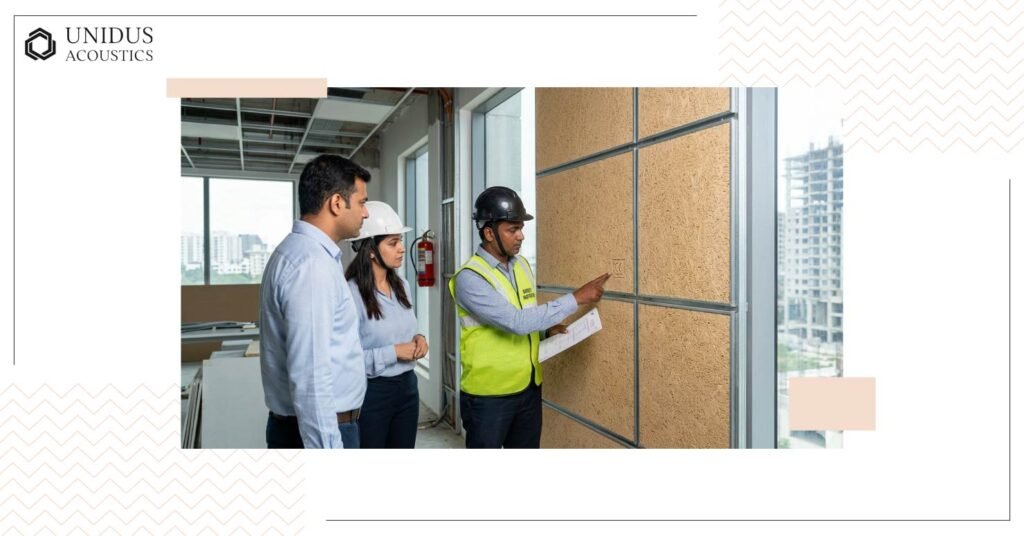
The acoustical survey report is where most delays happen. It isn’t a checkbox exercise. Someone has to measure or calculate sound pressure levels across frequency bands, plot them against the correct NC curve, and repeat the process for every distinct room type, not one sample office. A corporate interior with meeting rooms, open desking, a cafeteria, and a boardroom needs four or five separate acoustic profiles, each with its own treatment plan and paperwork.
Why Occupant Satisfaction Complicates the Picture
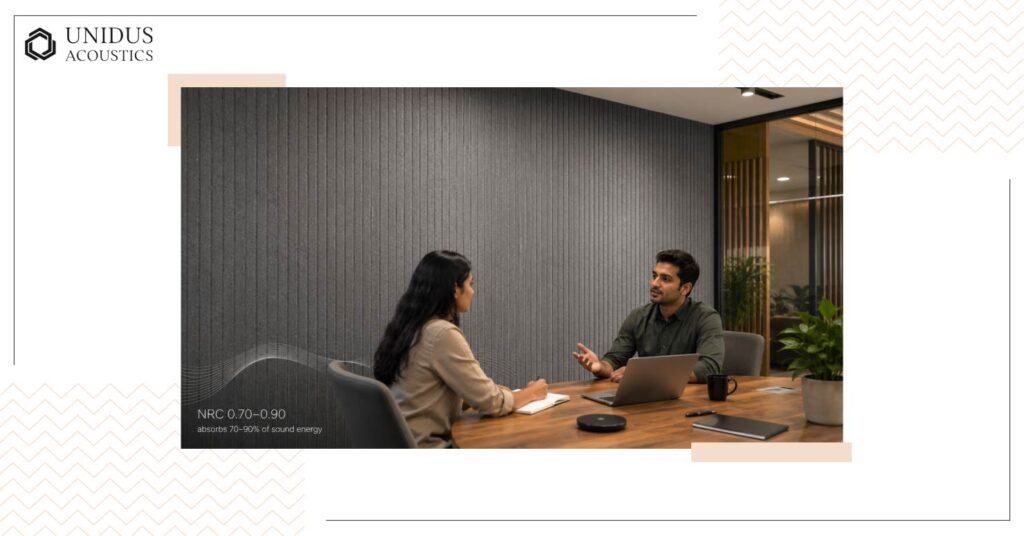
Rating systems that ask for post-occupancy satisfaction data, which some of IGBC’s Health and Well-being credits do, put the design team in an unusual spot: scored on how the building performs after handover, not only on how it was specified. A ceiling system rated correctly on paper can still fail this test. That happens when it’s value-engineered down mid-construction, or when the acoustic tiles on the drawing get substituted for a similar-looking product on site. Supply chain substitutions happen more often than anyone would like, and they rarely get caught before the satisfaction survey goes out.
IGBC vs. LEED: How the Acoustic Ask Differs
| IGBC (Health & Well-being / Green Interiors) | LEED (Indoor Environmental Quality) | |
|---|---|---|
| Reference basis | IGBC-defined criteria, adapted to the Indian context | ASHRAE HVAC Applications Handbook, AHRI 885 |
| What gets measured | NIC, NC, reverberation time, occupant satisfaction (select credits) | Background noise (dBA), sound insulation, reverberation time |
| Requirement type | Mixed: some mandatory, some credit-based | Credit-based; weighting varies by LEED version |
| Documentation needed | Acoustical survey report, satisfaction data where applicable | Calculations, field measurements, credit narrative |
| Common office benchmark | Assessed against IGBC’s internal comfort criteria | NC 35 – 40 is common industry practice for offices, though LEED doesn’t fix this figure directly |
The Documentation Gaps That Actually Cost Points

Most acoustic shortfalls in certification submissions aren’t design failures. They’re timing problems. Acoustic requirements tend to surface late in a project’s documentation checklist, often after ceiling grids, partition layouts, and furniture plans are already locked in. By the time someone asks for the NC calculation, the room geometry that would have made hitting the target easy isn’t up for discussion anymore. A few patterns repeat across Indian commercial projects:
- Reverberation time calculated for the room’s shell, then never recalculated once furniture and partial-height partitions went in.
- Acoustic ceiling tiles specified with an NRC figure that was never checked against a certified test report.
- No documented survey for secondary spaces like corridors and pantries, which some rating systems still expect.
- HVAC noise assessed at design stage but never remeasured after equipment got substituted during procurement.
- Occupant satisfaction data collected too late in the process to fix anything before the final review.
Specifying for the Certification, Not Just the Brief
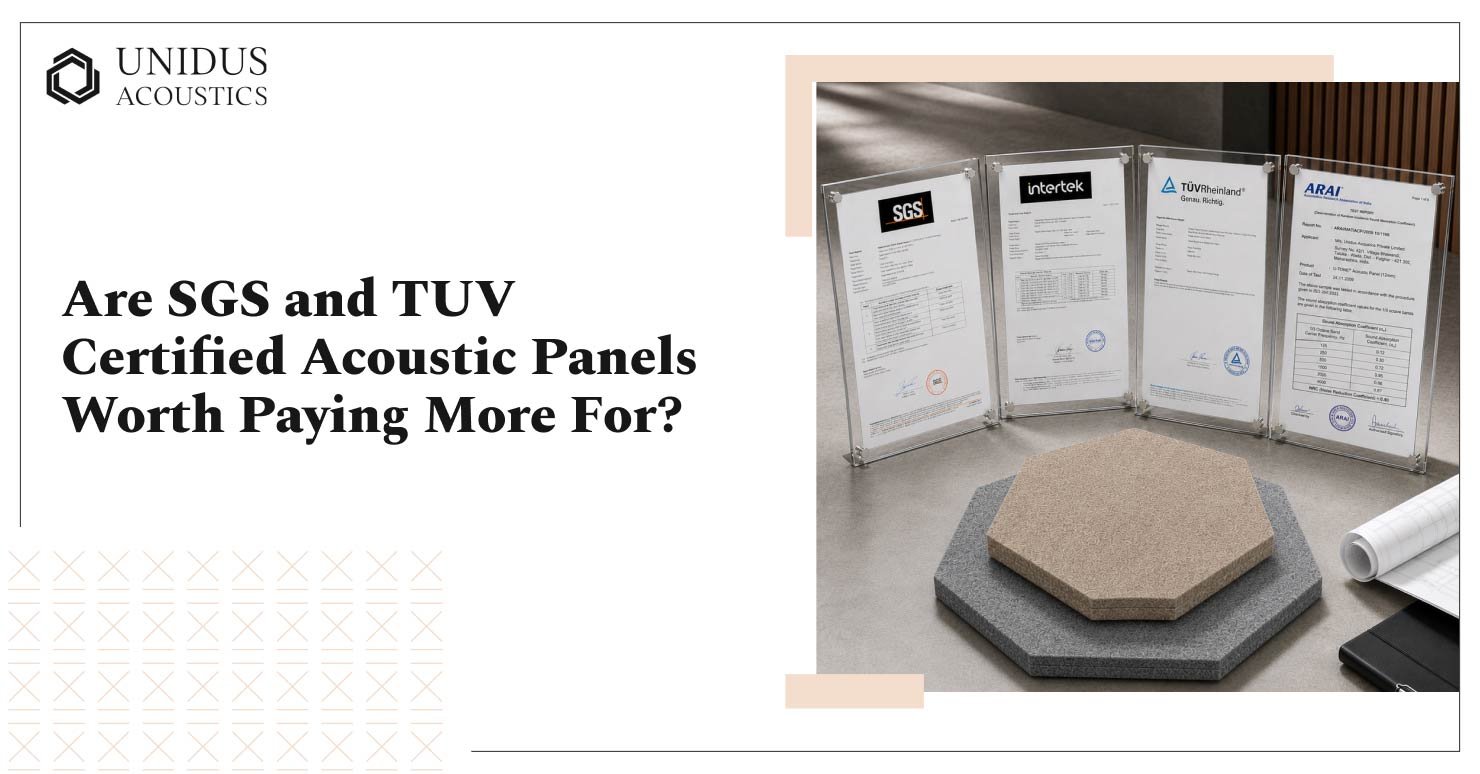
A green rating system doesn’t care what a product is called. It cares whether the tested performance behind it holds up under review. That’s the case for choosing acoustic panels, ceiling baffles, and wall systems backed by third-party test reports (SGS, Intertek, or TÜV Rheinland) rather than a supplier’s own numbers. At Unidus Acoustics, we build product documentation with certification submissions in mind, since a project team shouldn’t chase test data after the fact when a deadline is close. Several of these products also carry recycled content, which can support material credits running alongside the acoustic one.
Frequently Asked Questions
1. Is acoustic performance a mandatory requirement in IGBC certification, or just a credit?
It depends on the specific rating system. Under IGBC Green Interiors, acoustic comfort sits within the mandatory requirements a project must clear before credits count at all. Under other systems, it may sit purely as a scored credit, so check the requirement for the exact system in play.
2. What is a Noise Criterion (NC) rating, and why does it matter for certification?
NC measures how much background noise, mostly from HVAC equipment, sits in an occupied space. Assessors compare measured levels across frequency bands against standard NC curves. Most commercial offices target roughly NC 35 to 40, though the exact figure a certification expects depends on the system and room type.
3. Can standard false ceiling tiles meet a reverberation time requirement on their own?
Not automatically. Reverberation time depends on room volume, total surface area, and how much of that surface absorbs sound rather than reflecting it. A ceiling tile with a strong NRC rating helps, but hard flooring, glass partitions, and furniture density can still push a room past its target even with good ceiling treatment.
4. Do IGBC or LEED submissions require an acoustic consultant?
Neither names one as a formal requirement, but the underlying documentation, measured sound levels, reverberation calculations, and survey reports, generally needs to come from someone qualified to produce it. Most teams bring one in for exactly this reason.
5. What documentation do assessors usually ask for on acoustics?
At minimum, calculations or measurements for reverberation time and background noise, room by room. Some systems, including IGBC’s Health and Well-being rating, also ask for occupant satisfaction data collected once the space is in use.
6. Does LEED ask for the same acoustic requirements as IGBC?
The underlying concerns overlap (background noise, sound insulation, reverberation time), but the reference standards differ. LEED leans on ASHRAE and AHRI standards; IGBC applies its own criteria, adapted to the Indian context. A submission built for one doesn’t transfer directly to the other without rechecking the numbers.
The Bottom Line
Acoustic performance in a green building certification isn’t a design sentiment. It’s a set of numbers someone has to measure and document, then defend at review. Projects that handle this well treat the acoustic submission like any other technical deliverable: planned early, assigned to someone qualified, backed by test data that holds up on its own.
Unidus Acoustics works with architects and design teams on the acoustic panels, ceiling systems, and wall treatments that go into these submissions, backed by SGS, Intertek, and TÜV Rheinland test reports. For product specifications or documentation support on a certification-linked project, reach out to us.