Bangalore’s IT corridors have quietly set a benchmark for commercial acoustic design in India. Step into a well-spec’d office at Embassy Tech Village, Manyata Tech Park, or the Whitefield clusters and you’ll notice it – or rather, you won’t notice it. Conversations don’t bleed between floors. Conference rooms don’t echo. The noise floor sits at a level where people can actually think.
The architects and project management consultants behind those projects didn’t get there by accident. They worked with acoustic solutions providers who understood what that standard actually requires. This article is for anyone specifying acoustic consultants in Bangalore – what to look for, what questions to ask, and what separates a basic acoustic fix from a well-treated space.
Key Takeaways
- Untreated open-plan IT offices in Bangalore typically show reverberation times of 1.2–1.5 seconds. The target for a comfortable working environment is 0.6–0.8 seconds.
- An acoustic consultant’s scope spans site assessment, RT60 measurement, Noise Reduction Coefficient (NRC) specification, and tender documentation.
- Ask for the full third-party test report from SGS, Intertek, or TÜV Rheinland, not just a certificate number. The report shows per-frequency NRC performance and fire classification.
- Glass-fronted conference rooms and open-plan floors have different acoustic problems and need different treatment approaches.
- Acoustic pods address call privacy directly. No amount of ceiling treatment replicates what a fully enclosed booth provides.
Why Bangalore’s IT Parks Need Acoustic Treatment
The reasons are structural. Most IT park buildings weren’t designed with acoustics as a priority, and the interiors most tenants prefer make the problem considerably worse.
When Open-Plan Meets Glass
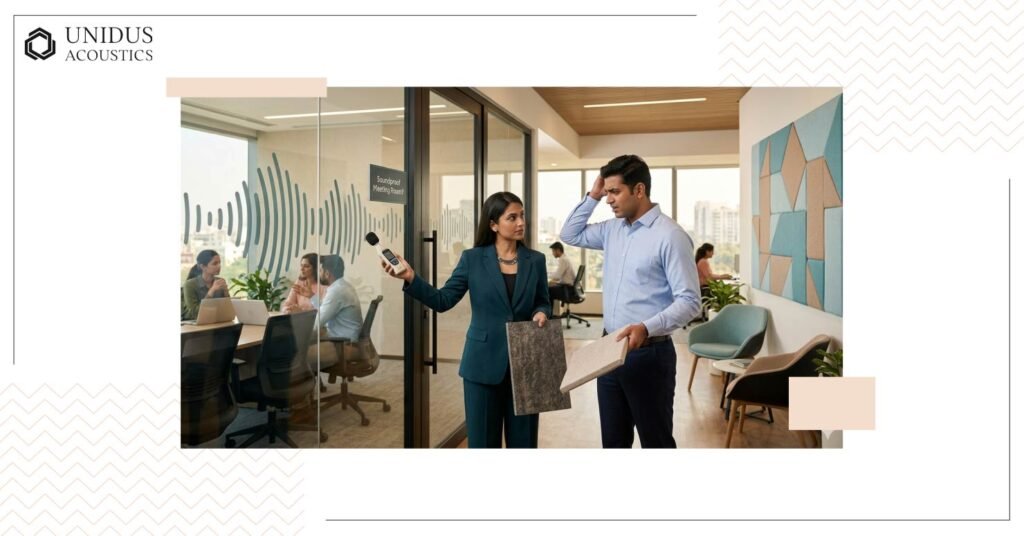
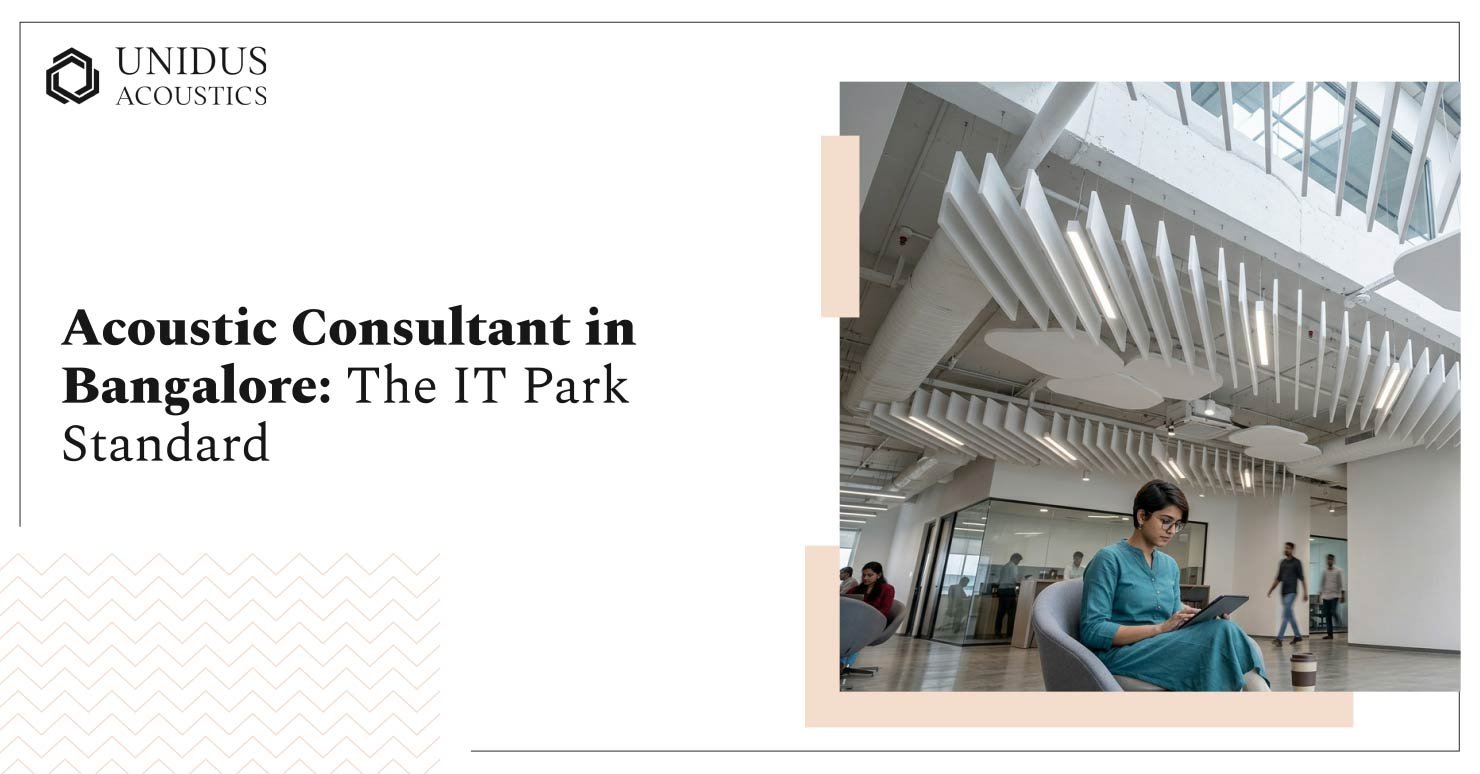
The standard IT park interior is predictable: glass partitions, polished concrete floors, exposed RCC slab ceilings, collaborative zones with minimal dividers. Visually clean, cost-efficient to build, and acoustically a hard reflective box. Reverberation times in untreated open-plan offices routinely exceed 1.2–1.5 seconds; the target for a comfortable working environment is 0.6–0.8 seconds.
Glass partitions compound the problem. They look like separation, but they’re not acoustic separation. Conversations inside a glass-walled meeting room are fully audible in the adjacent open plan. That’s a design decision made well before the acoustic brief is discussed, and undoing it at fit-out stage is expensive.
The Productivity Cost of Untreated Noise

A study by Oxford Economics found only 1% of employees could concentrate at their desk without extra effort. For teams writing code, reviewing system architecture, or on client calls, poor acoustics shows up in error rates and output quality. The business case for acoustic treatment isn’t comfort. It’s performance.
What an Acoustic Consultant in Bangalore Delivers
The scope depends on the project stage. For a new fit-out, the acoustic work happens at specification. For an existing office, it starts with a site diagnosis.
Site Assessment and Acoustic Diagnosis
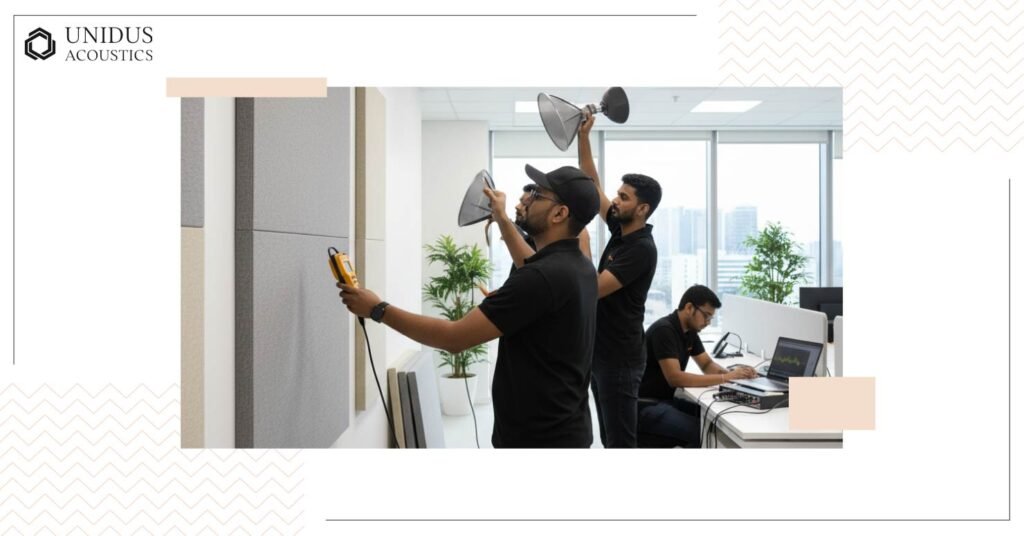
A proper assessment measures the existing reverberation time (RT60), maps the noise sources (HVAC, traffic, internal conversation density), and benchmarks against the target for each space type. For IT park open-plan areas, the standard target is 0.6–0.8 seconds RT60; for conference rooms and call rooms, 0.4–0.6 seconds. That target drives every product decision that follows.
For new fit-outs, this work happens before construction begins. Changing a Noise Reduction Coefficient (NRC) requirement at specification costs nothing. Retrofitting acoustic treatment after handover costs considerably more, so getting the brief right at the design stage matters.
Product Specification and Documentation
The assessment feeds into a product specification with confirmed NRC ratings, backed by third-party test certificates. For projects going through a formal tender process, which is standard for large IT park fit-outs, certification from SGS, Intertek, or TÜV Rheinland is typically a mandatory submission document.
Anyone can quote an NRC figure. Far fewer suppliers can produce the test report showing the specific assembly tested, per-frequency band performance, and fire rating result. Ask for the full report, not just the certificate number.
How to Evaluate an Acoustic Consultant in Bangalore
The category spans independent consultants, local contractors, and full-service acoustic solutions manufacturers. Here’s what to look for.
Product Range and Customisation Capability
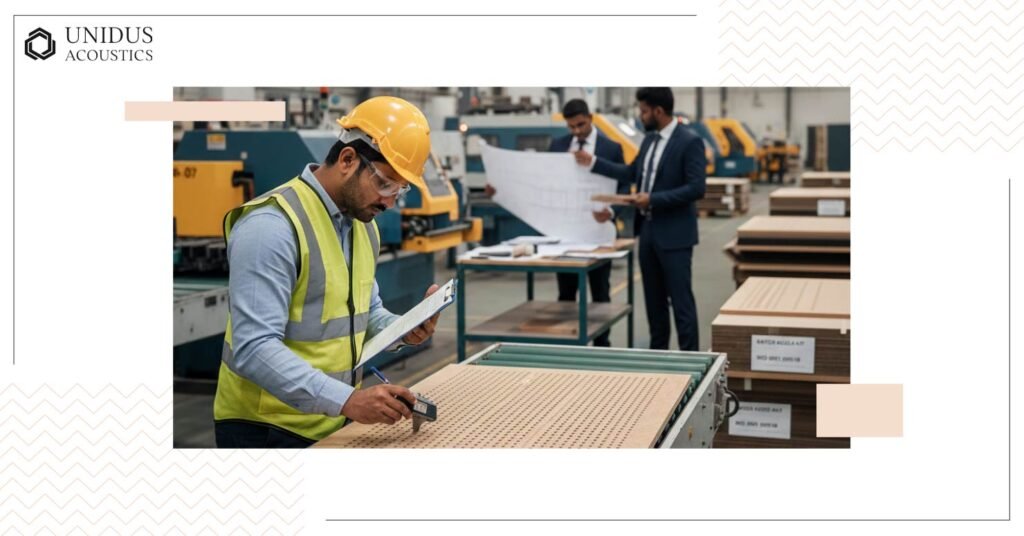
IT park fit-outs are rarely standard. A cluster of glass-walled meeting rooms needs different treatment from an open-plan floor, and a large all-hands space is a different problem again. A provider with a limited product range will tend to specify what they have rather than what each space actually requires. Look for a supplier who can offer wall panels, ceiling systems, acoustic pods, and custom-fabricated elements from their own manufacturing base.
Third-Party Test Certifications
Ask to see the actual test report from SGS, Intertek, or TÜV Rheinland, not just a certificate number. The report shows exactly what assembly was tested, the NRC at each frequency band, and the fire classification result. For projects requiring a Class B1 fire rating, this documentation is part of the specification, not an optional add-on.
Track Record in Comparable Commercial Projects
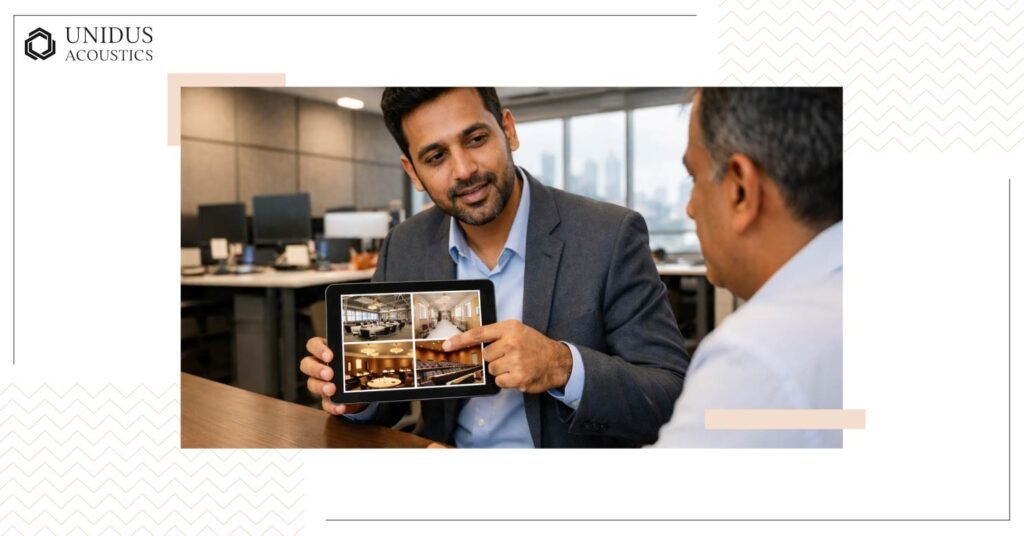
The acoustic challenges of a Bangalore IT park are different from a home theatre or a school assembly hall. Ask for completed projects in the same category before finalising who you work with.
Common Acoustic Problems in IT Park Offices and How to Fix Them
These problems tend to cluster around the same scenarios across most Bangalore IT park fit-outs.
Reverberation in Open-Plan Areas
The most common complaint is that the office is too loud, not because of any single noise source but because sound lingers. Someone speaking two workstations away is clearly intelligible three rows over. The fix is absorptive surface area on the ceiling and, where possible, on the walls. Acoustic ceiling panels or baffles address the largest surface area per installation; wall panels in collaborative and breakout zones add absorption without requiring structural intervention. This combination typically brings RT60 into the 0.6–0.8 second range. For a detailed look at how this plays out across different floor types, see our guide on reducing echo and improving speech privacy in open-plan offices.
Conference Room Echo and Speech Intelligibility
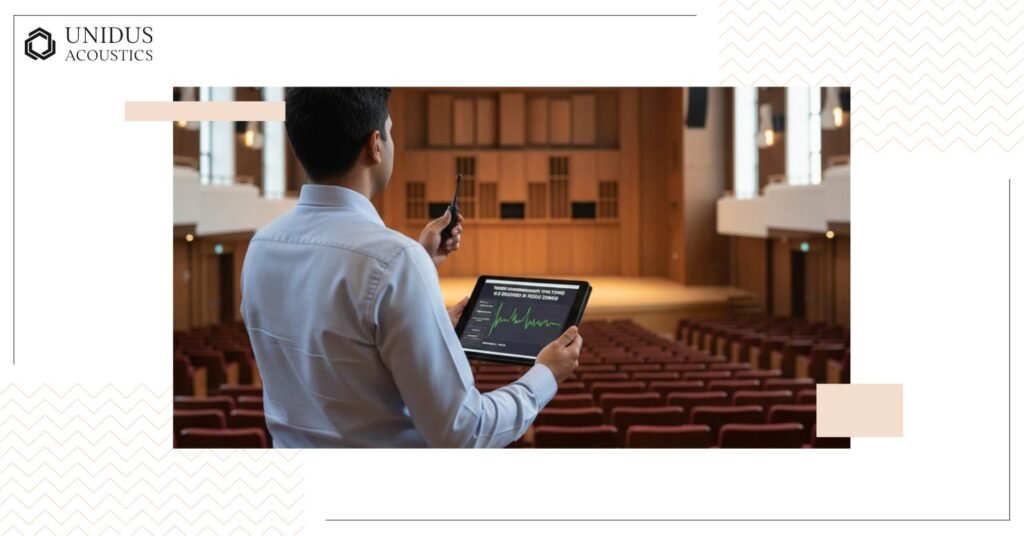
A glass-walled conference room with a hard ceiling is an echo chamber. Fixing this requires absorptive treatment on at least two surfaces, typically the ceiling and the rear wall behind the camera position. Panels with NRC 0.70–0.90 on the rear wall and acoustic false ceiling treatment above the meeting table will usually bring the room to the 0.4–0.6 second target.
Speech Privacy Between Workstations
Open-plan offices have a privacy problem as well as a noise problem. Someone on a call at one desk is clearly intelligible two rows over, not as background noise but as fully audible speech. The two-part fix: reduce overall reverberation with ceiling and wall treatment, and provide acoustic pods or focus booths for high-sensitivity calls. Acoustic screens between workstations help, but they don’t address the ceiling reflection path on their own.
Acoustic Products Specified in Bangalore IT Park Fit-Outs
Most Bangalore IT park specifications draw from the same core product categories. At Unidus Acoustics, these span wall panels, ceiling systems, perforated metal, and acoustic pods, though the exact assembly varies by space type, services layout, and aesthetic brief.
Acoustic Wall and Ceiling Panels
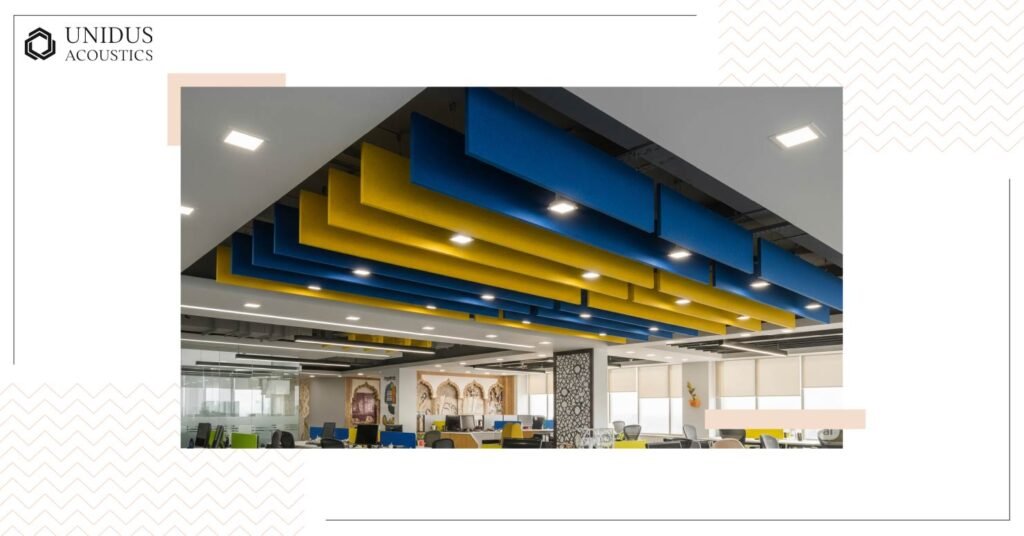
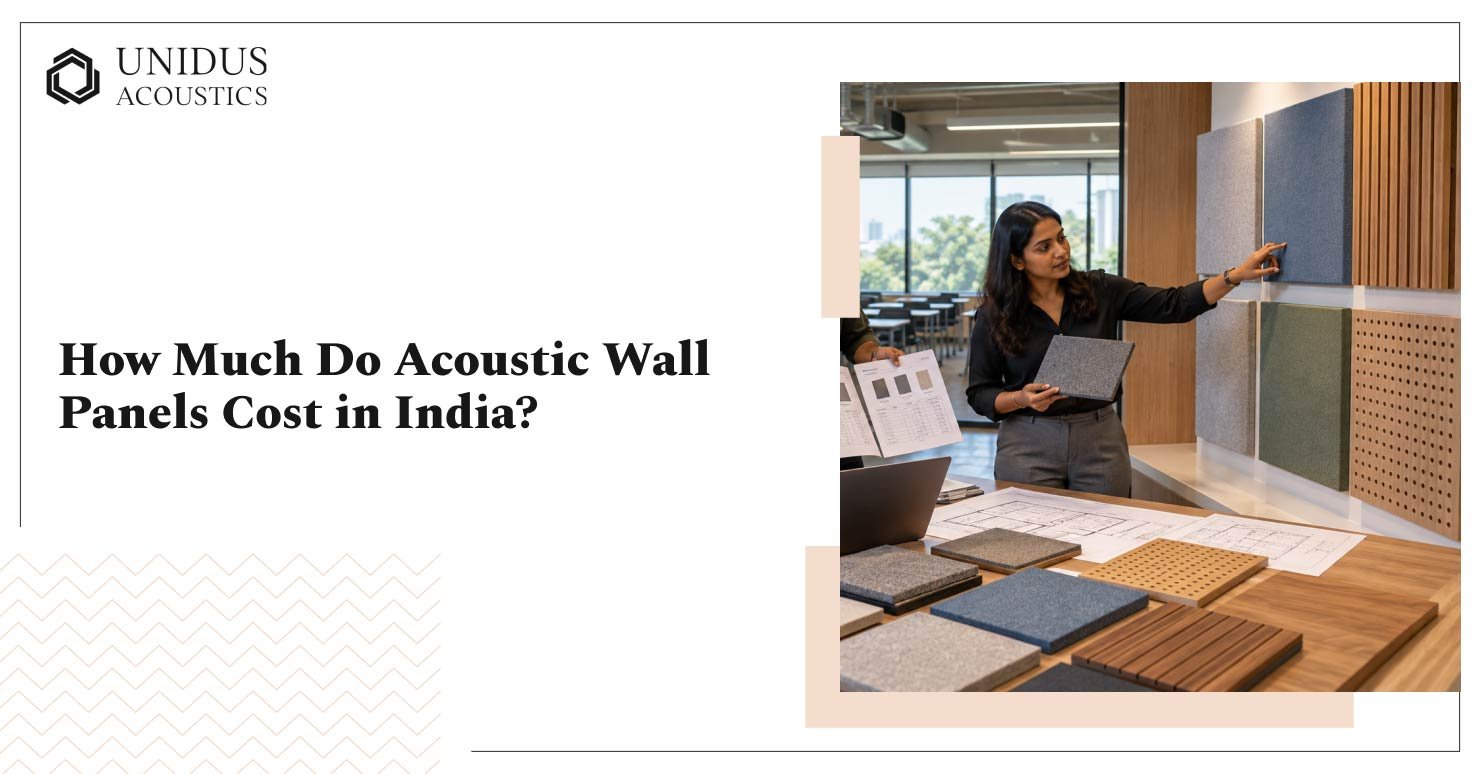
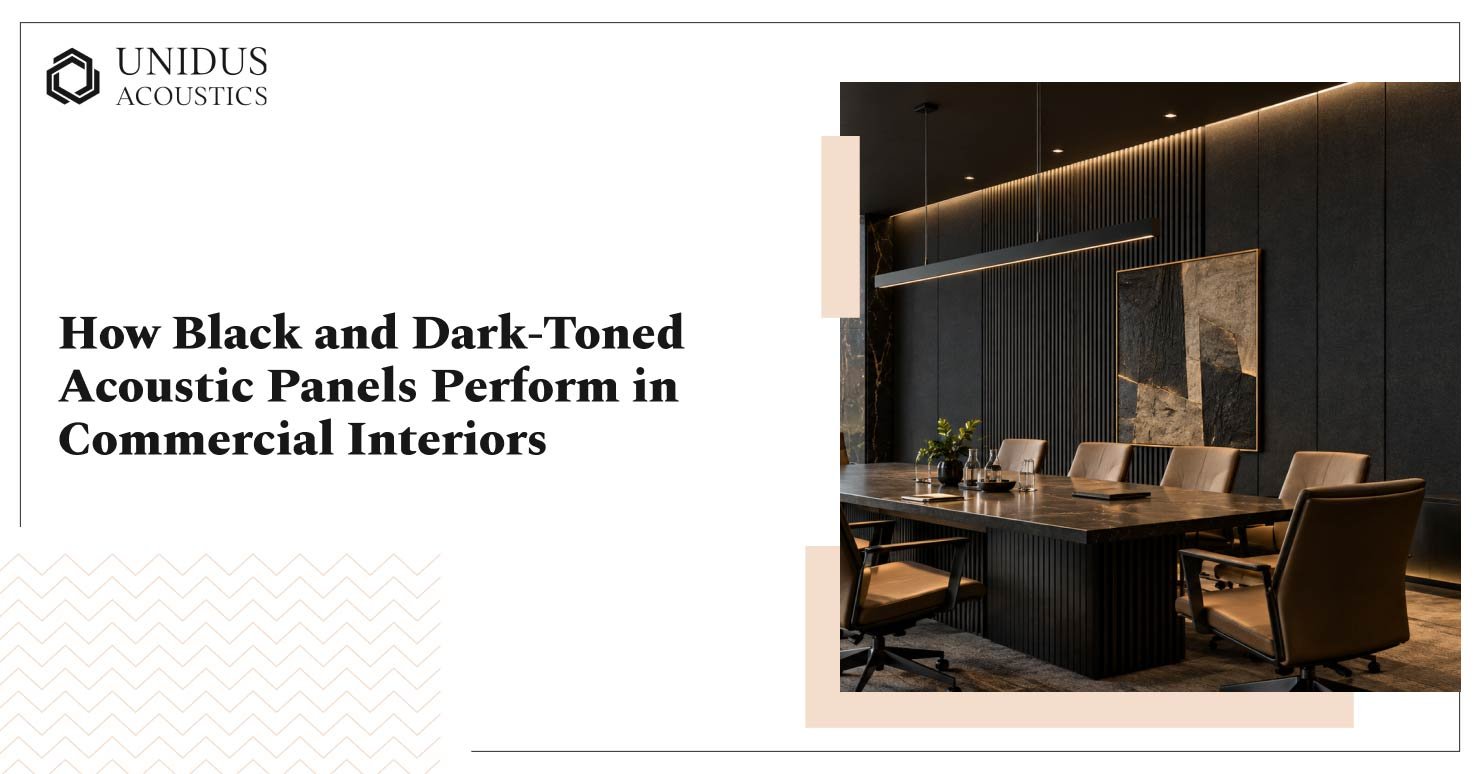
U-TONE acoustic panels (NRC 0.70–0.90, Class B1 fire rated, recycled polyester core, available in 64+ shades) are the core specification item for both wall and ceiling treatment in IT park fit-outs. For ceiling applications, options include direct-fix panels, suspended baffles, and acoustic clouds depending on ceiling height and services layout. For projects targeting LEED or green building compliance, the recycled polyester core is worth noting in the specification.
Perforated Metal Ceiling Systems
UNISTEEL Metal Ceiling is specified in open-plan IT offices where the industrial aesthetic is intentional and the ceiling needs to accommodate a complex MEP layout. When backed with appropriate acoustic insulation, UNISTEEL delivers NRC performance suited to standard open-plan environments. The key advantage over soft panel systems is the ability to route services through the ceiling without cutting around panel modules. For a full breakdown of how perforated metal performs in office renovations, including sizing options and custom finishes, see the linked guide.
Acoustic Pods and Focus Booths
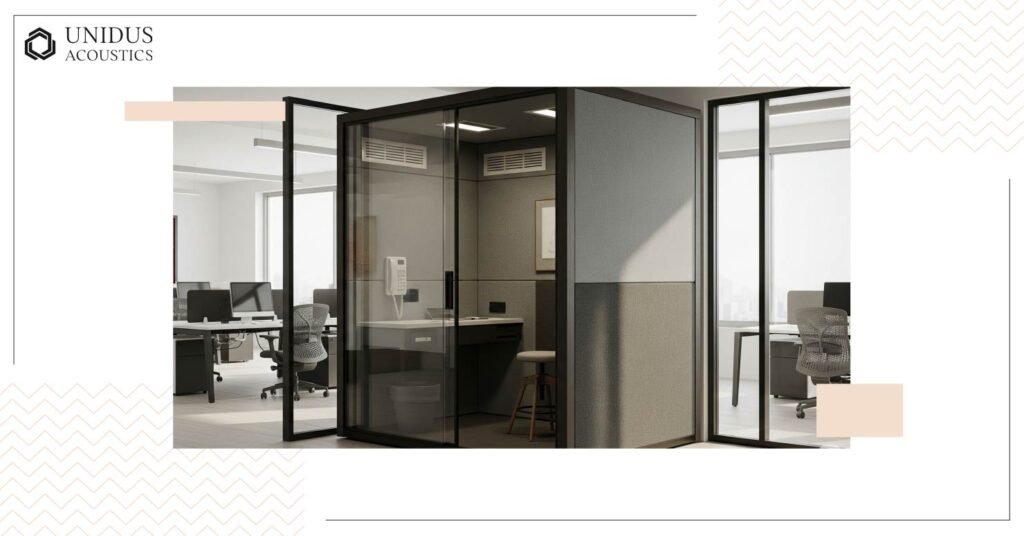
UNIPOD AS1 is a single-person call booth that removes the caller from the open plan entirely. UNIPOD AL1, the Meetup Zone Pod, accommodates 4–6 occupants for small-group meetings that would otherwise disrupt the surrounding floor. Both are increasingly specified as standard fit-out items in Bangalore’s corporate IT parks, where hybrid meeting quality has become a tenant requirement as much as an acoustic one.
Frequently Asked Questions
Do you need an independent acoustic consultant in Bangalore before specifying products?
For large or acoustically complex projects, an independent consultant to design the acoustic strategy first is worthwhile. For most IT park fit-outs covering open-plan floors, standard meeting rooms, and acoustic pods, an experienced acoustic solutions provider can guide the specification directly without a separate consultant engagement.
What is the typical lead time for supply to a Bangalore project?
Standard products are generally available from stock. Custom dimensions, colours, or fabricated elements may require 4–6 weeks. The team can confirm specific lead times once your project brief is clear.
What NRC rating should I specify for different space types in an IT park?
Open-plan floors typically work well with NRC 0.70–0.80. Conference rooms and call booths need higher absorption, NRC 0.80–0.90, particularly on the rear wall and ceiling. For projects targeting LEED points or NBC India 2016 compliance, per-frequency NRC data from a third-party test report is more useful than a single headline figure.
Conclusion
Unidus Acoustics works with architects, interior designers, and project management consultants on commercial fit-outs across India, including Bangalore’s IT corridor. With 40+ years of expertise and 635+ completed projects, clients include TCS, Infosys, SBI, Air India, and AIIMS. All products are tested by SGS, TÜV Rheinland, and Intertek, with NRC documentation and fire certificates ready for tender files.
To discuss a Bangalore project or download our product catalogue, contact us now.