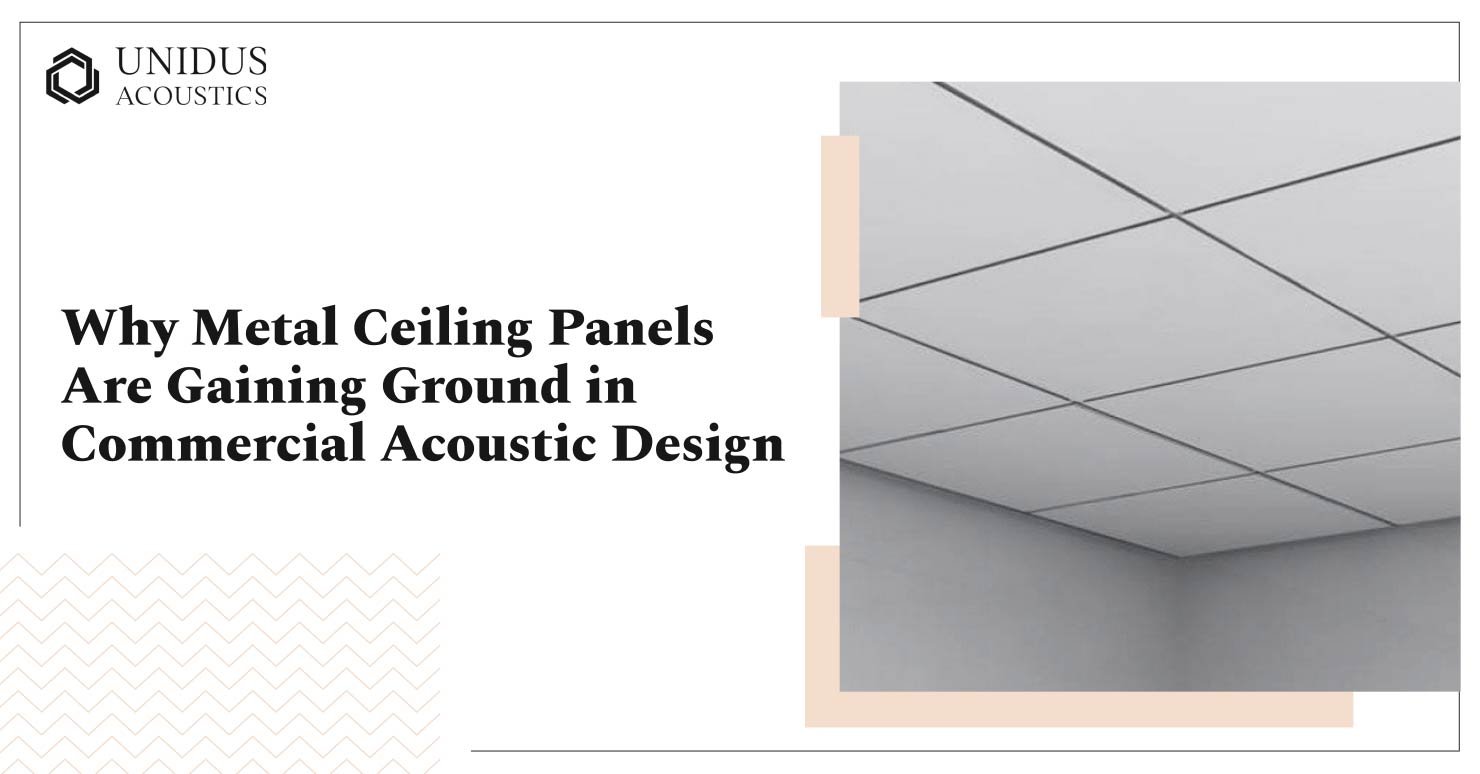
Commercial interiors have always had a complicated relationship with metal ceilings. For much of the last century, metal overhead read as industrial. Think warehouse roofing, factory sheds, the underside of a railway platform. The assumption followed naturally: hard materials make poor acoustic choices.
For unperforated metal over hard floors and bare walls, that assumption holds. But perforated metal ceiling panels, backed and installed correctly, are a different product in a different performance category.
Key Takeaways
- Perforated metal isn’t a reflective surface in the acoustic sense. The perforations let sound pass into an absorptive backing, so the backing spec matters as much as the panel.
- With the right backing (acoustic fleece, mineral wool, or glass wool), perforated metal reaches NRC values that compete with mineral fibre tiles and some fabric-wrapped panels.
- Metal wins on lifecycle cost, not upfront price. It survives maintenance access, cleans without degrading, and holds its finish across a 10 to 15-year fit-out.
- Open area drives the acoustics. Low open-area panels (3 to 6%) need a correctly specified backing, or they behave like a solid surface.
- Metal is the wrong call when the brief demands NRC above 0.85 across broad frequencies, or in very tall spaces where ceiling-level absorption alone won’t carry the room.
The Hard Surface Myth in Acoustic Design
The assumption that metal is acoustically bad runs into problems the moment you examine the physics. Hard surfaces reflect sound. That’s the problem with a painted concrete ceiling or a solid steel soffit. But perforation changes the equation.
Where the Assumption Breaks Down
A perforated metal ceiling panel is not a hard, reflective surface in the acoustic sense. The perforations act as apertures, allowing sound waves to pass through the metal face and into an absorptive backing layer. The metal skin becomes a filter rather than a reflector. How much sound passes through depends on the open area percentage of the perforation pattern and how well the backing system behind it is specified.
With appropriate backing (acoustic fleece at minimum, mineral wool or glass wool where you need more), perforated metal ceiling panels reach NRC ratings of 0.65 to 0.85. That range is comparable to standard mineral fibre ceiling tiles and, in properly assembled systems, overlaps with fabric-wrapped panels that are often assumed to perform better simply because they feel soft.
Why Architects Are Specifying Metal Ceiling Panels More Often
Metal ceiling panels have grown in specification frequency, not because acoustic performance alone made the case, but because the overall value proposition stacks up well when evaluated across a full project lifecycle rather than just the upfront cost of materials.
Durability and Long-Term Cost
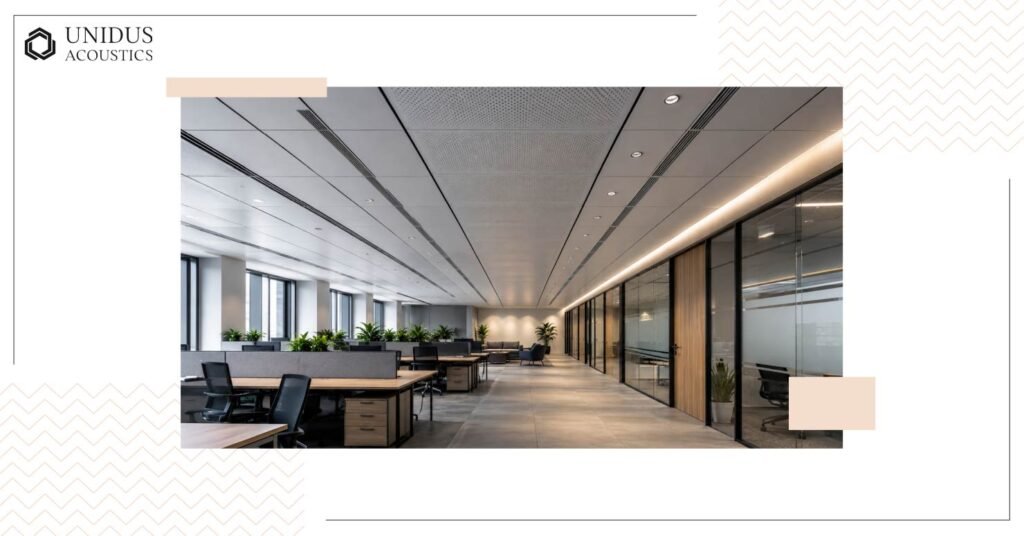
Mineral fibre ceiling tiles, the traditional workhorse of commercial acoustic ceilings, are fragile. They crack under maintenance access and yellow over time, and in humid or variable climates, they hold moisture. Metal panels do not have any of these failure modes. They take repeated maintenance access without structural damage and clean without degrading, holding their appearance for years.
In a commercial fit-out with a 10 to 15-year interior lifecycle, metal ceiling panels frequently cost less on a per-year-of-service basis even when the upfront specification cost is higher than fibrous alternatives. This is a calculation that project lifecycle accountants and facilities managers recognise immediately, even if it does not always appear in the initial specification justification.
Integration with MEP and Building Services
Coordinating lighting fixtures, sprinkler heads, HVAC diffusers, and cable trays through a ceiling system is one of the most time-intensive tasks in commercial interior design. Metal panel systems, particularly clip-in configurations, accommodate standard cut-outs and back-can lighting without requiring panel replacement when service routes shift during detailed design. Lay-in panels offer even greater post-installation flexibility, allowing full panel removal and reinstatement without damage.
For projects where services coordination is complex, as it is in most commercial office fit-outs above a certain scale, this flexibility has real construction-phase value.
Design Control
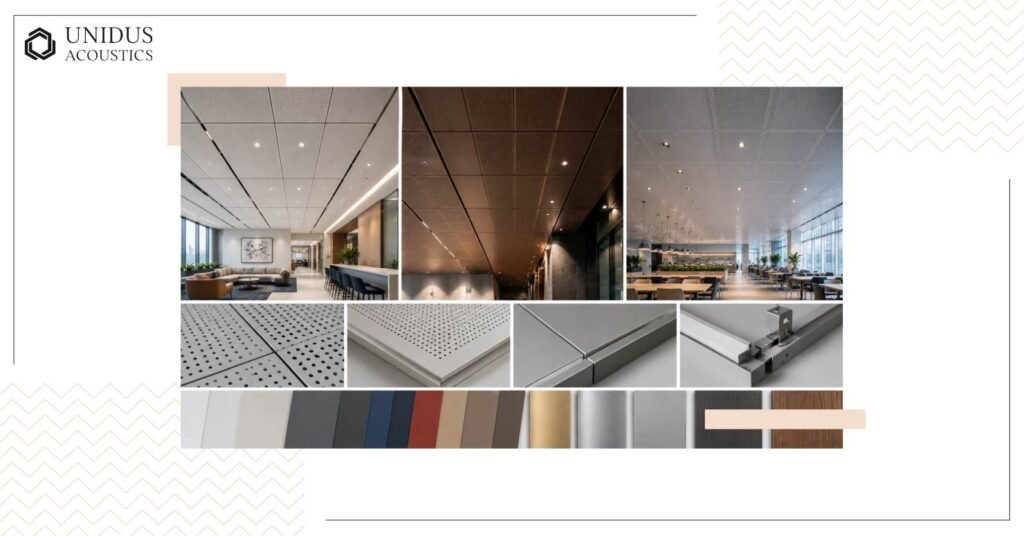
Metal ceilings offer a specificity of finish that fibrous alternatives struggle to match. Perforation patterns, edge profiles, tile geometries, custom powder-coat colours, and anodised finishes can all be specified to a degree of precision that gives the design team genuine control over the visual result. The finished ceiling is consistent: metal ages predictably, the surface does not vary across panels the way some dyed fibrous materials do, and the material holds its colour without the gradual fade that affects PVC-faced tiles.
For projects where the ceiling is a visible design element (which, in any well-considered commercial interior, it should be), this level of specification control matters.
Application Contexts Where Metal Ceiling Panels Consistently Perform
Understanding where metal ceiling panels work well in practice is more useful than a general performance claim. These are the commercial contexts where architects and designers reach for metal most consistently, and where the specification delivers reliably.
Corporate Offices and Open-Plan Workspaces
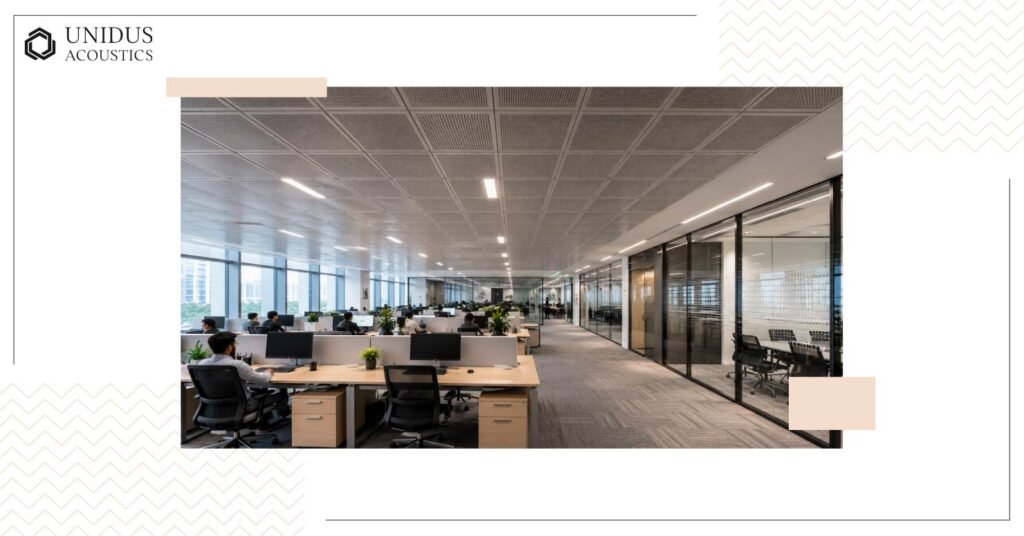
Open-plan offices are the strongest commercial use case for perforated metal ceiling panels. The acoustic problem here, excessive reverberation and speech carrying across workstations, suits ceiling-plane absorption well, and the 600mm modular format that most metal ceiling systems use integrates directly with standard office grid layouts and MEP coordination frameworks. The finish durability also means the ceiling holds up across multiple occupier fit-outs within the same shell, which matters for commercial landlords and developers.
Institutional Buildings and Government Facilities
Government and institutional projects carry specific requirements around fire performance, hygiene, long-term maintenance, and the accountability that comes with public budgets. Metal ceiling panels satisfy all three more reliably than fibrous alternatives. Non-combustible metal faces with fire-rated backing options meet Class B1 and equivalent requirements in most applicable building codes. Surfaces are cleanable without surface degradation. Panel systems remain accessible for ongoing MEP maintenance without incurring replacement costs.
Healthcare and Education
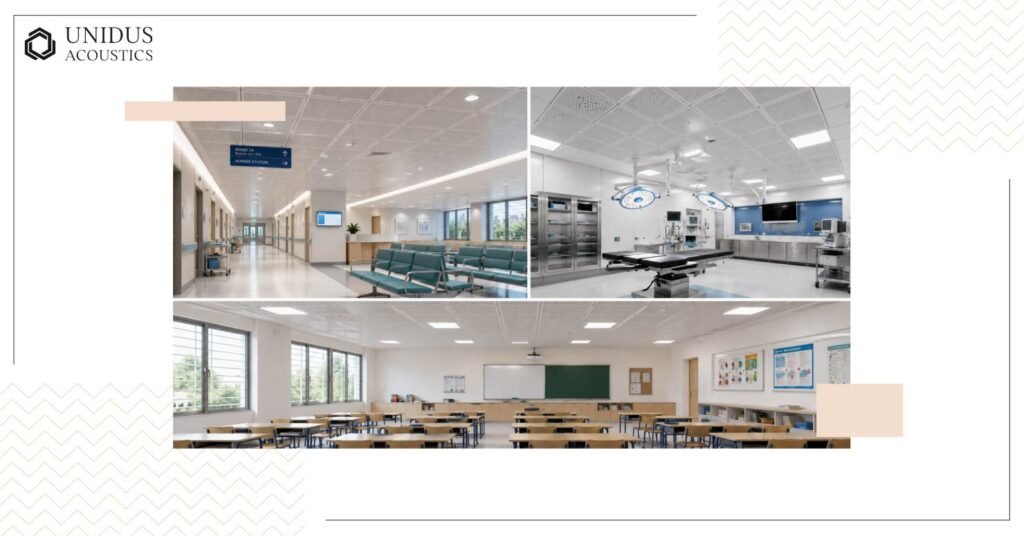
Healthcare environments have shifted noticeably toward perforated metal in corridors, waiting areas, and procedure rooms. The practical drivers are hygiene (cleanable surface without absorption of biological contaminants), predictable acoustic performance in high-ambient-noise environments, and resistance to the kind of physical contact that healthcare ceilings routinely absorb. Education settings have a similar rationale, particularly in schools where the same ceiling survives hard use over many years without requiring costly replacement cycles.
What Metal Ceiling Panels Do Not Do Well
A specification decision without its limitations is incomplete. These are the constraints to understand before committing to metal.
Low open area panels in the 3 to 6% range need a correctly specified backing to deliver meaningful absorption. Without it, they function acoustically like a solid surface. The panel choice alone does not guarantee acoustic results – the complete system does.
Metal panels are not the best choice for spaces that require NRC values above 0.85 across broad frequency ranges. Fabric-wrapped panels or thick polyester panels can reach those values more reliably when maximum absorption is the overriding brief and durability is a secondary consideration.
In spaces with very high ceilings where the absorptive surface is distant from the occupant plane, ceiling-level absorption alone may not be sufficient to meet the acoustic brief. This is a system design issue rather than a limitation of metal specifically, but it affects how metal ceiling panels should be specified when they are the only absorptive element in the scheme.
Choosing the Right Perforation System for a Commercial Project
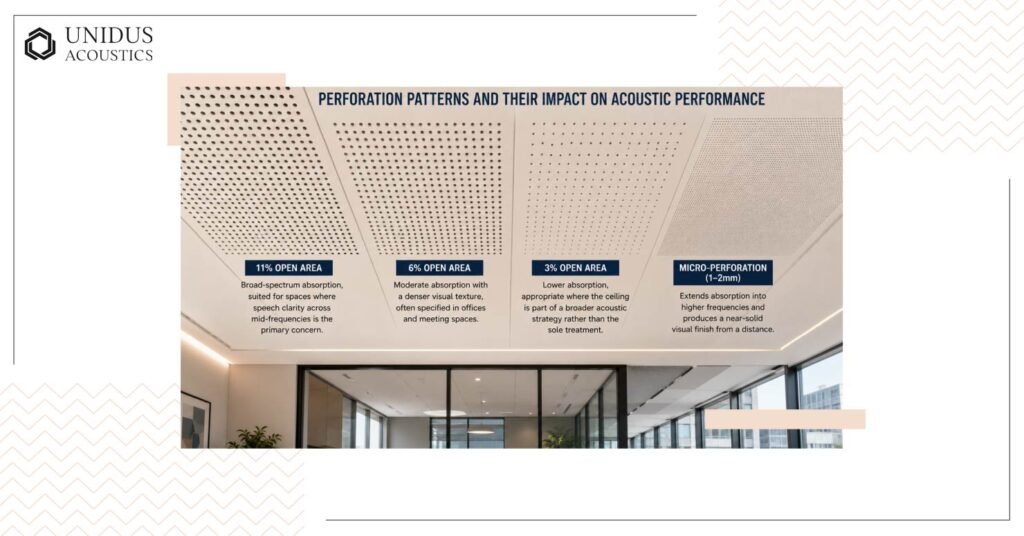
Most commercial metal ceiling ranges offer four broad perforation categories, each suited to a different balance of acoustic performance and visual character.
1. Plain, No Perforation (UAP0000)
Specified where acoustics are handled elsewhere, by wall treatment or soft furnishings, and the ceiling finish is primarily aesthetic or hygienic.
2. Fine Micro-Perforation, 3% open area (UA0316S)
Nearly invisible from normal viewing height. Works in formal or premium spaces where the acoustic brief is moderate and the visual brief demands a near-solid ceiling.
3. Standard Perforation, 6% Open Area (UAP0625D)
A visible but refined pattern. Suits mid-range acoustic requirements in standard commercial offices and institutional settings.
4. Higher Open Area, 11% (UAP0625S)
Maximises sound transmission to the backing. Appropriate for acoustically demanding spaces with high occupancy, open-plan layouts, or elevated reverberation control targets.
Frequently Asked Questions About Metal Ceiling Panels
1. Are metal ceiling panels acoustically effective without backing material?
No. A perforated metal face without acoustic backing performs similarly to a solid surface. The backing material – acoustic fleece, mineral wool, or glass wool – is where absorption happens. Always specify both the panel and the backing system.
2. What is the typical NRC range for perforated metal ceiling panels?
With appropriate backing, NRC ratings between 0.65 and 0.85 are achievable in standard commercial installations. Higher ratings generally require denser backing materials, greater plenum depth, or both.
3. How do metal ceiling panels compare to mineral fibre tiles for acoustic performance?
Both can achieve comparable NRC ratings in mid-frequency ranges. Metal panels hold a durability, maintenance, and hygiene advantage. Mineral fibre is generally lower in upfront cost. The right choice depends on the project’s lifecycle priorities and the acoustic brief, not on a general preference for one material over another.
4. Can metal ceiling panels be customised for colour and finish?
Yes. Powder-coat and anodised finishes are available in standard and custom colours across most commercial ranges. Custom perforation patterns are also possible for feature ceiling areas, subject to minimum order quantities.
The Case for Metal Ceiling Panels in Commercial Acoustic Design
Metal ceiling panels have earned their position in commercial acoustic design not because they are a trend but because the combination of acoustic performance, surface durability, and specification precision is genuinely difficult to replicate with other materials. For the right applications, high-traffic institutional and corporate environments where the ceiling needs to perform, survive maintenance access, and hold its finish over a long service life, they consistently deliver on all three criteria.
The specification question is not whether metal works acoustically. The question is whether the complete system, panel, perforation code, backing specification, and installation detail are assembled correctly. When it is, the results are reliable.
Unidus Acoustics‘ UNISTEEL metal ceiling range covers aluminium panels in lay-in and clip-in configurations, with multiple perforation codes (plain, 3%, 6%, and 11% open area), edge profiles, and finish options. It’s backed by 40+ years of expertise in custom acoustic solutions for commercial spaces.To discuss specifications, get project-specific guidance, or explore the full UNISTEEL range, contact us now.