“Soundproof insulation board” gets used for two different jobs on the market, and that overlap is usually what turns into a call to site months after handover. The term covers absorbing sound inside a room and blocking it from reaching the next one, and a specification built on the wrong meaning doesn’t just underperform. It gets more expensive to fix later. Here’s how to tell the two apart, and what the numbers on the data sheet actually measure.
Key Takeaways
- “Soundproof insulation board” gets used loosely for both sound-absorbing and sound-blocking products. Specifying the wrong type is the biggest cause of post-installation complaints.
- Absorptive boards reduce echo and reverberation inside a room. Blocking boards, usually denser and heavier, stop sound from passing through a wall or ceiling into the next space.
- STC (Sound Transmission Class) measures blocking. NRC (Noise Reduction Coefficient) measures absorption. A board can rate well on one and poorly on the other.
- STC 45 is widely treated as the point where conversations stop being understood through a wall, and STC 50 as a common baseline for commercial partitions.
- Installation detail decides real-world performance as much as the board itself. Gaps and weak points, doors and ducts especially, let sound flank around a well-rated board.
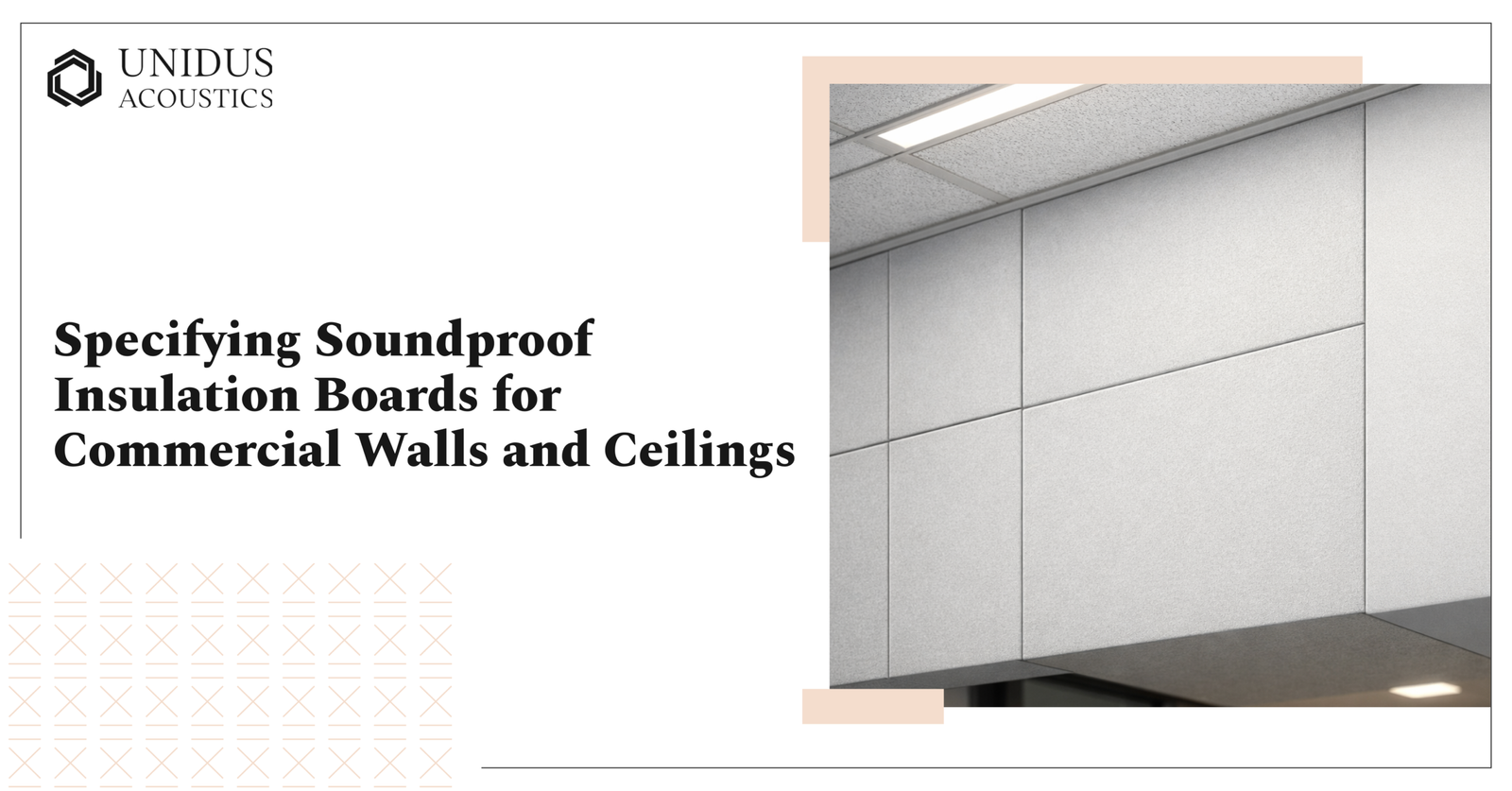
- Ceilings need a different specification logic than walls, since a ceiling board often manages absorption and transmission control together.
Absorption or Blocking? Get This Right Before Anything Else
A soundproof insulation board is a rigid or semi-rigid acoustic material specified either to absorb sound within a room or to block its transmission through a wall or ceiling, depending on its density and construction.
The term covers two products that solve opposite problems. An absorptive board reduces the echo bouncing off hard surfaces, improving speech clarity for people already in the room. A blocking board sits inside a wall or ceiling build-up and stops sound reaching the next room. Ordering the wrong one doesn’t just underperform. It often does nothing for the complaint that triggered the specification.
Why the Term Gets Used Loosely
Manufacturers apply “soundproof” to almost anything with acoustic properties, whether or not it blocks transmission. A board can carry a strong NRC rating and still let conversation through a partition, because absorption depends on surface porosity while blocking depends on mass and how well the assembly is sealed.
The Two Metrics That Decide the Spec
NRC measures how much sound a surface absorbs, on a scale from 0 to 1. STC measures how well an assembly blocks airborne sound, expressed as a single number, generally between 25 and 65 for commercial construction. Manufacturers often add mass to a blocking board through a mass-loaded vinyl layer inside the build-up, which is why MLV shows up so often once transmission numbers matter. A high NRC board tells you nothing about STC, and a spec built around one number alone is incomplete.
Specifying for Commercial Walls
Interior Partition Walls Between Offices or Meeting Rooms
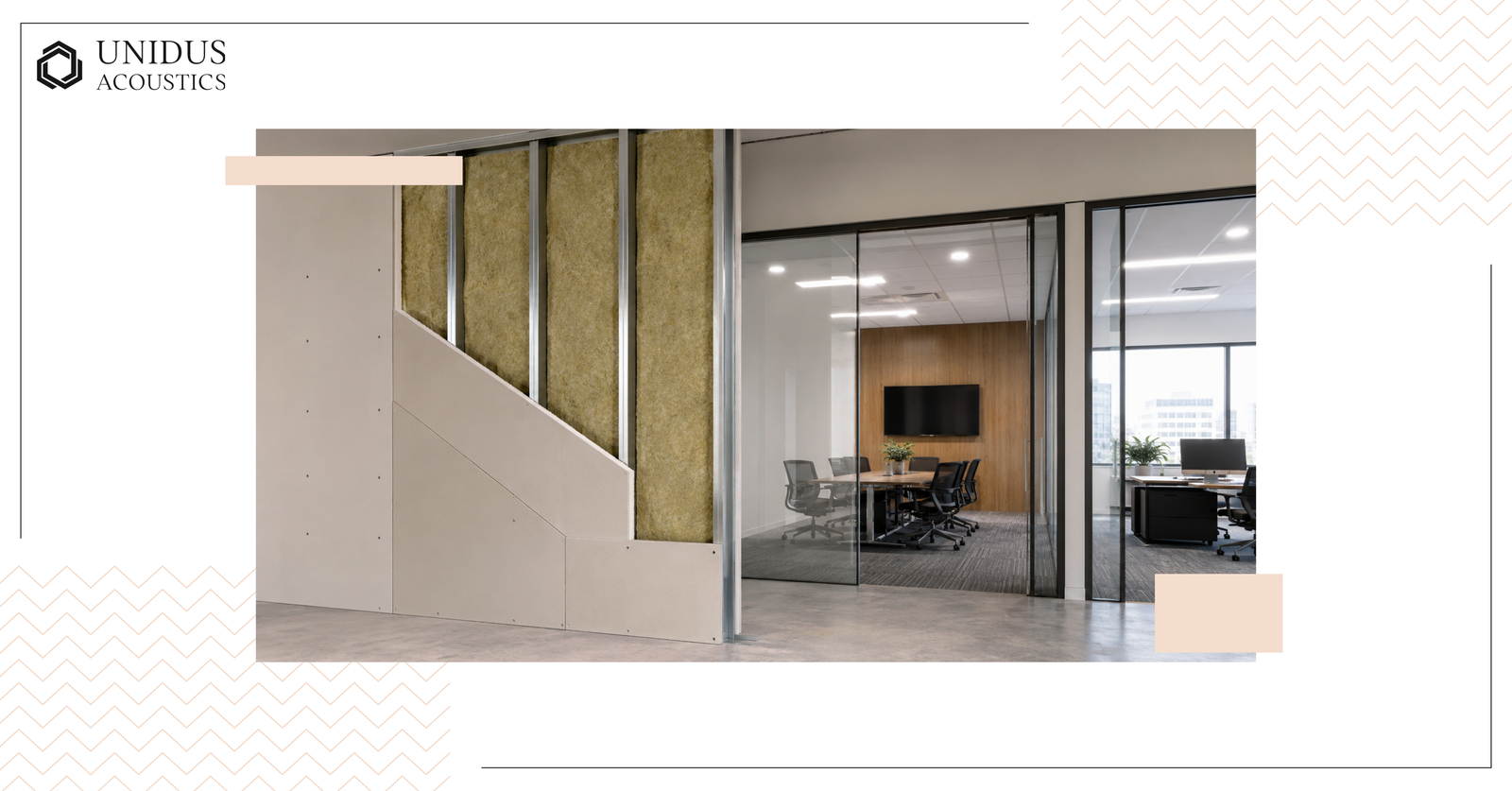
Where privacy between two enclosed rooms is the goal, an architect is usually solving for STC. STC 45 is widely treated as the point where conversations stop being understood through a wall, with STC 50 a common baseline for boardrooms and client-facing rooms.
Shared Walls in Multi-Tenant or Mixed-Use Buildings
Tenants with different noise profiles sharing a partition need a blocking board specified for the wall itself, not an absorptive finish on either side. The surrounding assembly, studs, sealant, door sets, has to match, or the data sheet rating won’t show up in practice.
Exterior-Facing Walls in Noise-Sensitive Zones
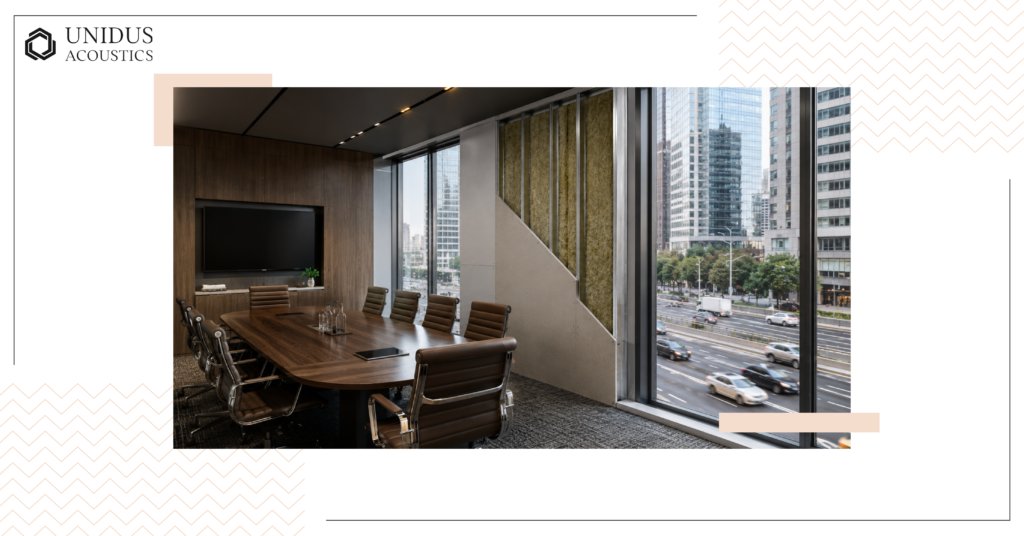
A boardroom backing onto a busy road or service corridor needs the same blocking logic on the exterior wall. This is commonly missed, because exterior build-ups are usually decided on thermal and structural grounds alone, with acoustics addressed separately, sometimes only after occupancy.
Specifying for Commercial Ceilings
Suspended Ceilings in Open-Plan Offices
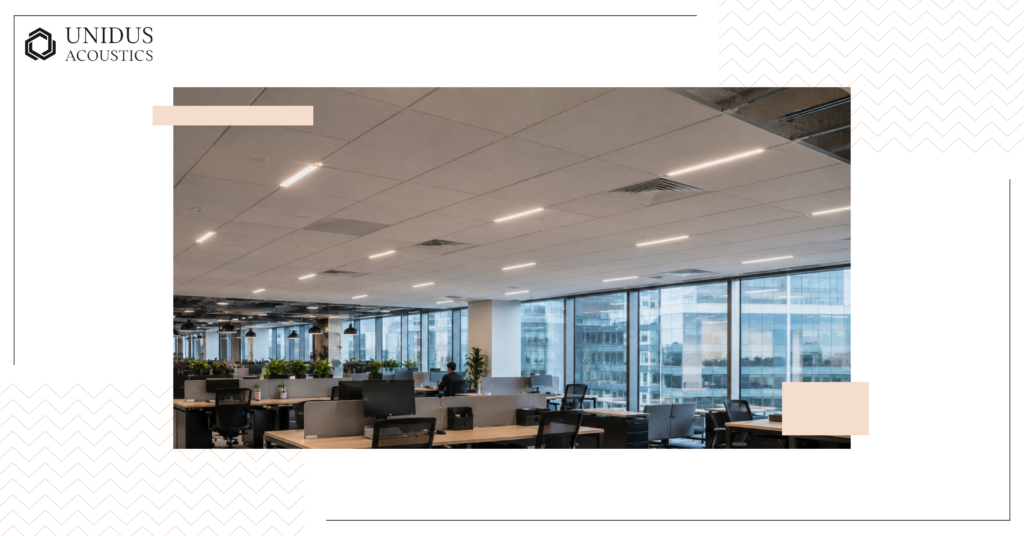
Most open-plan ceiling specifications solve an absorption problem, not a blocking one. An absorptive ceiling board, a mineral fibre tile or a wood wool panel, reduces the reverberant noise across a large floor plate, part of why open offices feel loud even without one disruptive conversation.
Ceilings Below Occupied Floors in Multi-Storey Buildings
A ceiling below an occupied floor has a second job: managing impact and airborne noise from above. This calls for a different build-up than a standard absorptive tile, often layering a denser board or membrane above the visible finish. Supplier documentation rarely separates the two, which is why this gap surfaces only after occupancy.
The Installation Details That Make or Break Performance
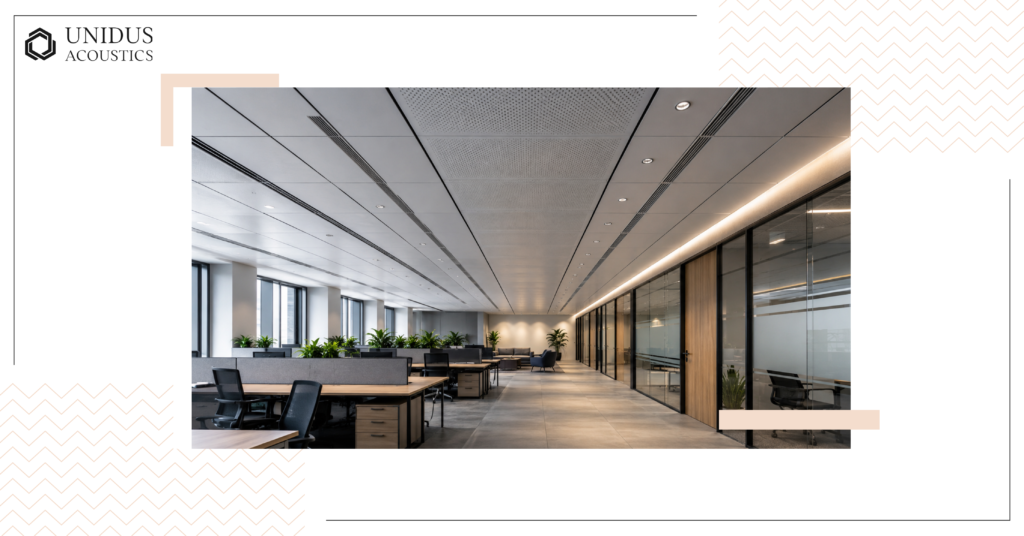
A board’s lab-tested rating describes the material in ideal conditions. Field performance depends on how the surrounding assembly is built.
- Continuous coverage matters more than the rating alone; a gap at the top of a wall or around a penetration lets sound through regardless of the board’s rating.
- Doors are usually the weakest point. A high-STC partition with a standard hollow-core door performs closer to the door’s rating.
- Ducts and cable trays need sealing detail specified alongside the board, not left to the contractor on site.
- Ceiling voids above partition walls need attention too. A wall stopping at the suspended ceiling line, rather than the structural slab, gives sound a clear path over the top.
Absorptive Insulation Board vs. Blocking Insulation Board
| Aspect | Absorptive Insulation Board | Blocking Insulation Board |
|---|---|---|
| Primary metric | NRC (Noise Reduction Coefficient). | STC (Sound Transmission Class). |
| What it solves | Echo, reverberation, speech clarity inside a room. | Sound passing into the next space. |
| Typical build | Lightweight, porous, often finished for visible mounting. | Dense, layered, usually concealed within the build-up. |
| Where it’s specified | Open-plan offices, auditoriums, echoey meeting rooms. | Shared walls, floors above occupied space, road-facing walls. |
| Fails when | Specified where the complaint is sound crossing a wall. | Installed with gaps, unsealed joints, or a weak door. |
For a wider view of partition design, our guide on partition wall sound insulation methods and our piece on soundproofing solutions for existing walls cover the retrofit and fit-out scenarios in more detail.
Frequently Asked Questions
1. What is a soundproof insulation board made of?
It depends on whether the board is built for absorption or blocking. Absorptive boards are typically porous, mineral fibre, glasswool, wood wool, or acoustic foam. Blocking boards rely on dense, layered materials, sometimes with a mass-loaded membrane, to add weight.
2. What’s the difference between a soundproof insulation board and a regular acoustic board?
In practice, the terms overlap. “Acoustic board” is often used for absorptive products, while “soundproof insulation board” gets applied to both types depending on the supplier. Ask for the specific NRC or STC rating instead of relying on either term.
3. What STC rating should I specify for commercial office walls?
For enclosed offices and meeting rooms where speech privacy matters, STC 45 is a widely used starting point, with STC 50 common where confidentiality matters more.
4. Do soundproof insulation boards work for ceilings the same way they work for walls?
No. Most ceiling specifications in open-plan offices solve for absorption, not transmission. Ceilings below occupied floors are the exception, where a denser board or membrane manages sound from above.
5. Can a high-STC board fail in the field despite a good lab rating?
Yes. STC ratings are measured in laboratory conditions with a sealed, gap-free assembly. Gaps, weak doors, or a partition short of the structural slab can pull real-world performance below the rated number.
6. Should soundproof insulation boards be combined with other acoustic treatments?
Frequently. A room can have a transmission problem and a reverberation problem at once. A blocking board handles the wall or ceiling assembly while an absorptive finish handles the room’s internal acoustics.
Getting the Specification Right Before It Reaches Site
The fastest way to avoid a post-occupancy complaint is one question before the board gets ordered: is this about sound leaving the room, or sound already inside it?
Unidus Acoustics has manufactured custom acoustic boards and insulation systems for Indian commercial projects for over 40 years, working directly with architects at the specification stage to match the board to the problem on the drawing.
If you’re working through a build-up that needs both absorption and blocking, we can help you get it right the first time. Get in touch with us.