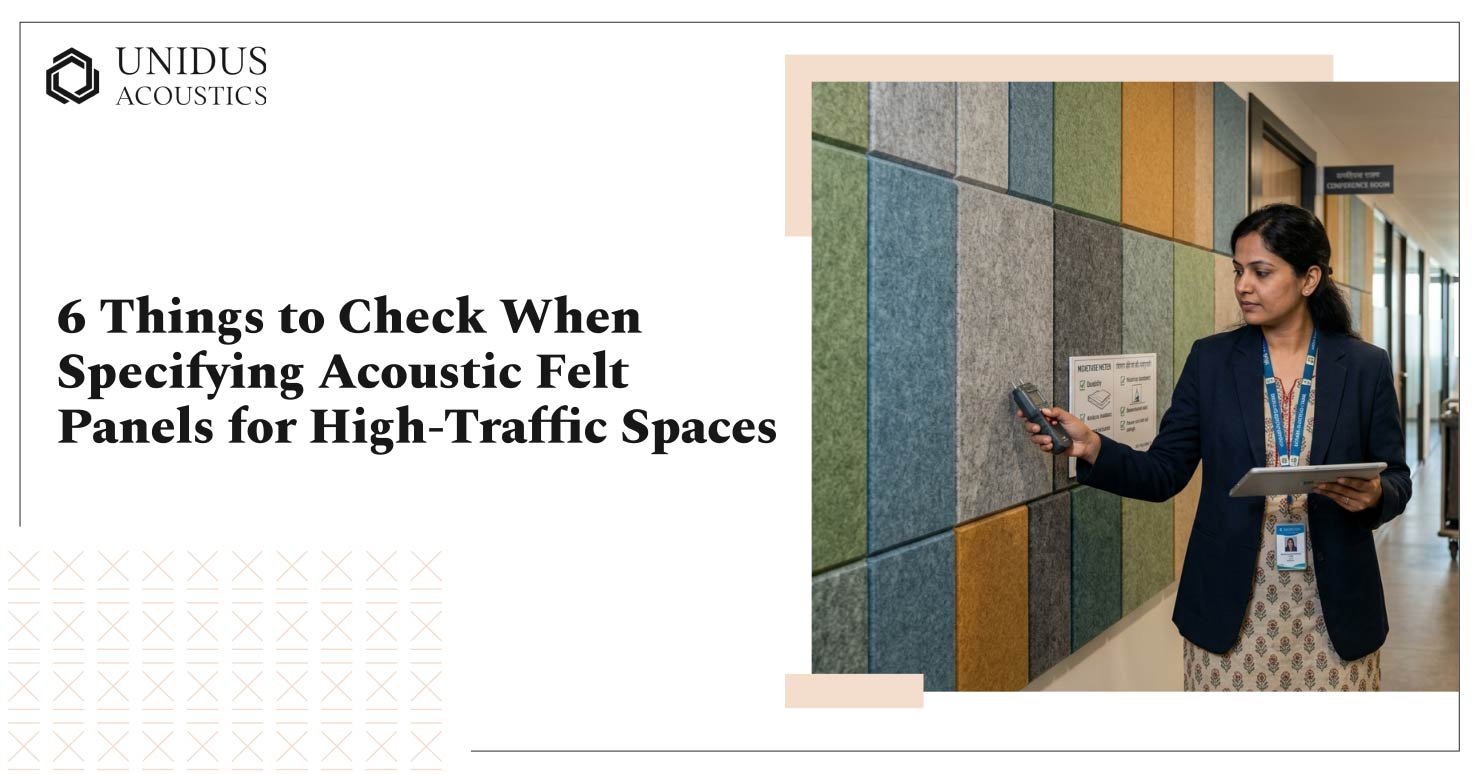
Acoustic felt panels have become a standard specification in commercial interiors. They absorb sound well across the mid-frequency range, come in an extensive colour palette, and carry a credible sustainability story given that most are made from recycled PET fibre.
High-traffic spaces impose conditions that low-use environments never will. Panels near entrances face cleaning chemicals. Those in corridors get knocked by trolleys, and panels in canteen areas contend with intermittent moisture and food service activity. The six checks below are the ones that matter most before committing to a specification for this kind of space.
Key Takeaways
- When specifying acoustic felt panels, NRC is a headline figure, not the full picture. Ask for the frequency profile across 125 Hz to 4,000 Hz to understand how the panel will actually perform in a mixed-noise environment.
- Density and thickness are independent variables. A 9 mm acoustic felt panel at 180–200 kg/m³ behaves differently in a high-footfall space than a 9 mm panel at 120 kg/m³.
- Class B1 fire rating must be independently verified by test certificate from an accredited laboratory, not just stated on a data sheet.
- PET fibre panels resist moisture better than natural fibre alternatives but are not waterproof. Plan placement accordingly in canteen zones and entrance lobbies.
- Colour batch consistency is a real specification risk for large-area installations. Order complete panel quantities in a single production run wherever possible.
- Installation method affects both programme flexibility and long-term maintenance access. Mechanical fixings that allow clean panel removal are the more practical choice for spaces with ongoing services requirements.
What to Check Before Specifying Acoustic Felt Panels
These are the six technical areas where specification decisions have the most material impact on long-term performance in high-footfall commercial spaces.
1. What NRC Rating Do Acoustic Felt Panels Need for High-Traffic Spaces?

The NRC value on a product data sheet is a single-number average across four octave bands: 250 Hz, 500 Hz, 1,000 Hz, and 2,000 Hz. That average can mask uneven performance. A panel that absorbs strongly at 1,000 and 2,000 Hz but performs poorly at 250 Hz will show a reasonable headline NRC while leaving low-frequency room noise largely untreated.
How to Read the Frequency Profile Behind the NRC Number
Request the full absorption coefficient data across all tested octave bands (125 Hz through 4,000 Hz) before finalising your specification. This is standard information on a proper acoustic test report from an accredited laboratory. If a supplier cannot produce it, treat that as a signal to probe further.
For open-plan offices and most high-footfall commercial spaces, panels with NRC 0.70 or above are the starting threshold for meaningful acoustic benefit.
2. How Does Panel Density Affect Durability in High-Traffic Spaces?
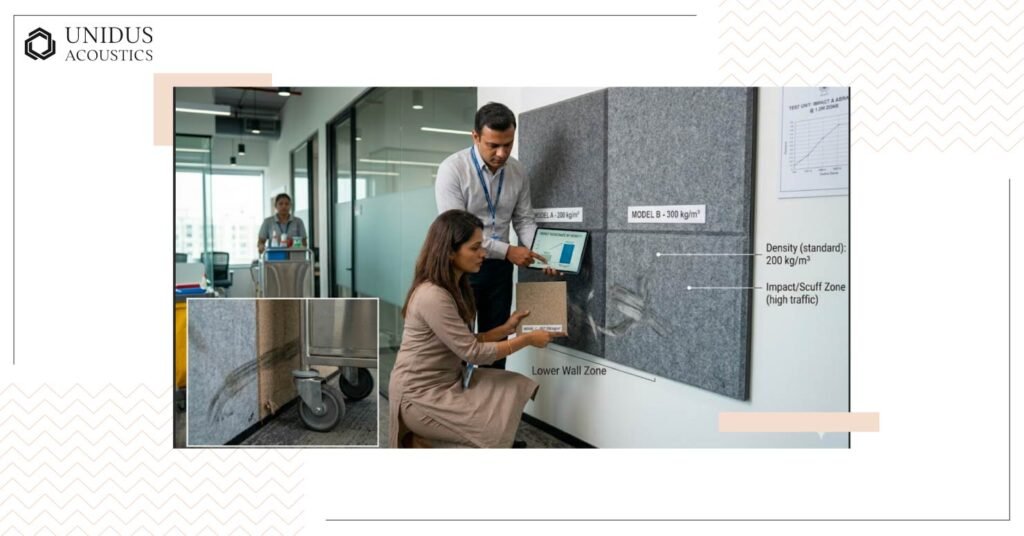
Standard acoustic felt panels made from recycled PET fibre have a density of 180–200 kg/m³. That density gives the panel enough rigidity to hold its shape and enough surface resistance to handle incidental contact under normal conditions. In a high-traffic space, however, normal conditions aren’t the baseline.
Panels installed at lower wall zones, from floor level up to roughly 1.2 metres, in corridors, reception areas, and waiting zones face scuffing, physical impact from trolleys and equipment, and cleaning contact that upper-wall panels never encounter.
Why Thickness Is Not a Reliable Indicator of Impact Resistance
A panel at 9 mm and 180–200 kg/m³ is meaningfully more impact-resistant than a 9 mm panel at 120 kg/m³. Both may carry similar NRC ratings; their behaviour in a high-footfall space is not the same. Check density explicitly in the product specification.
For zones with clear impact risk, starting panel installation from 1.2 metres upward, or combining acoustic felt panels with a more robust base material at lower wall heights, reduces the likelihood of early replacement.
3. What Fire Rating Do Acoustic Felt Panels Require for Commercial Use in India?
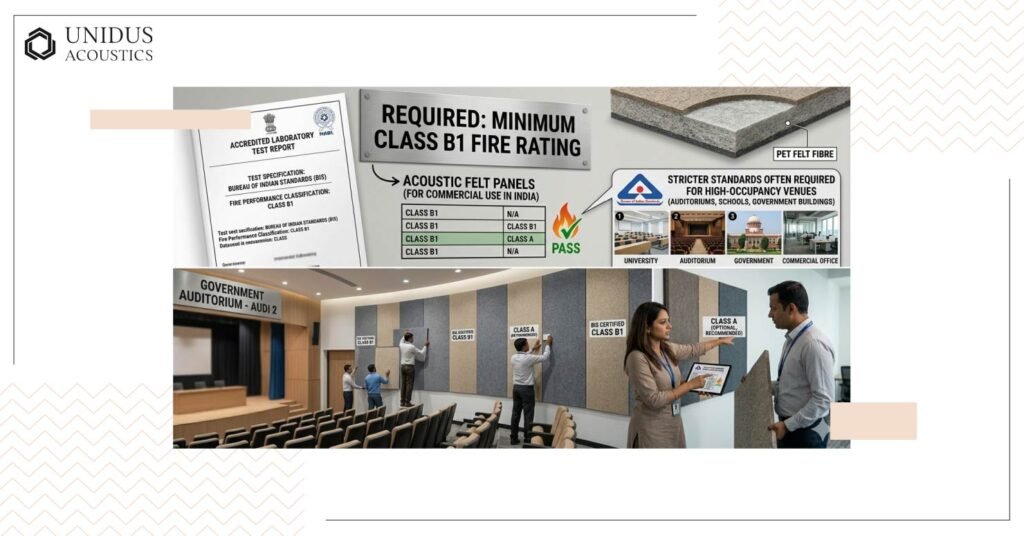
Acoustic felt panels used in commercial spaces in India should carry a minimum Class B1 fire rating. Government facilities, educational institutions, auditoriums, and high-occupancy venues often require more stringent classification.
What Is the Difference Between a Fire Rating on a Data Sheet and a Test Certificate?
The fire rating on a data sheet is not the same as a test certificate. Request certificates from SGS, Intertek, or TÜV Rheinland. These are the most commonly referenced accrediting bodies in commercial acoustic specification in India. Under the National Building Code of India 2016, high-occupancy commercial spaces carry fire performance requirements that align with the Class B1 minimum. If your project falls under a government tender or institutional brief, the test certificate is what procurement documentation will ask for, not the data sheet classification.
For projects pursuing LEED or WELL certification, ask for VOC emissions data as well.
4. Are Acoustic Felt Panels Suitable for Moisture-Prone Zones?
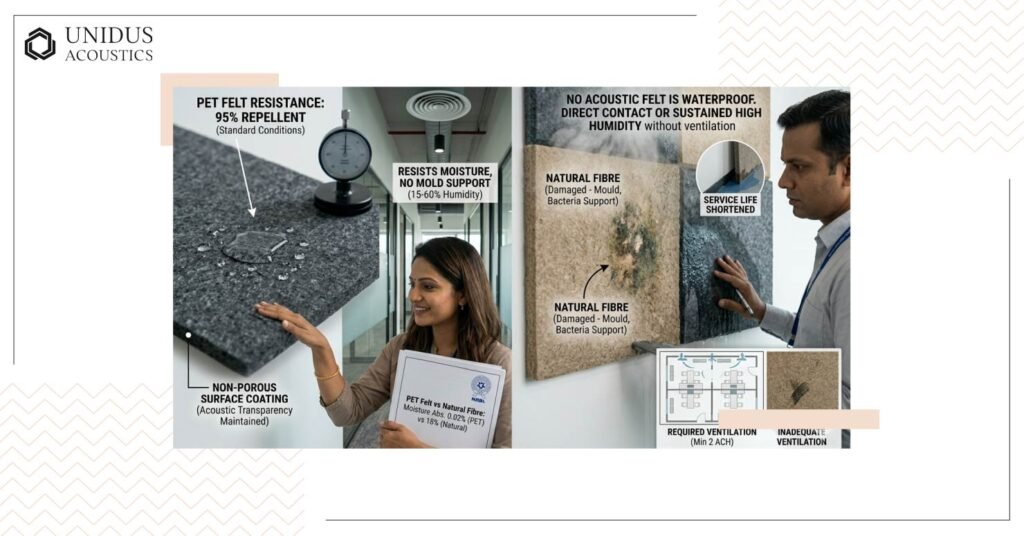
Acoustic felt panels are porous by design. PET fibre panels resist moisture significantly better than natural fibre alternatives and don’t support mould or bacterial growth under normal humidity conditions. That said, no acoustic felt panel is waterproof, and direct water contact or sustained high humidity without adequate ventilation will shorten the panel’s service life.
Where Should Acoustic Felt Panels Not Be Installed?
Position acoustic felt panels above the splash zone in canteen and cafeteria areas. Avoid installing them in external transition zones without managing vapour ingress. In spaces where air conditioning units discharge cold air directly overhead, check whether the panel finish is prone to condensate marking at low ambient temperatures.
5. How Do You Ensure Colour Consistency in Acoustic Felt Panels Across Large Installations?
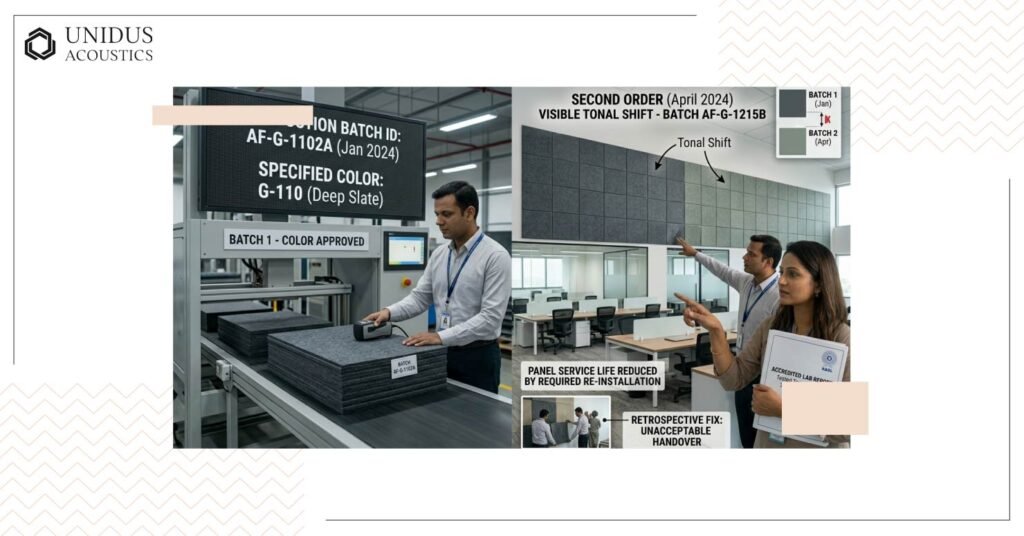
In a large-area installation, acoustic felt panels are very often ordered across more than one production batch. The first batch arrives and looks right. A second order placed three months later can arrive with a visible tonal shift, and in any client-facing installation, that becomes a handover issue. The fix is retrospective and usually involves re-ordering and re-installing panels that were otherwise performing well acoustically.
What to Confirm With Your Supplier Before Placing a Panel Order
Ask the supplier whether colour consistency can be maintained across orders placed months apart. Request a sample from the actual production batch matched to your order, not a showroom sample produced earlier. For large installations, ordering the complete panel quantity in a single production batch is the most reliable way to eliminate this risk entirely.
Unidus Acoustics‘ U-TONE panels are available in 64+ colour options, with batch consistency maintained across repeat orders. This matters particularly for large floor-area fit-outs where panels arrive in multiple deliveries.
6. Which Installation Method Works Best for Acoustic Felt Panels in High-Traffic Projects?
Acoustic felt panels fix in several ways: direct adhesive bonding for flat wall installations, mechanical fixings (clips, standoffs, or channel systems) where the panel may need to be removed and replaced, and suspension systems for ceiling clouds or baffles.
How Fixing Method Affects Maintenance Access and Long-Term Cost
Adhesive-bonded panels are among the last items applied before handover and don’t suit a multi-trade programme well. If acoustic work is happening in parallel with other trades, mechanical fixing methods are more compatible and reduce installation damage risk. For high-traffic spaces where building services access is an ongoing requirement, fixings that allow clean panel removal without surface damage carry a lower long-term cost than panels that have to be cut out.
Frequently Asked Questions About Acoustic Felt Panels
1. What is the difference between acoustic felt panels and PET acoustic panels?
They describe the same material from different angles. Acoustic felt panels refer to the textile-like surface finish; PET acoustic panels refer to the base material (polyethylene terephthalate, a form of recycled polyester). In the commercial acoustic market, both terms refer to panels made from compressed recycled polyester fibre.
2. Are acoustic felt panels fire-safe for commercial installation in India?
Acoustic felt panels used in commercial spaces should carry a minimum Class B1 fire rating, independently verified by third-party test certificates from accredited laboratories. Always request the actual test report, not just the product data sheet classification.
3. Can acoustic felt panels be cleaned in a high-traffic environment?
PET acoustic panels can be cleaned using fog, spray, or wipe methods without damage to the surface, provided the cleaning agent is appropriate for the material. Avoid saturating the panel with liquid and avoid abrasive methods that can alter the surface texture.
Specifying Acoustic Felt Panels? Here’s How Unidus Acoustics Can Help
Unidus Acoustics has been delivering acoustic solutions for commercial spaces in India for over 40 years. Across 635+ completed projects, the team has worked with clients including Air India, AIIMS, Infosys, TCS, SBI, Reliance, and Ashoka University, specifying acoustic felt panels and broader acoustic solutions for spaces that impose exactly the kind of demands this article covers. That project depth means the specification questions architects and designers run into are ones the team has already encountered, usually more than once.
The U-TONE range of acoustic felt panels is made from recycled polyester fibre, carries a Class B1 fire rating, and is independently certified by SGS, Intertek, and TÜV Rheinland. Panels are available in 9 mm and 12 mm thicknesses at 180–200 kg/m³ density, across 64+ colour options with customised sizing. Surfaces are disinfectable by fog, spray, or wipe, which makes them a practical choice for high-footfall zones including canteen areas, corporate corridors, reception lobbies, and open-plan office floors.
If you are working through a specification and need to confirm product suitability, fire certification documentation, colour batch ordering, or installation guidance, the team is available to help. Contact us now.