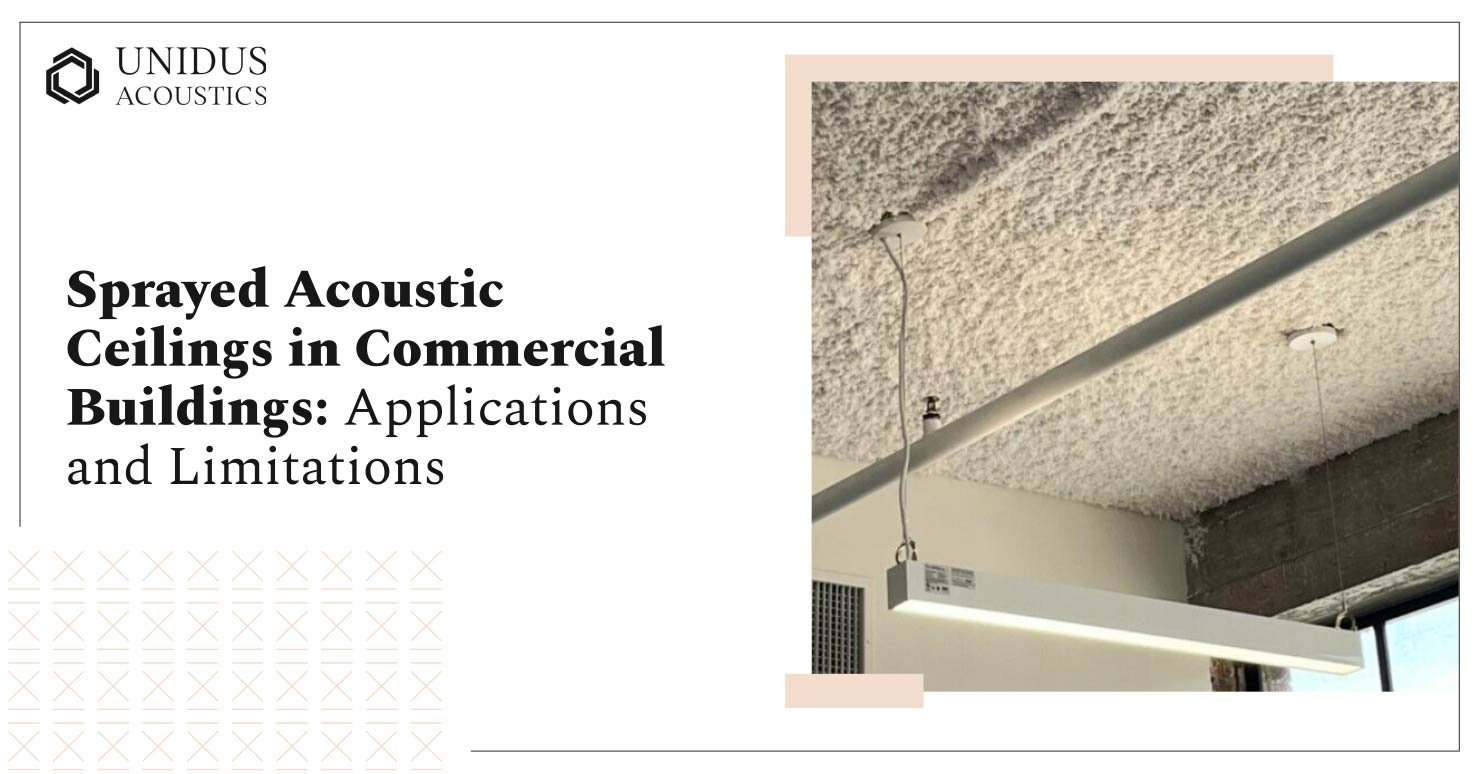
Sprayed acoustic ceilings get specified when the design brief won’t tolerate visible grid lines, panel edges, or any interruption overhead. The finish looks like plaster. The acoustic function comes from the porous structure of the applied material. For certain project types, that combination is exactly what’s needed.
The question is which project types, and what the real cost of that seamlessness is, well beyond the upfront material spend. Both are worth covering before committing to the format.
Key Takeaways
- A sprayed acoustic ceiling is a monolithic coating applied directly to the ceiling surface, valued primarily for its seamless appearance and sound absorption in spaces where visible joints or panel grids are architecturally unacceptable.
- The format suits specific contexts: heritage renovations, curved or vaulted ceiling forms, and premium hospitality or performing arts venues where design demands an uninterrupted overhead surface.
- There are significant operational constraints: difficult patch repairs, restrictions on repainting, no access to ceiling services after application, and higher installation costs than panel-based systems.
- Panel-based ceiling systems, including acoustic tiles and metal ceiling panels, deliver comparable or better NRC performance with substantially more flexibility for maintenance, service access, and future changes.
- For the majority of Indian commercial office, institutional, and corporate projects, modular ceiling systems represent a more practical long-term specification than sprayed ceiling treatments.
What a Sprayed Acoustic Ceiling Is and How It Works
Unlike tiled or panel-based ceiling systems, sprayed ceilings have no visible seams and no suspended grid below the structural soffit. The acoustic function comes from the porosity of the applied material rather than from a suspended absorption system.
The two main product categories within this format work quite differently in practice, and understanding which one is appropriate matters a great deal at the specification stage.
Spray-applied mineral fibre products
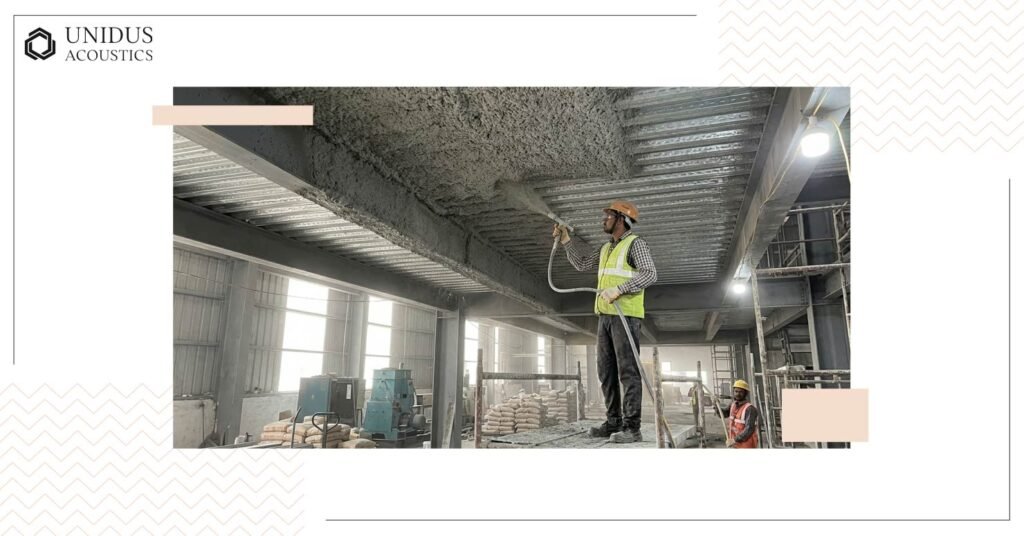
Spray-applied mineral fibre was one of the earliest forms of applied acoustic treatment in large commercial buildings. The product is mixed with water and sprayed directly onto concrete, metal deck, or plasterboard soffits. The resulting surface has a coarse, textured appearance, and NRC performance varies depending on application thickness and substrate.
These products were widely used in industrial spaces, car parks, retail units, and institutional corridors where the visual quality of the ceiling was a secondary consideration. The finish is not paintable with standard products, maintenance options are limited, and the texture is rougher than most modern commercial interiors would accept. They remain relevant in industrial and utility contexts but are increasingly uncommon in fit-out work where the ceiling plane is a visible design element.
Acoustical plaster systems
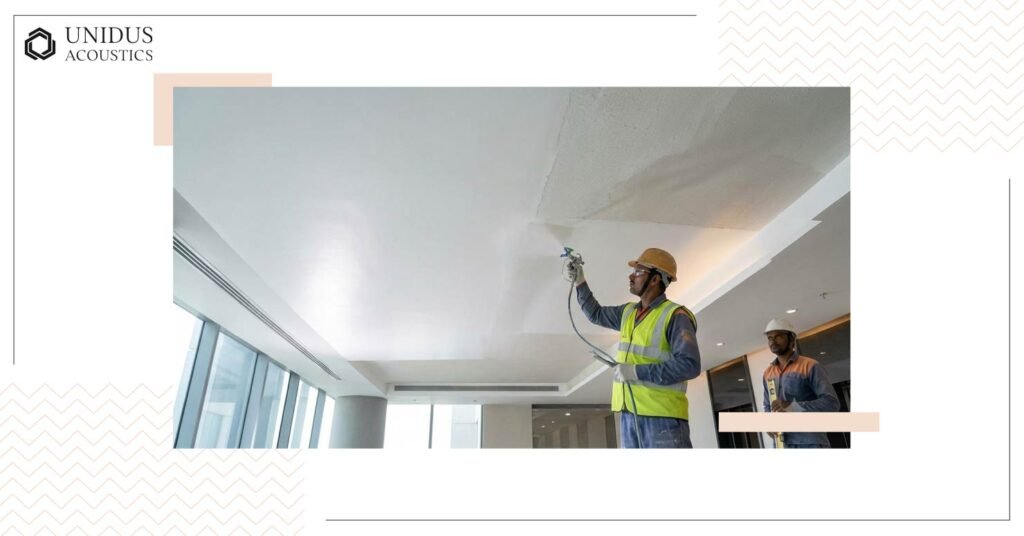
Acoustical plaster represents the premium end of sprayed acoustic ceiling technology. Unlike spray-applied mineral fibre, acoustical plaster presents as a smooth, fully paintable surface that is visually indistinguishable from standard plasterwork. The porous substrate is applied beneath a specialised finish coat, allowing the ceiling to absorb sound while appearing completely conventional.
Premium acoustical plaster systems can achieve NRC ratings of 0.70-0.90 depending on system depth and substrate configuration, which is comparable to high-performance panel systems. The critical structural advantage is that the material can be applied to flat, curved, domed, vaulted, and compound-curved ceilings and walls without any limitation on ceiling form, something acoustic tile and panel systems cannot match.
The tradeoff is that acoustical plaster requires skilled applicators, careful site preparation, and an upfront investment that significantly exceeds commodity acoustic solutions.
Where Sprayed Acoustic Ceilings Make Sense in Commercial Projects
There are specific building types and design conditions where a sprayed ceiling is the clearest specification choice. Getting clear on those conditions helps avoid specifying the format in contexts where a better alternative exists.
Heritage buildings and renovation projects
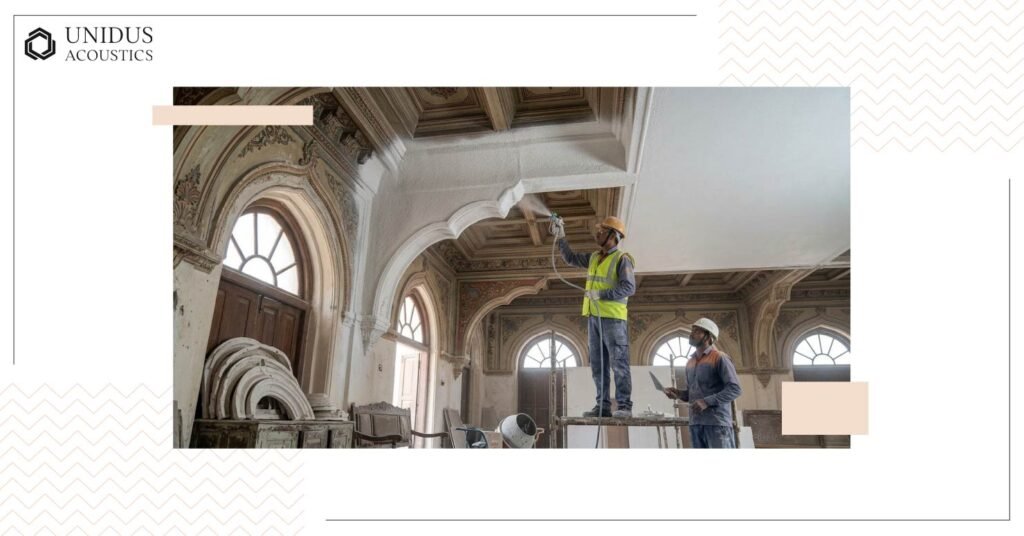
When working inside a heritage structure with ornate soffits, curved plasterwork, or architectural features that need to be preserved, acoustical plaster can be applied over existing surfaces without altering the ceiling form. Suspended panel systems require a new structural grid, which typically adds height loss and introduces load to the existing structure. Spray application avoids both.
In renovation contexts, this is a genuine advantage that other acoustic systems can’t easily replicate. Early acoustic planning in retrofit projects is particularly critical in heritage buildings, where structural discoveries mid-construction can eliminate ceiling treatment options that appeared viable at design stage.
Curved and non-rectangular ceiling geometries
Curved auditoriums, domed lobbies, barrel-vaulted corridors, and compound-curved architectural features are difficult to treat with prefabricated panel systems. Standard tiles don’t bend. Custom-curved panels are slow to produce and expensive. Spray application follows the substrate geometry precisely and produces a continuous acoustic surface regardless of form.
For architects designing high-end hotel lobbies, performing arts venues, or exhibition spaces with architecturally expressive ceilings, this adaptability makes sprayed systems worth the cost premium in a way that panel systems simply cannot match. The NRC rating performance at equivalent depth is comparable to panel systems, so the acoustic case and the architectural case align.
Spaces where ceiling service access is not required
Sprayed ceilings are direct-to-substrate by definition. There is no accessible plenum above them. In spaces where all services, including electrical, HVAC, and data infrastructure, are either fully embedded in the structural slab or completely surface-mounted, this isn’t a constraint at all.
In most modern commercial buildings, though, ceiling plenums serve as the primary distribution zone for building services. Sealing that space permanently with a sprayed ceiling treatment has post-handover consequences that are abstract at design stage and very concrete when a tenant needs to run additional cabling or an HVAC unit requires access.
The Real Limitations of Sprayed Acoustic Ceilings
The limitations of this format are less visible than the advantages in a design presentation, which is exactly why they deserve explicit coverage before a specification commitment.
Why a sprayed acoustic ceiling is difficult to repair
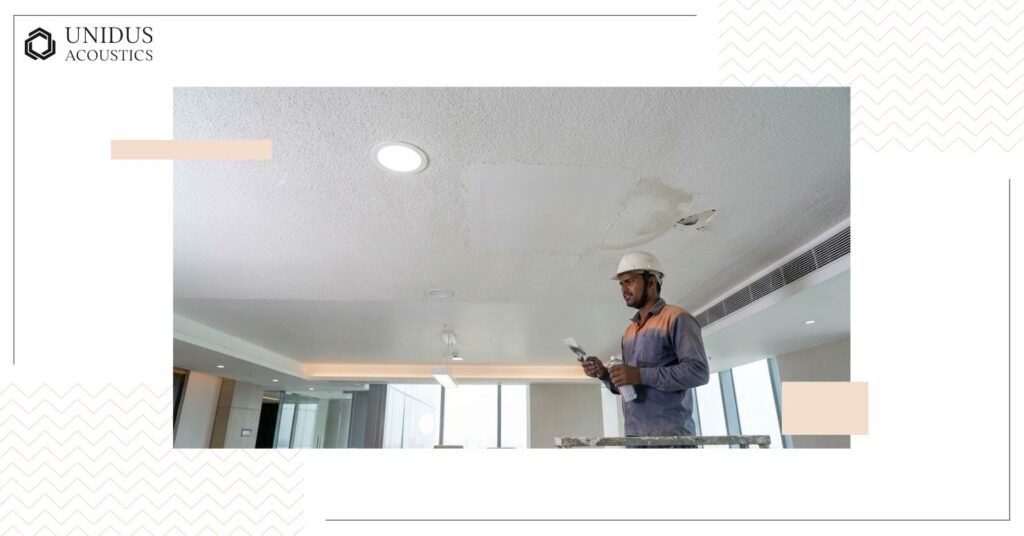
Any physical damage to a sprayed acoustic ceiling creates a repair problem that is hard to resolve without visible evidence of patching. Water damage from a pipe above, accidental impact from maintenance work, or the need to install a new light fitting all produce a repair requirement. Matching the spray texture and colour of an existing installation after a localised repair rarely achieves an invisible result. Over time, repaired areas tend to remain visible and the ceiling appearance degrades even if acoustic performance remains intact.
Panel-based ceiling systems allow individual tile or panel replacement. Damage is contained, the replacement element is identical to the original, and the ceiling returns to its original appearance cleanly. That advantage is not trivial across the operational life of a commercial building.
Repainting restrictions and long-term acoustic degradation
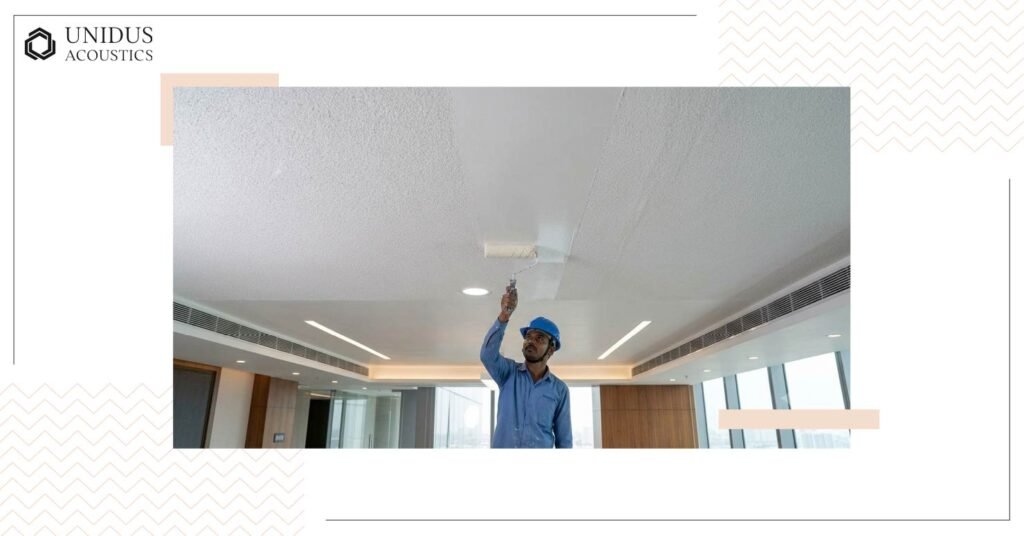
The acoustic performance of a sprayed ceiling depends on the open-pore structure of the surface remaining unblocked. Standard emulsion or latex paint applied over an acoustic ceiling surface fills those pores and significantly reduces NRC performance. The ceiling looks freshly painted but no longer functions as an acoustic product.
This is a real operational issue in commercial buildings where tenants refresh interiors at lease renewal without knowledge of the ceiling system. It’s also a cost issue when the only way to restore acoustic performance after a standard repaint is to strip and reapply the entire system.
Cost of application and specialist labour requirement
Sprayed acoustic ceilings require specialist equipment, trained applicators, and careful protection of all adjacent surfaces before work begins. The preparation, application, curing, and finishing sequence is more involved than panel installation and adds time to the construction programme. In projects where the acoustic specification is under cost pressure, panel-based systems consistently offer better value per square metre of treated surface, with more predictable installation timelines.
Panel-Based Alternatives and When to Prefer Them
For the majority of commercial building types in India, acoustic ceiling tiles and panel systems deliver equivalent or better NRC performance with significantly better maintenance characteristics, lower installation complexity, and the ability to adapt the ceiling plane to changing service requirements over the building’s life.
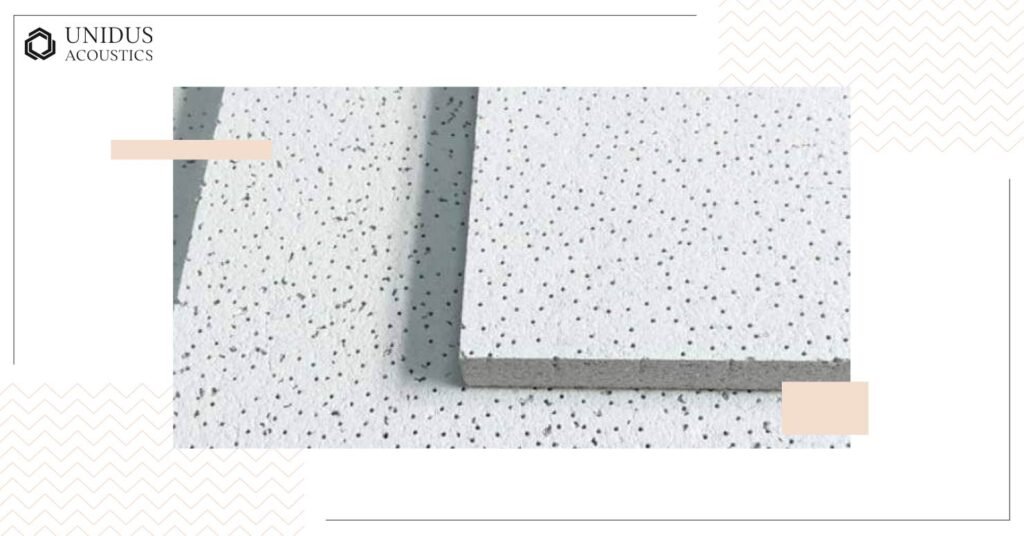
Mineral fibre acoustic ceiling tiles achieve NRC values of 0.70-0.85, which matches or exceeds many sprayed ceiling systems, with individual tile replaceability, demountable access to the plenum, and straightforward compliance with commercial fire codes. They remain the most widely specified acoustic ceiling product in Indian corporate and institutional construction for these reasons.
In spaces with high ceilings where the ceiling plane itself isn’t the primary treatment surface, acoustic sound baffles and ceiling panel systems provide high coverage at lower material cost and can be positioned at heights that bring the treatment closer to where conversations and reverberation actually occur.
Metal ceiling panels work well in spaces where durability, moisture resistance, and acoustic performance must coexist: food service areas, retail environments, certain healthcare contexts, and institutional spaces where hygiene and cleanability are requirements alongside sound control.
For large-volume open spaces such as atriums, airport terminals, or multipurpose halls, the ceiling treatment choice becomes part of a broader acoustic strategy that typically involves wall and floor treatments working together, not just an overhead surface decision.
Understanding the difference between soundproofing and acoustic treatment is also worth clarifying with clients before selecting any ceiling system: sprayed ceilings and acoustic tiles both reduce reverberation and echo within the space. Neither blocks sound transmission between floors or rooms in the way that structural isolation does.
Sprayed Acoustic Ceiling vs. Acoustic Ceiling Tiles vs. Metal Ceiling Panels
| Feature | Sprayed Acoustic Ceiling | Acoustic Ceiling Tiles | Metal Ceiling Panels |
|---|---|---|---|
| Typical NRC range | 0.70–0.90 (product-dependent) | 0.70–0.85 | 0.40–0.80 |
| Visual appearance | Seamless, monolithic | Grid-based tile pattern | Clean, industrial or architectural finish |
| Curved/complex surfaces | Yes, follows any form | No (flat only) | Limited (some system types) |
| Plenum access | No | Yes (demountable) | Yes |
| Tile/panel repair | Difficult; patches often visible | Easy (individual tile swap) | Easy (individual panel swap) |
| Repainting | Restricted (blocks acoustic pores) | Not applicable | Easy (metal surface) |
| Fire rating | Typically non-combustible (mineral fibre base) | Class A (mineral fibre) | Non-combustible |
| Best applications | Heritage, curved forms, premium hospitality | Offices, institutions, healthcare | Retail, industrial, food service |
| Approximate cost | High (material + specialist application) | Moderate | Moderate to high |
Frequently Asked Questions
1. What is a sprayed acoustic ceiling?
A sprayed acoustic ceiling is a porous coating applied to a ceiling substrate using spray equipment. It can be mineral fibre-based (producing a rough, textured finish typically used in industrial or utilitarian spaces) or an acoustical plaster system (producing a smooth, paintable surface that visually resembles standard plasterwork). Both types reduce reverberation by absorbing sound energy through the porous structure of the applied material.
2. What NRC rating does a sprayed acoustic ceiling achieve?
NRC ratings depend on the specific product and application depth. Premium acoustical plaster systems typically achieve NRC 0.70-0.90. Spray-applied mineral fibre products vary more widely. Always request certified test data for the specific product and thickness being considered: published NRC values without test documentation and frequency breakdown data are not reliable for a commercial acoustic specification.
3. Can you repaint a sprayed acoustic ceiling?
Standard wall and ceiling paint blocks the open pores through which a sprayed acoustic ceiling absorbs sound. This significantly reduces NRC performance after painting, even though the ceiling appears visually intact. Most acoustical plaster manufacturers produce specialist finishes designed to maintain acoustic performance. Standard hardware store paint is not appropriate and will degrade the system’s acoustic function.
4. How long does a sprayed acoustic ceiling last?
With minimal disturbance and proper care, acoustical plaster systems can last several decades. The primary longevity risk is physical damage requiring repair, since patches are difficult to match invisibly. Spray-applied mineral fibre in industrial settings can also remain serviceable for 20-30 years with minimal intervention if left undisturbed.
5. When is a panel system a better choice than a sprayed acoustic ceiling?
In most commercial office and institutional projects, panel systems offer better overall value: comparable or better NRC, simpler maintenance, individual replaceability, and plenum access for building services. Sprayed ceilings are worth the additional investment when the ceiling form is curved or architecturally complex, when the brief requires no visible seams or grid, or when the project involves a heritage surface that must be preserved rather than replaced.
6. Is a sprayed acoustic ceiling a practical choice for Indian commercial buildings?
Sprayed acoustic ceilings are used in India primarily in premium hospitality, performing arts venues, and high-specification corporate headquarters where the ceiling form or design brief justifies the cost. For standard commercial office, healthcare, and institutional construction, acoustic ceiling tile systems and modular panel solutions offer better cost-to-performance ratios and are more broadly supported by local manufacturers and installation contractors.
Conclusion
Sprayed acoustic ceilings earn their place in a narrow but genuine set of commercial applications. Heritage renovations, curved architectural soffits, and premium design environments where no joint, grid line, or panel edge can appear overhead are the contexts where the format is worth the investment. For most standard commercial construction, the maintenance constraints, service access limitations, and long-term repair challenges typically outweigh the aesthetic advantage.
For architects and designers specifying acoustic ceiling treatments for Indian commercial projects, acoustic false ceiling solutions, modular ceiling grid systems, and acoustic ceiling tiles cover the vast majority of acoustic requirements with the flexibility, maintainability, and service access that sprayed systems can’t offer. Knowing where the sprayed format genuinely wins, and where it creates long-term problems, is part of what a well-informed ceiling specification looks like.
Unidus Acoustics manufactures acoustic ceiling solutions across mineral fibre tiles, metal ceiling systems, and panel-based formats for commercial, institutional, and hospitality applications across India. With over 40 years of manufacturing expertise, our team works with architects and designers from specification through to installation.
Reach us at hi@unidusindia.com, call +91-9625332290, or visit unidusacoustics.com.