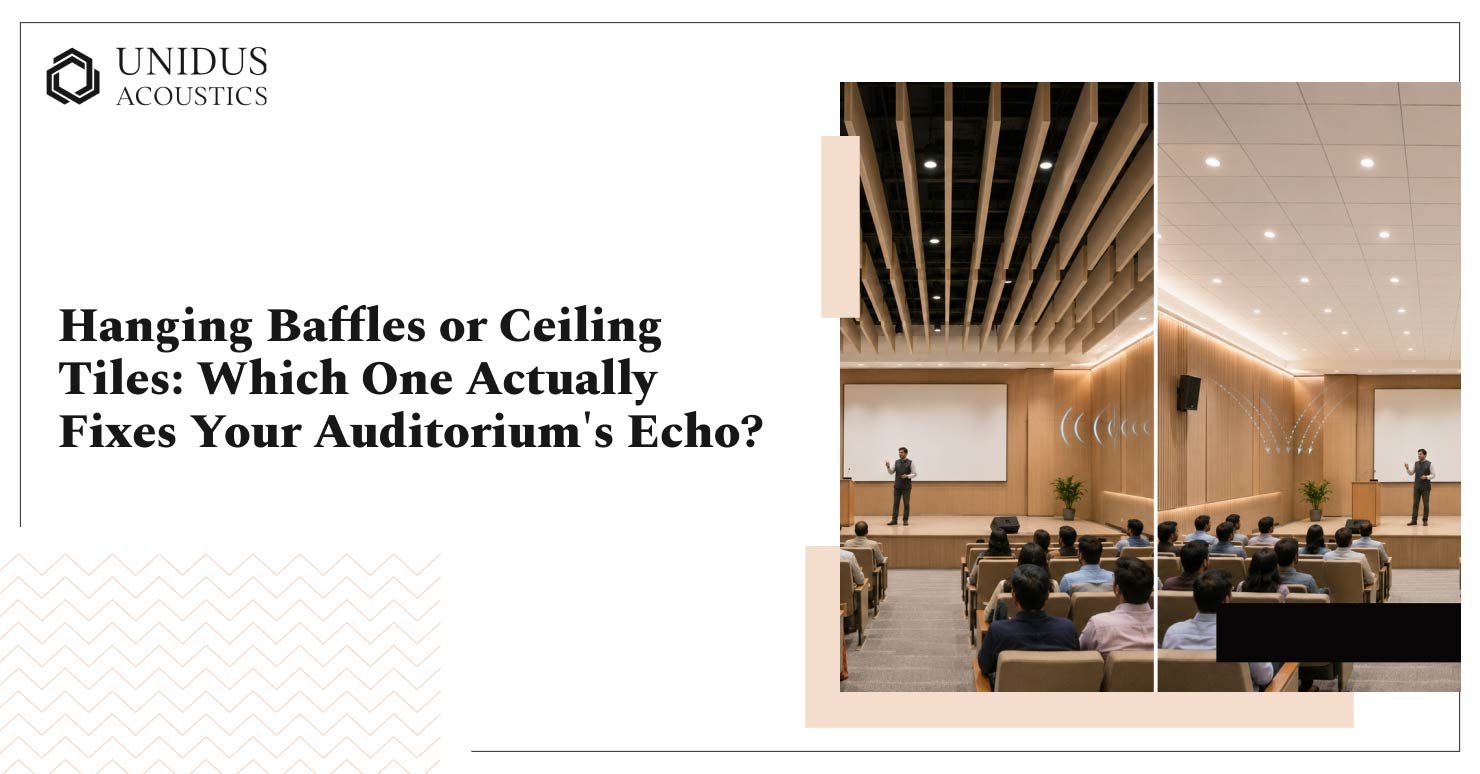
If your auditorium still sounds like a train station after the acoustic panels went up, the ceiling is probably why. Walls catch some of the noise, but sound bounces off a flat, hard ceiling and keeps travelling across the room. That’s what turns speech into a blur and applause into a long, muddy roar. Between hanging baffles and ceiling tiles, baffles tend to cut reverberation faster in large, high-ceilinged auditoriums. Tiles work better when you need a finished, serviceable ceiling with lighting and HVAC built in. Most auditoriums seating a few hundred people or more end up using both.
That’s the short answer. Here’s what actually decides it for your room.
Key Takeaways
- Hanging baffles expose two absorbing surfaces per panel, so they control reverberation faster than tiles in large, high-volume spaces.
- Ceiling tiles need a false ceiling grid, which works well when you also want to hide services or add a finished look.
- Ceiling height, existing structure, and how much of the ceiling is already committed to lighting and HVAC decide which product fits.
- Mixed-use auditoriums (lectures, performances, AV events) often need baffles over the stage or high zones and tiles across the rest of the ceiling.
- Get the room’s reverberation time (RT60) checked before locking either specification. That number tells you how much absorption you need, not the product.
Why the Ceiling Decides Your Echo Problem
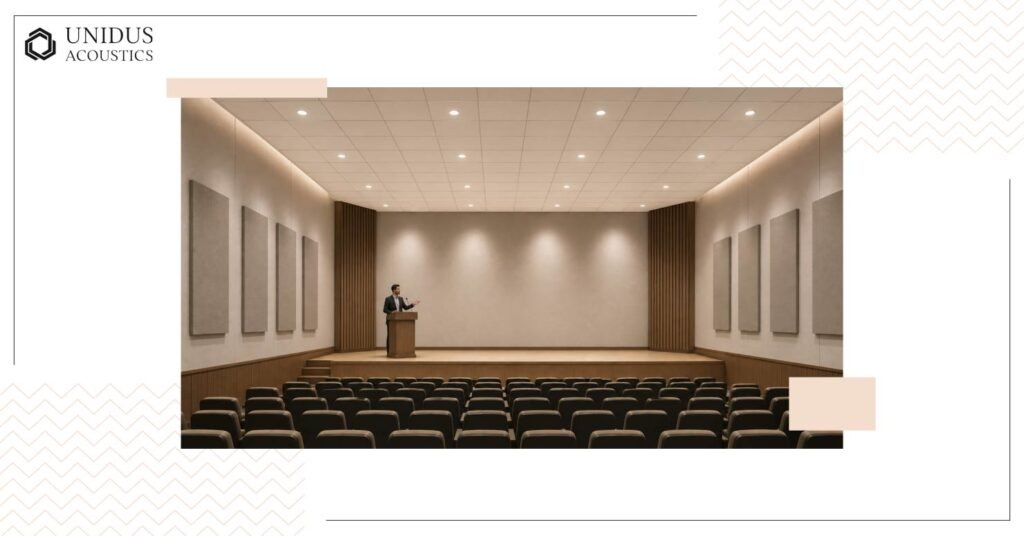
Sound doesn’t just travel outward from a speaker. It hits the ceiling, drops into the seating, hits the back wall, and comes back. In a large auditorium with a high ceiling, that ceiling is often the biggest untreated surface in the room, and wall panels alone can’t make up for it.
This is why a room can look fully treated (fabric panels along the side walls, a clean finish at the back) and still echo the moment someone speaks without a mic. The wall panels are catching reflections at ear level. Nothing overhead is catching them at all.
Reverberation time, or RT60, is what actually measures this. It’s the time it takes for sound to decay by 60 decibels after the source stops, and it’s measured in octave bands rather than as a single number. Speech-focused spaces generally need shorter RT60 than concert halls, since longer decay times that suit music start working against spoken clarity. This is the number your ceiling treatment needs to target, and it’s different from NRC, which measures how much sound a single material absorbs rather than how a whole room behaves. If you’re specifying wall panels alongside your ceiling, it’s worth checking the NRC rating of what you’re using so the two numbers actually work together.
What Hanging Baffles Actually Do
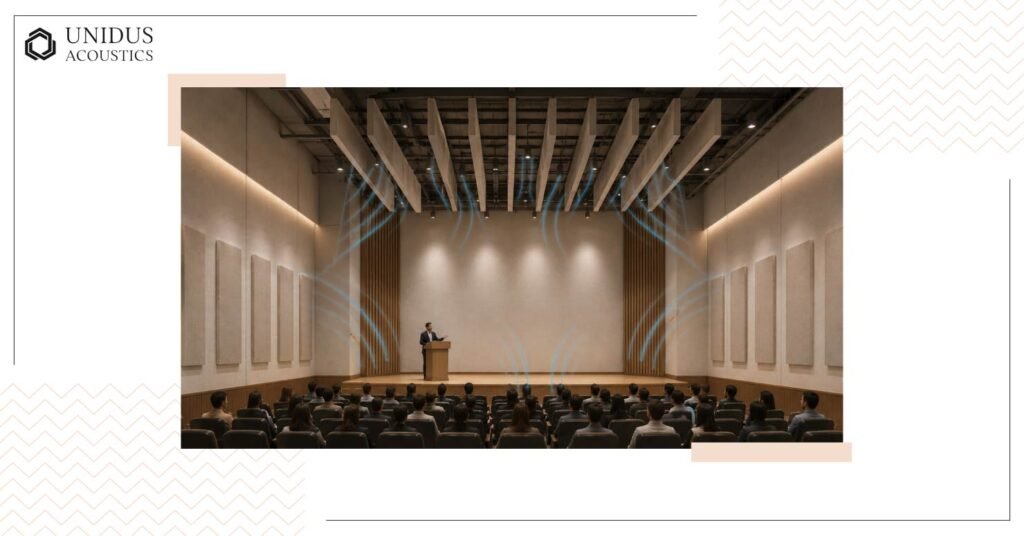
Baffles hang vertically or at an angle from the ceiling structure, either individually or in rows. Because they’re suspended rather than mounted flush, sound hits them from both sides, front and back. That means each panel absorbs more per square foot of ceiling than a flat, surface-mounted product would.
That makes baffles a strong fit for:
- Auditoriums with exposed ceilings or structural elements you’d rather not box in.
- Tall, open ceilings, where reflections travel a longer path before returning to the audience.
- Rooms where the echo problem is concentrated in one zone, over the stage or above a specific seating block, rather than spread evenly.
Grouped baffles, sold as clouds or canopies, do the same absorption work while reading as a design feature rather than a retrofit. This is also where a lot of auditorium briefs go wrong: the baffle count gets set before anyone works out where the reflections are actually landing. Specifying acoustic treatment by zone rather than by total square footage tends to solve this.
The trade-off: baffles don’t conceal anything. If your ceiling carries exposed conduit or ducting you’d rather not show, baffles alone won’t solve that part of the brief.
What Ceiling Tiles Actually Do
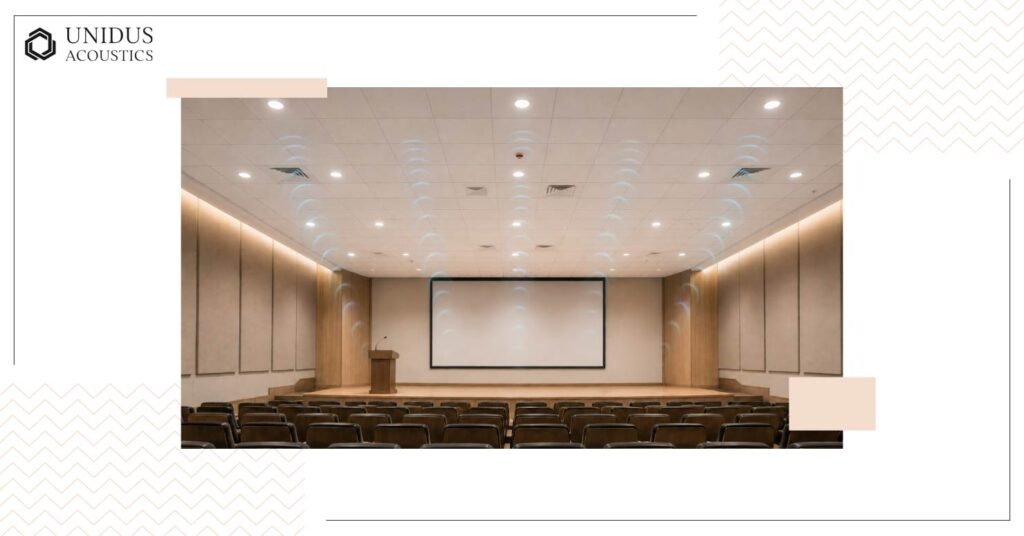
Tiles sit within a suspended grid, flush against the false ceiling line. They absorb sound from one face only, the room-facing side, but in exchange give you a ceiling that can carry lighting, HVAC diffusers, sprinklers, and cabling without any of it being visible from the seating below.
Tiles make more sense when:
- The auditorium needs a uniform, finished ceiling look, common in corporate auditoriums and conference-style halls.
- Electrical, AV, or HVAC runs need to sit above the ceiling line, out of sight.
- Ceiling height is on the lower side, where a suspended grid system gives consistent coverage without visual clutter.
Because tiles absorb from a single face, covering more ceiling area is usually needed to reach the same RT60 target that fewer baffles could hit in a taller room. That’s a function of geometry, not a shortcoming of the product. Once the grid is in, though, swapping acoustic ceiling tiles for higher-NRC ones later is a far smaller job than reworking a baffle layout, which is worth factoring in if the room’s use is likely to change.
Baffles vs Tiles: Side by Side
| Factor | Hanging Baffles | Ceiling Tiles |
|---|---|---|
| Absorption per panel | Higher, both faces exposed | Lower, single face exposed |
| Best ceiling height | Tall, open ceilings | Works well at most heights, especially lower ceilings |
| Hides services (wiring, ducting) | No | Yes |
| Visual style | Sculptural, suits exposed-structure ceilings | Clean and uniform |
| Installation | Suspended from structure | Needs a false ceiling grid |
| Best suited for | Large auditoriums, mixed-use halls, stage zones | Corporate auditoriums, conference and lecture halls |
Frequently Asked Questions
1. Do hanging baffles work as well as ceiling tiles for reducing echo?
For large, high-ceilinged rooms, baffles typically absorb more sound per panel since both faces are exposed. For smaller rooms or ones where services need to stay hidden, tiles are usually the more practical fit.
2. Can I use both baffles and ceiling tiles in the same auditorium?
Yes, and it’s common. A grid ceiling across the seating area combined with baffles or clouds over the stage or high zones works well in mid-to-large auditoriums where lighting and AV integration matter alongside acoustics.
3. How do I know how much ceiling coverage my auditorium actually needs?
That depends on the room’s reverberation time (RT60), shaped by volume, existing surfaces, and current absorption. It’s worth checking before finalising either product, since coverage area matters more than which product you pick first.
4. Do ceiling tiles reduce sound as effectively without a false ceiling?
No. Tiles are designed to sit within a suspended grid. Without it, you lose both the mounting system and the plenum space above that helps trap and dampen sound.
Neither Fixes Echo Just by Being Installed
The fix depends on how much of the ceiling’s absorption capacity actually gets used, which comes down to coverage and placement, not the material alone. A specification that scatters a handful of baffles across a 300-seat hall without concentrating them where speech reflections matter most, over the stage and the first several rows, tends to leave the room still echoing. The same baffles placed with intent change how the room sounds within days of use. This gap usually isn’t about a wrong call on the brief. It’s that acoustic coverage often gets finalised before anyone runs the room’s actual reverberation numbers.
If you’re working with a high, structurally exposed ceiling and want to move fast, baffles or clouds are usually the better starting point. If you’re building or renovating a corporate auditorium where lighting, AV, and HVAC integration matter as much as acoustics, a tile-based ceiling gives you both systems in one. For most mid-to-large auditoriums, the honest answer isn’t either-or. Baffles handle the high-volume zones near the stage or the tallest part of the ceiling. Tiles cover the rest, keeping the ceiling serviceable and finished.
At Unidus Acoustics, this is one of the more common calls we field on auditorium acoustic briefs, usually after a first round of wall treatment hasn’t solved the echo. If you’re specifying a ceiling and want a second read on coverage before you finalise it, contact us now.