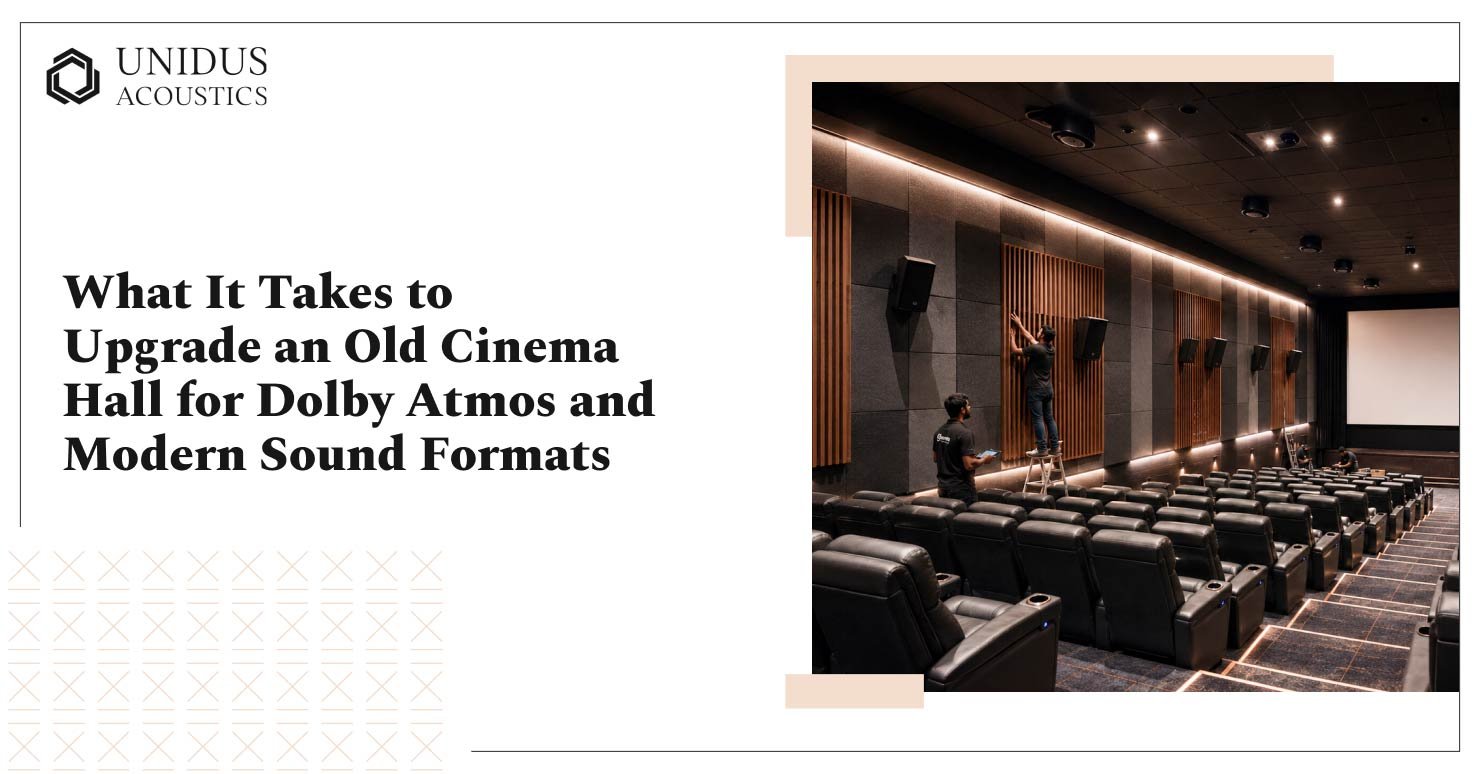
Upgrading an old cinema hall for Dolby Atmos starts with the room, not the speakers. Dolby’s own specification requires absorptive treatment around screen speakers and the side walls near them, and older auditoriums built for stereo or 5.1 sound rarely meet that already. Unidus Acoustics has seen this play out across entertainment properties. The acoustic work, ceiling access for overhead channels, wall absorption, and isolation between adjoining screens usually has to happen before or alongside the new speaker layout, not after.
Key Takeaways
- Dolby Atmos requires at least 50mm of absorptive treatment on walls and ceiling surfaces near screen speakers, a specification most older auditoriums don’t already meet.
- Adding overhead height channels needs ceiling access and structural capacity that older false ceilings weren’t built for.
- Reverberation control matters more in an Atmos auditorium, since a live room blurs the separation between overhead and screen channels.
- Bass from the Atmos low-frequency channel travels through partition walls more easily, so isolation between adjoining screens often needs upgrading too.
- Retrofitting an occupied multiplex screen by screen limits revenue loss, compared to closing the whole property for renovation.
- Acoustic treatment and Dolby Atmos speaker installation are separate scopes of work, usually handled by different specialists on the same project.
What Upgrading to Dolby Atmos Actually Requires From the Room
Dolby Atmos adds height channels and object-based audio to a cinema’s sound system, and both depend on how the room absorbs and isolates sound, not just on speaker count. Installing the speakers without addressing the room’s acoustics rarely delivers the format the way it was designed to sound.
Most cinema halls built for stereo or 5.1 sound weren’t designed with this in mind. That’s why an Atmos upgrade in an older auditorium is rarely just a speaker swap.
Why Don’t Older Auditoriums Meet Dolby Atmos Requirements?
Dolby’s cinema specification is specific about what the walls near the screen need to do. Where screen speakers aren’t baffled, the standard calls for at least 50mm of absorptive treatment on the nearby walls and ceiling. That treatment also extends to the side walls next to the left and right screen speakers, stopping sound from building up behind the screen and becoming audible as a smear inside the auditorium.
How Much Wall Absorption Does Dolby Atmos Need?
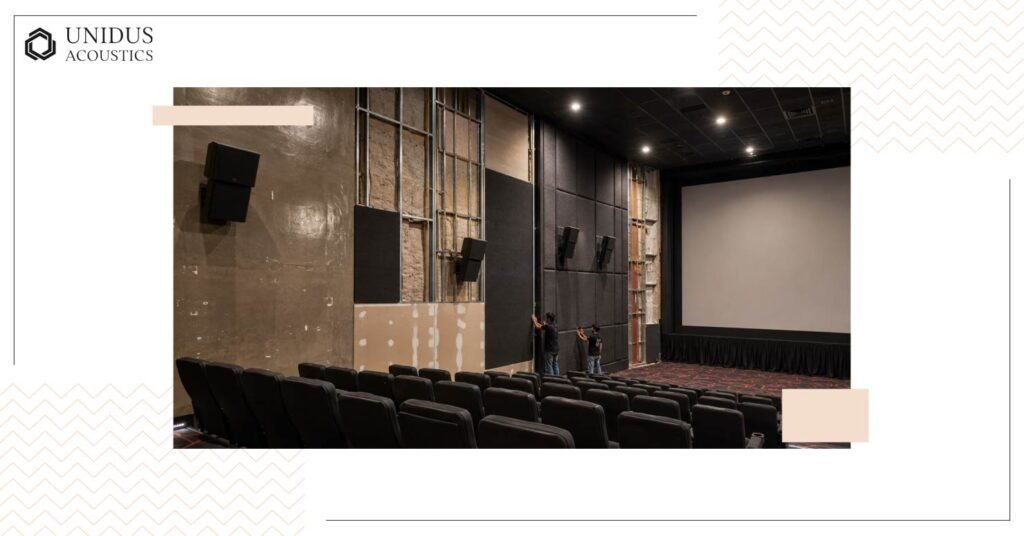
Older auditoriums typically used whatever wall finish suited the interior design brief at the time, and that was rarely 50mm of absorptive material near the screen. Painted walls, thin fabric over gypsum, or bare plaster in that zone reflect sound rather than absorbing it. The new speakers end up working against the format instead of with it.
Does Dolby Atmos Need More Reverberation Control Than Standard Cinema Sound?
Cinemas already need a short reverberation time for dialogue to stay intelligible. Atmos raises the bar further, since the format layers height and surround channels that need to stay separated from each other. A live, reflective shell blurs the height channel into the surrounds, which undercuts the effect the format is built to deliver.
What Ceiling and Wall Work Does a Dolby Atmos Retrofit Need?
The acoustic work usually happens in two zones. The ceiling, where the height channels sit, and the walls, where absorption near the screen and along the sides needs upgrading.
Overhead Speaker Zones and Ceiling Access
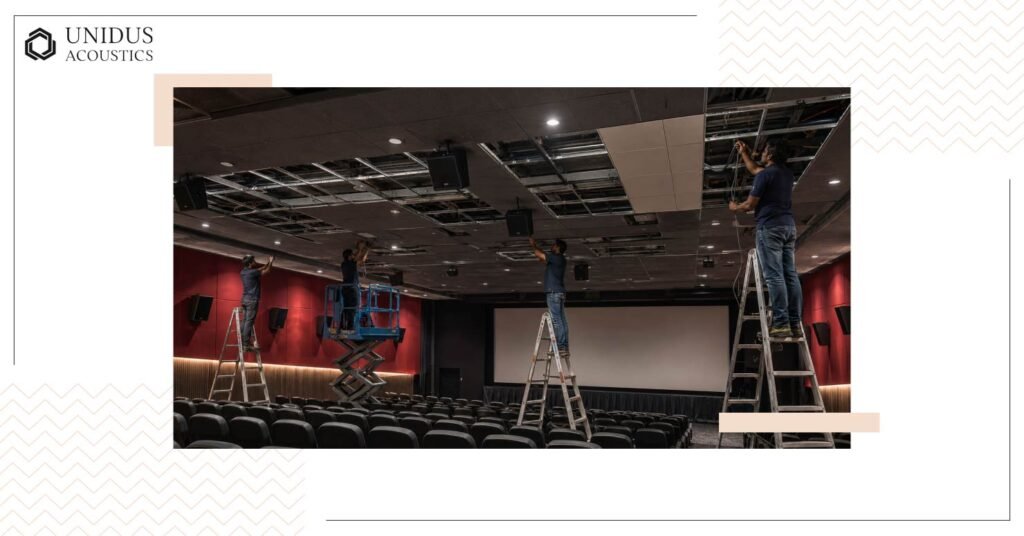
Height speakers need a ceiling structure that can hold their weight and give installers access to run cabling. Older false ceilings, built for a single centre cluster of house lights, rarely have either. Reinforcing the grid or replacing sections of the ceiling with an acoustic tile that also holds the required load is often part of the retrofit, not an optional add-on.
Side Wall and Rear Wall Treatment for Immersive Channels
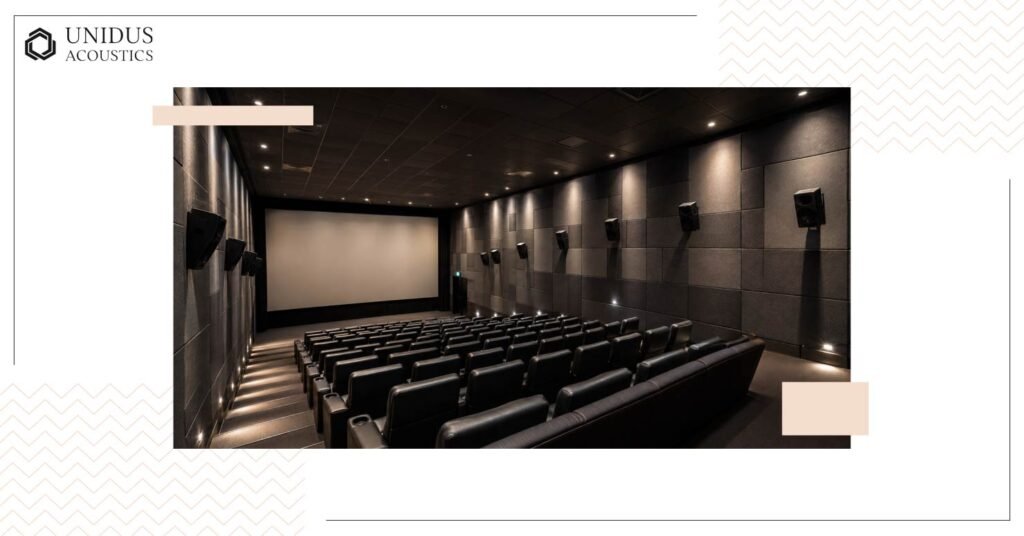
Surround and rear channels rely on side and rear walls behaving predictably, absorbing enough to avoid flutter echo without deadening the room completely. Full Tone or AcoustiSoft tiles, both rated up to NRC 0.90, are common choices for this zone, since they hit the absorption target without the bulk of thicker panel systems.
Sound Isolation Between Adjoining Screens
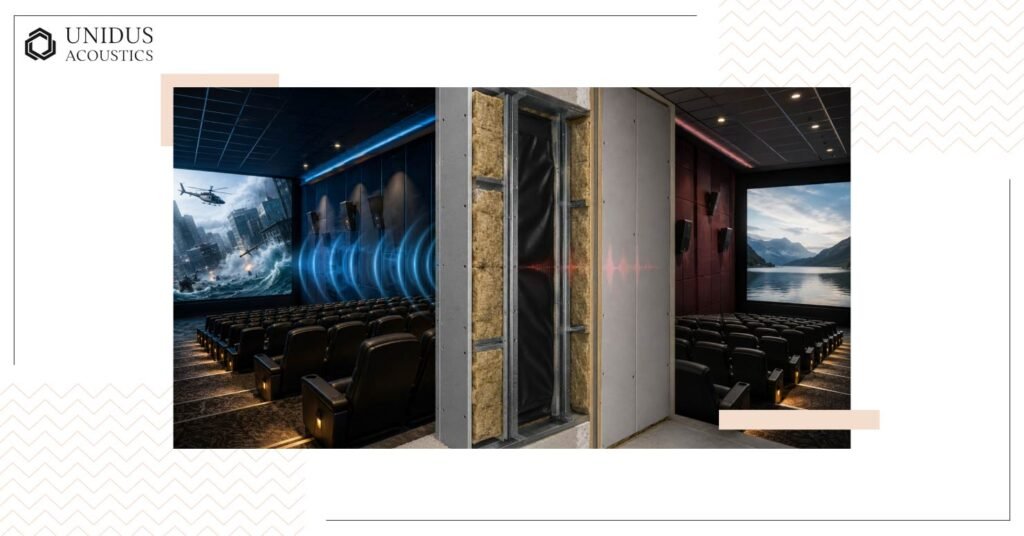
Atmos brings a dedicated low-frequency channel built to stay flat between 31.5 and 120 Hz, which means more consistent bass energy than a standard stereo or 5.1 mix. Bass travels through a partition wall more easily than midrange or treble, so a multiplex adding Atmos to one screen often finds the neighbouring screen more affected than before.
Sound deadening membrane inside the partition wall, rated for a specific STC value, addresses this separately from the wall panels facing into the auditorium. It’s worth checking during the same retrofit, even if only one screen is getting the Atmos upgrade.
What Areas of a Cinema Hall Need Treatment for a Dolby Atmos Retrofit?
Not every zone in the auditorium needs the same work. The table below breaks down where the priority sits for each part of the hall.
| Zone | Primary Concern | Typical Treatment |
|---|---|---|
| Screen wall and speaker baffle zone | Absorption per Dolby’s 50mm requirement | U-Tone Acoustic Panels or Fluted Panel, minimum 50mm build-up. |
| Side and rear walls | Reverberation control for surround channels | Full Tone Tile or AcoustiSoft Tile. |
| Ceiling above seating | Structural capacity for height speakers, plus absorption | Reinforced grid with AcoustiSoft or Full Tone tiles. |
| Partition wall to next screen | Bass isolation between auditoriums | Sound Deadening Membrane within the wall build-up. |
Can a Multiplex Upgrade to Dolby Atmos Without Closing Down?
Multiplexes rarely close every screen for a sound upgrade. Acoustic treatment and speaker installation both work screen by screen, usually scheduled around a property’s lowest-footfall days or overnight hours, so the rest of the multiplex keeps operating during the retrofit.
Unidus Acoustics doesn’t install or certify the Dolby Atmos speaker system itself. That’s the audio integrator’s scope, working to Dolby’s own specification and design tools. What falls within our scope is the room, the wall and ceiling treatment, and the isolation between screens that the speaker system depends on to perform the way it’s meant to.
Frequently Asked Questions
1. Does every cinema hall need acoustic treatment before adding Dolby Atmos?
Most older halls do. Dolby’s specification requires absorptive treatment near screen speakers and side walls, and few auditoriums built for stereo or 5.1 sound meet that already. A site assessment confirms exactly what your auditorium needs first.
2. Can Dolby Atmos speakers be installed without touching the ceiling?
Rarely. Height channels need ceiling-mounted speakers, which usually means structural checks and often ceiling replacement. Older false ceilings built for lighting alone seldom have the access or load capacity height speakers need.
3. Why does adding Atmos to one screen affect the screen next door?
Atmos includes a dedicated low-frequency channel with more consistent bass than standard formats, and bass travels through partition walls more easily than other frequencies. Adjoining screens often need upgraded sound isolation once one screen adds Atmos.
4. How long does a Dolby Atmos acoustic retrofit usually take per screen?
This depends on the extent of ceiling and wall work needed, and whether the screen closes fully or works around limited hours. A site assessment is the only reliable way to scope a timeline, since older auditoriums vary widely.
5. Does upgrading to Dolby Atmos always mean redoing the entire auditorium?
No. Many retrofits focus on the screen wall, ceiling zone, and side walls nearest the new speakers, since that’s where Dolby’s requirements concentrate. A full acoustic overhaul is usually only needed if existing finishes are in poor condition.
6. Does Unidus Acoustics install the Dolby Atmos speaker system as well?
No. We handle the room’s acoustic treatment, wall and ceiling absorption, and isolation between screens. The Dolby Atmos speaker system itself is installed and certified by an audio integrator working to Dolby’s specification.
Conclusion
Upgrading an old cinema hall for Dolby Atmos works best when the room is treated as part of the project, not an afterthought once the speakers arrive. Absorption near the screen, ceiling capacity for height channels, and isolation between screens usually decide whether the format sounds the way it’s meant to.
Unidus Acoustics brings 40+ years of expertise across corporate, institutional, and entertainment spaces, backed by SGS, Intertek, and TÜV Rheinland certification. Our product range is built for exactly this kind of acoustic retrofit. If you’re planning a Dolby Atmos upgrade and want a site assessment, reach out to us now.