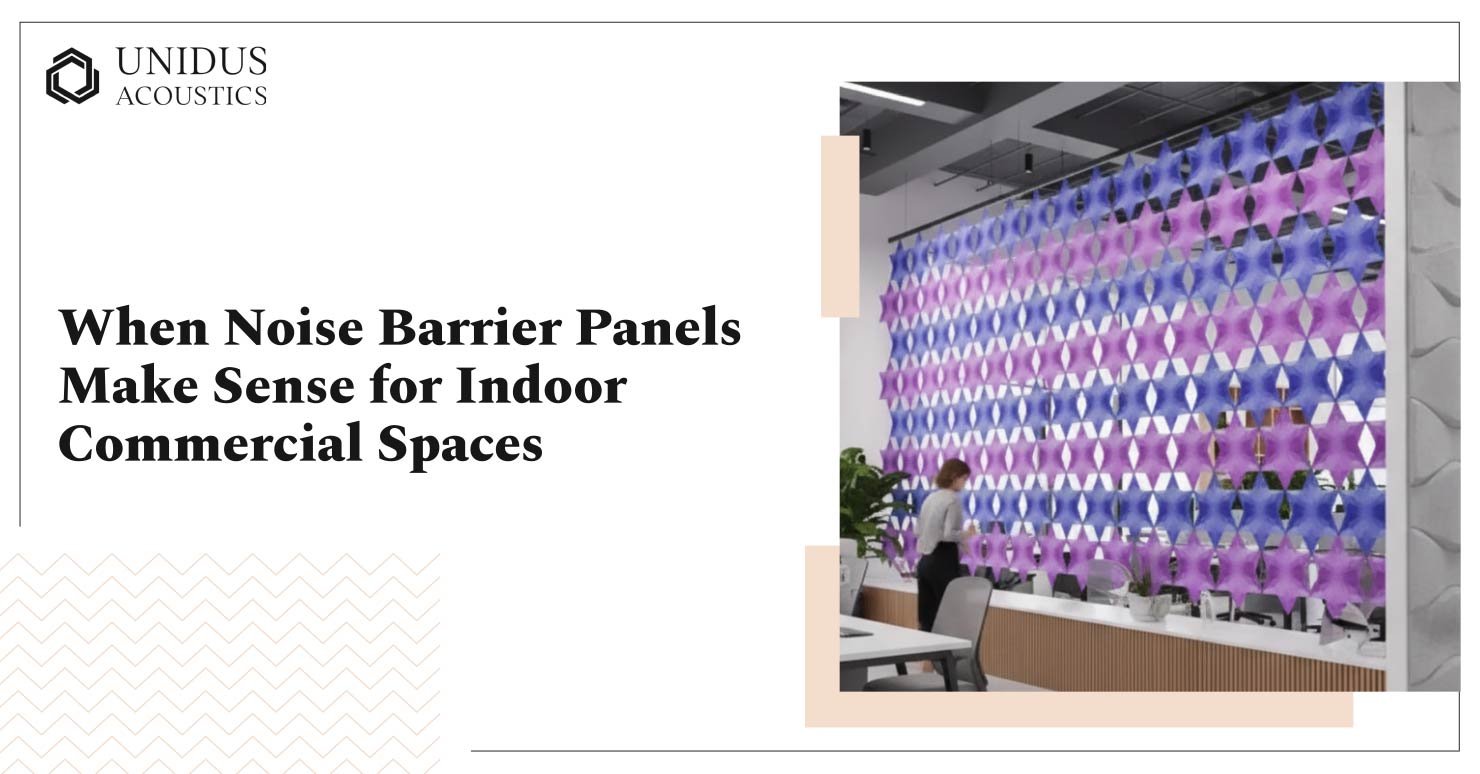
Architects and facility teams often reach for “noise barrier panels” when what they actually need is acoustic absorption, or the other way round. At Unidus Acoustics, this mix-up is one of the most common specification questions we get, mainly because the two products solve completely different problems. This guide breaks down what a barrier panel actually does, the handful of situations where it’s the right call, and where it won’t touch the issue at all.
Key Takeaways
- Noise barrier panels block sound from crossing a wall or partition. An acoustic panel absorbs sound already inside a room. Treating the two as interchangeable is the most common specification error on commercial projects.
- Barrier panels earn their place when a loud, ongoing source, a generator room, a loading bay, a pump room, or a busy pantry, sits right next to a space that needs to stay quiet.
- Mass, not softness, is what stops sound from travelling. Dense, layered materials block transmission; foam and fibre absorbers were never built for that job.
- A single nearby conversation can cut a worker’s concentration by up to two-thirds, but in most open offices that’s a reverberation and layout problem, not one a barrier panel can fix.
- Barrier panels add weight, thickness, and usually cost. Before specifying one, confirm the complaint is about sound crossing a partition and not sound bouncing around inside the room itself.
- In spaces carrying both problems, a shared wall letting noise through and a room that echoes on its own, combining a barrier layer with an absorptive finish is what holds up.
A noise barrier panel is a dense, mass-loaded acoustic product engineered to block airborne sound from passing through a wall, ceiling, or partition, rather than to absorb sound already present in a room.
What Are Noise Barrier Panels
Noise barrier panels are built to stop airborne sound from passing through a wall, ceiling, or partition. It works on a simple physical principle: sound has to push a lot of mass out of its way to get through, and the heavier and more layered the material, the less energy makes it to the other side.
That’s a different job from what most people picture when they hear “acoustic panel.” An acoustic panel absorbs sound that’s already inside a room, cutting down echo and reverberation so speech stays clear and a space doesn’t feel harsh. It does little to stop sound from leaving the room in the first place. We’ve written about this distinction in more depth in Soundproofing vs Acoustic Treatment: What You Actually Need, but the short version matters here: confuse the two, and a client ends up with an expensive wall of foam that looks the part but doesn’t solve the actual complaint.
Why the Confusion Happens
The confusion usually starts with marketing language. Plenty of products get called “soundproof” or “noise reducing” regardless of whether they block sound or absorb it. A spec sheet that leads with Noise Reduction Coefficient (NRC), a measure of absorption, rarely makes clear that it says nothing about how the product performs on transmission. NRC and Sound Transmission Class (STC) measure two entirely different things, and a product can score well on one while doing almost nothing for the other, a distinction most vendor literature glosses over.
When Noise Barrier Panels Are the Right Call
Barrier panels justify their cost and weight in a handful of situations where sound needs to be kept out, not tamed.
Mechanical and Plant Rooms Next to Occupied Space
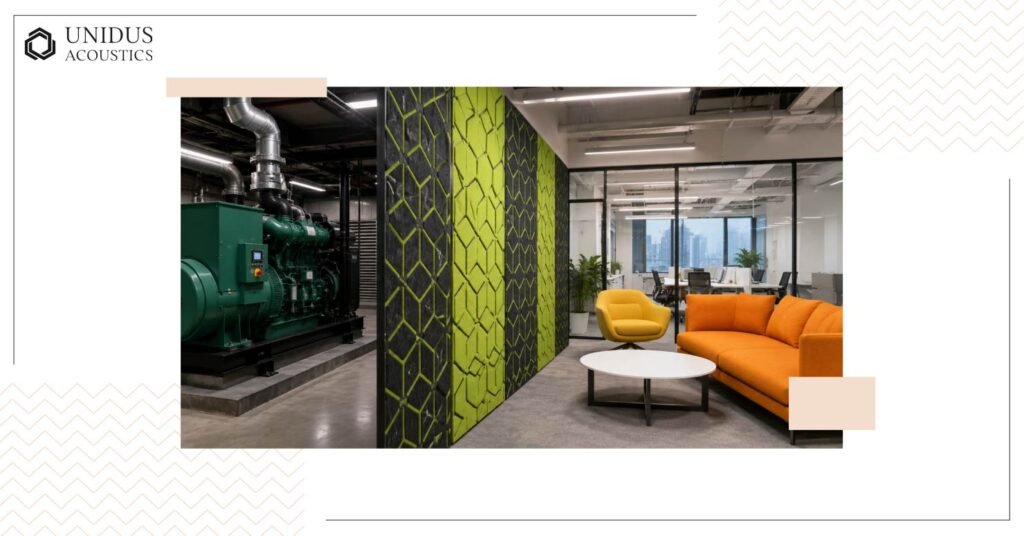
Generator rooms and HVAC plant produce continuous, high-decibel noise that doesn’t fluctuate with the workday. When one of these sits beside a boardroom, a reception area, or office floor plates, a barrier layer inside the shared wall is usually the only thing that keeps the noise from becoming a daily complaint.
Loud Pantries or Break-Out Zones Beside Conference Rooms
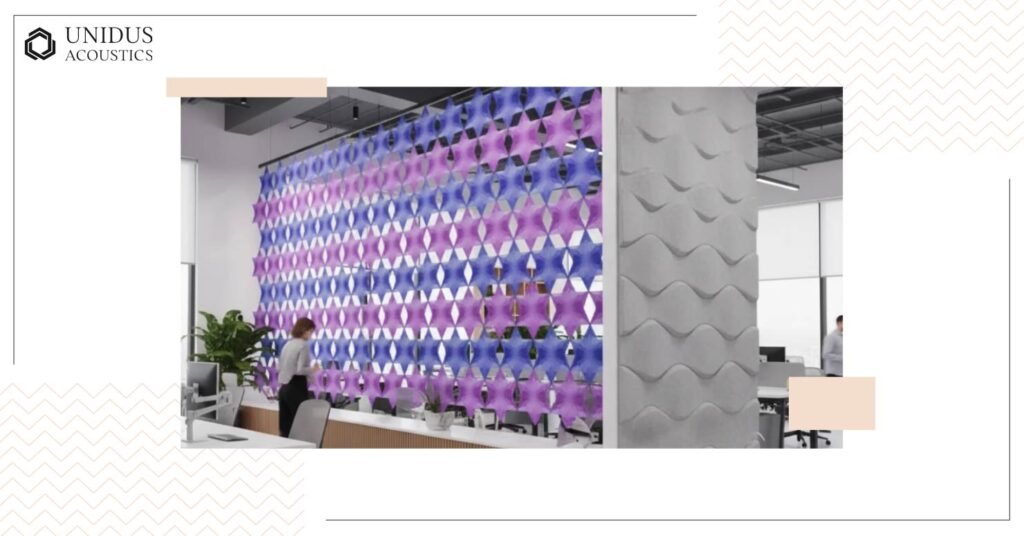
Pantries with grinders, blenders, ice makers, and constant footfall are noisier than most architects budget for at the design stage. If one sits adjacent to a meeting room where confidentiality matters, a barrier panel in the dividing wall protects the conversation on the other side far more reliably than an absorptive finish ever could.
Shared Walls in Multi-Tenant Office Buildings
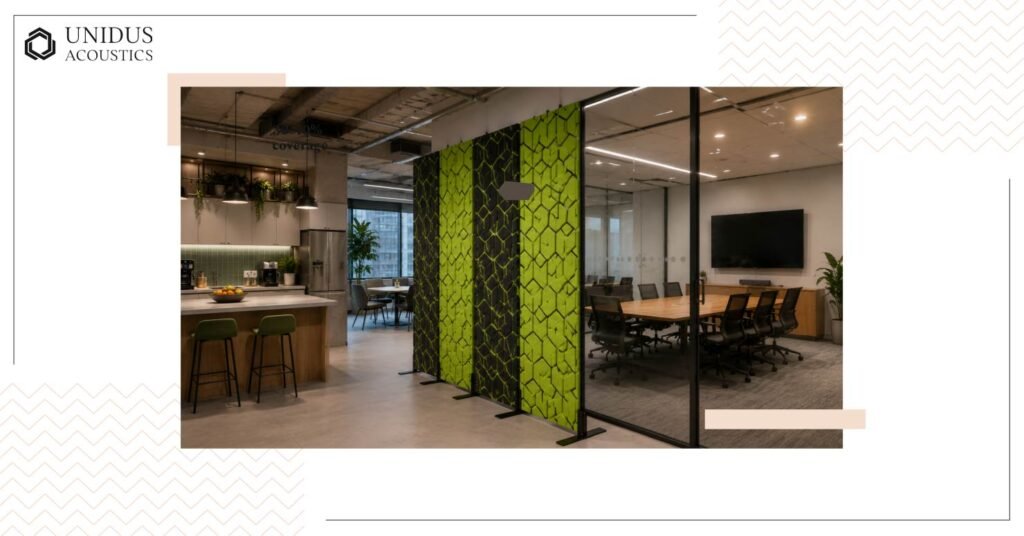
Two tenants sharing a partition wall often end up with completely different acoustic needs, one running an open, high-energy floor, the other needing quiet for calls and focused work. A barrier panel in that shared wall addresses the actual point of failure: sound crossing between tenancies, not noise within either one.
Auditoriums and Boardrooms Facing External Road or Corridor Noise
Rooms used for presentations, board meetings, or recorded sessions are sensitive to background intrusion in a way open workspaces aren’t. If an auditorium or boardroom backs onto a busy corridor, a lift lobby, or a road-facing wall, a barrier system built into that wall keeps external noise from bleeding into a space where clarity matters.
Where a Barrier Panel Won’t Solve the Problem
Most open-office noise complaints have nothing to do with sound crossing a wall. They’re about speech and activity noise bouncing around inside the room employees already occupy.
None of that gets fixed by a barrier panel, because there’s no partition for the noise to cross. What that situation needs is absorption, ceiling baffles, wall-mounted acoustic panels, acoustic clouds, or soft furnishings, placed to interrupt reflected sound before it reaches someone’s desk. Specifying a barrier product here adds cost without touching the source of the complaint.
What to Check Before You Specify

A few questions, asked before the drawings are finalised, save a lot of rework later.
- Confirm whether the complaint is about sound crossing a wall or reverberating within a room; the fix is different for each, and no single product does both well.
- Check the construction of the partition itself. A barrier layer added to a wall with gaps, unsealed penetrations, a weak door, or an unsealed duct won’t perform, because sound will flank around it regardless.
- Decide early if the space needs a combined system. Rooms with both a transmission problem and an internal echo problem need a barrier layer and an absorptive finish working together, not either alone.
- Where budget allows, get an acoustic consultant to verify assumptions with actual testing rather than relying on catalogue figures for the finished assembly.
For a broader view of how barrier materials fit alongside other insulation options, our guide to sound insulation materials walks through the main categories architects choose between.
Noise Barrier Panels vs. Acoustic Absorption Panels
| Aspect | Noise Barrier Panels | Acoustic Absorption Panels |
|---|---|---|
| What it does | Blocks sound from passing through a wall, ceiling, or partition. | Reduces echo and reverberation inside a room. |
| Core material property | Mass and density. | Porosity and surface texture. |
| Typical placement | Inside a wall cavity or as a dense layer within the partition build-up. | Mounted on room surfaces such as walls and ceilings. |
| Best suited for | A loud zone sitting next to a quiet one. | Echo and speech clarity within a single room. |
| Visual presence | Usually hidden inside the construction. | Visible as a decorative finish within the room. |
Frequently Asked Questions
1. What is the difference between noise barrier panels and acoustic panels?
Noise barrier panels block sound from passing through a wall or partition using mass and density. An acoustic panel absorbs sound that’s already inside a room, reducing echo and improving speech clarity. They solve different problems and aren’t interchangeable.
2. Can a noise barrier panel reduce echo inside a room?
Not effectively. Barrier panels are built to stop transmission, not to absorb reflected sound. A room with an echo problem needs an absorptive product, not a barrier one, even if the barrier panel is installed correctly.
3. Where should noise barrier panels be installed in a commercial building?
They work best inside or against shared walls between a loud zone and a quiet one: plant rooms beside offices, pantries beside conference rooms, partition walls between tenants, or auditoriums backing onto busy corridors.
4. Do noise barrier panels need to be combined with other acoustic treatments?
Often, yes. If the same space also has an internal reverberation problem, a barrier layer alone won’t address it. Combining a barrier product with an absorptive finish covers both the transmission and the echo.
5. How is a noise barrier panel different from a sound deadening membrane?
A sound deadening membrane is one common form a noise barrier product takes: a thin, dense, mass-loaded layer added within a wall, ceiling, or floor build-up to block transmission. Unidus Acoustics manufactures this as a standalone product for exactly this purpose. Our guide to when MLV-based sound deadening makes sense covers this in more detail.
6. Does installing a noise barrier panel guarantee complete silence between two rooms?
No. Sound can still flank around a barrier through gaps, doors, ducts, or unsealed joints, no matter how good the panel itself is. A barrier panel is one part of a properly sealed assembly, not a standalone guarantee.
Getting the Specification Right the First Time
Noise barrier panels do one job well: stopping sound from moving between spaces that need to stay acoustically separate. Confirming that’s the actual problem, before ordering a product built for it, is what keeps a project on budget and solves the client’s complaint.
Unidus Acoustics has spent over 40 years building custom acoustic solutions for Indian commercial spaces, including mass-loaded barrier systems like our Sound Deadening Membrane, engineered for the shared-wall problems architects run into on live projects. If you’re specifying for a space with a real transmission issue, we can walk through the assembly with you and recommend what fits the brief.