Partition wall sound insulation is the application of materials and construction methods to reduce airborne sound transmission between adjacent spaces, measured by Sound Transmission Class (STC), where a higher number indicates better acoustic isolation.
In practical terms, partition wall sound insulation covers every design and material decision that affects how much sound passes through an interior dividing wall, whether that wall is gypsum board on studs, a glass partition system, or a modular demountable product.
These decisions are far easier to get right at the specification stage than after handover, when an undersized partition becomes a costly retrofit problem. This guide covers 6 partition wall sound insulation methods that work in commercial office environments, along with the conditions under which each makes sense.
Key Takeaways
- Partition wall sound insulation works best when it addresses mass, cavity fill, decoupling, and airtightness together, not any single method in isolation.
- STC ratings of 45-52 are typically needed for speech privacy in meeting rooms and private offices.
- Partitions that stop at ceiling height, without plenum treatment, lose most of their rated isolation performance.
- Acoustic panels on partition surfaces reduce reverberation within a room but do not improve a wall’s STC rating.
- Even a well-rated partition performs poorly if gaps at skirting, around service penetrations, or above the suspended ceiling are left unsealed.
Why Partition Wall Insulation Matters in Office Fit-Outs
Lack of speech privacy is one of the biggest sources of workplace dissatisfaction in open-plan offices, and it directly affects whether meeting rooms, focus zones, and confidential spaces function as intended. Office noise is not a minor inconvenience: it affects cognitive performance, error rates, and whether employees can do the work the space is designed to support.
Office noise is not a minor inconvenience; it affects cognitive performance, error rates, and whether employees can actually do the work the space is supposedly designed to support.
India’s acoustic insulation market is expected to grow at a CAGR of 7.62% from 2025 to 2030, driven in part by design professionals increasingly recognising acoustic specification as a core deliverable rather than an optional upgrade.
How Each Partition Wall Sound Insulation Method Works and When to Use It
1. Insulation Fill in the Wall Cavity
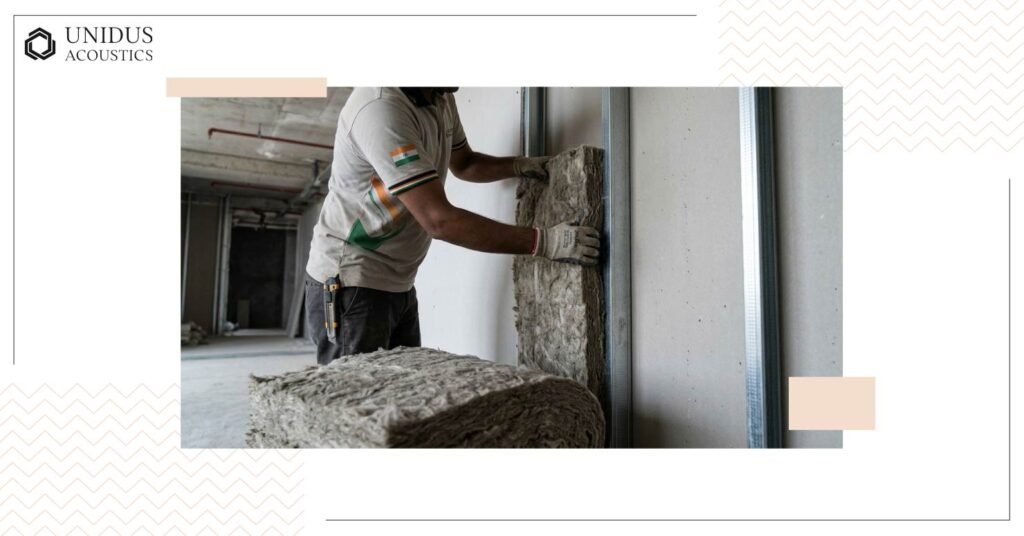
Adding stone wool or glass wool insulation inside the partition wall cavity is one of the most cost-effective baseline improvements in commercial fit-outs. An unfilled cavity creates an air column that resonates and transmits sound efficiently. A fibrous insulation fill absorbs that sound energy within the wall assembly, converting it to heat through friction.
Stone wool is commonly specified here because it handles acoustic and thermal performance together and resists moisture. Cavity fill alone increases partition STC by approximately 5-8 points, depending on construction, which makes it a baseline requirement in most commercial specifications.
Limitation: Cavity fill works best against mid- to high-frequency sound; low-frequency noise from HVAC or mechanical plant needs additional mass or decoupling.
2. Adding Mass to Partition Walls
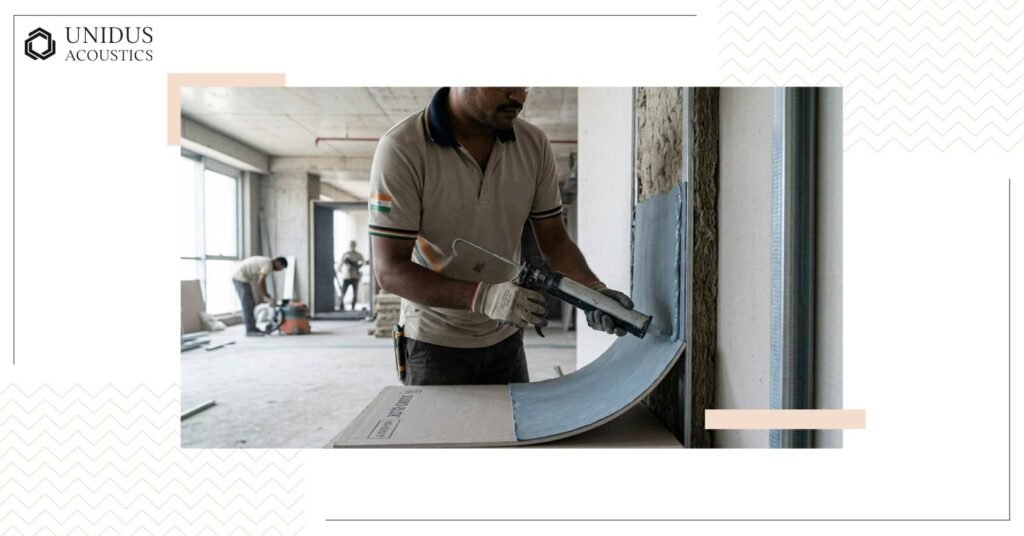
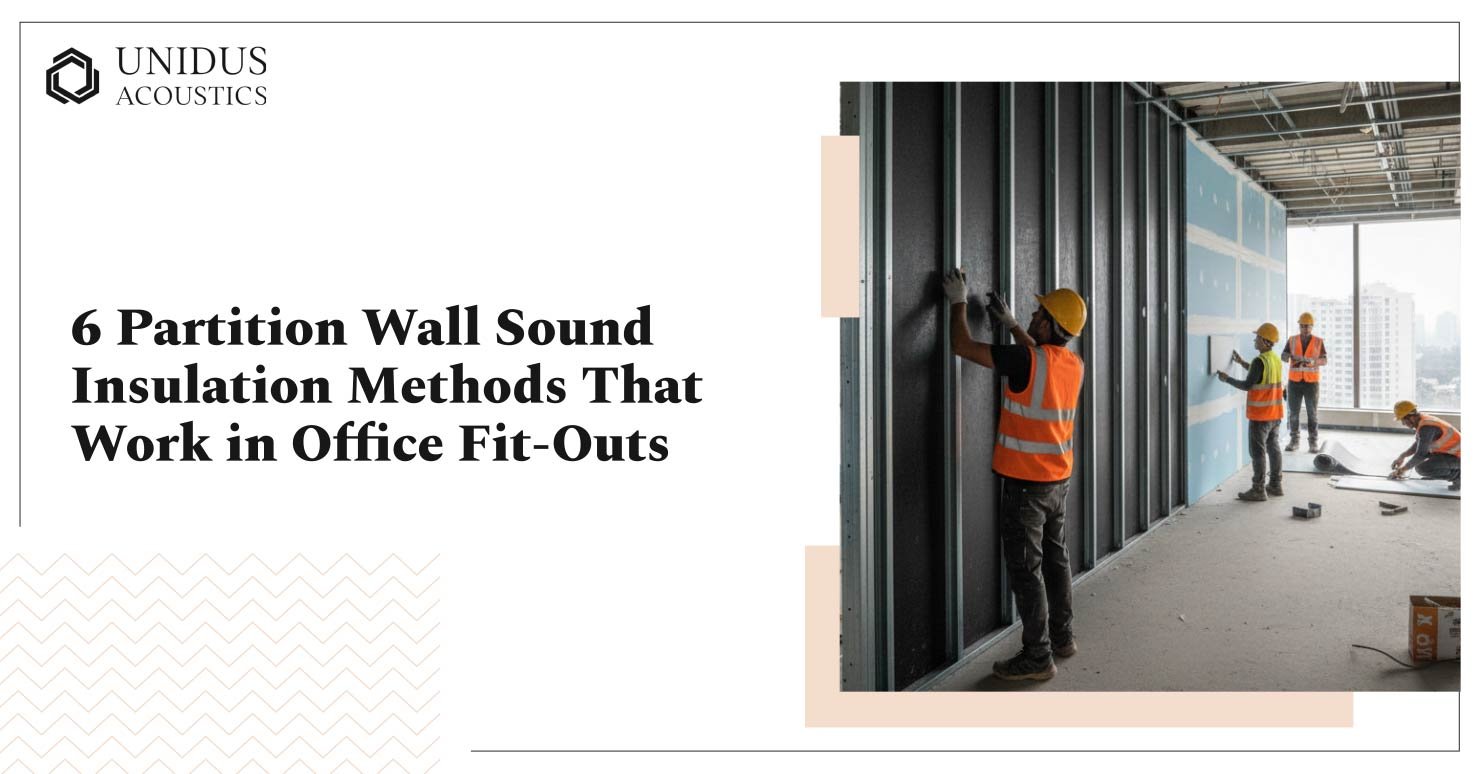
Mass is one of the core principles of sound isolation: denser, heavier walls transmit less sound energy than lighter ones. The standard approach in commercial fit-outs is specifying double-layer gypsum board, higher-density wallboard, or a sound-dampening membrane between finish layers.
Each additional 12mm gypsum layer adds approximately 5-7 STC points to a standard stud partition, depending on fixing and whether studs are shared. Double-layer specification is now common for enclosed spaces requiring basic speech privacy, including HR rooms, focus areas, and small meeting rooms.
Limitation: Extra layers increase wall thickness, affecting floor plans and adding structural load across large wall areas.
3. Decoupled Stud Framing
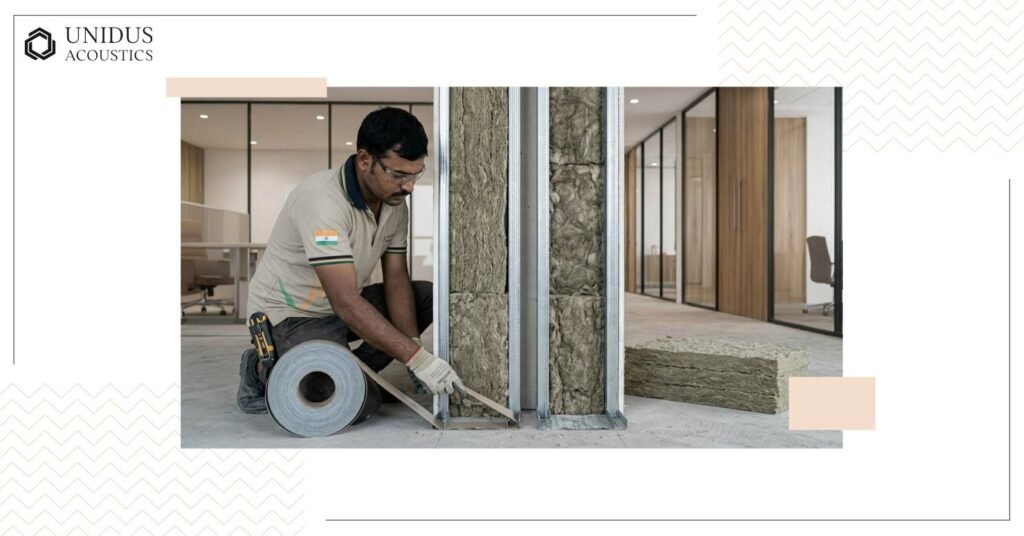
Decoupling physically separates the two sides of a partition so sound vibration cannot travel directly through the structural framing. Two approaches are used in practice: staggered stud framing, with rows of studs alternating on a wider sole plate without touching, and double stud walls, with two separate frames and an air gap between them.
Decoupling blocks mid- and low-frequency sound and is required where STC ratings above 50 are needed, such as boardrooms or any room where a confidential conversation needs to stay that way. It adds 50-100mm of wall thickness beyond a standard partition, so it needs to be coordinated at the layout planning stage rather than added later.
Limitation: The added thickness affects usable floor area, and works best combined with cavity fill and double-layer boarding.
4. Acoustic Panels Mounted on Partition Surfaces
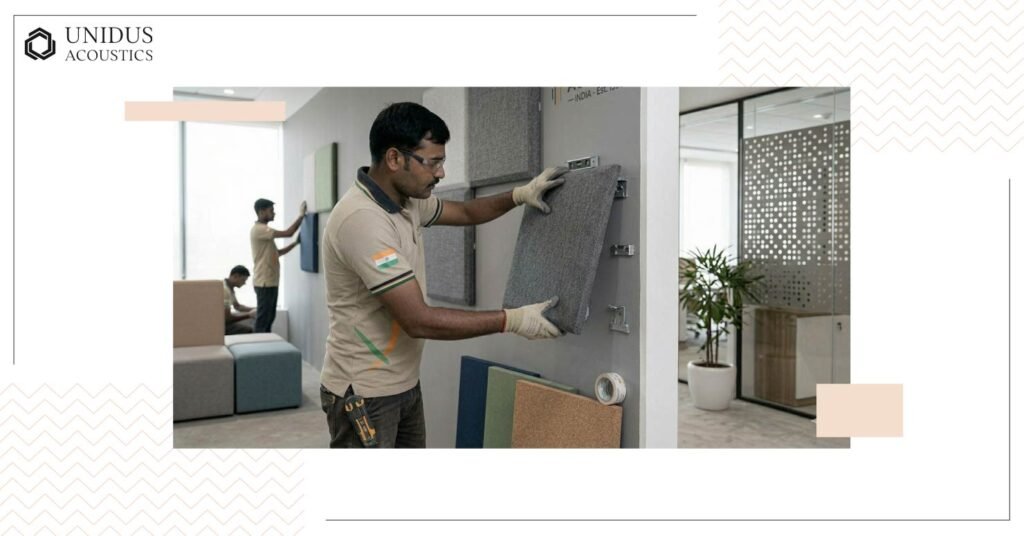
Acoustic panels mounted on partition surfaces do not increase STC ratings, a distinction worth stating clearly because it is regularly misunderstood on site. What they do is reduce reverberation within a room, absorbing reflected sound before it builds up and adds to the ambient noise level.
Specified correctly, acoustic wall panels address echo and reverberant noise in open-plan areas and collaboration zones. They come as fabric-wrapped polyester fibre, stone wool boards with decorative facings, or perforated rigid panels. NRC values vary by material and thickness. A 12mm recycled polyester fibre panel, such as Unidus Acoustics’ U-TONE range, typically achieves NRC 0.70-0.90 depending on surface treatment, and is available in 64+ shades.
Limitation: Acoustic panels are a room-treatment measure, not a partition-isolation measure, and should be specified alongside structural wall insulation methods, not instead of them.
5. Mass-Loaded Vinyl (MLV)
Mass-loaded vinyl is a dense, limp, flexible membrane that adds significant mass to a wall assembly without adding much thickness. It is installed between layers of wallboard, either adhered to the stud framing or hung within the partition cavity before boarding.
MLV is most useful in two situations: retrofits where adding structural layers isn’t feasible, and thin-profile applications where every millimetre of wall thickness affects layout. It particularly helps with mid-frequency sound transmission, where many standard partitions fall short.
Limitation: MLV costs more per square metre than an equivalent gypsum layer, so for new-build fit-outs, additional boarding is usually the more economical choice. It becomes cost-effective in retrofit and upgrade projects.
6. Full-Height Partitions with Plenum Treatment
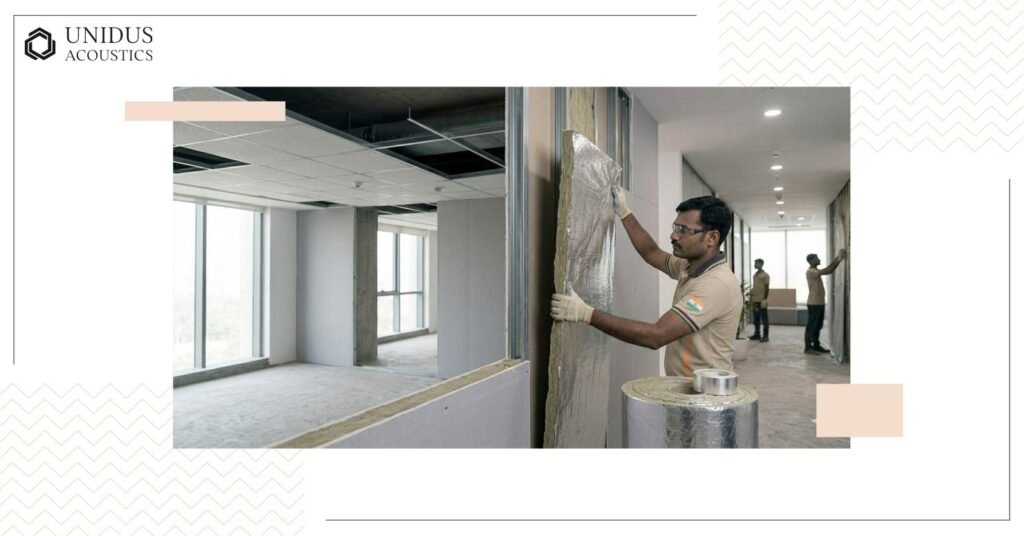
A partition that stops at the suspended ceiling, without extending to the structural slab above, creates an open flanking path. Sound travels up over the partition, across the ceiling void, and down into the adjacent room. This is one of the most common specification oversights in commercial office fit-outs, and one of the most acoustically significant.
Extending the partition from floor to structural slab (full-height) eliminates the plenum path entirely, and is the more reliable specification for enclosed rooms requiring speech privacy. Where mechanical services, ductwork, or structural elements make full-height walls difficult to execute, treating the plenum with a lightweight acoustic barrier, typically stone wool with foil facing or MLV, works alongside the suspended ceiling to block the flanking path instead.
Limitation: Full-height partitions need coordination with structural drawings, MEP runs, and ceiling specifications early in the design process. Retrofitting them after fit-out is far more disruptive than specifying them from the start.
Comparison: Which Partition Wall Insulation Method Suits Your Space?
| Method | STC Impact | Best For | Main Limitation |
|---|---|---|---|
| Cavity insulation fill | +5–8 points | All enclosed spaces, baseline spec | Less effective against low-frequency noise |
| Additional wall mass (gypsum layers) | +5–7 per layer | Meeting rooms, private offices, focus rooms | Adds wall thickness, affects floor plan dimensions |
| Decoupled stud framing | +10–15 points | Boardrooms, confidential rooms, executive offices | Significant thickness increase, layout coordination needed |
| Acoustic panels on surfaces | No STC change | Open-plan areas, reverb control, collaboration zones | Does not reduce sound transfer between rooms |
| Mass-loaded vinyl (MLV) | +3–7 points | Retrofits, tight-profile upgrades, thin-wall situations | Higher cost per STC point vs. additional gypsum boarding |
| Full-height partition / plenum barrier | Restores design STC | All enclosed rooms where speech privacy is required | Requires coordination with MEP and structural drawings |
Frequently Asked Questions
1. Can insulation be added to an existing partition wall without demolishing it?
In most cases, no, since insulating a cavity requires access to the inside of the wall. For existing partitions, options include an additional surface layer of gypsum board or MLV, better sealing at gaps and service penetrations, or treating the ceiling plenum above. Combined, these can meaningfully improve performance without demolition.
2. How much does a sound proof wall partition cost in a commercial fit-out?
Costs vary by method: a standard single-stud partition with cavity fill costs far less per square metre than a decoupled double-stud system with high-density boarding. Getting the specification right upfront delivers better value for money than retrofitting after handover.
3. How do acoustic panels differ from soundproof wall partitions?
Acoustic panels absorb reflected sound energy within a room, reducing echo and reverberation, while a soundproof partition physically blocks sound from passing between adjacent rooms. The two address different problems. Panels mounted on partition surfaces improve in-room acoustics, but don’t add to the wall’s STC rating or improve sound isolation between spaces.
Conclusion
Partition wall sound insulation in office fit-outs is a system, not a single material decision. Mass, decoupling, cavity fill, and plenum treatment each address a different part of how sound moves through and around a wall, and when one element is missing, the overall performance suffers regardless of how well the others are specified.
At Unidus Acoustics, we work with architects and interior designers across India to help them balance form and function in commercial acoustic specifications, from the right wall panel systems through to delivery on time and to budget. With 40 years of expertise and 635+ completed projects, we offer custom acoustic solutions that fit the design intent without compromising on performance. We help our clients turn noise into harmony.
To discuss a project or request our product catalogue, contact us at hi@unidusindia.com, call +91-9625332290, or visit unidusindia.com.