Mineral fibre acoustic ceiling tiles are suspended ceiling panels made from natural and recycled mineral materials, designed to absorb airborne sound within a space and, in higher-performance products, to reduce sound transmission through the ceiling plane into adjacent rooms.
But not all mineral fibre tiles perform the same way. NRC, CAC, fire rating, humidity resistance, edge profile, and surface texture choices all affect which product is right for which space. Specifying without understanding those differences often results in rooms that underperform acoustically, even when the ceiling looks exactly as intended.
This guide covers what mineral fibre acoustic ceiling tiles are, how they work, what the key performance metrics mean, and how to approach specification for different commercial environments.
Key Takeaways
- Mineral fibre acoustic ceiling tiles work by absorbing sound within the room (NRC) and, in higher-spec products, blocking sound from passing through the ceiling plenum into adjacent spaces (CAC).
- NRC ratings for mineral fibre tiles typically range from 0.55 to 0.90, depending on thickness, density, and surface texture.
- CAC (Ceiling Attenuation Class) matters as much as NRC for enclosed rooms like meeting rooms and private offices, where ceiling-path sound transfer is a concern.
- Surface texture affects acoustic performance: pinhole and fine fissured finishes absorb more sound than smooth painted surfaces. Field painting reduces NRC.
- Standard size is 595x595mm, compatible with most T-bar suspension grids. Edge profiles (Square, Microlook, Tegular) affect both aesthetics and installation.
What Are Mineral Fibre Acoustic Ceiling Tiles?
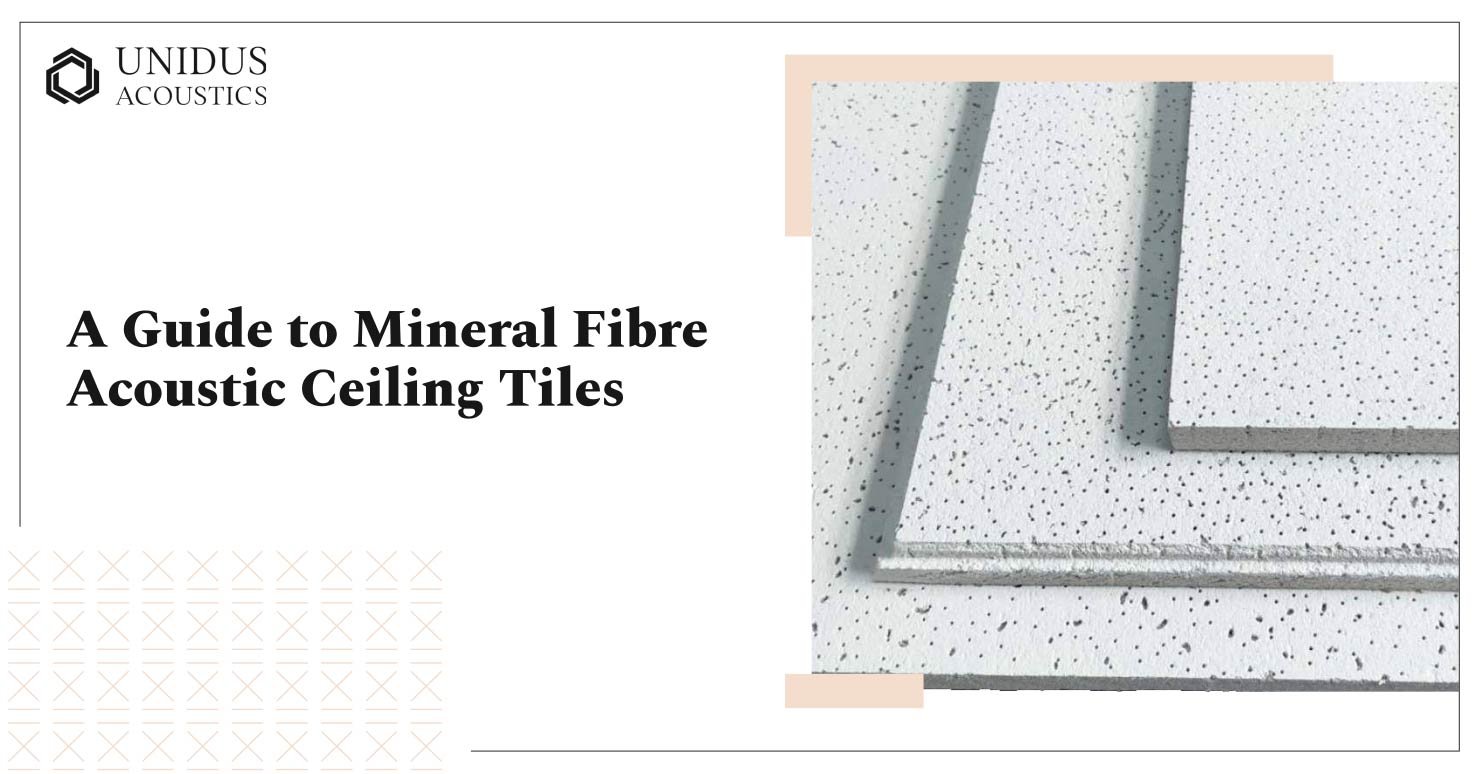
Mineral fibre acoustic ceiling tiles are manufactured from a blend of materials that typically includes mineral wool or slag wool, perlite, starch binders, and clay. The manufacturing process forms these materials into a slurry, which is then pressed into tiles, dried, and surface-treated.
This produces a lightweight, non-combustible tile that sits in a standard T-bar grid. Tiles are either laid in (resting on the grid flange) or clipped in, depending on the edge profile. They can be replaced individually when damaged, which makes them practical for commercial spaces with ongoing maintenance requirements.
In the Indian market, mineral fibre tiles are widely used in offices, educational institutions, hospitals, and government buildings for their combination of acoustic performance, fire compliance, and value for money in large-area ceiling applications.
How Do Mineral Fibre Acoustic Ceiling Tiles Absorb Sound?
Sound absorption happens when sound waves enter a porous material and lose energy through friction as the waves interact with the fibres inside. Mineral fibre tiles work because their internal structure is open and fibrous enough for sound waves to penetrate, but dense enough to dissipate the energy before it reflects back into the room.
Two factors determine how much sound a tile absorbs: thickness and surface porosity. Thicker tiles provide more material for sound energy to travel through and dissipate within. Surface porosity, which depends on the face texture, determines how much sound can actually enter the tile body in the first place. A pinhole or fine fissured face allows more sound energy into the tile than a smooth painted surface does, which is why surface treatment directly affects NRC performance.
This also explains why repainting mineral fibre tiles in the field, a common maintenance approach in older offices, reduces acoustic performance. The paint fills the micro-pores in the surface that make absorption possible.
Understanding the Key Performance Metrics Before Specifying
Three metrics matter most when specifying mineral fibre acoustic ceiling tiles for commercial projects: NRC, CAC, and fire rating. They measure different things and should not be traded off against each other without understanding what each controls.
NRC: Noise Reduction Coefficient
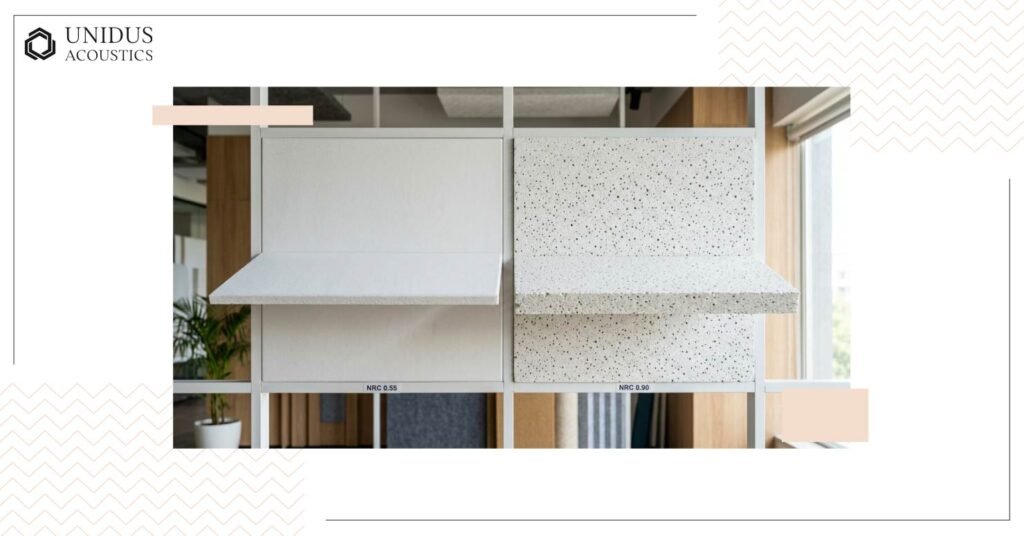
NRC is a single-number rating that indicates how much sound energy a material absorbs. A tile with NRC 0.75 absorbs 75% of the sound that hits it and reflects the remaining 25% back into the room. For open-plan commercial offices, NRC 0.75 or higher is typically specified. For enclosed rooms with significant soft furnishings (upholstered seating, carpet, curtains), NRC 0.65 can be adequate because the furnishings contribute additional absorption.
Mineral fibre tiles generally achieve NRC values between 0.55 and 0.90. Products at the lower end are typically thinner (12mm) with smoother surface treatments. Products at the higher end are thicker (18-20mm), denser, and carry more open-face textures like pinhole patterns.
CAC: Ceiling Attenuation Class
CAC measures how well a ceiling tile blocks sound from traveling upward through the tile, across the plenum void, and downward into an adjacent room. This matters most in layouts where partition walls stop at the suspended ceiling height, because the ceiling becomes a shared sound path between rooms. A high NRC tile with low CAC does not prevent confidential conversations from escaping through the ceiling.
Tiles with CAC 35 and above are considered high-performance for sound isolation. Standard mineral fibre tiles typically achieve CAC 23-35. Where both NRC and CAC performance are required, such as meeting rooms that also need good in-room acoustics, specifying a tile that meets minimum thresholds on both metrics is essential.
Fire Rating
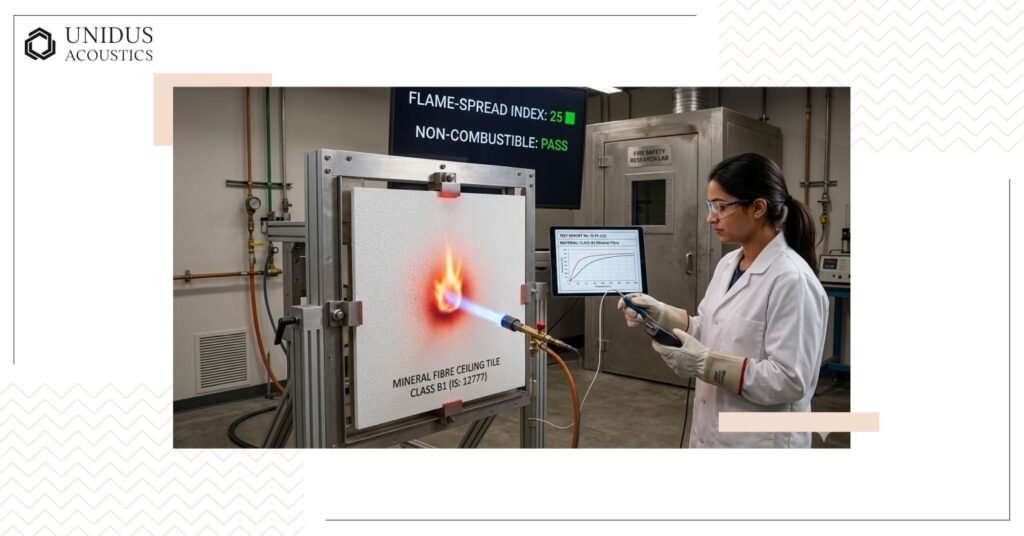
Mineral fibre tiles are non-combustible and typically carry Class A (or Class B1 in Indian classification) fire ratings, meaning they have a flame-spread index of 25 or less. For commercial applications in India, the specification should confirm the fire rating explicitly against project requirements and local building code. Mineral fibre’s non-combustible nature makes it suitable for applications across office, institutional, and healthcare environments without additional treatment.
Mineral Fibre vs Other Ceiling Tile Materials
Mineral fibre is not the only option for acoustic suspended ceilings. Understanding how it compares to fibreglass and perforated metal tiles helps narrow the specification to the right material for the space.
| Property | Mineral Fibre | Fiberglass | Perforated Metal | Wood Wool |
|---|---|---|---|---|
| Primary material | Natural/recycled minerals | Glass fibres | Steel or aluminium | Wood wool + cement binder |
| Typical NRC range | 0.55–0.90 | 0.75–1.00 | Depends on backing | 0.40–0.75 |
| Typical CAC range | 23–40 | 15–25 | 10–25 (without backing) | Low |
| Fire rating | Class A / B1 | Class A | Class A | Class A / B1 |
| Humidity resistance | Moderate (grade-dependent) | High | High | Good (moisture-resistant grade) |
| Design range | Wide (textures, edge profiles) | Moderate (smooth finishes) | High (patterns, cutouts) | Moderate (natural texture) |
| Typical use case | Offices, education, healthcare | High-humidity or cleanroom environments | Design-forward commercial spaces | Auditoriums, community halls, educational |
Where Mineral Fibre Acoustic Ceiling Tiles Work Best
Mineral fibre acoustic ceiling tiles are a practical specification across a wide range of commercial environments. The spaces below represent where they consistently deliver on both acoustic and operational requirements.
Open-Plan Offices
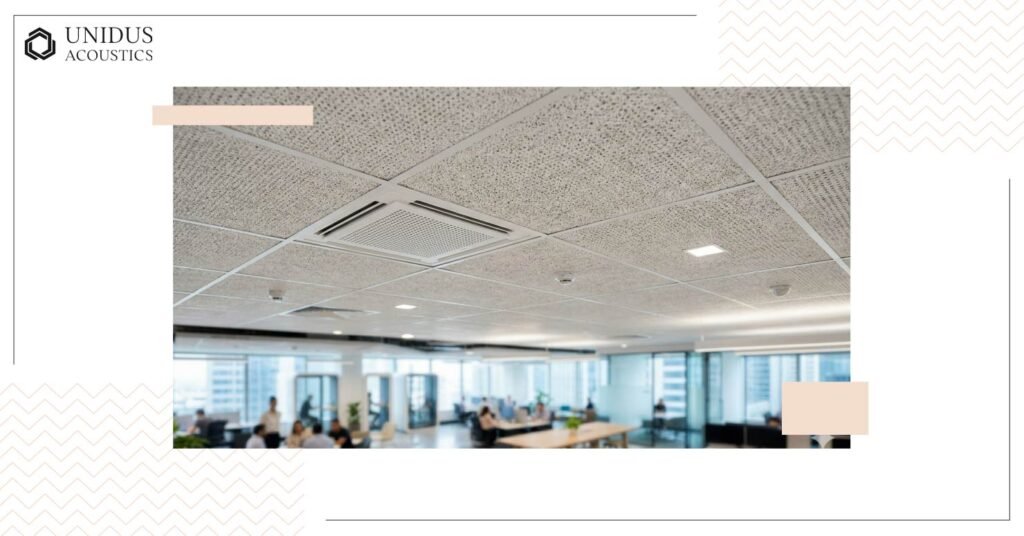
In open-plan layouts, the ceiling is typically the largest continuous surface available for sound absorption. Specifying high-NRC mineral fibre tiles across the ceiling plane reduces ambient noise levels and shortens reverberation times. Shorter reverberation makes speech less intelligible at distance, which reduces distraction in the open floor, and makes it easier for people to hold conversations without raising their voices.
For open-plan offices, NRC 0.75 is typically the minimum useful specification. Spaces with hard flooring, glass partitions, or exposed concrete surfaces elsewhere in the palette need higher NRC ceilings to compensate.
Meeting Rooms and Conference Rooms
Meeting rooms need a ceiling tile that handles two things: controlling echo within the room and limiting sound transfer to adjacent spaces. That means looking for products that meet NRC 0.75 or above and CAC 35 or above in the same tile. Lower-performance tiles can address one or the other, but rarely both.
A meeting room ceiling with high NRC but low CAC will sound good inside but allow conversations to escape through the plenum. A ceiling with high CAC but low NRC will isolate sound effectively but leave the room acoustically harsh, with noticeable echo and speech fatigue during longer calls and meetings.
Educational and Institutional Buildings

Schools, training centres, university seminar rooms, and government buildings regularly specify mineral fibre tiles for their balance of acoustic performance, fire compliance, and long-term maintenance practicality. The tamper-proof and corrosion-resistant surface treatments available on commercial-grade mineral fibre products suit environments with higher traffic and more demanding maintenance cycles than a typical corporate office.
Healthcare Facilities
Hospitals and clinics present a specific combination of requirements: acoustic performance for patient privacy and staff concentration, hygiene surfaces that can be wiped down, and non-combustible materials. Mineral fibre tiles with disinfectable surface treatments and Class A fire ratings are well-suited to healthcare ceiling specifications, and their humidity resistance ratings should be checked against the specific area, since clinical spaces near wet areas require higher-grade products.
What to Look for When Specifying Mineral Fibre Ceiling Tiles
Several decisions at specification stage have a direct effect on both performance and long-term appearance. These are the factors worth confirming before finalising the product selection.
Edge Profile
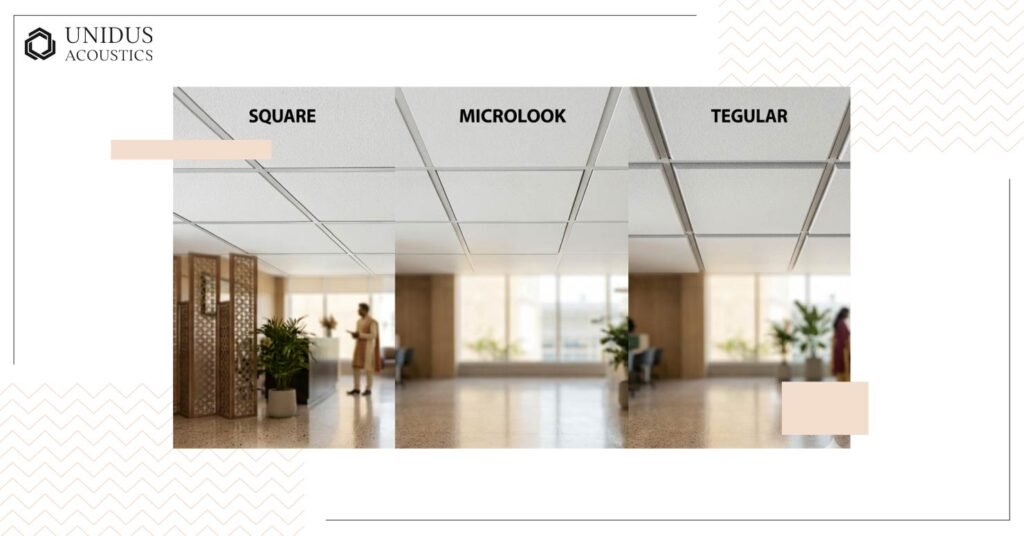
The three standard edge profiles are Square (creates a visible grid line), Microlook (a finer reveal that reduces the visual grid), and Tegular (a stepped edge that creates a shadow line at the grid, giving the ceiling more visual depth). Edge profile does not significantly affect acoustic performance, but it affects how the ceiling reads from below and should be coordinated with the interior design intent.
Surface Texture and NRC Correlation
Pinhole and fine fissured textures are standard for high-NRC applications. Smoother surfaces, while visually cleaner, reduce sound absorption. If the design requires a smooth finish but acoustic performance is also a priority, specifying a thicker tile (18-20mm) with a more open texture is a better approach than compensating elsewhere.
Humidity Rating
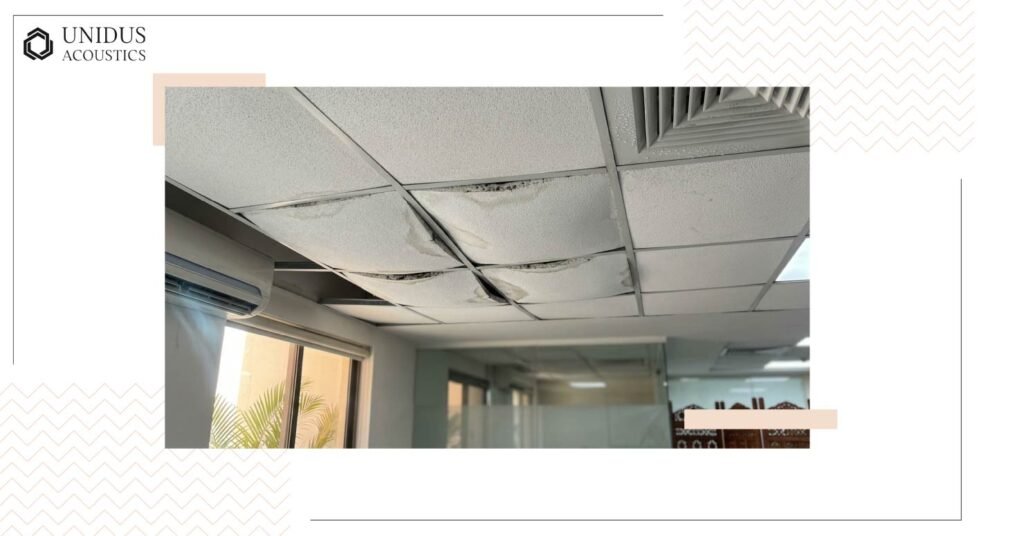
Standard mineral fibre acoustic ceiling tiles have humidity performance limits that vary by product grade, and the specific rating should be confirmed against the product data sheet. Spaces near HVAC discharge points, areas with significant temperature cycling, or zones near wet areas need tiles with higher humidity ratings. Specifying the wrong humidity grade causes visible sagging over time, which is a maintenance and appearance problem even if acoustic performance is nominally unaffected.
Suspension Grid Compatibility
The standard 595x595mm format is compatible with most commercial T-bar suspension grid systems. Non-standard sizes require custom grid coordination, which affects both lead time and cost. Where an existing grid is being retained in a refurbishment, confirming tile-to-grid compatibility before ordering avoids site-level delays.
Frequently Asked Questions
What NRC rating do mineral fibre acoustic ceiling tiles typically achieve?
NRC varies by product. Standard 12mm mineral fibre tiles with a painted surface typically achieve NRC 0.55-0.65. Thicker products (15-20mm) with pinhole or fine fissured textures can reach NRC 0.80-0.90. Specifying for open-plan offices, the general guidance is NRC 0.75 as a minimum, with higher values warranted in spaces with little other soft furnishing or absorption.
Can mineral fibre acoustic ceiling tiles be painted after installation?
Painting mineral fibre tiles is not recommended where acoustic performance matters. The paint fills the surface pores that allow sound to enter the tile, reducing NRC noticeably. Some manufacturers allow a single coat of specified latex paint with minimal performance impact, but field painting should always be confirmed against the product’s warranty terms before it is done on site.
What is the difference between NRC and CAC for mineral fibre acoustic ceiling tiles?
NRC measures how much sound a tile absorbs within the room, controlling echo and reverberation. CAC measures how much sound a tile blocks from escaping through the ceiling plane into an adjacent room. For open-plan spaces, NRC is the primary metric. For meeting rooms and private offices with walls that stop at the suspended ceiling, both NRC and CAC need to meet their respective targets.
Are mineral fibre acoustic ceiling tiles fire-rated?
Yes. Mineral fibre is a non-combustible material, and commercial mineral fibre tiles typically carry Class A or Class B1 fire ratings, depending on the product and the certification standard applied. For commercial and institutional projects in India, the specification should confirm fire rating compliance explicitly, as requirements vary by building occupancy type.
Conclusion
Mineral fibre acoustic ceiling tiles are a specification workhorse in commercial interiors because they deliver acoustic performance, fire compliance, and design flexibility in a format that is familiar to contractors and easy to maintain. Getting the selection right comes down to matching NRC and CAC targets to the room’s function, choosing a surface texture and thickness that deliver the required absorption, and confirming humidity and edge compatibility before the order is placed.
At Unidus Acoustics, we manufacture the U-TONE Mineral Fibre Tile range for commercial ceiling applications. The range offers thickness options from 12 to 20mm, texture choices including Pinhole (Tegular and Square edge), Fine Fissured, and Pintex, and edge profiles in Square, Microlook, and Tegular. Tiles are tamper-proof and corrosion-resistant, with a standard size of 595x595mm for straightforward compatibility with commercial grid systems.
With 40+ years of expertise across 635+ completed projects in 16 cities, we deliver custom acoustic solutions for architects, interior designers, and institutional clients who need ceiling systems that balance form and function. We support specifications at the design stage, not just after the brief is locked.
To discuss your ceiling specification or request the product catalogue, contact us now.