
Acoustic panel certifications are third-party lab reports and certificates that back up what a datasheet claims about fire safety, indoor air quality, sound absorption and material content. On a commercial project in India, a claim counts as certified only when it comes with a named lab, the standard it was tested against, a test date and a report number; anything less is the supplier’s own statement.
Key Takeaways
- “Certified” can mean an accredited lab report, a product certification mark or a supplier’s own unverified claim, and the three aren’t the same thing.
- Four categories matter for commercial interiors: fire safety (reaction-to-fire), indoor air quality (VOC emissions), acoustic performance (NRC and sound absorption), and environmental or material credentials.
- Green building ratings such as IGBC and LEED score a whole project; they sit a layer above the product-level test reports that back up an individual panel.
- A proper test certificate names the lab, describes the sample precisely, cites a dated standard and carries a report or batch number. A marketing claim usually leaves most of that out.
- Our 9mm polyester fibre board has independent fire test results (DIN 4102 Class B1, UL 94), and our catalogue carries sound absorption and VOC emission reports; third-party certificates from SGS, Intertek and TÜV Rheinland are available on request.
What Certified Means for an Acoustic Panel
A certification is a claim backed by an independent third party that tested a specific product sample against a named standard and put its name on the result. That’s the full definition. It implies a lab that doesn’t work for the manufacturer, a documented and repeatable test method, and a report that can be produced on request, with a date, a sample description and a result that either passes or doesn’t.
The words get used loosely in conversation, so it helps to separate three documents. A test report is the primary record, issued by the lab, describing the exact sample tested and the result. A certificate is sometimes a summary of that report and sometimes a broader scope document, such as a factory’s management system instead of one product, issued by a certification body. A self-declaration is the manufacturer stating a performance figure with no third party involved at all. It’s legitimate as an engineering estimate. It isn’t something a fire consultant or a client’s compliance team should accept as equivalent to an accredited result.
None of these is automatically wrong to use. The trouble starts when a self-declaration gets presented with the confidence of a certificate and nobody checks which one they’re looking at.
Accreditation is easy to overlook. A lab can be a well-known name and still not be accredited for the specific test in your report. Accreditation under ISO/IEC 17025 is granted method by method, so the lab’s published scope should list the standard on your certificate, whether that’s ASTM C423 for absorption or ISO 16000 for emissions.
The pressure to get this right has grown. Corporate occupiers increasingly ask procurement teams to document indoor air quality and sustainability credentials before a fit-out is approved. Government and PSU projects often attach certification requirements to empanelment and tender documents. Green building assessors want specific test reports as supporting evidence, not product brochures. A purchase manager or an interior contractor sitting between the design intent and a vendor’s claims needs a working sense of which certifications carry weight.
The 4 Categories of Certification That Matter
Most of what gets checked on a commercial interiors project falls into four buckets, and a supplier worth working with should be able to produce something in each.
1. Fire Safety and Reaction-to-Fire Testing
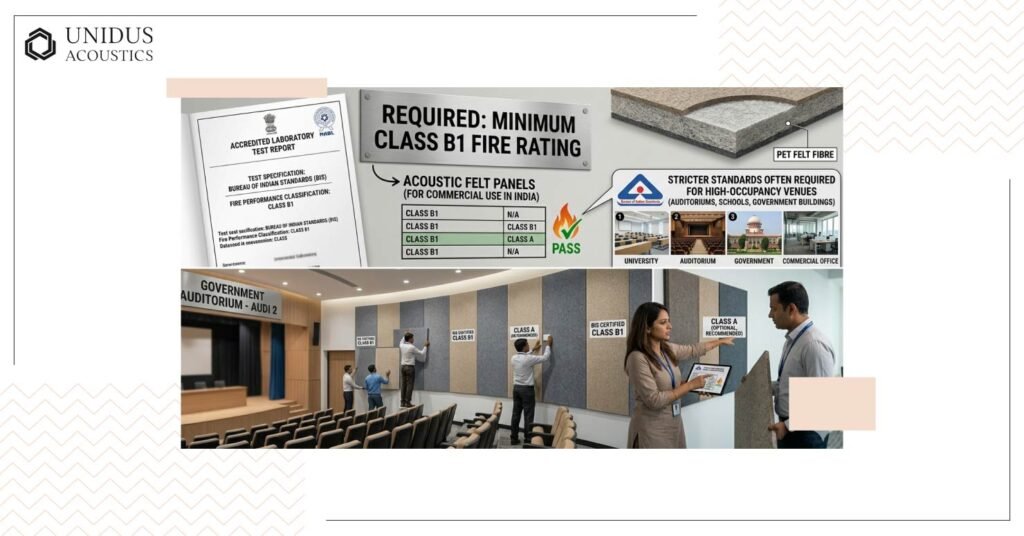
This covers how a material ignites, spreads flame and self-extinguishes. It’s tested under systems such as India’s IS 12777, Germany’s DIN 4102 or the UL 94 test for plastics and polymer-based cores. It isn’t the same as structural fire resistance, which is a separate, minutes-rated test for walls, doors and compartments, and which a fire consultant works out independently of the panel.
A panel’s fire classification is specific to the exact facing, core and thickness tested. A different fabric on the same core can change the result, so the certificate has to match the configuration going into the spec, not only the product family name.
Our detailed guide to fire-rated acoustic panels for commercial buildings explains each classification system and how they differ.
2. Indoor Air Quality and VOC Emissions
Acoustic panels sit in occupied spaces: boardrooms, classrooms, cafeterias and meeting cabins, often close to where people breathe for hours at a stretch. That’s why emissions testing matters more than it gets credit for in most specification conversations.
Standards such as the ISO 16000 series (with evaluation schemes like Germany’s AgBB/DiBt) and ANSI/BIFMA M7.1, the US furniture-industry standard, measure volatile organic compound and formaldehyde emissions from a finished product. The test runs in a controlled chamber over a defined period; it doesn’t rely on the raw material’s datasheet. A panel that tests well acoustically but has never been through emissions testing leaves a gap for any workplace that cares about air quality, and that gap is widest in enclosed meeting rooms and cabins with limited air exchange.
3. Acoustic Performance Testing (NRC and Sound Absorption)
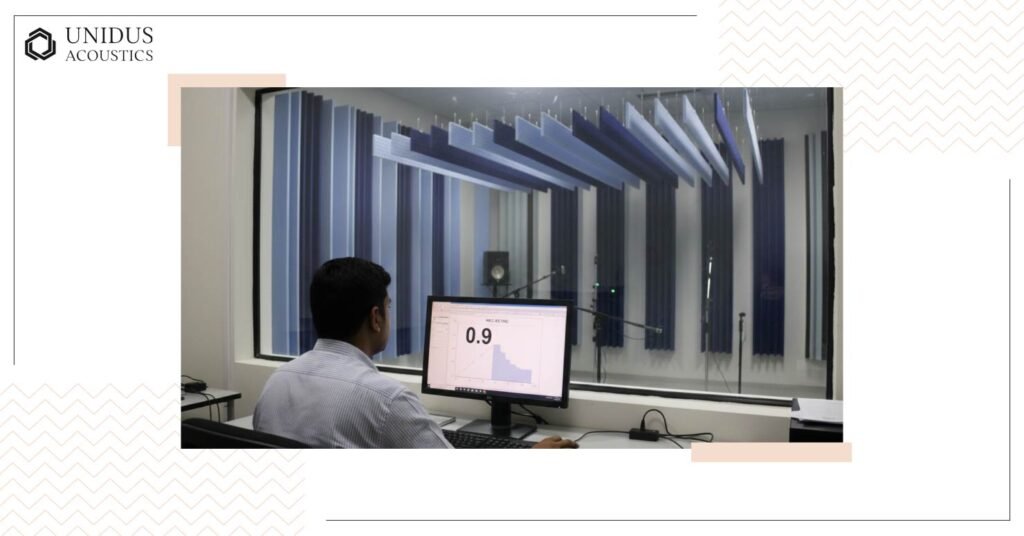
This is the category most directly tied to why a panel is specified at all. The Noise Reduction Coefficient (NRC) is a single averaged figure derived from sound absorption coefficients across the 250 Hz to 2000 Hz range. It’s measured through reverberation-room testing under ASTM C423 or the equivalent ISO 354 method, in an accredited acoustic lab, and not estimated from what the raw material is known to do.
A panel’s actual NRC depends on its thickness, density, mounting method and the air gap behind it. The same core mounted two ways, direct-fixed or with a gap behind it, can show meaningfully different figures on paper even though the panel hasn’t changed.
Our article on the noise reduction coefficient rating walks through the maths, and the note on NRC testing and acoustic panel performance covers how to verify a vendor’s figure instead of taking the datasheet number at face value.
4. Environmental and Material Certifications
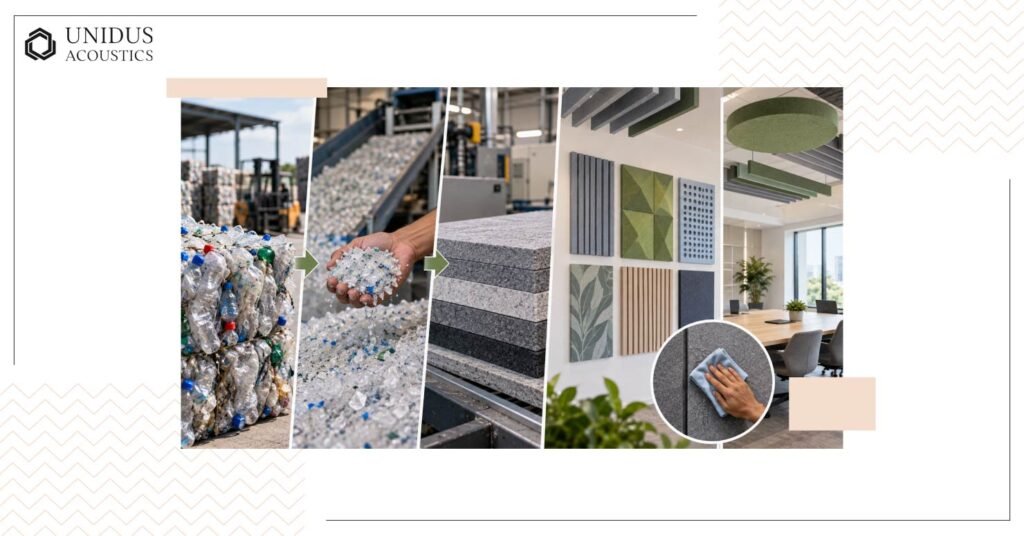
This category covers recycled content, sustainable sourcing and material composition. Claims are commonly verified through schemes like the Global Recycled Standard (GRS), which audits the recycled content percentage and the chain of custody of a material such as recycled polyester fibre, from input to finished product.
It sits apart from fire and acoustic testing, but it increasingly appears alongside them on projects targeting green building ratings, where recycled content can contribute towards the overall score. A growing number of corporate tenants ask about it even without a formal certification pursuit, as part of their own sustainability reporting. One practical point: scope certificates carry validity dates, so check that the one you’re shown is current.
Reading a Test Certificate Without Getting Lost in the Jargon
A proper test certificate carries a specific set of details, and a quick scan for them tells you more than the headline claim on page one.
| Check This | Why It Matters |
|---|---|
| Accredited lab name | An independent, recognised lab, not an in-house facility, is what makes a result a certification instead of a claim. |
| Exact sample description | The test should match the thickness, facing and material you’re specifying, not a different configuration from the same product family. |
| Named standard and version | Standards get revised; a report should cite the specific standard and year it was tested against. |
| Report or batch number | A real report carries a unique reference number that traces back to the lab if questioned. |
| Test date | Fire, VOC and acoustic performance can all shift with formulation changes; an old report on an updated product isn’t current evidence. |
| Scope of the result | Confirm whether the certificate covers the product itself or a broader scope, like a factory’s management system, which is a different kind of claim. |
If a datasheet makes a certified claim and the supporting report isn’t attached, asking for it isn’t awkward. It’s a standard part of specifying a product for a commercial project, and a supplier confident in its testing will have the reports ready to send.
Our guide to specifying acoustic panels for commercial projects shows where those reports slot into a submission.
Green Building Certifications vs Product-Level Testing
These two layers get conflated often, so it’s worth separating them. Green building ratings like IGBC, LEED and WELL score an entire project against a weighted framework covering acoustics, energy, water, materials and air quality. A project earns points across many categories, and acoustic panels are only one input. Product-level certification is narrower: one material passing one specific test. Our article on IGBC and green building acoustic performance sets out what the rating asks for on the acoustic side.
A panel can hold excellent individual test reports and still be one input among many into whether a project reaches a given rating. Acoustic panel certifications and green building ratings are related, but they shouldn’t be presented as interchangeable on a spec sheet.
In practice, a sustainability consultant asks for the product-level reports directly when assembling a green building submission. The rating itself is awarded at project level, after documentation across dozens of materials has been gathered and checked. Calling a panel “LEED certified” is using the phrase loosely. “Eco-friendly” gets the same loose treatment; the paperwork is what shows whether an eco-friendly acoustic panel is real or marketing. Products contribute credits through their documented material and emissions data; the building, not the panel, earns the certification.
Common Certification Mistakes on Commercial Projects
A few patterns come up often enough to flag. None of them is unique to one supplier, and most trace back to supply chain pressure and the sheer volume of documents at handover.
One Report Applied to a Whole Range
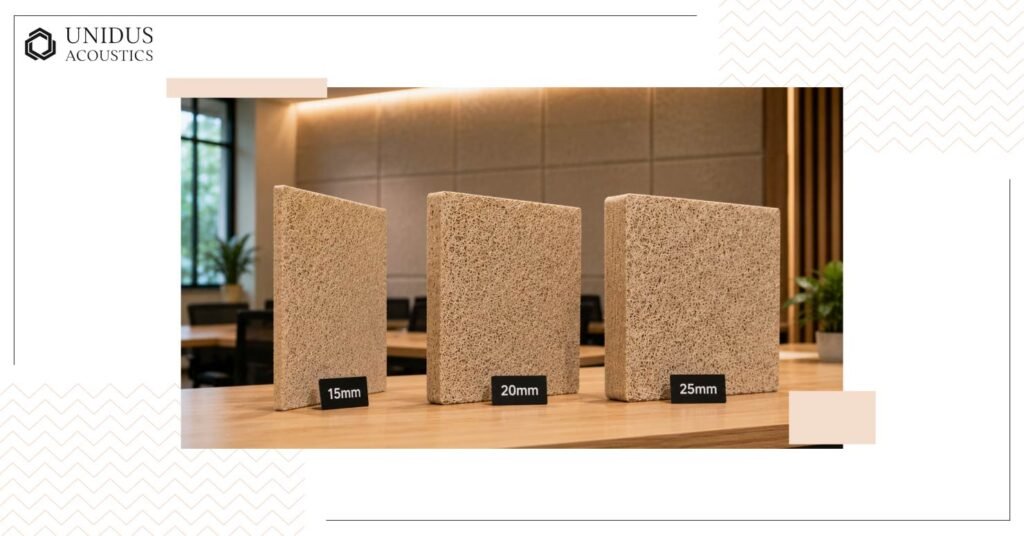
A fire or NRC result from one thickness or finish sometimes gets quoted for the entire product family in a sales conversation, even though other configurations were never separately tested. The fix is simple: ask which exact SKU the report covers.
A Certification Mark Without the Report
A logo on a brochure isn’t the same as a document a compliance team can file and defend. If the report isn’t offered alongside the mark, ask for it.
Substitutions That Change What Ships

Supply chain substitutions happen. What’s written into a spec and what arrives on site don’t always match, usually because of material availability or substitutions further down the chain. Specifying exact test report numbers, not only a product name, in the documentation is the most reliable way to catch this before installation instead of after.
Green Credits Claimed From the Wrong Certificate
Recycled content and emissions certificates feed into specific, defined credit categories under rating systems like IGBC and LEED. The scope of a certificate (one material, one factory, one batch) doesn’t always match what’s being claimed towards project points. So many documents move through a project handover that mismatches are easy to miss. Have the sustainability consultant check the certificate scope directly, and don’t rely on a summarised claim in a tender document.
How Unidus Acoustics Approaches Testing and Certification
Unidus Acoustics doesn’t rest on one headline claim. Independent reports on fire, emissions and sound absorption for its polyester fibre products are included in the catalogue, so a specifier can read them.
On fire, the 9mm polyester fibre board has an independent report classifying it as Class B1 under DIN 4102-1 and DIN 4102-16, with UL 94 test results of HB/V-0 on the same material. Sound absorption has independent reports under ASTM C423 and ISO 354 methodology. For VOC and formaldehyde emissions, independent chamber test reports against the ISO 16000 series, evaluated under AgBB/DiBt, sit alongside an ANSI/BIFMA M7.1 report. Across the range, third-party test certificates from SGS, Intertek and TÜV Rheinland are available on request for tender submissions.
On recycled content, the advice applies to any supplier, Unidus Acoustics included: check the validity date on the scope certificate you’re shown. Each report covers the sample named on it. Where a project calls for a different thickness or facing, the team will say plainly whether a matching report exists.
The capability comes from 40+ years of manufacturing. The test reports are what let an architect or a purchase manager verify it instead of taking it on trust.
Checking the Paperwork Before It Becomes a Problem
Certification on an acoustic panel is only as useful as the specifics behind it: which lab, which standard, which exact sample, which date. A headline claim without that detail is a starting point for a question, not an answer to one. Commercial projects in India increasingly ask for this paperwork as a matter of course, from fire consultants, green building assessors and procurement teams alike. A supplier who can produce it without delay is telling you something about how the rest of the project will go.
Unidus Acoustics supplies custom acoustic solutions, and its catalogue carries independent test reports on fire safety, air quality and acoustic performance. If you’re evaluating acoustic panel certifications for a commercial project, contact us and our team will share the reports available for the product you’re considering
Frequently Asked Questions
1. What’s the difference between a test report and a certificate for an acoustic panel?
A test report is the lab’s primary document for one specific sample and result. A certificate can summarise that report or cover a broader scope, such as a certification body’s compliance mark. Both are useful; neither should substitute for the other without checking which one you’re holding.
2. Is NRC the same as a fire rating?
No. NRC (Noise Reduction Coefficient) measures how much sound a panel absorbs, tested under ASTM C423 or ISO 354. A fire rating measures how a material reacts to flame and heat. They’re separate test programmes on separate standards.
3. Do acoustic panels need VOC or emissions certification in India?
Requirements vary by project. Green building ratings such as IGBC, LEED and WELL give weight to indoor air quality, and many corporate occupiers ask for emissions data as standard practice, whether or not the building is pursuing formal certification.
4. What does a Global Recycled Standard (GRS) certification verify?
It verifies the recycled content percentage of a material and traces the chain of custody from recycled input to finished product. An accredited certification body audits it, so it doesn’t rest on the manufacturer’s word.
5. Can a supplier’s self-declared specification be trusted?
It depends on the use. A self-declared figure can be a reasonable engineering estimate for early-stage design. For a fire NOC submission, a green building points claim or any compliance-critical document, a reviewer will expect an accredited third-party test report.
6. How often should fire or acoustic test certificates be renewed?
There’s no single interval across every standard. A certificate tied to a formulation or construction that has since changed is no longer current evidence. Match the report’s date and sample description to the product being shipped, and don’t assume an older certificate still applies.