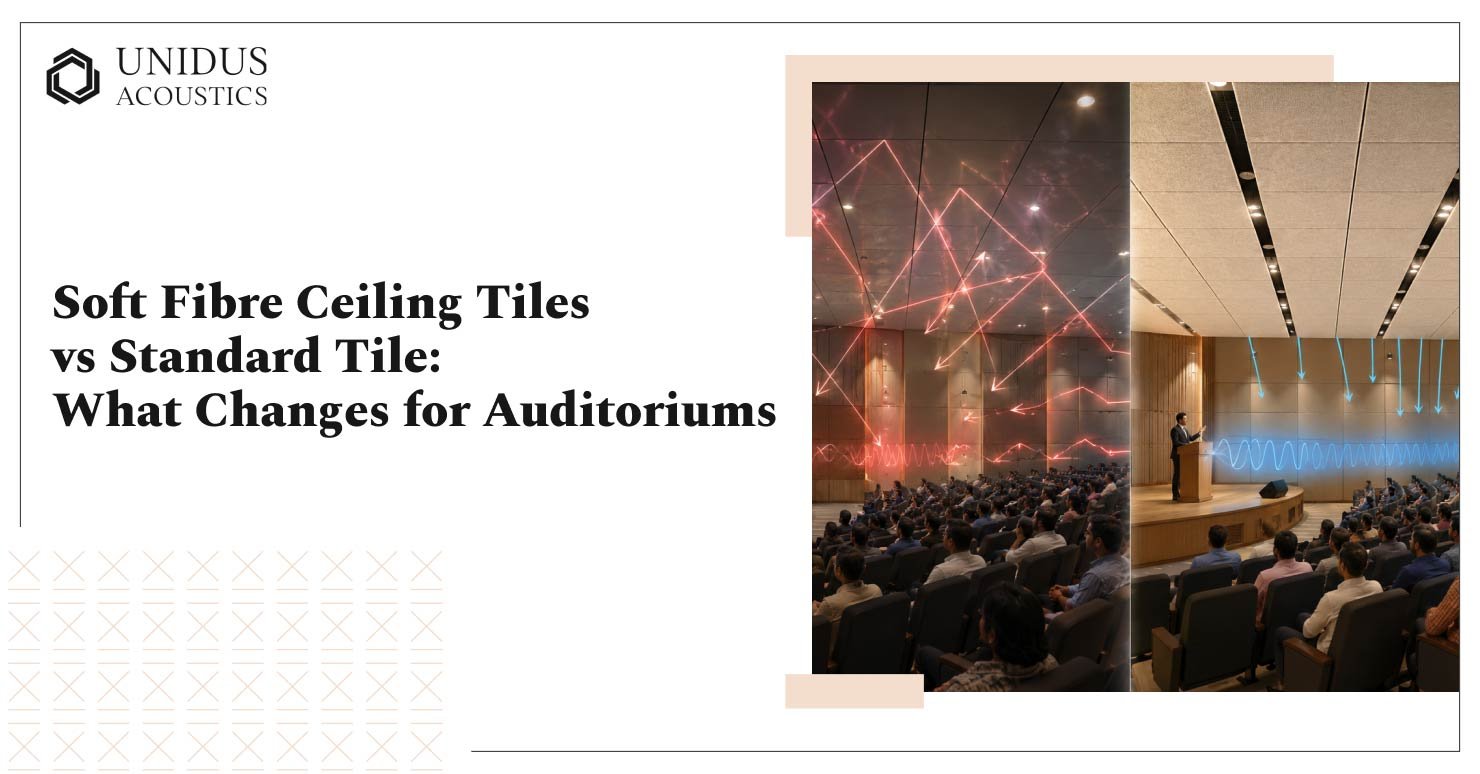
An auditorium ceiling does more acoustic work than any other surface in the room. Swap a standard mineral fibre tile for a soft fibre one, and the change isn’t cosmetic. It’s how much sound the ceiling absorbs versus how much it bounces straight back at your audience. For a space where speech clarity and music decide whether the room “works,” that difference shows up the moment the seats fill.
This article breaks down what actually changes between soft fibre ceiling tiles and standard tiles in an auditorium context, where each one holds up, and what that means for your spec sheet.
Key Takeaways
- Soft fibre ceiling tiles use a long-fibre glasswool core built specifically for sound absorption, reaching NRC values of up to 0.90.
- Standard mineral fibre tiles use a denser, painted core built for durability and thermal performance first, with absorption as a secondary benefit.
- The gap between the two matters most in rooms with hard, reflective surfaces, exposed seating, or a mix of speech and amplified sound, which describes most auditoriums.
- Neither tile is the “wrong” choice everywhere. The room’s use case, budget cycle, and existing wall treatment should decide which one gets specified.
- Edge profiles, sizes, and finish options are close enough between the two that installation and grid compatibility are rarely the deciding factor.
The Real Difference Isn’t the Tile, It’s the Core
Both tile types look similar from the auditorium floor: a flat, 595mm modular panel sitting in a suspended grid. The difference lives inside the tile, in the material doing the absorbing.
What soft fibre ceiling tiles are actually made of
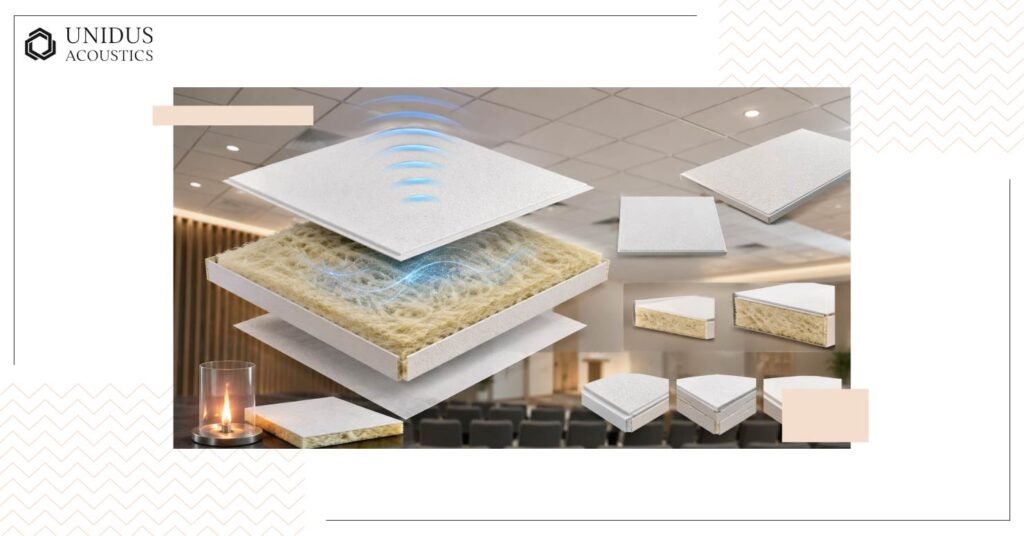
At Unidus Acoustics, our soft fibre ceiling tiles use a soft, long-fibre glasswool core with sealed edges, finished with a decorative face and a tissue-lined back. That open, fibrous structure is what lets sound energy pass into the tile and dissipate, rather than reflect off it. It’s available in 15mm and 20mm thickness, in 595x595mm and 595x1195mm sizes, with square, tegular, or microlook edge profiles, and it carries a Class A fire rating.
What standard tiles are actually made of
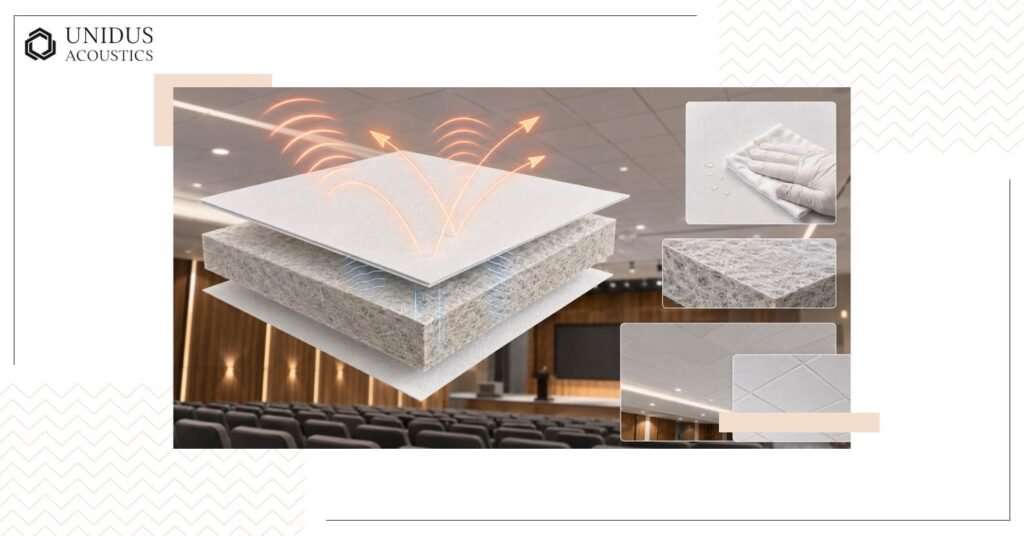
A standard tile, in most auditoriums, means a mineral fibre ceiling tile: a denser core with a painted, coated surface, built primarily for durability, tamper resistance, and a clean, uniform look. It absorbs some sound too, since any porous ceiling material does, but the core is dense and the surface is sealed for wipeability, which limits how much energy actually enters the tile instead of reflecting off the face.
Industry testing under standards like ASTM E1264 has consistently placed painted mineral fibre tiles in a moderate absorption band, well below what a purpose-built soft fibre core delivers. That gap is the whole story here.
What Changes Acoustically in an Auditorium
Here’s how the two compare on the factors that actually affect how an auditorium sounds and how it holds up over time.
| Factor | Soft Fibre Ceiling Tile | Standard Tile |
|---|---|---|
| Core material | Soft, long-fibre glasswool | Dense mineral fibre, painted finish |
| NRC (sound absorption) | Up to 0.90 | Moderate, well below high-absorption soft fibre cores |
| Best suited for | Speech-heavy and music auditoriums, reflective interiors | Corridors, back-of-house, budget-constrained ceiling runs |
| Surface durability | Softer face, less tamper resistant | Tamper proof, corrosion resistant coating |
| Fire rating | Class A | Class A range available |
| Thickness options | 15mm, 20mm | 12mm to 20mm |
| Finish | White texture, white matt, black matt | Finish |
An empty auditorium and a full one behave differently, and this is where the tile choice gets tested. Bodies, clothing, and seat upholstery absorb some sound on their own. But the ceiling, the largest unbroken hard surface in most halls, still carries the bulk of the reverberation control. A room specified with standard tiles and hard walls can sound perfectly fine on a walkthrough and then turn boomy and unclear the moment a few hundred people and a PA system are in it.
Where Each Tile Type Still Makes Sense
There’s a tendency in specification meetings to treat this as an upgrade-or-downgrade decision. It isn’t. Budget cycles, phased fit-outs, and mixed-use ceiling runs are a normal part of how auditorium projects get built, and both tile types have a legitimate place in that process.
When standard tiles are the right call
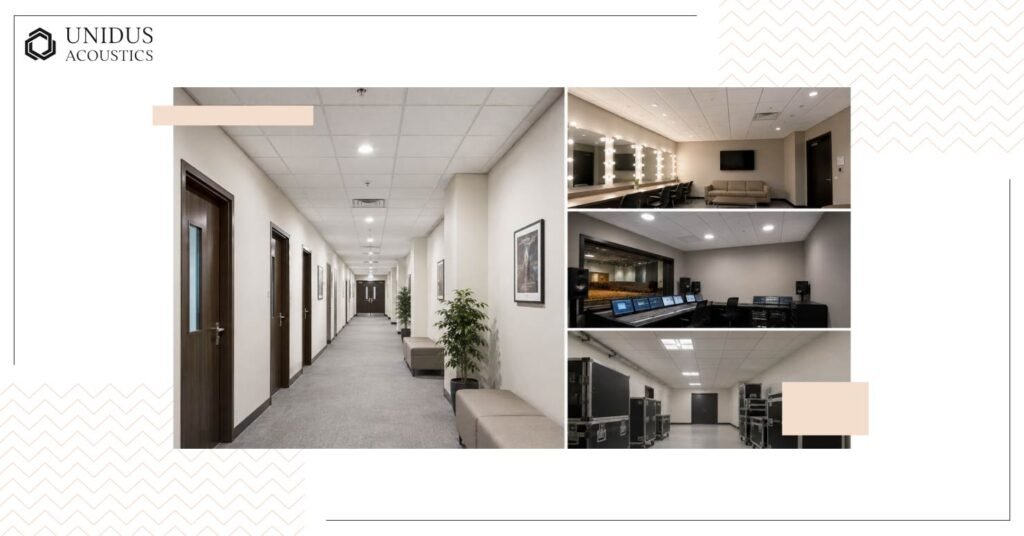
Standard tiles do their job well in areas adjoining the auditorium: green rooms, corridors, control rooms, and back-of-house zones where durability and a clean finish matter more than absorption. If the auditorium’s walls are already carrying most of the acoustic treatment through panels or baffles, a standard ceiling tile can be a reasonable way to balance the budget across the project rather than over-specifying every surface.
When soft fibre earns its keep
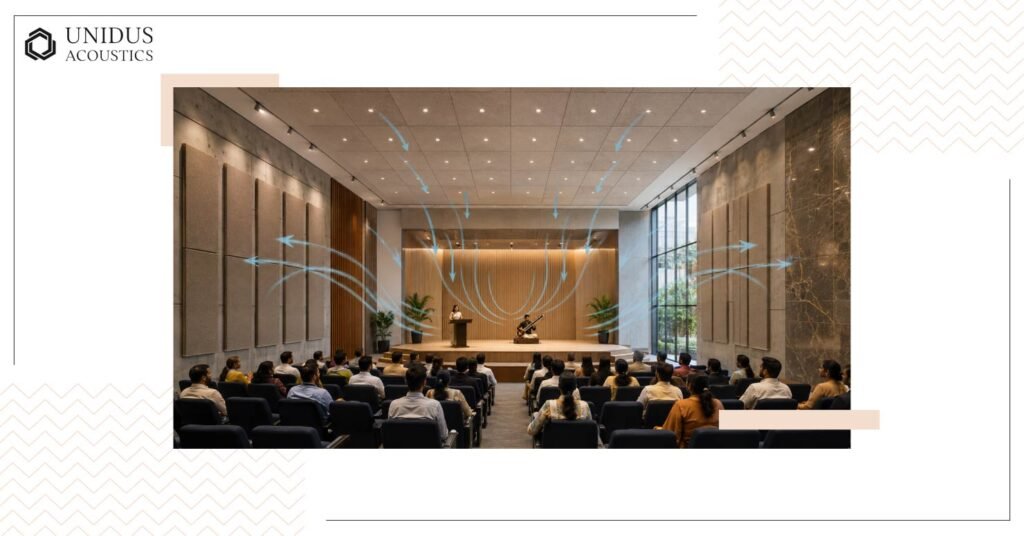
Soft fibre tiles make the most difference in halls where the ceiling has to do heavy lifting: rooms with glass, polished stone, or exposed concrete on the walls, rooms hosting both speech and music, or any auditorium where the brief specifically calls out reverberation time or speech intelligibility. If our acoustic solutions for auditoriums already include absorptive wall treatment, pairing it with a soft fibre ceiling closes the loop rather than leaving one surface working against the rest.
Cost, Maintenance, and Installation: What Purchase Teams Should Know
Soft fibre tiles typically sit at a higher price point than standard mineral fibre tiles, largely because the core material and manufacturing process are built around absorption rather than surface hardness. That cost difference is often smaller than teams expect once it’s spread across a full ceiling run, but it’s worth flagging early rather than discovering it at the quotation stage.
On installation, both tile types drop into standard T-grid ceiling framework without special tools or sequencing changes, so switching between them mid-project rarely creates a construction problem. Maintenance is where the trade-off shows up again: standard tiles, with their coated, tamper-resistant surface, handle wipe-downs and incidental contact better, which matters in back-of-house zones with more foot traffic. Soft fibre tiles are better kept to areas with controlled access, which most auditorium seating zones already are.
Supply timelines for both tile types generally track project schedules well when ordered at the same stage as the rest of the acoustic false ceiling solutions for a build, so this rarely needs to be treated as a separate procurement track.
Specifying the Right Tile for Your Auditorium Brief
A few questions tend to settle this quickly during specification:
- What’s already absorptive in the room? If the walls carry fluted wall panels or similar treatment, the ceiling has less to compensate for.
- What’s the primary use? A lecture-only hall has different reverberation targets than one hosting music or amplified performance.
- Does the brief reference an NRC or reverberation time target? If so, check how NRC ratings are measured against what’s actually specified, since the gap between a standard and soft fibre tile is usually the fastest way to close that number.
- Is this ceiling zone visible to the audience, or is it back-of-house? That alone often answers the question.
When the answers aren’t obvious, working through it with an acoustic consultant before the tile line item gets locked into the BOQ tends to save a change order later.
Frequently Asked Questions
1. Do soft fibre ceiling tiles cost significantly more than standard tiles?
They generally sit higher per square metre, though the gap across a full auditorium ceiling is often smaller than teams expect once installation and grid costs are factored in equally for both.
2. Can soft fibre and standard tiles be mixed in the same ceiling grid?
Yes. Since both use compatible modular sizes and standard T-grid framework, it’s common to use soft fibre tiles over the seating area and standard tiles in adjoining back-of-house zones.
3. Is a standard tile ever acoustically sufficient for an auditorium?
It can be, particularly in smaller halls or rooms where wall panels are already handling most of the absorption. The ceiling doesn’t have to carry the full acoustic load on its own.
4. Does tile choice affect fire safety compliance?
Both soft fibre and standard tile options are available with Class A fire ratings, so this is rarely the deciding factor between the two; it’s worth confirming against the specific project’s fire code requirements regardless of which tile is chosen.
Where This Leaves Your Spec
The choice between soft fibre and standard ceiling tiles isn’t about picking the “better” product. It’s about matching the tile’s core material to what the room actually needs to sound like once it’s full. Get that match right at the ceiling, and the rest of the auditorium’s acoustic treatment has far less to compensate for.
At Unidus Acoustics, we work through this exact trade-off with project teams regularly. If you’re specifying ceiling tiles for an auditorium and want a second read on the brief, our full product range covers both tile types along with the wall and baffle systems that usually pair with them. Contact us to know more.