Acoustic treatment for hospitals is consistently under-specified. WHO guidelines set a ceiling of 35 dBA for patient-occupied areas during the day, 30 dBA at night. Most hospital wards run at 50–60 dBA under normal operation, with ICUs running higher still, because equipment noise alone pushes well past the threshold before any human activity is added. For patients with limited physiological reserves, that gap shows up as disrupted sleep and slower recovery. For the architect on a healthcare brief, it becomes a specification liability discovered at handover, not at design stage.
At Unidus Acoustics, we’ve delivered acoustic treatment for healthcare facilities across India, including AIIMS. The gap we encounter most often isn’t a product problem. It’s the specification: acoustic treatment listed as a line item with no performance targets, no zone differentiation, and no hygiene criteria attached. Contractors default to what’s available, and the result is a product on the wall that looks right without functioning right.
Key Takeaways
- WHO guidelines recommend that noise in patient wards should not exceed 35 dBA during the day and 30 dBA at night; most hospitals in documented studies exceed both thresholds in normal operation.
- Hospital acoustic treatment must be zone-specific. A patient ward, an ICU, a waiting area, and a consultation room each have different acoustic requirements and cannot share a single specification.
- Disinfectability is the most frequently missing criterion in healthcare acoustic specifications and the one most likely to cause problems at handover and during facility audits.
- Acoustic specifications should state target NRC values and reverberation times (RT60) for each zone rather than leaving performance outcomes to contractor discretion.
- Materials installed in hospital interiors in India must carry a minimum fire rating of Class B1.
Why Hospital Acoustics Is a Clinical Issue
The WHO recommends that patient-occupied areas should not exceed 35 dBA during the day and 30 dBA at night. Research shows that sleep disturbance begins to manifest at time-averaged levels as low as 30 dBA, making even the upper end of the recommended range a ceiling rather than a target.
Elevated noise increases stress hormone production and raises blood pressure in patients who are already compromised. For paediatric wards, unfamiliar sounds compound the clinical experience in ways that are difficult to offset through other means. Acoustic treatment in healthcare settings isn’t a design upgrade. It’s part of what the facility is supposed to do medically.
Acoustic Treatment Requirements by Hospital Zone
A single specification covering every area of a hospital almost never works well. Different zones have different acoustic briefs, and the same material at the same NRC value will be under-specified in some areas and over-specified in others.
Patient Wards
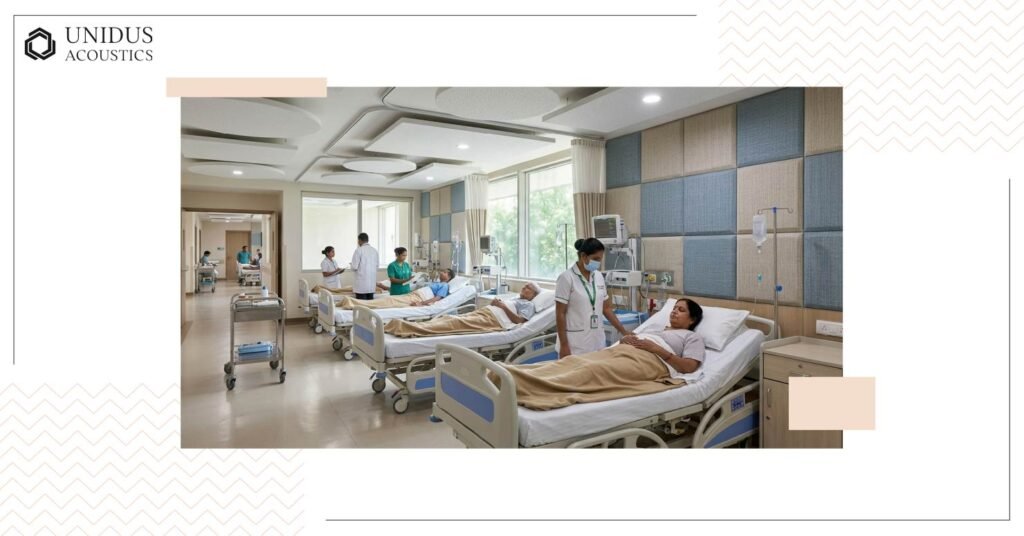
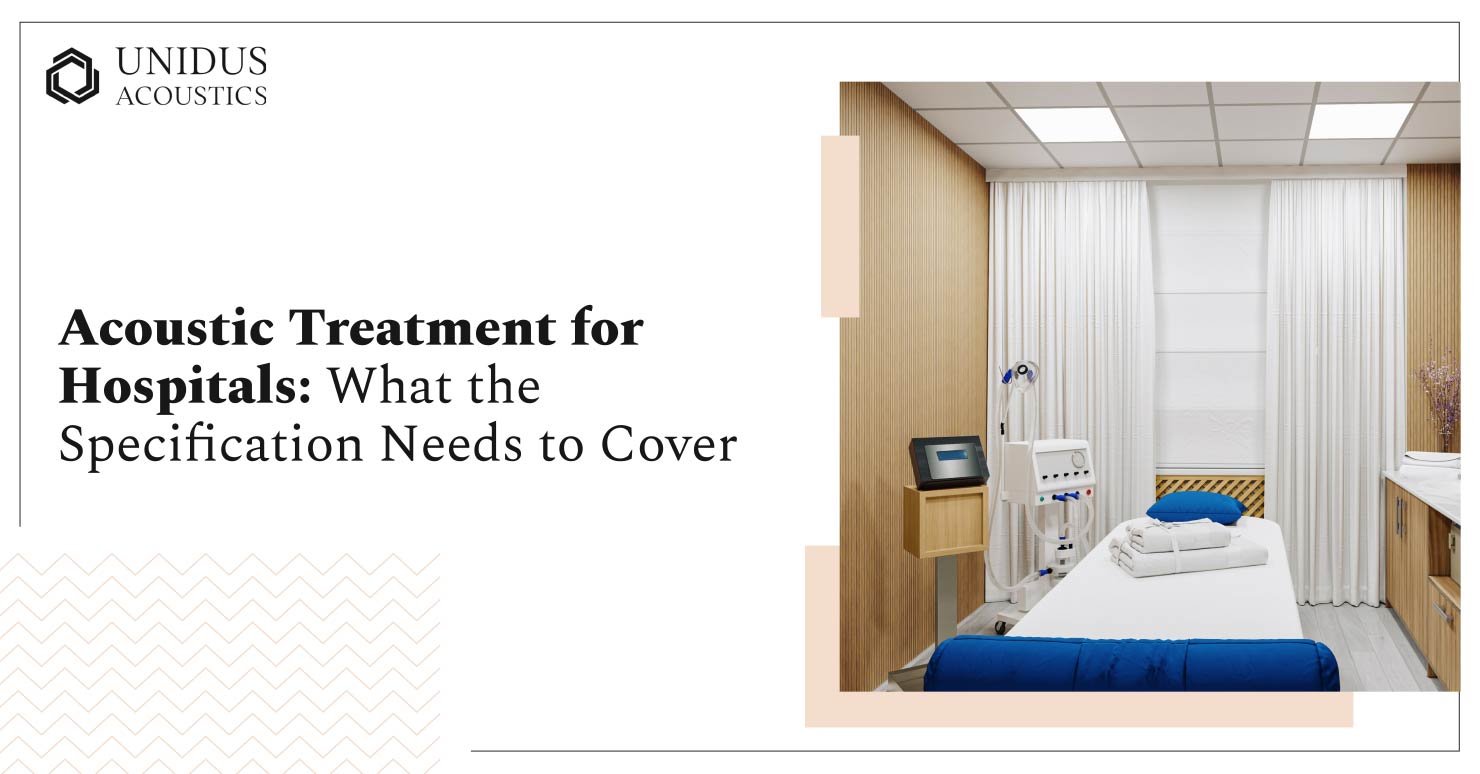
The priority in patient wards is reducing ambient noise levels and shortening reverberation time. Standard ward construction, with hard walls, ceilings, and impervious flooring, creates reverberation times that amplify every movement, trolley wheel, and corridor conversation.
Specify acoustic wall panels with a minimum NRC of 0.70 on surfaces adjacent to patient beds. Ceiling treatment using suspended clouds or direct-mount panels should target an RT60 of under 0.6 seconds in single-bed rooms and under 0.8 seconds in multi-bed bays. Materials must support disinfection by fog, spray, and wipe-clean protocols without surface degradation over repeated cycles. Fabric-wrapped panels and PET acoustic boards work well in this zone; they hold up under standard hospital disinfection protocols and can be specified in custom dimensions to fit non-standard bay layouts.
ICUs and Critical Care Areas
ICUs present a different problem. Medical equipment generates a continuous broadband background that already exceeds safe thresholds before any human activity is added. Acoustic treatment here must address absorption across the frequency range while maintaining speech clarity, because clinical communication cannot be compromised.
Specify ceiling materials with NRC 0.80 or above. Avoid open-cell or highly textured surfaces; they trap particulates and resist thorough cleaning. Smooth, impervious-surface panels are more appropriate for infection-controlled environments than traditional fibrous tiles. Metal perforated panels with a powder-coated finish are a practical option in this zone, meeting both the NRC threshold and hygiene requirements without compromising ceiling aesthetics.
Waiting Areas and Reception Zones
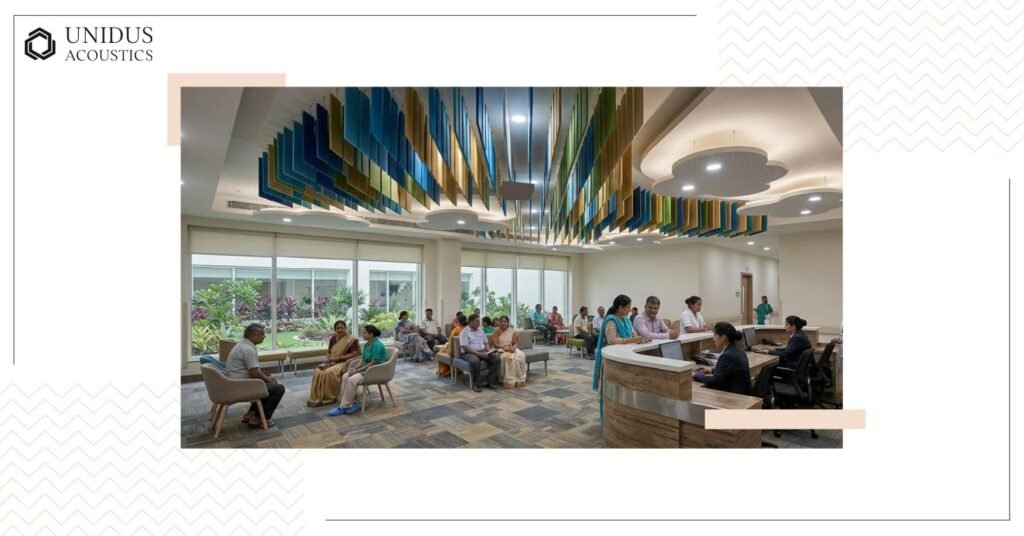
These are high-footfall spaces with no fixed layout and reflective surfaces throughout. Suspended baffles and acoustic clouds perform well here because they don’t consume wall space and integrate naturally into ceiling design without a clinical appearance.
The brief for a waiting area is less about eliminating noise and more about controlling reverberation so conversations don’t carry across the room. Target an RT60 of 0.7–1.0 seconds. Staff working reception desks across a full shift benefit significantly from this kind of treatment even when patients don’t consciously register it.
Consultation Rooms and Diagnostic Spaces
Speech privacy is the primary driver in consultation rooms. A room where a patient’s conversation can be heard in the corridor is both a clinical and legal liability. Specify acoustic panels on at least two facing surfaces to reduce internal reverberation and shorten the distance over which speech is intelligible.
Note clearly in any brief that acoustic wall panels manage internal reverberation, not sound isolation through the partition. Door seals, wall construction, and glazing are separate specification items. Both are needed; neither substitutes for the other.
Corridors and Staff Areas
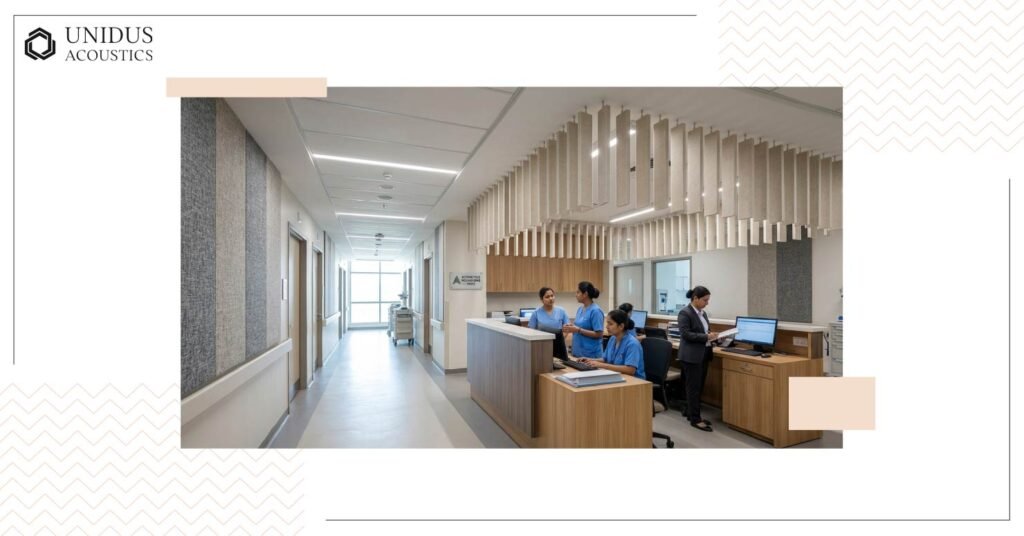
Corridors function as noise propagation channels. Treating corridor walls adjacent to patient zones reduces the ambient noise that bleeds into rooms through gaps around doors and low-mass partitions. At nursing stations, ceiling baffles above workstations reduce the cumulative noise exposure staff absorb across a twelve-hour shift.
What a Hospital Acoustic Specification Must Include
A complete acoustic specification for a hospital project covers at least four areas. Most briefs address one or two; the rest are typically discovered at handover or during a facility audit.
NRC Values by Zone
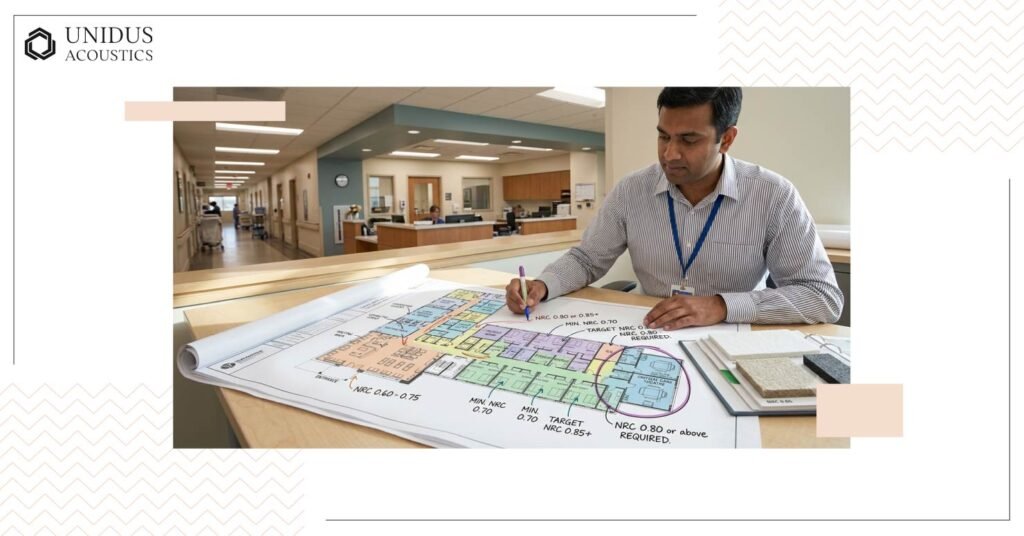
Specify a minimum NRC for each area rather than a single value for the whole project. A product with NRC 0.50 reads as an acoustic material but performs very differently from one rated NRC 0.85. Patient wards and ICUs should not accept below NRC 0.70. Critical care environments benefit from NRC 0.80 or above. Waiting areas and corridors can function adequately at NRC 0.60–0.75, depending on surface coverage.
Reverberation Time (RT60) Targets
RT60 targets give acoustic consultants and contractors a measurable outcome to design towards. Without them, spaces get either over-treated or under-treated. Standard values for healthcare briefs: 0.4–0.6 seconds in patient rooms and ICUs; 0.6–1.0 seconds in reception, circulation, and waiting areas.
Disinfectability Requirements

This is the most consistently missing requirement in healthcare acoustic specifications. Any material installed in patient-occupied or clinical zones must be rated for repeated disinfection by fog, spray, and wipe-clean over the full operational life of the building. Request test data from material suppliers before specifying. A panel with strong NRC performance that degrades under repeated disinfection cycles isn’t appropriate for healthcare use.
Fire Rating
For interior acoustic materials in Indian hospital projects, a minimum fire rating of Class B1 is required under NBC 2016 provisions for institutional occupancies. Confirm this at the specification stage, not at installation.
For projects targeting NABH accreditation, acoustic performance is worth treating as a compliance consideration rather than just a design one. NABH standards include provisions for patient environment quality, and noise levels in patient-occupied zones are directly relevant to those criteria.
Where Most Hospital Acoustic Briefs Fall Short
A few patterns show up consistently in incomplete healthcare acoustic specifications.
Treating walls and ignoring ceilings is the most common. In most hospital configurations, ceiling area drives reverberation more than walls, and a wall-only treatment addresses only part of the problem.
Beyond that, applying a single NRC value across every zone type and specifying acoustic material with no hygiene criteria both result in briefs that look complete on paper and fail in practice. Each of these gaps is avoidable at the specification stage, not after.
Frequently Asked Questions
Can acoustic treatment be installed in infection-sensitive clinical areas?
Yes, provided the materials are rated for the disinfection protocols used in that zone. In patient-occupied or clinical areas, acoustic treatment panels need to support repeated fog, spray, and wipe-clean disinfection without surface degradation or performance loss over time. Not all products meet this standard, so request hygiene test data from suppliers before specifying.
What NRC value should acoustic treatment materials meet in a hospital?
For patient wards and ICUs, specify a minimum NRC of 0.70, with NRC 0.80 or above preferred in critical care areas. Waiting areas and corridors can work with NRC 0.60–0.75, depending on surface coverage. Specifying by zone rather than applying a single value across the facility produces significantly better results.
What is the difference between acoustic treatment and soundproofing in a hospital?
Acoustic treatment manages sound within a space by absorbing reverberation and reducing ambient noise levels. Soundproofing is about preventing sound from transferring between spaces, through walls, floors, or ceilings. Both matter in a healthcare setting, but they work differently and need to be addressed as separate specification items. Acoustic treatment panels on a wall affect what happens inside the room; the wall construction itself determines how much sound passes into the corridor. A complete hospital brief covers both, and neither substitutes for the other.
Conclusion
A hospital acoustic specification that works zone by zone, sets NRC and RT60 targets as measurable criteria, and confirms disinfectability and fire rating before procurement is a complete specification. Getting from a typical line-item brief to that point takes a conversation, not a budget increase.
With 40+ years of expertise and 635+ completed projects across India, Unidus Acoustics works with architects and designers on custom acoustic solutions across commercial, institutional, and healthcare settings. To discuss acoustic specifications for a hospital project, contact our team.