White acoustic panels perform identically to any other colour of the same product. Acoustic absorption happens inside the panel, through the core material, not at the surface. What determines performance is the finish type; a white acoustic fabric or perforated surface is acoustically transparent, while a painted or coated hard surface is not. Colour is not the variable that matters.
This article explains how different types of white acoustic panels behave in commercial interiors, where the real acoustic performance decisions lie, and what to watch for when specifying white panels for minimalist schemes.
Key Takeaways
- White acoustic panels perform identically to darker versions of the same product. The core material and thickness determine NRC, not the colour.
- The finish type is what matters. Acoustic fabric and perforated metal (>20% open area) are sound-transparent. Painted or hard-coated surfaces are not, and will significantly reduce absorption regardless of the core beneath.
- Flush-mounted fabric-wrapped panels at 50mm thickness with a polywool or glasswool core achieve NRC 0.80–0.90 in most commercial applications.
- White panels in minimalist interiors work best when specified early, placed at first-reflection points between 900mm and 1,800mm from floor level, and distributed across more than one surface.
- Always request third-party test certificates (ISO 354 or ASTM C423) from SGS, Intertek, or TUV Rheinland before finalising a specification. Quoted NRC values without test evidence are unreliable.
The Colour Myth: Why White Does Not Reduce Acoustic Performance
This question comes up consistently in commercial projects, particularly now that white-dominant and material-minimal interiors have become a standard brief in corporate and institutional design. The absorptive material (polywool, glasswool, stone wool, wood wool) works by converting sound energy into a tiny amount of heat as sound waves move through its fibrous structure. The colour of the outer fabric or finish does not participate in this process.
A white acoustic fabric, like any other acoustic fabric, is specified by its flow resistance, the degree to which it allows air (and therefore sound) to pass through it while providing a finished surface. The correct acoustic fabric for a panel is acoustically transparent, meaning it does not significantly obstruct the sound reaching the absorptive core. That property has nothing to do with whether the fabric is white, grey, or patterned.
The complication arises when ‘white’ is achieved by a non-porous surface. A panel painted white with standard emulsion, finished with a hard coat, or laminated with an impermeable film, is a different product from a panel faced with white acoustic fabric, and it will perform very differently. The hard surface reflects sound rather than passing it through to the absorptive core. That is a common specification error in minimalist commercial interiors where the finish specification comes before the acoustic specification.
Surface Finishes and Their Effect on Acoustic Performance
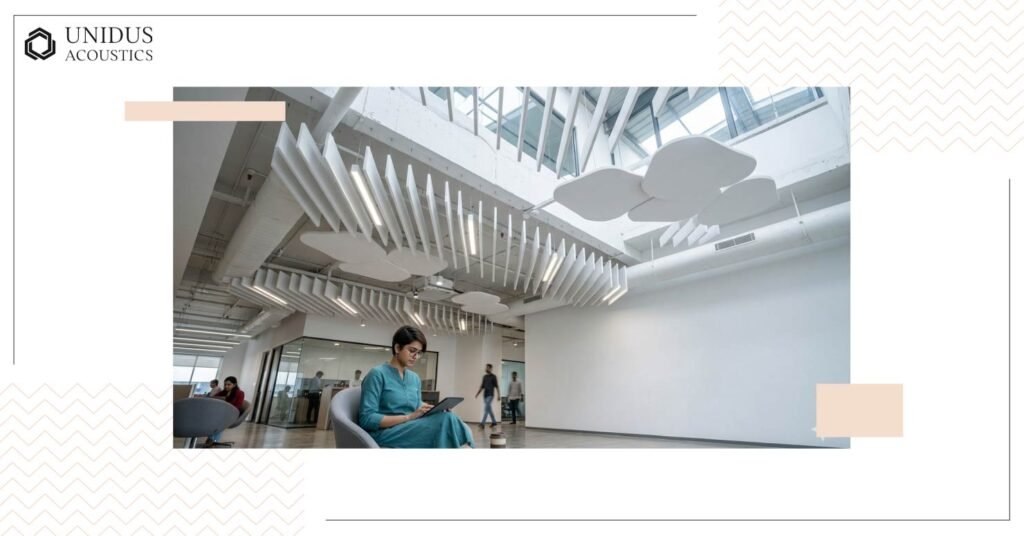
Before specifying any white acoustic panel, it helps to understand how different white finishes affect NRC. The table below outlines the main options:
| Surface Finish | Effect on NRC | Visual Consideration |
|---|---|---|
| White fabric-wrapped panel | None. NRC unchanged vs. darker fabric of same weight. | Clean, neutral. Works in most palettes. |
| White painted hard surface | Significant reduction. Hard coatings block pore absorption. | Do not use for acoustic performance. |
| White perforated metal over absorptive core | Depends on the perforation ratio. High perforation (>20%) preserves most NRC. | Crisp, industrial aesthetic. Works in minimal interiors. |
| White wood wool panel | NRC 0.55–0.85 depending on thickness. Unaffected by colour. | Textured, warm. Adds tactile interest to white schemes. |
| White printed Polywool panel | NRC 0.70–0.90. Full performance retained. | Custom print on a white base. Integrates branding or patterns. |
The summary: if the white finish is a sound-transparent material (acoustic fabric, perforated metal with adequate open area, wood wool), full acoustic performance is retained. If it is a painted or impermeable hard surface, acoustic performance is substantially reduced regardless of how good the core material is.
White Acoustic Panels in Practice: What Works in Minimalist Spaces
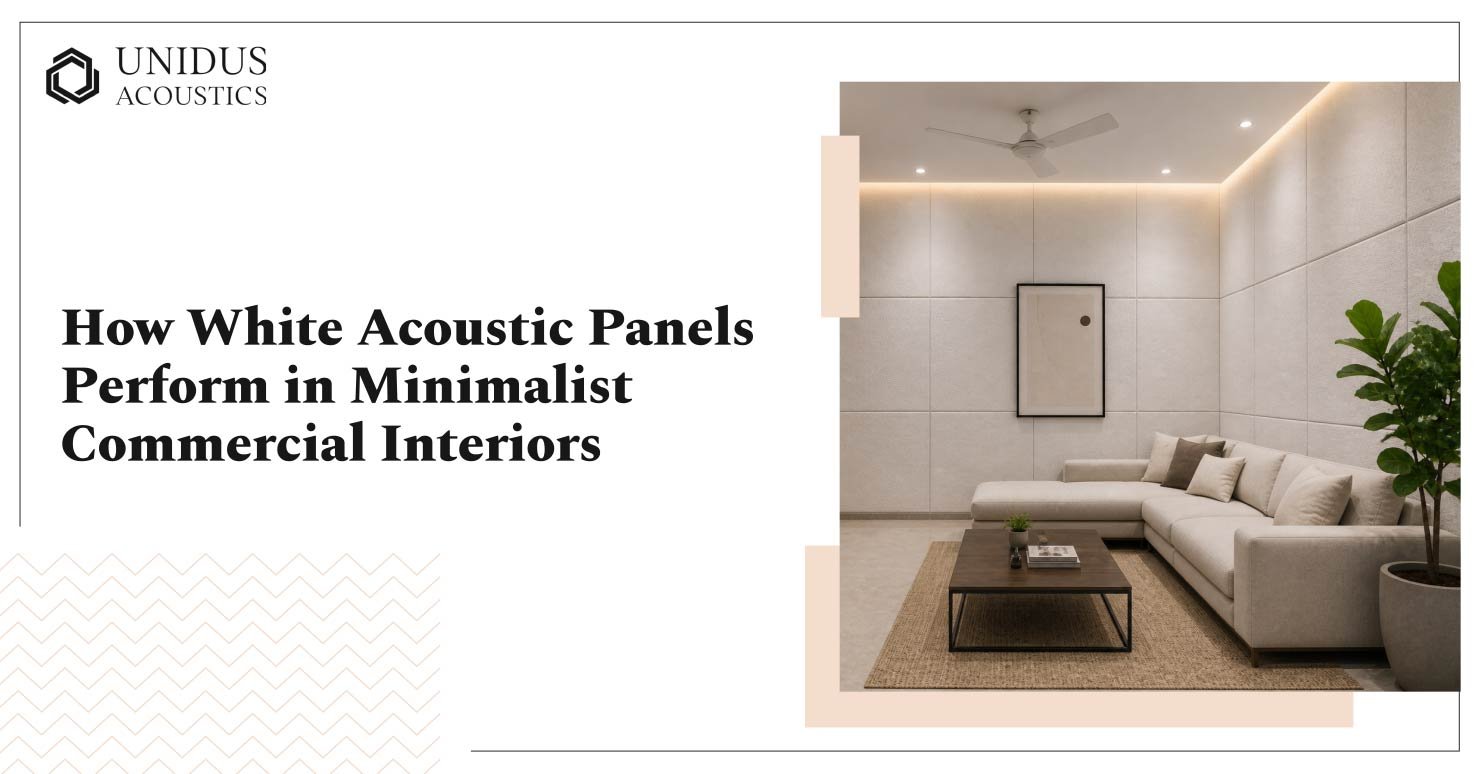
Minimalist commercial interiors tend to share a few characteristics that affect how acoustic treatment should be specified: high ceilings, large glazed surfaces, polished concrete or stone floors, and a preference for architectural surfaces that do not call attention to themselves.
In this context, white acoustic panels can be integrated in ways that are unobtrusive, or used as deliberate design elements rather than afterthoughts. A few approaches that work:
Flush-Mounted Fabric-Wrapped Panels
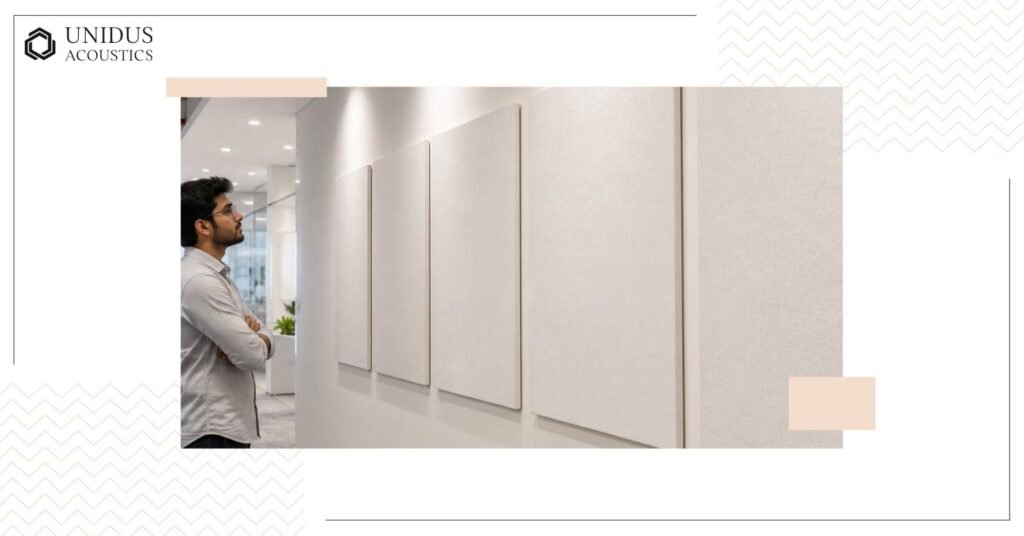
The most common solution for white minimalist schemes. The panel sits against the wall with a small reveal at the perimeter and reads as a clean surface rather than an applied treatment. With the right bracket detail, it can appear almost flush. An NRC of 0.80–0.90 is achievable at 50mm thickness with a polywool or glasswool core and an acoustic fabric facing.
The fabric selection matters here. Several acoustic fabric ranges offer tight, consistent weaves in white and off-white that hold up in commercial cleaning cycles and resist yellowing under UV exposure. For spaces with significant daylight, it is worth specifying a UV-stable facing.
White Wood Wool Panels

Wood wool introduces texture into a white scheme, which some designers read as a positive. The mineral-bonded fibre structure of wood wool gives the surface a distinctive relief pattern that catches light differently from a flat fabric surface. Performance ranges from NRC 0.55 to 0.85 depending on thickness and core composition.
In minimalist interiors where the brief allows for tactile interest, white wool panels can provide acoustic function while adding a material quality that pure fabric-wrapped panels cannot. They are also more durable at lower wall heights, where panels are more likely to be touched or knocked.
Perforated Metal Over Absorptive Core

A growing choice for corporate and institutional interiors with a more technical aesthetic. A white powder-coated perforated metal skin sits over a glasswool or stone wool core. The perforations allow sound to reach the absorptive material behind, and the degree of perforation, typically between 20% and 40% open area, determines how much of the core’s absorption capacity is available.
This system performs best in spaces with mid-to-high frequency noise loads: open-plan offices, conference facilities, and training rooms. It is less effective at low frequencies than a deeper fabric-wrapped panel because the air gap between the skin and core is typically smaller. But the visual result, clean, flat, metallic, white, integrates naturally into minimalist commercial architecture in a way that fabric panels sometimes cannot.
What Specifiers Commonly Get Wrong
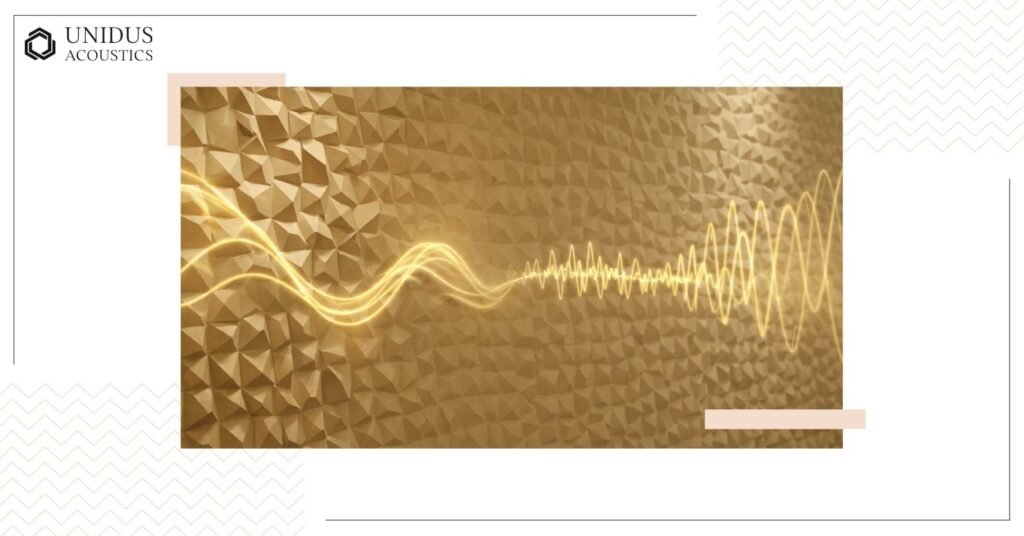
Several recurring errors affect the performance of white acoustic panels in commercial projects:
- Treating acoustic panels as a remediation measure. Panels added after a fit-out is complete can rarely be placed optimally, as furniture, workstations, and circulation paths limit where they can go. Early coordination between acoustic specification and interior design produces better outcomes than post-handover treatment.
- Under-specifying coverage. A few panels on one wall of a large open-plan office will produce minimal improvement. The coverage needs to be sufficient for the room volume and the noise load it is expected to manage.
- Overlooking maintenance requirements for white finishes in specific environments. White fabric-wrapped panels in food-adjacent zones or below 1.2m in high-traffic corridors will accumulate surface marks faster than darker finishes. This doesn’t affect performance, but it affects long-term appearance. Factor in cleaning cycles or specify a darker panel at lower wall heights if the space demands it.
Frequently Asked Questions About White Acoustic Panels
1. Do white acoustic panels perform as well as dark-coloured ones?
Yes, provided the white finish is an acoustic fabric or a high-perforation surface. The absorptive core drives NRC performance, not the colour. A white fabric-wrapped panel with a 50mm polywool core will perform identically to a charcoal version of the same panel.
2. Will white acoustic panels show dirt more easily in a commercial setting?
This depends on the fabric. Most commercial acoustic fabrics have a tight weave that resists surface dust. Panels in high-touch zones (below 1.2m) or near food service areas may need periodic cleaning. Polywool panels are disinfectable by fog, spray, or wipe.
3. Can white acoustic panels be used in fire-rated commercial interiors?
Yes. Fire rating is a property of the core and facing materials, not the colour. Polywool panels carry a Class B1 fire rating regardless of colour. Always verify the fire certificate for the specific product being specified.
4. Are printed white acoustic panels a viable option for branded environments?
Yes. Printed acoustic panels use a high-resolution print process on the acoustic fabric or surface. A white-dominant print on a panel with the same absorptive core retains full NRC performance.
Specifying White Acoustic Panels — Unidus Acoustics
Unidus Acoustics has been supplying commercial acoustic solutions across India for 40+ years, including fabric-wrapped panels, Polywool panels (NRC 0.70–0.90, Class B1 fire rating), printed acoustic panels, wood wool panels, perforated metal ceiling systems, ceiling baffles and clouds — all available with custom sizing and colour options, including full white and off-white finish ranges.
Third-party test certifications from SGS, Intertek, and TUV Rheinland are available for all core products. NRC documentation and fire certificates are supplied for tender files.
To discuss a specification or download the product catalogue, contact us.