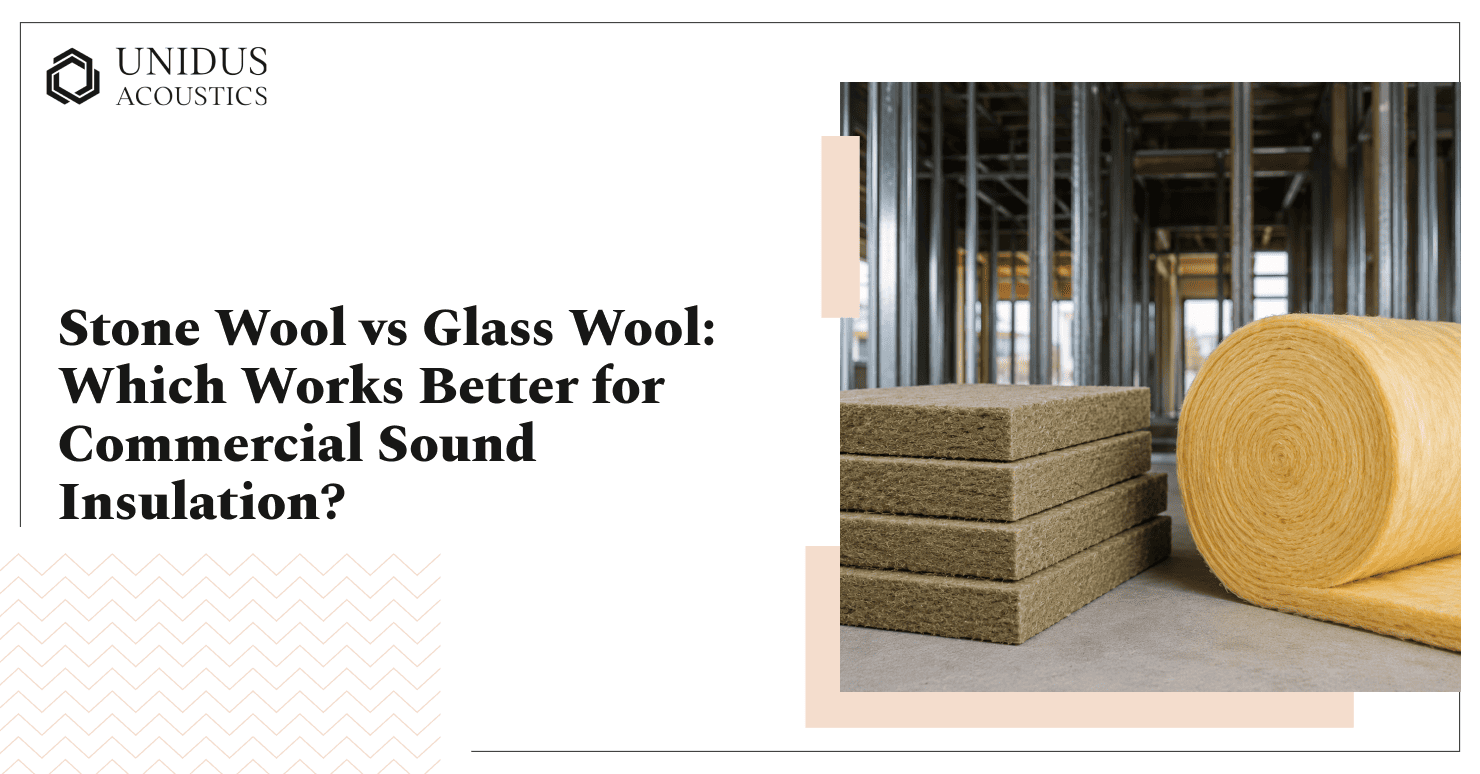
Stone wool and glass wool both show up on the same tender documents and supplier catalogues, often listed side by side with no explanation of which one actually suits the room in question. At Unidus Acoustics, this is one of the first questions architects ask when a project moves from concept to spec sheet. Both materials are effective, both get specified across commercial projects every day, and the difference between them is in the details.
Key Takeaways
- Stone wool and glass wool are both spun mineral fibre insulations, one made from basalt rock and slag, the other from molten glass, and the raw material drives most of the difference between them.
- Stone wool typically runs denser than glass wool, which is generally why it edges ahead on sound absorption and low-frequency control.
- Both materials are classified as non-combustible and typically reach the same top fire safety classification, so fire performance alone rarely settles the choice.
- Glass wool usually has a marginally lower thermal conductivity, making it a touch more efficient for pure thermal insulation at equal thickness.
- Stone wool tends to hold up better under moisture and humidity, a real consideration in Indian climates and in washrooms, kitchens, and basements.
- For most commercial ceiling and wall applications in India, the finished product built around the fibre ends up mattering more than the raw material choice itself.
What Is the Difference Between Stone Wool and Glass Wool?
Stone wool and glass wool are both types of mineral wool insulation, made by melting raw material at high temperature and spinning it into fine fibres that trap air and absorb sound. Both sit on the absorption side of the equation rather than the isolation side, meaning they reduce echo and reverberation within a space rather than blocking sound from travelling between spaces.
The word “mineral wool” covers both, which is part of why the two get confused so often on site and in spec sheets. Adding to the confusion, a well-known international manufacturer’s brand name for stone wool insulation is widely used in India as a generic term for the entire material category, the way a specific brand name sometimes stands in for an entire product type in everyday conversation. This piece uses “stone wool” throughout to keep that distinction clear.
How Is Stone Wool Made?
Stone wool is produced by melting basalt rock along with industrial slag (a byproduct of steel production) at temperatures above 1,400°C, then spinning the molten material into fibre. The resulting product is dense, holds its shape well under compression, and is commonly supplied in batts, boards, or loose fill.
How Is Glass Wool Made?
Glass wool starts with silica sand, often blended with recycled glass, melted and spun the same way. The fibres are finer and the finished product lighter for a given thickness, which is why glass wool shows up so often in ceiling tile cores where weight on the grid matters.
Which Absorbs Sound Better: Stone Wool or Glass Wool?
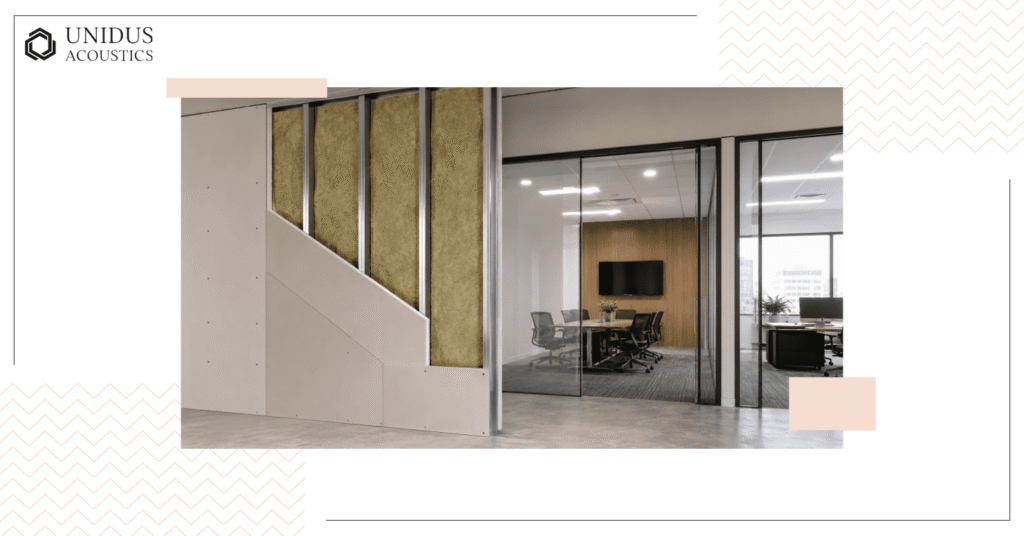
Density is the biggest lever here. Stone wool products commonly run denser than comparable glass wool products at the same thickness, and denser fibre generally means better sound absorption, particularly at lower frequencies, the register where HVAC hum, traffic noise, and footfall sit. Industry NRC comparisons put higher-density stone wool products at 0.90 and above, with standard glass wool typically close behind in the 0.75–0.90 range. In practice, the gap between a well-specified glass wool product and a well-specified stone wool product is often smaller than the marketing suggests. Thickness and installation detail move the number more than the raw material choice does.
For a conference room or office where speech clarity is the goal, this difference matters less. For an auditorium, home theatre, or a wall backing onto a mechanical room, it matters quite a lot.
Fire Rating and Thermal Performance: Stone Wool vs Glass Wool
Sound is rarely the only requirement on a spec sheet. Fire and thermal performance usually sit right alongside it, and this is where the two materials look more alike than different.
Do Stone Wool and Glass Wool Have the Same Fire Rating?
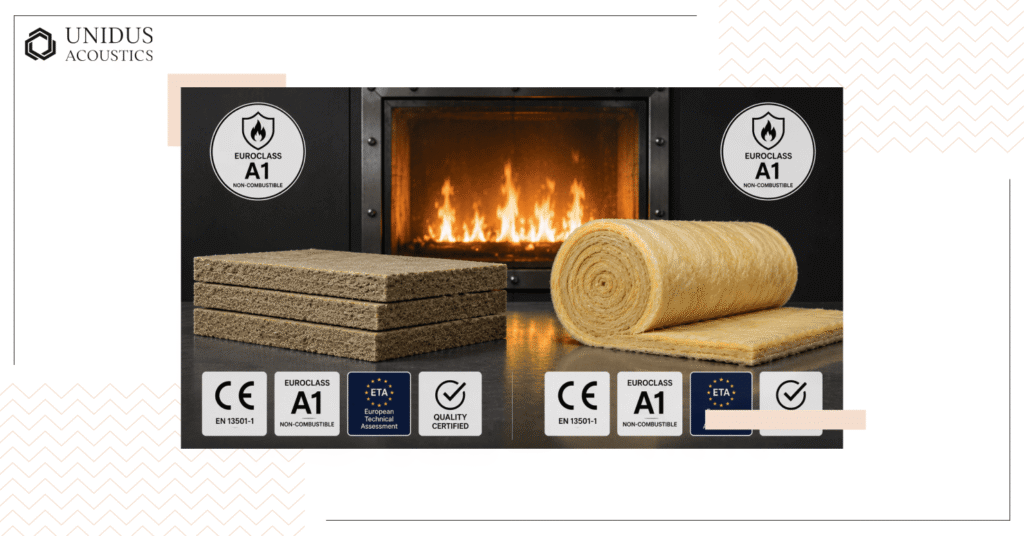
Both are classified as non-combustible and typically achieve Euroclass A1, the highest tier in the European fire reaction classification system. Stone wool holds its structural integrity at higher temperatures, commonly cited above 1,000°C, which is why it turns up more often in fire-rated barrier systems and industrial settings. For most commercial interior applications in India, both materials clear the fire safety bar.
Which Has Better Thermal Conductivity?
Glass wool typically has a slightly lower thermal conductivity (lambda value) at the same density, which translates to a marginally better R-value for a given thickness. In practice, this rarely changes a decision made primarily for acoustic reasons.
Moisture, Handling, and Durability: Where They Differ
Density and fire rating tell part of the story. What shows up on site months after installation comes down to how each material handles moisture and physical handling.
How Do They Perform in Humid Conditions?
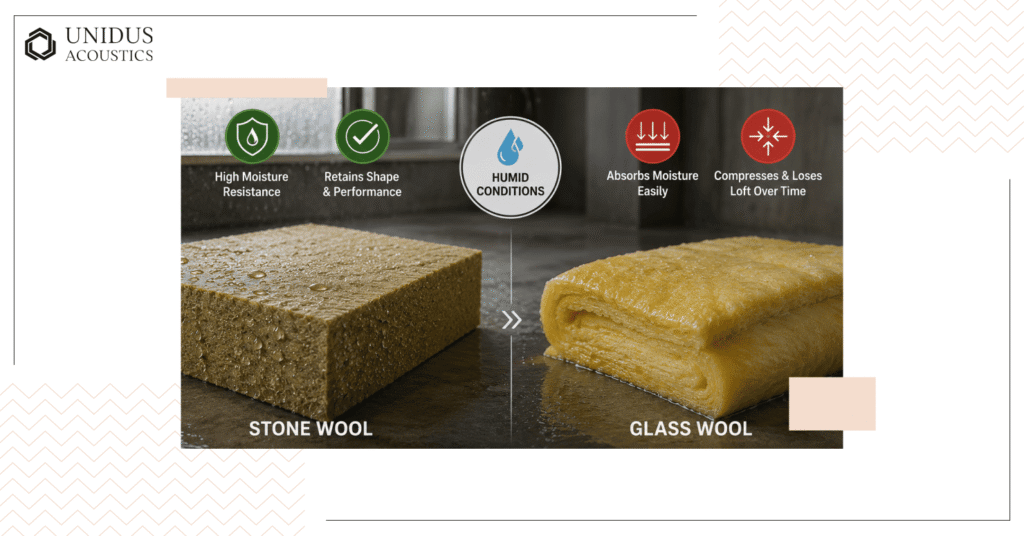
Stone wool generally resists moisture better than glass wool, holding its shape and performance in humid conditions rather than compressing or losing loft. This matters more in India than in a drier climate, particularly for basements, kitchens, washroom-adjacent walls, and any installation near a building’s exterior envelope.
Which Is Easier to Install?
Glass wool is lighter and easier to cut and handle, which can mean faster installation on large-volume runs. Stone wool needs a little more care but holds its cut edge and shape better over time, particularly on vertical walls where sagging is a concern with lighter materials. Both can irritate skin and airways during cutting if handled without gloves, masks, and ventilation, a precaution that applies either way.
Stone Wool vs Glass Wool: Quick Comparison Table
| Property | Stone Wool | Glass Wool |
|---|---|---|
| Raw Material | Basalt rock and industrial slag | Silica sand and recycled glass |
| Typical Density | Higher (denser fibre structure) | Lower (lighter fibre structure) |
| Sound Absorption | Generally stronger, especially at low frequencies | Strong in speech-range frequencies, lighter weight |
| Fire Rating | Euroclass A1; holds integrity above 1,000°C | Euroclass A1; non-combustible |
| Thermal Conductivity | Slightly higher lambda value | Slightly lower lambda value (marginally better R-value) |
| Moisture Resistance | Generally better in humid conditions | More prone to compressing or losing loft when damp |
| Typical Commercial Use | Auditoriums, plant rooms, fire-rated barriers | Suspended ceiling tiles, large-format wall systems |
Frequently Asked Questions
1. Is stone wool the same as glass wool?
No. Both are mineral wool insulations made by melting raw material and spinning it into fibre, but stone wool starts from basalt rock and industrial slag, while glass wool starts from silica sand and recycled glass.
2. Which is better for soundproofing, stone wool or glass wool?
Stone wool generally performs marginally better at lower frequencies because of its higher density, while glass wool performs comparably well in the speech-frequency range at a lighter weight. Neither blocks sound between rooms on its own; that needs a broader wall or ceiling assembly built for isolation.
3. Do stone wool and glass wool have the same fire rating?
Both are non-combustible and commonly achieve the same top-tier Euroclass A1 rating. The denser option holds its structural integrity at higher temperatures, which is why it’s more common in fire-rated barrier and industrial applications.
4. Does glass wool typically cost less than stone wool in India?
Glass wool is generally priced lower for comparable thickness, largely because of its simpler manufacturing process and lighter shipping weight. The finished product usually has a bigger impact on overall project cost than the raw fibre choice.
5. Can stone wool and glass wool be used together in the same building?
Yes. It’s fairly common on larger commercial projects to specify one where fire and moisture resistance matter more (plant rooms, service risers) and the other where weight and cost efficiency matter more (large-format suspended ceilings).
6. Which material suits humid Indian climates better?
Stone wool generally holds its shape and acoustic performance better in humid conditions, making it a more dependable choice for basements, washroom-adjacent walls, and coastal projects.
Choosing the Right Material Starts With the Room, Not the Fibre
Both stone wool and glass wool are legitimate, widely used insulation materials, and neither is the wrong answer on its own. What tends to go wrong on Indian commercial projects is choosing the material before the room’s actual acoustic brief, NRC target, fire rating, and installation constraints have been worked through, whether that’s an auditorium chasing low-frequency control, a suspended ceiling grid where weight matters, or a government building where fire compliance documentation drives the decision.
Unidus Acoustics works across glass wool cored soft fibre tiles, wood wool boards, and recycled polyester panels like U-TONE, and can help match the finished product, not just the raw fibre, to what a specific room actually needs. For NRC data, fire certification, and specification support on an upcoming project, contact us now.