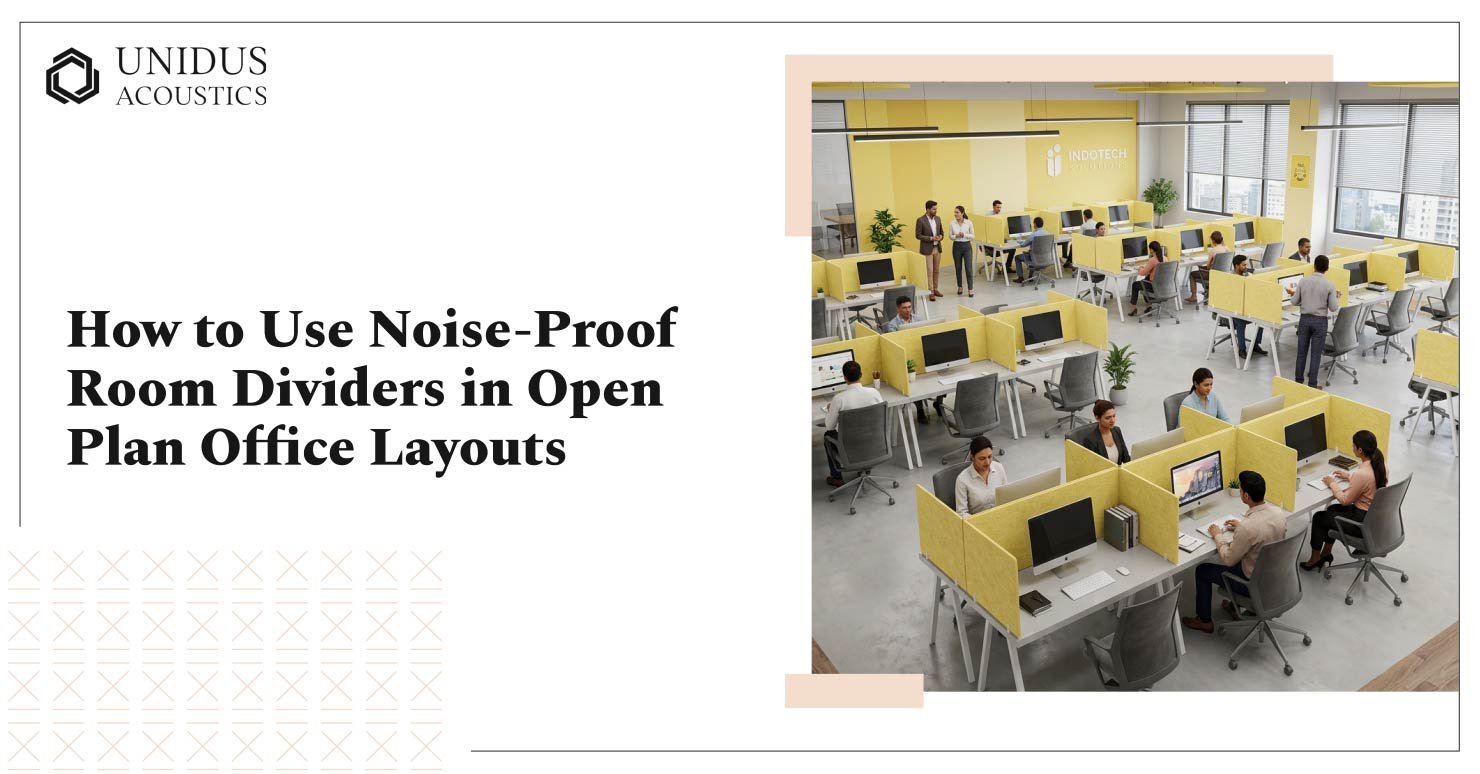
Open plan offices have a noise problem that most design teams underestimate at the brief stage. A global workplace survey found that seven in ten office workers experience regular disruption from conversations and ambient noise. A 2024 survey of 2,000 knowledge workers found that 63% actively struggle to concentrate because of noise at work, and nearly half report it as a direct source of stress. For a building type that dominated workplace design thinking for two decades on the promise of collaboration, the acoustic failure rate is striking.
Room dividers are among the most common interventions, but they’re routinely misapplied. At Unidus Acoustics, we’ve seen this pattern across 635+ completed projects in India: undersized panels at the wrong points in a layout do little measurable good, and oversized freestanding configurations create visual density without improving the acoustic environment. Getting it right means understanding what these products actually do acoustically, and how to use them in conjunction with other elements in the space.
Key Takeaways
- A 2024 survey of 2,000 knowledge workers found that 63% struggle to concentrate due to workplace noise open plan offices are the primary environment driving this.
- Noise-proof room dividers work through sound absorption, not sound blocking; they reduce acoustic energy in the room rather than creating a silent zone.
- Placement matters more than product selection in most cases. A divider in the wrong position can redirect sound rather than reduce it.
- Different divider types (freestanding space dividers, desk-height screens, and acoustic pods) serve different functions and shouldn’t be used interchangeably in a specification.
- Dividers perform best as part of a layered acoustic strategy alongside ceiling treatment; deployed alone, they address only a portion of the room’s noise problem.
Sound Absorption Versus Sound Blocking: An Important Distinction
This is the most important thing to understand before specifying any room divider for acoustic purposes.
A noise-proof room divider does not block sound the way a full-height wall does. When sound waves hit the panel’s absorptive surface, the fibrous or cellular material converts that acoustic energy into very small amounts of heat rather than reflecting it back into the room. The panel reduces the total acoustic energy in the space and shortens reverberation time.
The practical effect is meaningful, but it works differently to what most non-specialists expect. A divider with NRC 0.80 absorbs 80% of the sound that directly contacts its surface. Conversations from across the room still reach you; they’re quieter, less reverberant, and less cognitively intrusive. The divider doesn’t create silence; it reduces the acoustic load.
For open plan offices, this means dividers are most effective at reducing ambient noise levels and making the room feel less acoustically fatiguing over a full working day. Speech from the other side of the panel still reaches you; the difference is that it arrives with less energy, is less sharply defined, and doesn’t trigger the same level of involuntary attention. For someone doing focused individual work, that difference is significant.
Types of Noise-Proof Room Dividers and What Each One Does
Not every acoustic divider serves the same purpose, and substituting one type for another in a specification produces results that don’t match the brief.
Freestanding Space Dividers
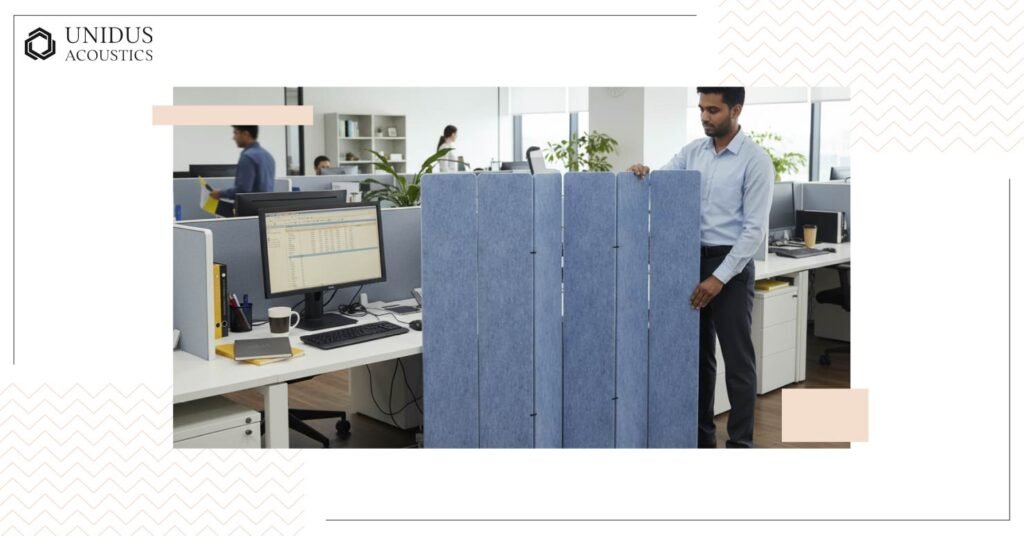
These are floor-standing panels, typically 1.6m–2.0m in height, designed to segment larger office areas into functional zones. They work well for creating defined quiet zones within an open floor plan, separating collaborative areas from focus areas, or giving a team a visual and acoustic boundary without constructed partition walls.
Space dividers in this category (such as those manufactured by Unidus Acoustics in recycled polyester, available in thicknesses of 9/12/18/24mm with NRC values of 0.70–0.90) are available foldable or fixed and can be specified to custom dimensions, colours, and configurations. The acoustic performance depends on the panel thickness, the NRC of the material, and, critically, how much of the divider’s absorptive surface faces the room’s primary sound sources. With 84+ fabric shades available and fully customised sizing, they can also be specified to complement rather than disrupt the interior design intent.
Desk Dividers and Acoustic Screens

Desk-height dividers (typically 400–600mm above desk surface) work differently from freestanding panels. Their surface area is too small to have a meaningful effect on room-level reverberation. Their function is more localised: reducing direct sound transmission between immediately adjacent workstations and providing a degree of visual privacy that reduces the psychological sense of exposure.
They’re most useful in densely packed desk configurations where conversation between close neighbours is the dominant distraction. They won’t solve a whole-floor noise problem and shouldn’t be specified with that expectation.
Acoustic Pods and Enclosed Booths
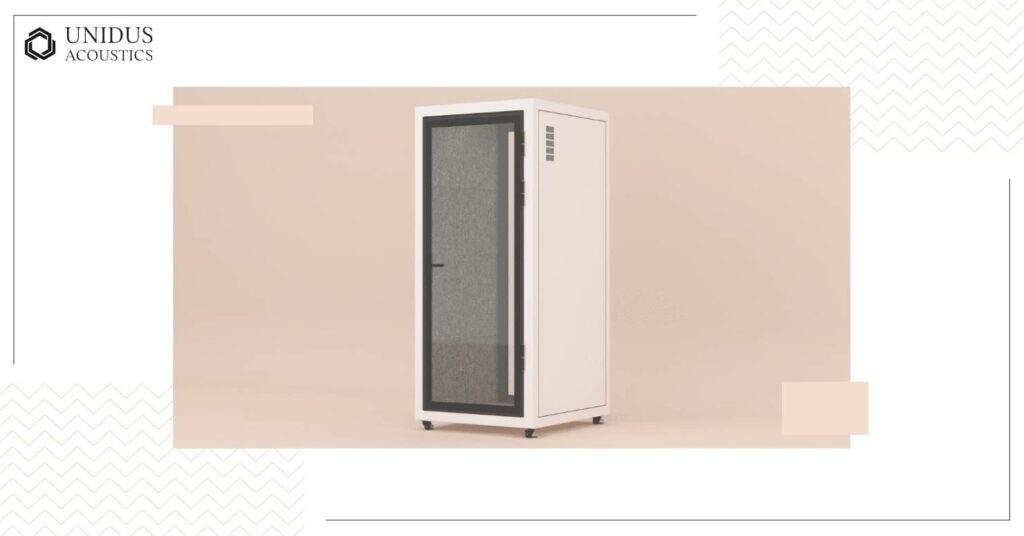
For tasks that require genuine quiet (a client call, a video conference, deep focus work), an enclosed acoustic pod provides near-complete speech isolation. The UNIPOD AS1, for instance, is designed specifically for these use cases. Pods are the right tool when the requirement is isolation rather than zone-level noise reduction. They’re not a substitute for room-level treatment and shouldn’t be specified instead of it.
Placement: Where Dividers Actually Work
The placement of dividers has a greater effect on acoustic outcome than most office fit-out specifications acknowledge.
Position Dividers Between the Noise Source and the Quiet Zone

If the office has a collaborative area that generates significant voice noise and a focus area nearby, the divider goes between them, with its absorptive face oriented towards the louder zone, not the quieter one.
Don’t Push Dividers Flush Against Walls

A freestanding panel pushed against a wall absorbs on one side only. Even 300–400mm of clearance behind the panel allows it to function from both faces, which approximately doubles the absorptive surface area contributing to the room’s acoustic treatment.
Account for Overhead Transmission
Dividers address sound at floor-to-panel-height. Ceiling-reflected sound travels over every divider in the room. Studies in acoustic design consistently show that combining floor-level dividers with ceiling-level sound absorption produces better results than floor-level treatment alone. A floor-level intervention without ceiling treatment solves part of the problem.
The most effective open plan acoustic treatments layer these elements: freestanding or desk dividers to interrupt horizontal sound paths, ceiling baffles or acoustic clouds to address overhead reverberation, and wall panels on hard reflective surfaces to reduce broadband room reverberation. Each element does something the others can’t.
What to Specify When Selecting Noise-Proof Room Dividers
NRC Value
For meaningful acoustic performance in an open plan office, specify panels with a minimum NRC of 0.70. Products below this will have a marginal and often undetectable effect in a reverberant commercial space.
Panel Thickness
Thicker panels absorb low-frequency sound more effectively. For typical office noise (primarily speech, concentrated between 500 Hz and 2,000 Hz), panels at 12mm and above perform adequately. A 24mm specification extends performance into lower frequencies and is worth considering in particularly noisy environments.
Fire Rating
Class B1 is the standard fire resistance requirement for interior furnishings in commercial spaces in India. Confirm this before specifying; not every product marketed as an acoustic divider carries it.
Material and Durability
Recycled polyester is the most widely used high-performance material for acoustic dividers. It maintains NRC values over time, is available in a wide range of colours and finishes, and is easy to clean. Products that also support disinfection cleaning are relevant for high-turnover shared office environments.
The Case for Not Stopping at Dividers
The British Journal of Psychology links noisy workplaces to productivity reductions of up to 60%. Independent research has found that employees in the noisiest office environments are significantly more likely to report intentions to leave their jobs within six months. These are not marginal effects.
Room dividers are an effective part of fixing this, but only a part. A specification that addresses floor-level absorption without accounting for ceiling reverberation and hard surface reflections is treating one acoustic pathway while leaving two others open. The outcome is a space that looks acoustically treated but still performs poorly.
The most productive brief conversation isn’t “which dividers do we need?” It’s “what’s the combined acoustic strategy for this floor plan?” which covers dividers, ceiling treatment, wall absorption, and any enclosed zones for tasks that need isolation.
Frequently Asked Questions
1. Do noise-proof room dividers actually block sound?
Not in the way a full-height wall does. Acoustic room dividers absorb sound energy rather than physically blocking it. They reduce ambient noise levels and shorten reverberation time, making an open plan office feel quieter and less acoustically fatiguing, though sound still passes over and around them. For complete isolation, an enclosed pod or a constructed partition is the appropriate solution.
2. How tall should office room dividers be?
For any meaningful effect on room-level acoustics, freestanding dividers should be at least 1.6m tall. Desk dividers (400–600mm above desk height) serve a more localised function: reducing direct transmission between adjacent workstations rather than addressing the room’s acoustic environment broadly.
3. What NRC value should I look for in an acoustic room divider?
Specify a minimum NRC of 0.70 for open plan office use. This means 70% of the sound energy that contacts the panel surface is absorbed rather than reflected. Products below this value will have limited measurable effect in a reverberant commercial environment.
4. Can acoustic dividers reduce employee stress, not just noise levels?
A 2024 survey of 2,000 knowledge workers found that nearly 47% are actively stressed by workplace noise preventing them from concentrating. The British Journal of Psychology links high-noise workplaces with productivity drops of up to 60% and elevated staff turnover. A well-designed acoustic environment addresses both the physical measurement of noise and the lived experience of working in it.
Conclusion
Noise-proof room dividers work well when they’re specified with clear performance criteria (minimum NRC 0.70, appropriate thickness, correct fire rating), placed with an understanding of how sound actually travels in the room, and integrated into a broader acoustic strategy that includes ceiling treatment.
Unidus Acoustics manufactures acoustic space dividers and desk dividers in recycled polyester with NRC values of 0.70–0.90, available in customised sizes, thicknesses, and colours, with Class B1 fire rating as standard. With 40+ years of expertise in commercial acoustic design across India, we install solutions that balance form and function.
To discuss acoustic treatment for your open plan office project contact us now.