
Architects and interior designers increasingly reach for perforated acoustic panels when a project needs acoustic performance alongside a ceiling or wall finish that holds up to scrutiny. The material reads well in contemporary interiors. Correctly assembled, the performance numbers can rival far bulkier solutions.
But getting to those numbers requires more than selecting a panel. It requires understanding what actually drives performance: perforation geometry, backing material, installation depth, and the spaces you are designing for.
Key Takeaways
- A perforated panel without a specified backing is an aesthetic choice, not an acoustic one. The complete system (panel face, backing material, and air cavity depth) determines what the installed ceiling actually delivers.
- Once the open area exceeds 20%, the backing material retains close to its full acoustic effectiveness. Below that threshold, a portion of sound reflects off the face before it can reach the backing.
- GI panels suit most commercial interiors. Aluminium is the better choice for high-humidity environments and retrofit projects where grid load needs to be managed.
- A plenum depth of 200mm or more consistently improves low-frequency absorption. Where that depth isn’t achievable, denser backing materials can partially compensate. Confirm the trade-off through acoustic modelling rather than assuming it.
- All four of the most common specification errors (no backing specified, open area mistaken for performance, unaddressed plenum bypass, edge profile mismatch) are avoidable at the brief stage.
How Do Perforated Acoustic Panels Actually Work
Before looking at specifications, the physics is worth understanding. A perforated panel on its own absorbs very little. The metal or board it is made from is a reflective surface. What creates acoustic performance is the complete system, the perforated face plus the absorptive material behind it.
What Role Does the Perforated Face Play in Sound Absorption?
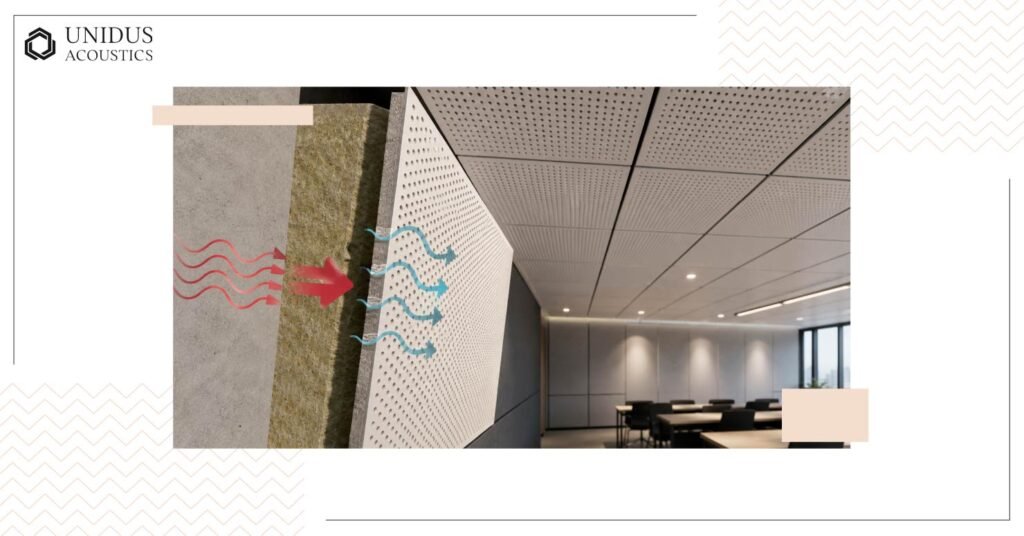
Perforations are apertures that allow sound waves to pass through the hard face and reach an absorptive backing layer. The panel face itself reflects sound; the holes let it through. How much sound gets through depends on the open area percentage the ratio of perforation area to total panel area.
When open area exceeds 20%, acoustic testing data consistently shows the backing material retains close to 100% of its effectiveness. At lower open area percentages, a proportion of sound is reflected before it can engage the backing, reducing overall absorption. Open area percentage, in short, is the most useful variable to confirm early when evaluating any perforated acoustic ceiling system.
Why Backing Material and Air Cavity Matter as Much as the Face
Once sound passes through the perforations, it enters a resistive layer: acoustic fleece, mineral wool, or glasswool infill. This layer converts sound energy into heat through friction between air molecules and fibres. The thickness and density of this backing determine how well the system handles different frequencies. The depth of the air cavity between the panel and the structural ceiling above plays an equal role.
Deeper cavities (200mm and above) consistently improve low-frequency absorption. Denser backing materials tend to perform better across a wider frequency range but add weight to the grid. This is why specifying a perforated panel without specifying the backing system is an incomplete brief.
How Do Perforation Patterns Affect Acoustic Performance
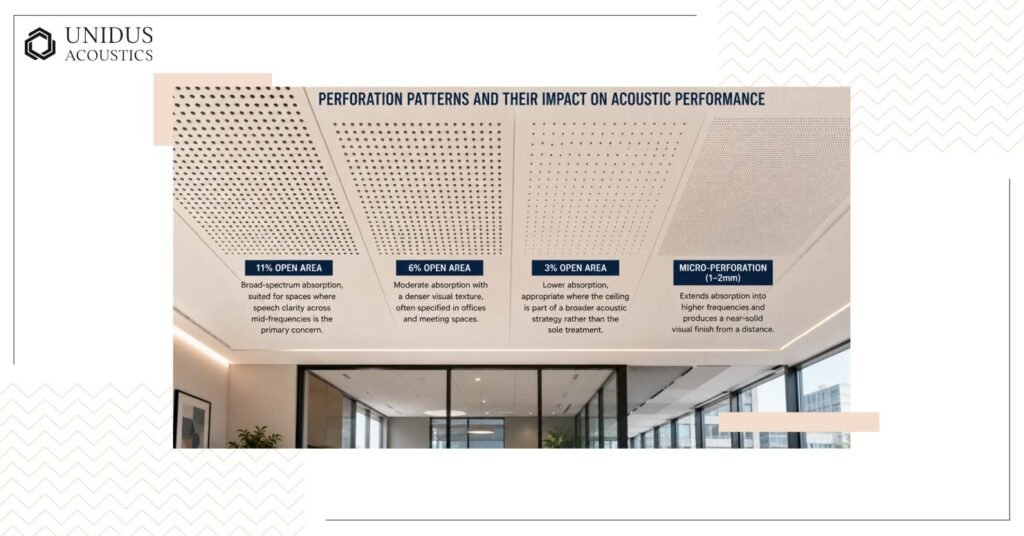
Different perforation codes exist for reasons beyond aesthetics. Open area percentage, hole size, and hole spacing all interact to shape how the panel performs across the frequency spectrum. The perforation code, in other words, is as much a performance variable as the backing system.
What Is Open Area Percentage and Why Does It Matter?
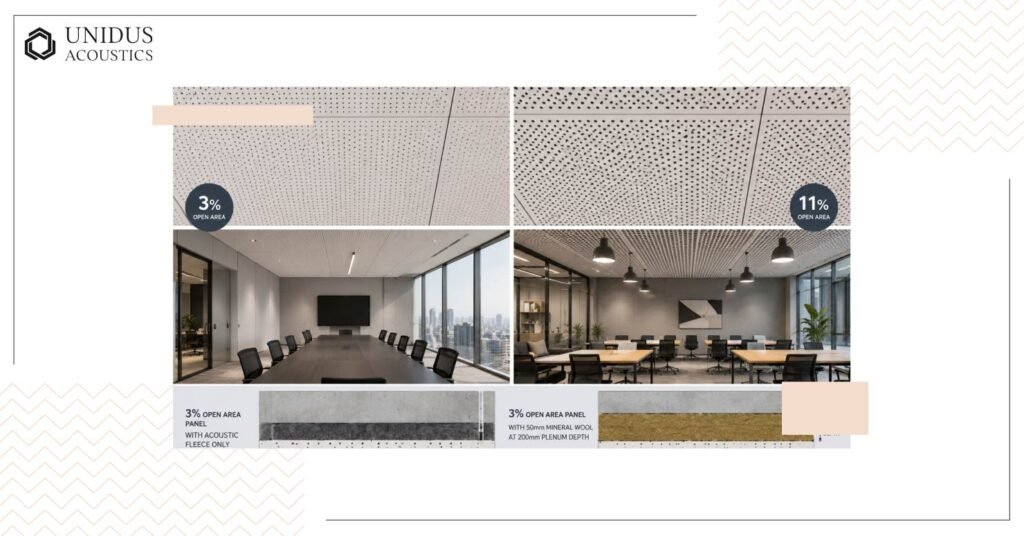
Open area percentage is the most direct lever for controlling how much sound reaches the backing material. Panels in the 3 to 6% open area range offer a near solid visual aesthetic while still allowing meaningful absorption when correctly backed. They suit formal spaces where the ceiling needs to look unbroken. Panels at 11% open area let significantly more sound through. They suit high activity environments where speech clarity or reverberation control takes priority over a minimal visual pattern.
A 3% open area panel with acoustic fleece only performs very differently to the same panel with 50mm mineral wool at 200mm plenum depth. The same perforation code can yield significantly different results depending on the complete system specification.
How Do Hole Size and Spacing Target Specific Frequencies?
Larger holes with wider spacing perform better at lower frequencies (250 to 500 Hz): the range where mechanical hum, HVAC noise, and low register speech sit. Smaller or micro perforated patterns (under 1.5mm hole diameter) perform better at mid to high frequencies (1,000 to 4,000 Hz), where speech intelligibility is most affected.
For most commercial and institutional applications, mid-range performance is the dominant concern. Standard perforation patterns in the 2 to 3mm hole diameter range are a reasonable default. Where plant room or mechanical service noise is a constraint, backing depth and perforation geometry need to be addressed together.
When Should You Specify Micro Perforated Panels?
Micro perforated panels are common in boardrooms, executive reception areas, or anywhere the visual brief demands a solid looking ceiling without acoustic compromise. From normal viewing height, the perforations are barely visible. Right NRC is achievable with the right backing. Reaching those numbers typically requires greater cavity depth or denser infill than a standard perforated system. The trade off is worth understanding before committing to a specification, particularly in retrofit projects where plenum depth is constrained.
Galvanised Steel vs. Aluminium: Which Perforated Metal Ceiling Panel Fits Your Project
The two primary material options for commercial perforated acoustic panels are galvanised steel (GI) and aluminium. Both suit a wide range of commercial applications, but their properties differ in ways that affect specification decisions.
Galvanised Steel (GI) Panels
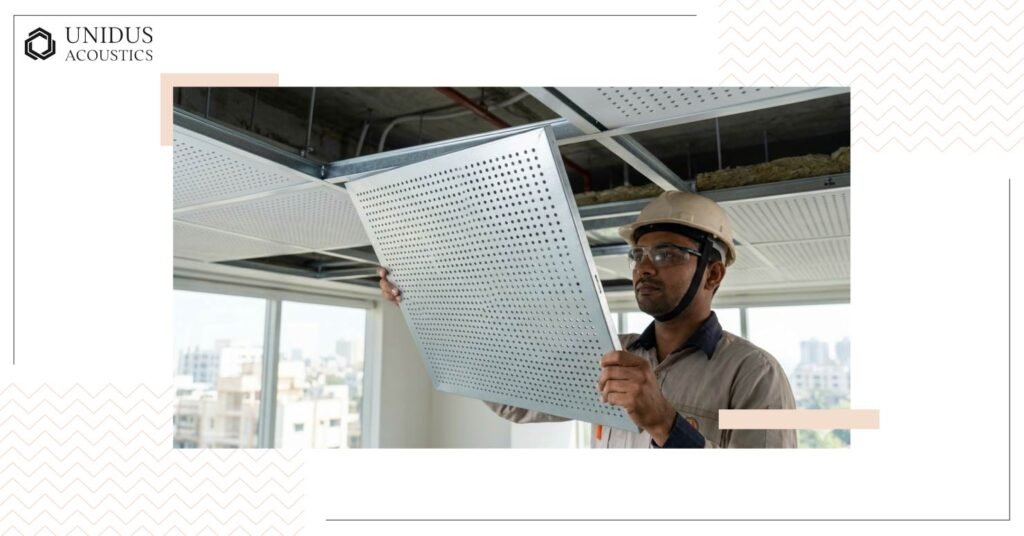
GI panels are the workhorse option for most commercial applications. They are dimensionally stable, resistant to temperature variation, and cost effective at scale. Thickness in standard commercial systems.
Aluminium Panels
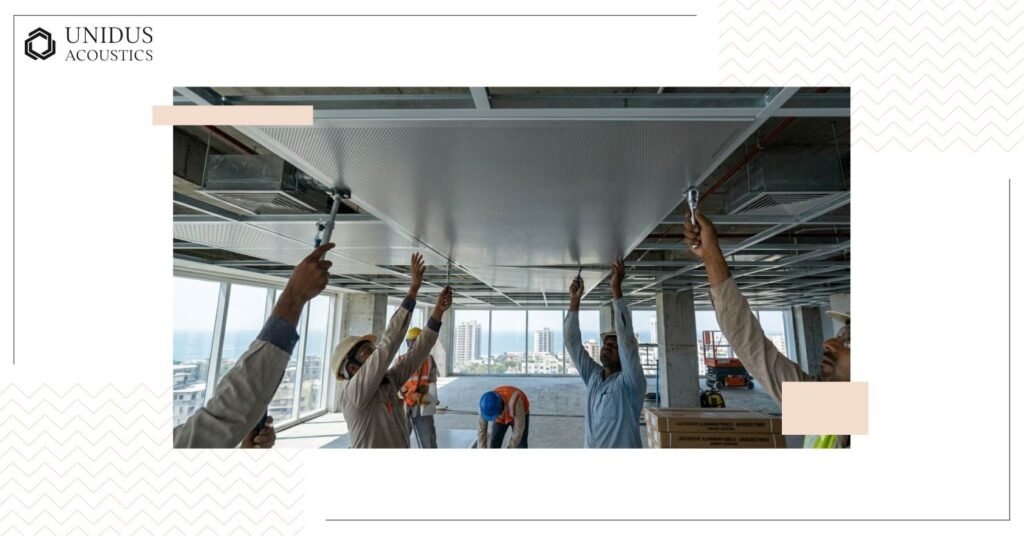
Aluminium offers a weight advantage for large span or retrofit ceilings where load on the grid needs to be managed. It is also more corrosion resistant in high humidity environments, relevant for coastal installations, food service areas, and certain healthcare settings. The finish options for aluminium are somewhat broader, particularly for anodised or custom powder coat applications.
What Are the Core Specification Parameters to Include
Every parameter below should appear as an explicit line item in any specification document, tender brief, or BOQ. Omitting any one of them introduces ambiguity that typically resolves against acoustic performance.
Panel Dimensions and Edge Profile
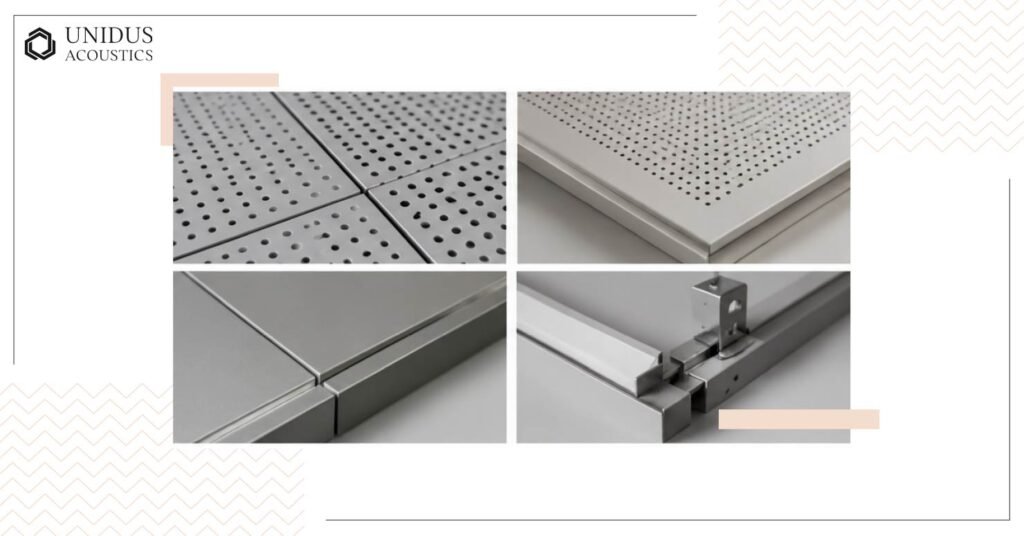
Standard sizing in most commercial grid systems is 595 x 595mm, fitting a 600mm modular grid with appropriate installation clearance. Edge profiles affect both the visual result and the installation method. Square edge gives a clean, uniform joint with an exposed grid. Tegular (or concealed) edge profiles recess the panel face below the grid level for a flush appearance. Microlook profiles reduce the visible grid to a near invisible fine line, common in corporate fit outs where the grid is meant to disappear entirely.
Backing Materials and Infill Specification
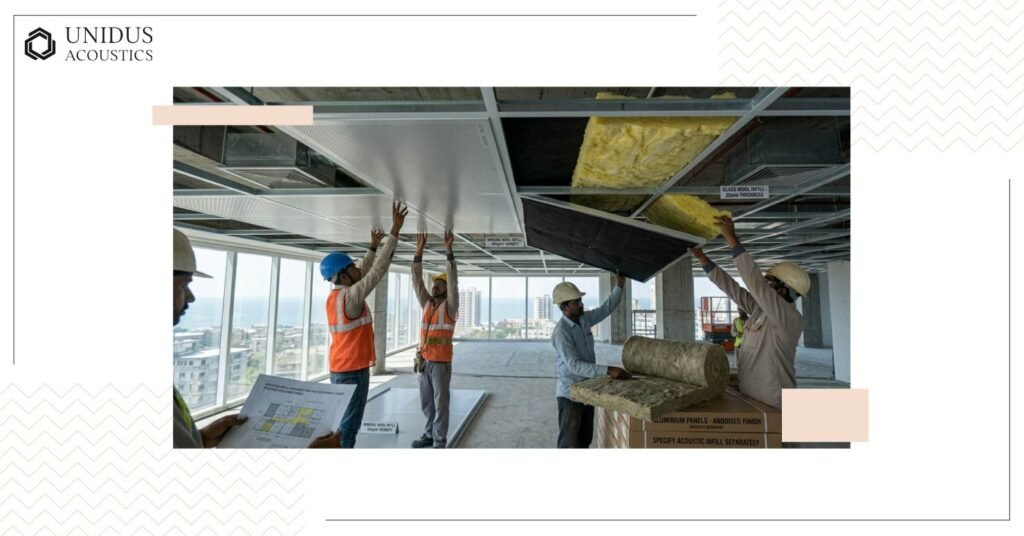
Acoustic fleece is the baseline backing for any system making performance claims. Fleece alone is adequate for moderate acoustic requirements in standard offices. For heavier acoustic briefs (conference rooms, healthcare waiting areas, open plan offices with high occupancy), mineral wool or glasswool infill should be specified alongside fleece. State density and minimum thickness as separate requirements. Without these, the contractor is free to interpret the brief in ways that compromise performance.
What NRC Rating Should You Specify by Space Type?
Open plan offices, classrooms, and call centres benefit from right NRC at the ceiling plane. Conference rooms can often work at NRC 0.65 to 0.75, depending on wall treatment and soft furnishings. Corridors and public circulation areas can work at lower ratings. Reverberation control in long corridors is frequently underspecified. Healthcare waiting areas and wards require both background noise control and speech clarity, pushing toward NRC 0.75 or above.
Where Do Perforated Acoustic Ceiling Panels Perform Best?
Perforated acoustic panels are not the right answer to every ceiling brief. Knowing where they consistently perform and where they have limitations helps narrow the specification earlier in the process.
Open Plan Offices and Corporate Interiors
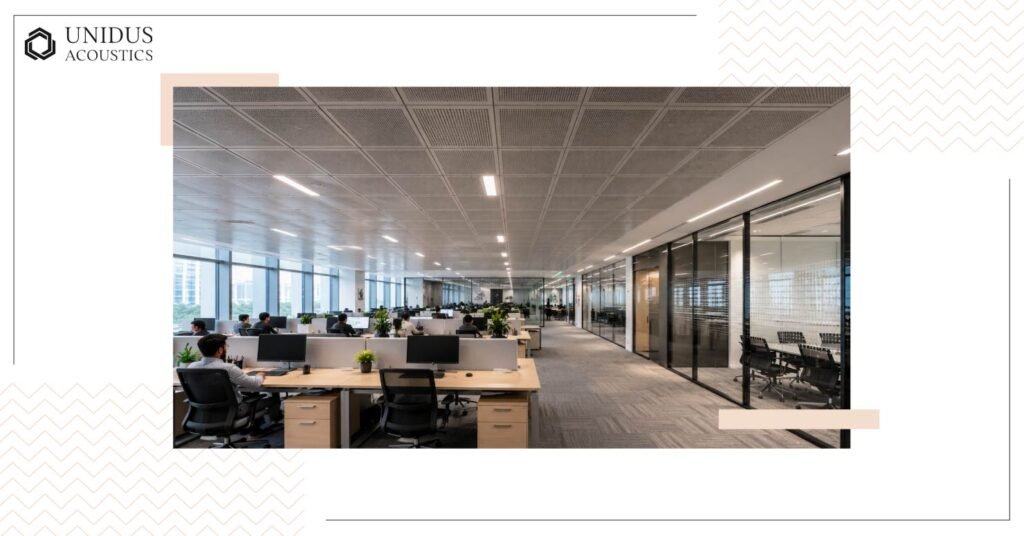
Open plans generate the most consistent acoustic complaints in commercial design. Perforated acoustic ceiling panels with appropriate backing, installed across the full ceiling plane, can bring reverberation times down meaningfully and cut conversational noise propagation across workstations. The 600mm modular format integrates cleanly with standard MEP layouts, which simplifies coordination with the services engineer.
Corridors, Lobbies, and Public Circulation Areas
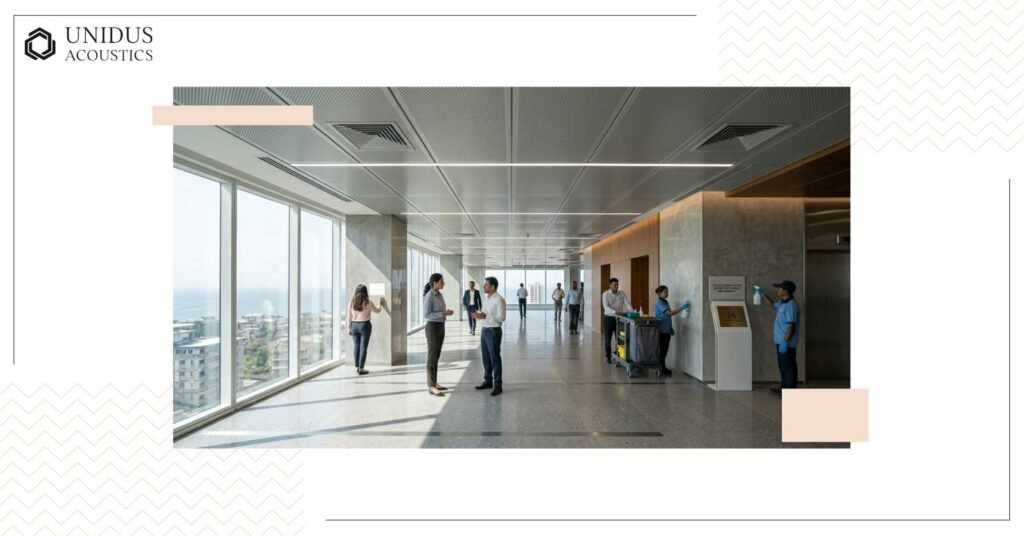
High ceilings and hard wall finishes in circulation zones create long reverberation tails, affecting speech clarity and general comfort. A perforated acoustic ceiling over these areas, even without heavy infill, can reduce echo significantly. The material holds up well here too: metal panels resist cleaning, impact damage, and the gradual yellowing or sagging that affects softer tiles over time.
Institutional and Healthcare Settings
Institutional projects typically require fire performance certification, hygiene compliance, and long-term maintenance accountability. Perforated GI or aluminium panels satisfy all three more reliably than fibrous alternatives. Non-combustible metal faces with fire-rated backing options meet fire performance requirements applicable in most commercial building codes. Surfaces are cleanable without degradation. Panel systems remain accessible for MEP maintenance without replacement costs on re-access.
Installation Variables That Affect Performance
A technically correct specification can underperform when installation details aren’t followed. The same gaps come up repeatedly on commercial projects.
Exposed vs. Concealed Grid Systems
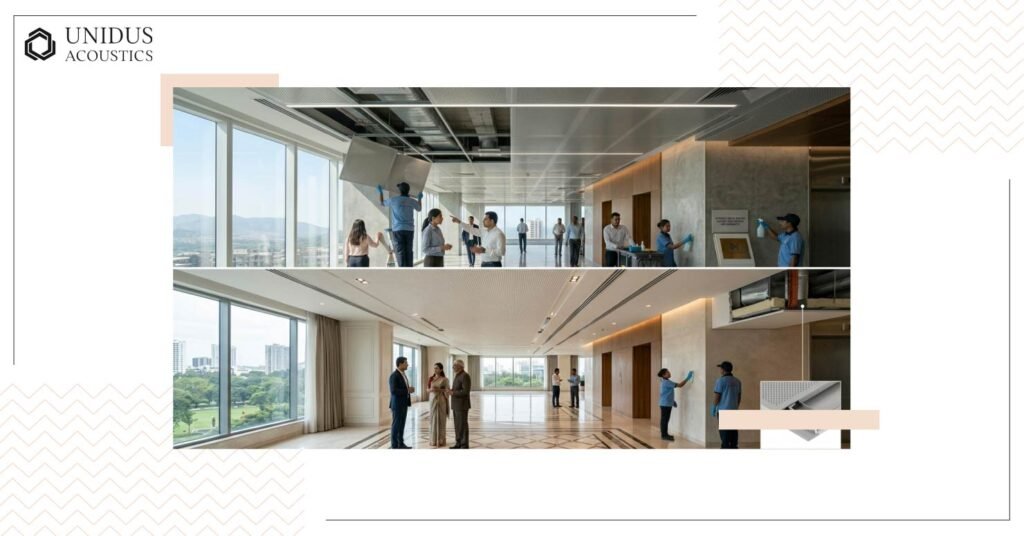
High ceilings and hard wall finishes in circulation zones create long reverberation tails, affecting speech clarity and general comfort. A perforated acoustic ceiling over these areas, even without heavy infill, can reduce echo significantly. The material holds up well here too: metal panels resist cleaning, impact damage, and the gradual yellowing or sagging that affects softer tiles over time.
Institutional and Healthcare Settings
Institutional projects typically require fire performance certification, hygiene compliance, and long-term maintenance accountability. Perforated GI or aluminium panels satisfy all three more reliably than fibrous alternatives. Non-combustible metal faces with fire-rated backing options meet fire performance requirements applicable in most commercial building codes. Surfaces are cleanable without degradation. Panel systems remain accessible for MEP maintenance without replacement costs on re-access.
Which Installation Variables Affect Acoustic Performance?
A technically correct specification can underperform when installation details aren’t followed. The same gaps come up repeatedly on commercial projects.
Exposed vs. Concealed Grid Systems
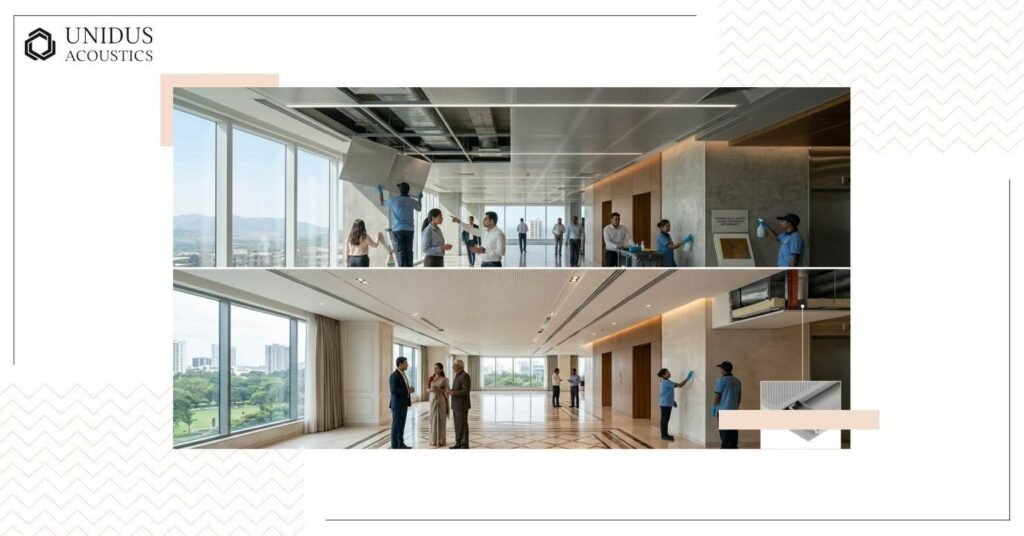
Exposed grid (lay-ng) systems are quicker to install and allow easy access for MEP maintenance. Concealed grid and clip-in systems give a cleaner finish but require more careful coordination at the fixture level. For acoustic performance, neither system is inherently better than the other. What matters is that panels are fully seated, the backing is correctly placed and continuous, and the plenum isn’t functioning as an unplanned acoustic bypass through unsealed penetrations.
Air Cavity Depth and Low Frequency Performance
The air gap between the panel backing and the structural slab above is not just a construction tolerance. It is an acoustic variable. A cavity of 200mm or more consistently improves low-frequency absorption compared to systems installed with minimal plenum depth. Where plenum constraints exist, denser backing materials at greater thickness can partially compensate. Model the trade-off rather than assuming it.
What Are the Most Common Specification Errors to Avoid?
Not all acoustic underperformance on commercial projects traces back to wrong material choices. These errors appear repeatedly.
No Backing Specified in the Brief
A perforated panel without an explicit backing specification is an aesthetic choice, not an acoustic one. Always specify backing material type, density, and minimum thickness as separate line items.
Open Area Mistaken for Performance
Higher open area does not automatically mean better acoustic results. Backing depth and material density set the upper limit on system performance, regardless of the perforation code.
Plenum Bypass Left Unaddressed
Services, cable trays, and unsealed penetrations crossing the plenum transmit sound through the ceiling plane regardless of panel NRC rating. Sealing requirements need to be in the spec.
Edge Profile Specified Against the Wrong Grid Type
A tegular or concealed edge panel against an exposed grid system (or vice versa) creates installation problems that resolve by replacing materials or accepting a compromised finish. Check edge profile against grid type at the specification stage, not during installation.
Frequently Asked Questions About Perforated Acoustic Panels
1. What NRC rating should I specify for a perforated acoustic ceiling panel?
For open plan offices and classrooms, NRC 0.75 or above is the accepted benchmark. For spaces with moderate acoustic demands such as corridors or reception areas, NRC 0.65 to 0.70 is typically adequate. Always specify NRC alongside the full backing system description. The panel face alone has no meaningful NRC value without it.
2. Can perforated acoustic panels be used on walls as well as ceilings?
Yes. Wall applications are often specified alongside perforated ceiling systems to increase total absorptive surface area. Edge profiles and fixing systems differ between wall and ceiling applications. Specify both separately in the brief.
3. Are GI panels suitable for humid environments?
GI has adequate humidity resistance for most commercial interiors in standard conditions. For consistently high humidity environments: commercial kitchens, pool areas, or coastal climates, aluminium panels are the more appropriate choice.
4. What is the minimum plenum depth recommended for good acoustic performance?
A plenum of 200mm or more consistently improves low frequency absorption. Where services or structural constraints prevent this, specify denser backing materials and confirm the performance impact through acoustic modelling before finalising.
Specifying Perforated Acoustic Panels: The Key Principles
Getting the specification right on a perforated acoustic ceiling isn’t complicated, but it demands treating the system as a whole. Selecting the panel face without specifying the complete assembly is the most consistent route to underperformance. It is a gap that appears in otherwise careful specifications more often than it should.
Panel dimensions, perforation code, edge profile, backing material and density, air cavity depth, grid type: all of it needs to be addressed together. Any one of them, underspecified or left to interpretation, changes what the installed system actually delivers.
Unidus Acoustics has been designing and manufacturing perforated acoustic solutions for over 40 years. Our UNISTEEL range covers GI panels across multiple perforation codes, with square, tegular, and microlook edge profiles for lay-in and clip in systems. Standard sizing fits the 600mm commercial grid, and custom finishes are available for project specific requirements.
For project specific specification support, acoustic calculations, or a detailed product breakdown, contact us now