

A classroom that looks finished on the drawings can still fail once it’s occupied. Add thirty children and the traffic noise drifting in from the road outside, and even a well-planned room can turn into an echo chamber where the back row cannot follow the lesson. Acoustic solutions for educational institutions exist for exactly this gap, between how a space looks on paper and how it sounds once it’s in use. Unidus Acoustics, which has spent 40+ years working on acoustic solutions for commercial and institutional spaces in India, put together this guide to set out where campus acoustics tend to go wrong, what the relevant standards ask for, and which materials fit different parts of a school or college campus.
Key Takeaways
- Acoustic solutions for educational institutions matter most in classrooms, libraries, auditoriums and cafeterias, where reverberation and background noise interfere with speech.
- International guidance such as ANSI/ASA S12.60, alongside India’s own National Building Code, sets measurable targets for reverberation time and background noise in schools.
- Different campus zones need different treatment: soft, absorptive ceilings for classrooms, ceiling baffles for auditoriums, higher-mass partitions for music rooms, and durable panels for corridors and cafeterias.
- Retrofitting an occupied campus is possible in most cases without structural work, though it needs sequencing around the academic calendar.
- Fire safety ratings and durability matter as much as sound absorption once a product is going into a school, and so does how easy it is to keep clean.
Why Classrooms and Campuses Struggle With Sound
Most acoustic problems on a campus come down to two things happening in the same room: too much reflected sound, and too much noise getting in from outside it. Understanding both is what makes the fixes later in this guide make sense.
The Reverberation Problem in Large, Hard-surfaced Rooms
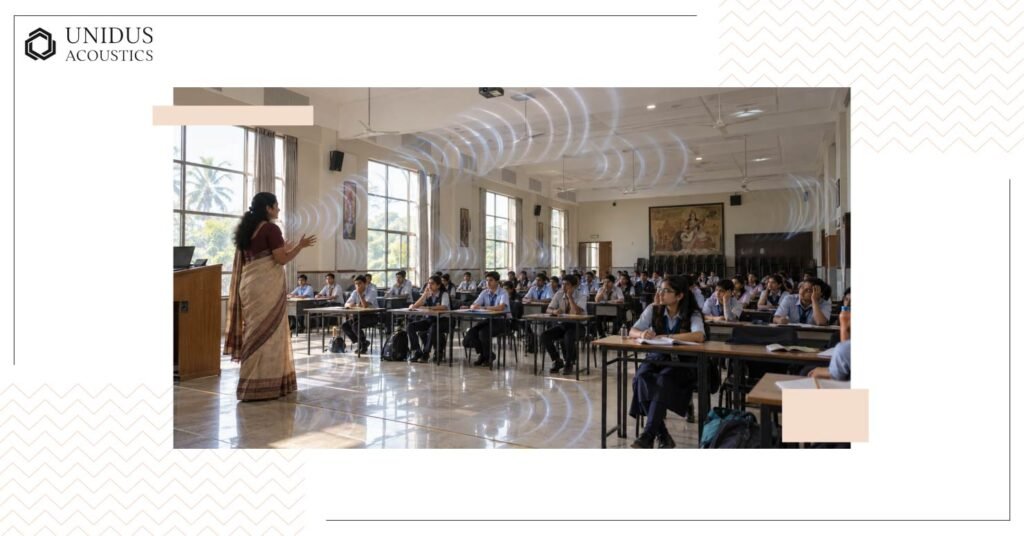
Classrooms, corridors, auditoriums and libraries are usually built with plaster ceilings and hard, tiled floors, surfaces that reflect sound rather than absorb it. In a room like that, a teacher’s voice keeps bouncing around long after the word is spoken, and by the time the reflections die down, the next sentence has started. Reverberation time, or RT60, is the standard way to measure this: it’s the time a sound takes to decay by 60 decibels, and it climbs fast in rooms with hard surfaces and high ceilings.
Background Noise from HVAC, Corridors and the World Outside
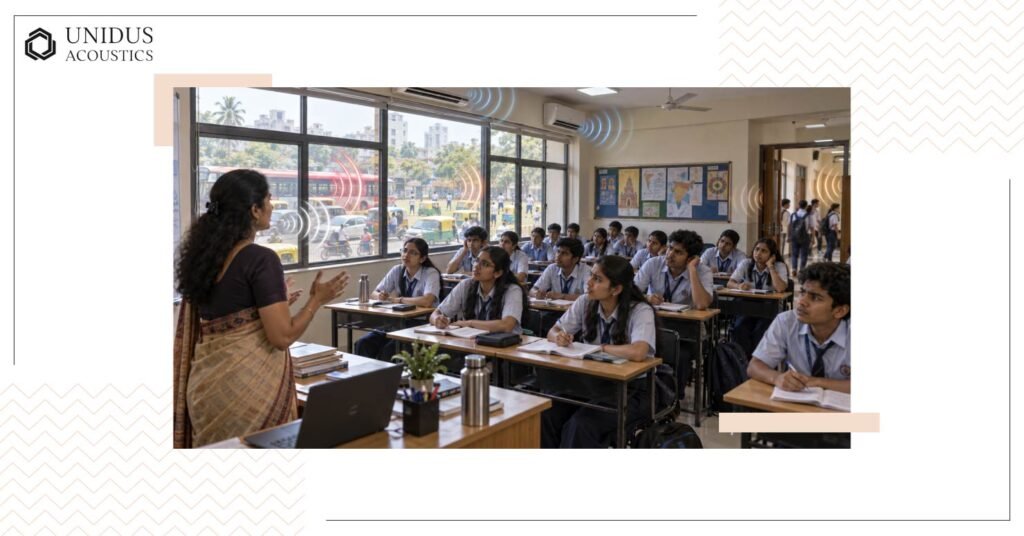
Traffic, playground activity, air conditioning units and the classroom next door all add a constant layer of noise that competes with the teacher’s voice. None of this is a planning failure. It’s what happens when a site sits near a road, or when budgets don’t stretch to acoustic glazing at the design stage. The result is the same either way: students strain to catch what’s being said, and the ones sitting further from the teacher lose the most.
What Poor Acoustics Costs a Campus

The effect isn’t only on comprehension. Teachers speaking over background noise for hours a day carry a higher risk of vocal strain, and students, particularly younger ones and those learning in a second language, lose a measurable share of what’s said in class. Acoustics researchers have documented both effects for years, in classrooms with volumes and layouts not far off from what’s common in India. None of this shows up in a floor plan. It only becomes obvious once the room is in use, which is usually well after the acoustic decisions have already been made.
What Good Acoustic Performance Looks Like on a Campus
Two reference points are useful here: one international, one specific to India.
ANSI/ASA S12.60, a Workable International Benchmark
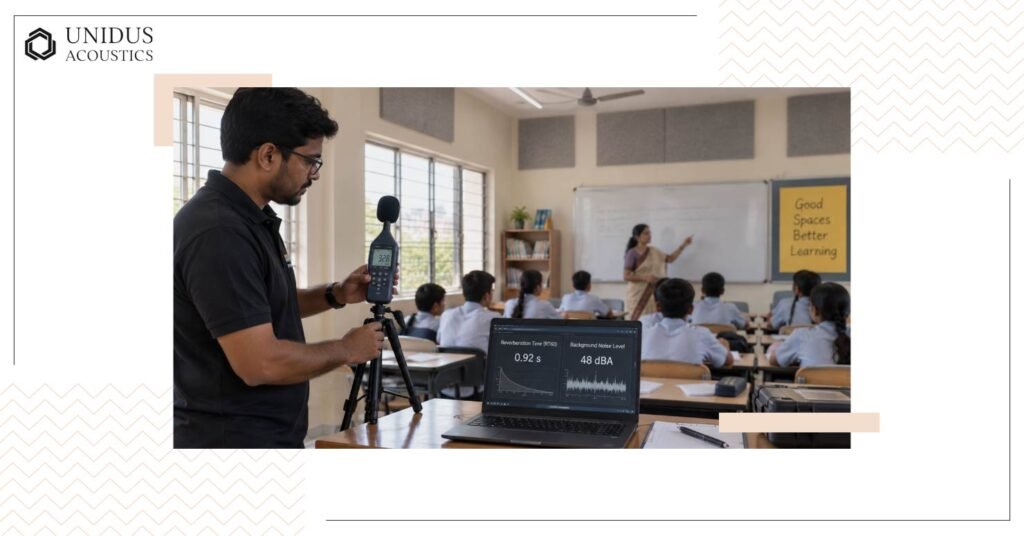
The American National Standards Institute’s S12.60 standard sets maximum reverberation times and background noise levels for classrooms, and even outside the US it works as a useful reference for what “good” sounds like. For a classroom under 10,000 cubic feet, the standard calls for a reverberation time under 0.6 seconds and background noise under 35 dBA. Most untreated Indian classrooms sit well above both figures.
The National Building Code of India and Educational Buildings
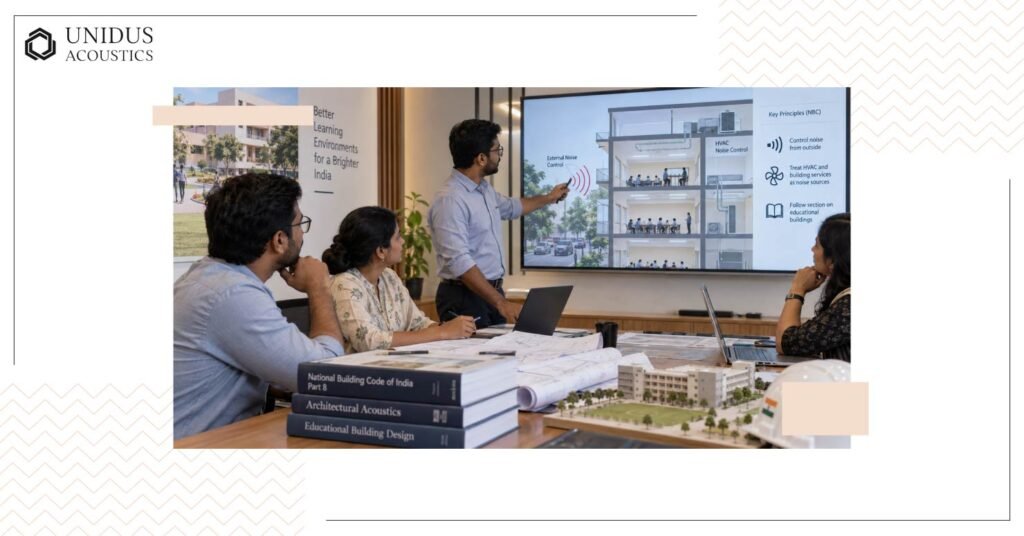
India’s National Building Code, Part 8, Section 4, deals directly with acoustics, sound insulation and noise control, and it carries a dedicated chapter for educational buildings within the code’s current revision. It doesn’t hand architects a single number the way ANSI does, but it lays out the planning principles instead: keeping noise from outside the building under control, and treating HVAC and other building services as noise sources in their own right. Reading the two standards together gives a fairly complete picture of what a campus should be aiming for.
Acoustic Solutions Mapped to Campus Zones
Not every part of a campus needs the same treatment, and treating a library like an auditorium, or the other way round, wastes budget without fixing the actual problem. Here’s how the requirements usually break down by zone.
Classrooms and Lecture Halls
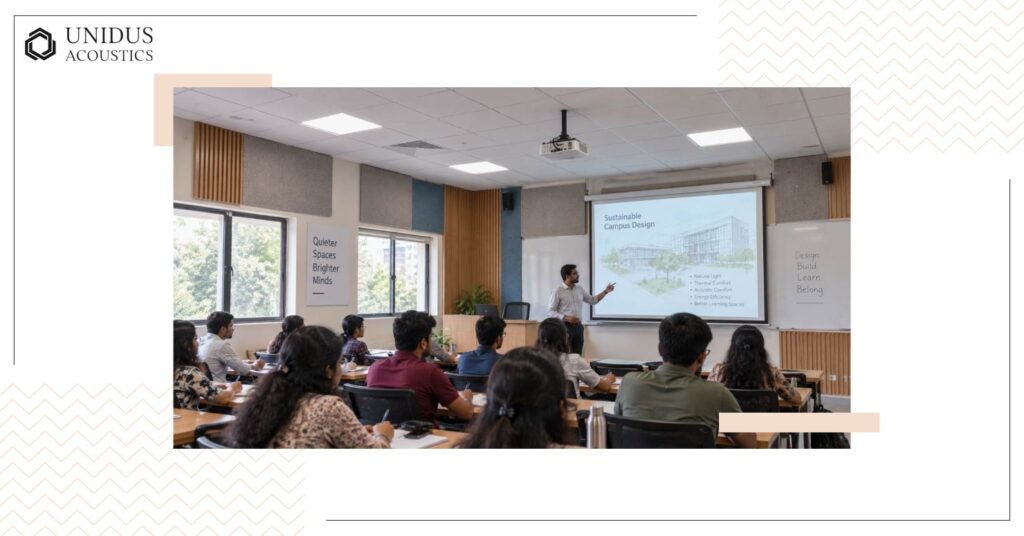
Classrooms need absorption on the ceiling and, where wall space allows, on at least one wall facing the hard, reflective surfaces. Soft fibre ceiling tiles bring reverberation down quickly without adding weight to the structure, and they’re straightforward to install over an existing grid. Where a wall also needs treatment, a guide to acoustic wall panels is worth reading before specifying anything, since fabric-wrapped or perforated finishes do the job without turning the room into something that looks like a recording studio.
Libraries and Reading Rooms
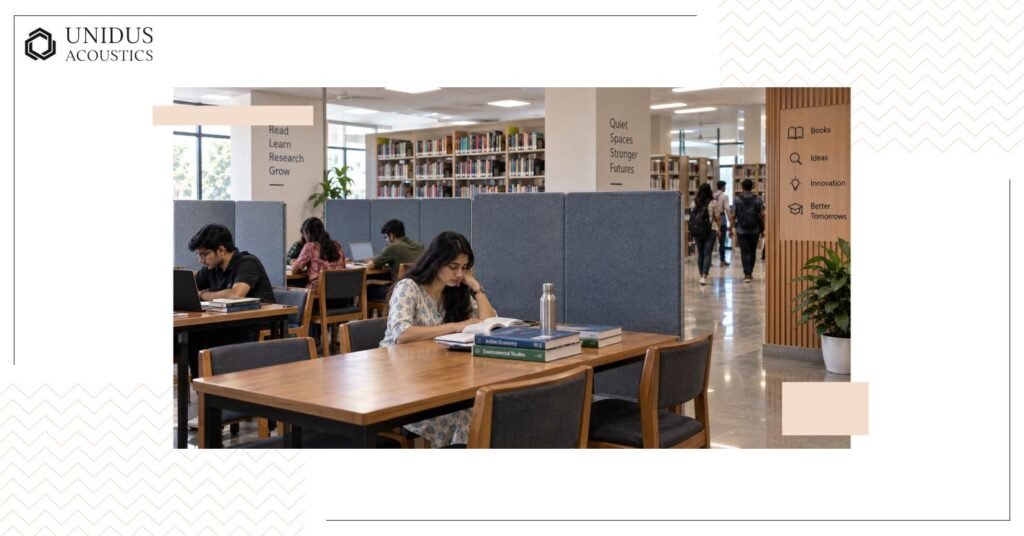
Libraries have a different problem: they need quiet zones sitting right next to open circulation areas, often within the same floor plate. Acoustic screens work well here because they define a reading zone acoustically without needing a full floor-to-ceiling wall, which keeps the layout flexible if the room gets reconfigured later.
Auditoriums and Multipurpose Halls
Auditoriums carry the highest stakes acoustically, since one speaker or performer needs to carry across a large volume. Acoustic solutions for auditoriums typically combine ceiling baffles or clouds with wall panels at ear height and behind the stage, and panel placement in a large auditorium matters as much as the total area treated. A hall with panels in the wrong spots can still have dead zones and hot spots even after the budget’s been spent.
Cafeterias, Corridors and Common Areas
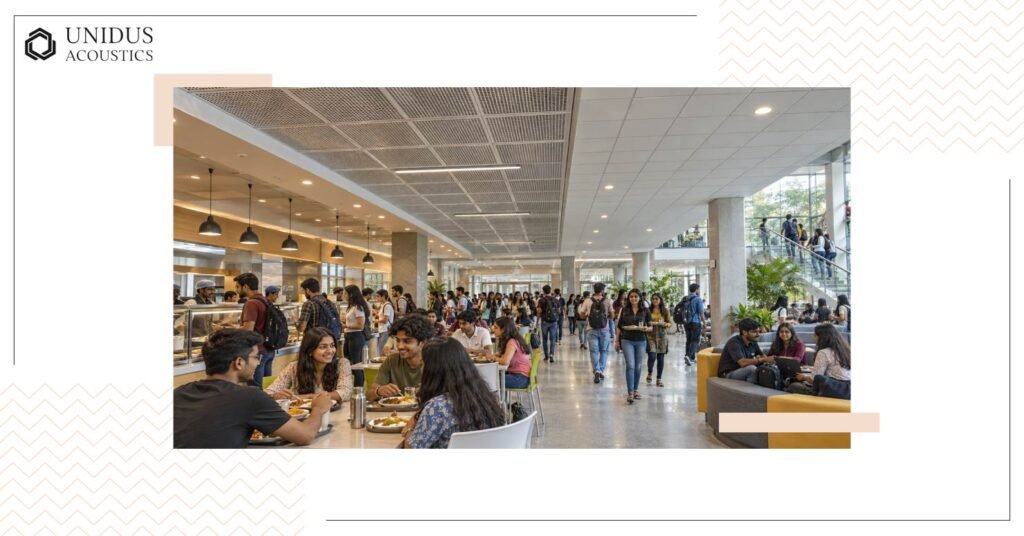
These are high-footfall, high-noise areas where durability matters more than fine-tuned acoustic performance. Metal ceiling systems with acoustic backing, or mineral fibre acoustic ceiling tiles, hold up to cleaning and knocks in a way that softer materials don’t, while still bringing down the general noise floor in spaces where dozens of conversations happen at once.
Music Rooms, Labs and AV Studios
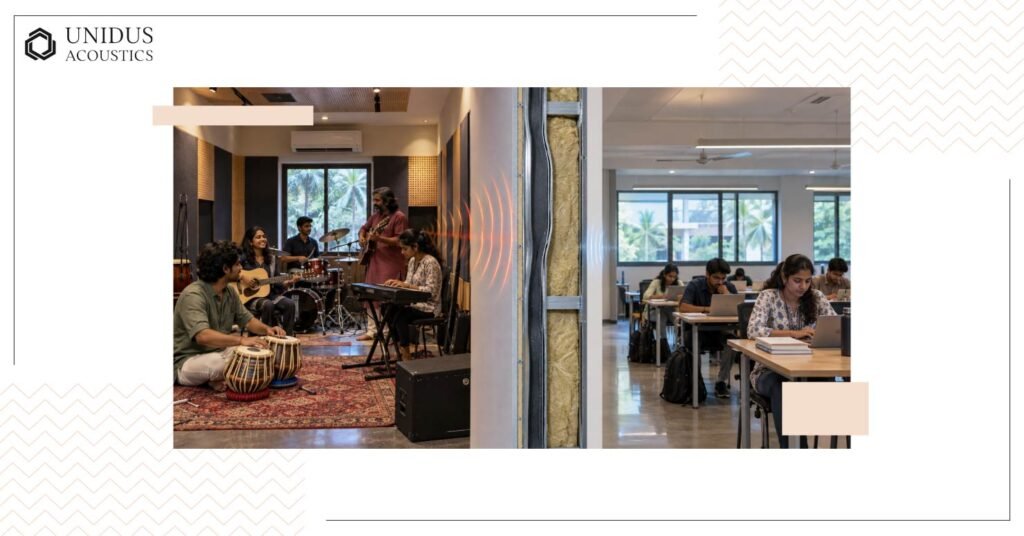
These spaces need something the rest of the campus doesn’t: sound isolation between rooms, not just absorption within them. A layer of MLV, or mass loaded vinyl, inside a partition wall, combined with sound insulation materials such as mineral wool, keeps a music practice room from leaking into the classroom next door. This is a different acoustic problem from the one classrooms and auditoriums have, and it needs a different fix.
Materials That Hold Up in Institutional Use
Choosing a material for a school isn’t the same exercise as choosing one for a corporate office. A few things matter more here.
Ceiling Systems for High-footfall Spaces

Both acoustic false ceilings and acoustic tiles built for ceiling and wall applications work well across a campus, and the choice usually comes down to budget and how much of the ceiling needs replacing versus retrofitting. Wood wool acoustic panels are worth considering too. They’re naturally fire-resistant and take paint well if the finish needs to match the rest of the room. Because of this, they’ve become a common choice on campuses pursuing green building credentials. Green building certification requirements are worth a separate read if that’s part of the project brief.
Wall Panels, Partitions and Sound Insulation
For walls, the decision usually splits between fabric-wrapped panels, which offer softer aesthetics and easier upkeep, and perforated or metal-faced panels, which suit high-traffic corridors and labs better. Where two rooms need to be acoustically separated rather than just treated internally, that’s when sound insulation materials enter the conversation instead of, or alongside, absorptive panels.
Durability, Fire Safety and Maintenance
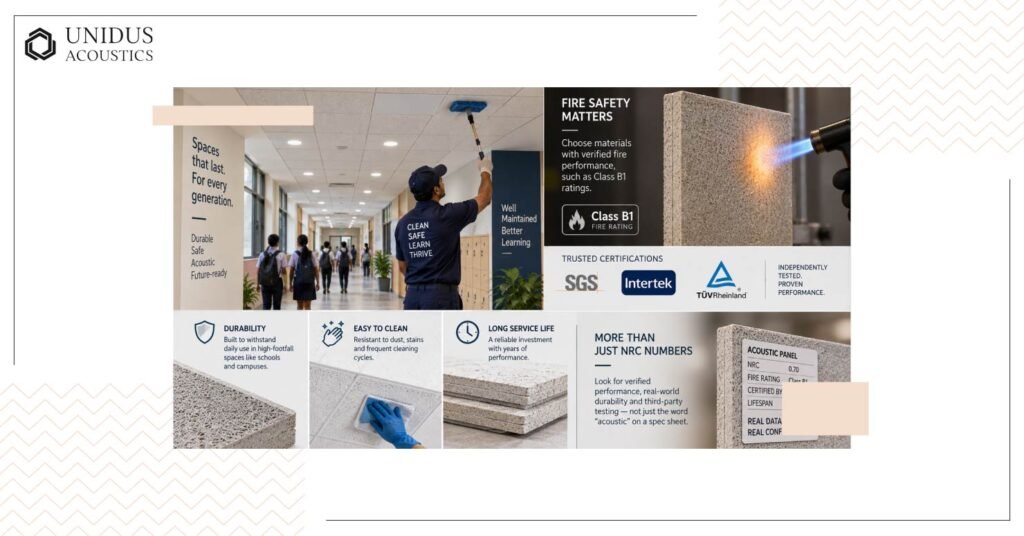
A material that performs beautifully in a showroom but can’t survive a decade of school corridors isn’t the right specification, however good its NRC rating looks on paper. Fire safety class and ease of cleaning matter here, and so does the expected lifespan of an acoustic panel before it needs replacing. Class B1 fire ratings and third-party certifications from labs such as SGS, Intertek or TÜV Rheinland are a reasonable shorthand for whether a manufacturer has tested these things, rather than describing a product as “acoustic” on a spec sheet with nothing behind the claim.
New Build or Retrofit: Planning Acoustics either Way
Most campus acoustic projects fall into one of two categories, and each comes with its own constraints.
Acoustics at the Design Stage
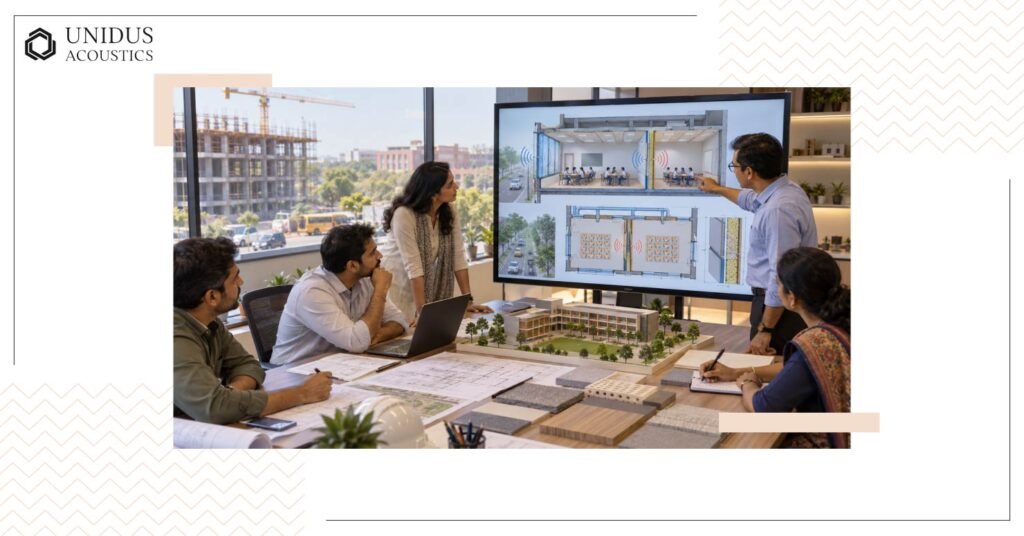
Acoustics cost the least to fix when they’re part of the original design, since the room’s shape, glazing and HVAC routing can all be planned around known noise sources. This is also the stage where when to invest in acoustic consultancy is worth asking as a question, since a consultant can flag classroom-to-classroom noise transfer before the walls go up, not after.
Retrofitting an Occupied Campus
Retrofitting is more common than most people expect, and it doesn’t usually mean gutting a room. Suspended ceiling treatments and wall panel upgrades can typically go in over a weekend or during a term break, without touching the building’s structure. Supply chain timelines matter more here than on a new build; a project that has to work around exam schedules or vacation windows needs materials ordered well ahead of the installation date, not decided on the week before.
Questions to Ask Before Choosing an Acoustic Partner for a Campus Project
A campus project usually runs on a tighter budget and a harder deadline than a corporate fit-out, which makes the choice of partner matter more, not less. A few questions are worth asking before signing off on a vendor:
- Has the product been tested for NRC and fire rating by an independent lab, and can that test data be shared.
- Can the vendor work around an academic calendar, and what does their typical installation timeline look like for an occupied building.
- Does the manufacturer offer samples in the sizes and finishes needed for the project, rather than a generic catalogue swatch.
- What happens if a panel gets damaged years later, and is a matching replacement still available.
Unidus Acoustics, which counts institutions such as Ashoka University among the campuses it has worked with, treats these as standard questions to walk through with a project team before work starts. A vendor who can’t answer them upfront is worth a second look before you sign.
Conclusion
Acoustic solutions for educational institutions aren’t a single product decision. A campus is several different acoustic problems living under one roof: a classroom that needs absorption, a library that needs a hushed corner, a music room that needs isolation, and a cafeteria that has to survive daily wear. Getting each zone right matters more than picking one material and applying it everywhere. Unidus Acoustics works through this zone by zone with architects, interior designers, government project teams and facility managers across Indian campuses, and can be reached for a project-specific consultation.
For a campus-specific consultation, architects and facility teams can contact us now, or explore the acoustic solutions on offer at unidusacoustics.com.
Frequently Asked Questions
1. What is the ideal reverberation time for a classroom?
Under ANSI/ASA S12.60, a classroom smaller than 10,000 cubic feet should have a reverberation time under 0.6 seconds, and larger rooms up to 20,000 cubic feet should stay under 0.7 seconds. Most Indian classrooms without acoustic treatment run well above this.
2. Does India’s National Building Code cover school acoustics specifically?
Yes. The National Building Code’s Part 8, Section 4 includes a dedicated chapter on educational buildings, alongside its broader provisions for outdoor noise planning and building services noise.
3. Can acoustic panels be added to a school without major construction?
In most cases, yes. Ceiling tiles, wall panels and partition upgrades are typically surface-mounted treatments that go in over an existing structure, and they can usually be scheduled during a term break or a weekend.
4. Which parts of a campus usually need acoustic treatment first?
Classrooms and auditoriums tend to show the problem first, since both depend on one speaker being heard across a full room. Libraries and music rooms follow close behind, for different reasons: quiet zones in one case, isolation in the other.
5. Do acoustic materials need a fire safety rating for use in schools?
Yes, and it’s worth confirming this before any product gets specified. Class B1 fire ratings and third-party lab certifications are a reasonable way to check whether a manufacturer’s claims hold up.
6. How long do acoustic panels last in a high-traffic school environment?
It depends on the material and how it’s finished, but well-specified panels in corridors and common areas are generally built to handle years of daily use. The finish and mounting method matter as much as the base material for how well a panel holds up over time.