Acoustic performance on commercial projects rarely gets decided by one person. There’s the architect, the interior designer, the MEP consultant, the client, and then somewhere in the chain, an acoustic consultant. Sometimes they’re involved from the start. Often, they’re not.
In Mumbai, where project timelines are tight and real estate carries serious cost, picking the wrong acoustic consultant creates problems that don’t show up until after handover. This guide is for architects and designers who want to avoid exactly that.
Why the Right Acoustic Partner Changes Everything
You already know that acoustics work best when they’re integrated early. The challenge isn’t awareness; it’s finding a partner who can actually keep up with a fast-moving commercial project, deliver custom solutions that fit your material palette, and provide the technical documentation you need without you chasing it.
Most acoustic vendors in Mumbai operate off a fixed catalogue. You tell them your ceiling height; they tell you which SKU fits. That works for basic projects. It doesn’t work when the brief calls for bespoke baffles, a specific colour family, or coordination with a lighting design.
What you’re looking for isn’t a supplier. It’s a partner who treats your design intent as brief.
What to Actually Evaluate When Choosing an Acoustic Consultant in Mumbai
There are a few things worth checking before you commit to an acoustic consultant in Mumbai. Some are obvious; others tend to get skipped until they become a problem.
1. Experience with Commercial Spaces, Not Just Studios

Acoustic treatment for a recording studio and acoustic treatment for a 2,000 sq ft open-plan office in Bandra Kurla Complex are fundamentally different problems. The materials differ. The NRC targets differ. The fire safety requirements definitely differ.
Ask any acoustic consultant you’re considering to walk you through at least two or three commercial projects in Mumbai or nearby. Offices, corporate campuses, healthcare facilities, hospitality spaces. The category matters. A consultant who mostly works on home theatres or studios will optimise for the wrong things.
2. Material Range and Customisation Depth

Standard catalogue products force you to compromise. You’ve locked in a material palette and a colour story, and then the acoustic vendor shows up with five options, none of which work.
What to check: Can they customise colour, shape, and material finish to match your specifications? Can they work in fabric, wood, metal, and PET panels across the same project? Do they have in-house manufacturing, or are they reselling imported stock?
This is where delivery reliability comes in. A vendor with local manufacturing has far more control over timelines than one importing from Europe or China. On a Mumbai project running to a deadline, that distinction matters a lot.
3. How They Fit Into Your Workflow

A good acoustic consultant shouldn’t create extra coordination overhead for your team. They should be able to submit NRC ratings, fire certificates, and product specifications in the format your tender documents require. They should flag clashes with MEP drawings early. They should show up to coordination meetings prepared, not reactive.
Ask them how they typically engage during the design phase versus execution. If their answer is purely execution-focused (“we come in when the ceiling is ready”), that’s a signal. The value of an acoustic consultant comes from early involvement, not late-stage fixes.
4. On-Time Delivery Track Record

This one gets underweighted. Acoustic panels and ceiling systems going in late can hold up an entire fit-out. In a city like Mumbai, where project delays have compounding costs, a vendor with a patchy delivery record is a risk you don’t need to take on.
Ask specifically about lead times for custom orders. Ask what happens if the material doesn’t pass QC. Ask whether they have stock of standard configurations for when timelines tighten. These aren’t aggressive questions; they’re the right ones.
Red Flags Worth Noting
An acoustic consultant who can’t provide NRC test reports from a certified lab is a problem. So is one who quotes generic absorption coefficients without specifying the test standard. Fire safety documentation is non-negotiable on commercial projects. If a vendor treats these as afterthoughts, walk away.
Similarly, be cautious of consultants who can only work from a fixed catalogue or who push back on customisation as complicated or expensive. Custom acoustic solutions for commercial spaces aren’t the exception; they’re the norm.
Once you know what to look for and what to avoid, the next step is finding a partner who consistently clears these bars. For architects working on commercial projects in Mumbai, Unidus Acoustics is one worth considering.
Why Architects and Designers Choose Unidus Acoustics for Mumbai Projects
Unidus Acoustics has 40 years of expertise in custom acoustic solutions across wall panels, ceiling systems, baffles, acoustic pods, and insulation. Projects span offices, corporate campuses, healthcare facilities, and institutional spaces. The client portfolio includes Air India, AIIMS, TCS, Infosys, SBI, Reliance, and Ashoka University, across settings where acoustic performance was as much a design requirement as an engineering one.
The Mumbai market has a specific pace. Unidus Acoustics’ quick-response manufacturing and local distribution network are set up for it. For architects who need acoustic panels in custom colours, U-TONE baffles tailored to a ceiling concept, or UNIPOD phone booths specified for a client’s open-plan fitout, the process starts with your design intent, not a catalogue.
Technical documentation for tender submissions, NRC ratings, fire certificates, and installation coordination is handled as standard, not as extras you have to ask for.
Questions Worth Asking Any Acoustic Consultant Before Signing Off

- Can you show me two or three commercial projects in Mumbai you’ve delivered in the last two years?
- What’s your typical lead time for custom-fabricated panels?
- How do you handle design coordination if our ceiling layout changes mid-project?
- What fire safety certifications do your products carry?
- Can your team produce acoustic specifications in a format compatible with our tender documentation?
The answers will tell you a lot more than any brochure.
Closing Thought
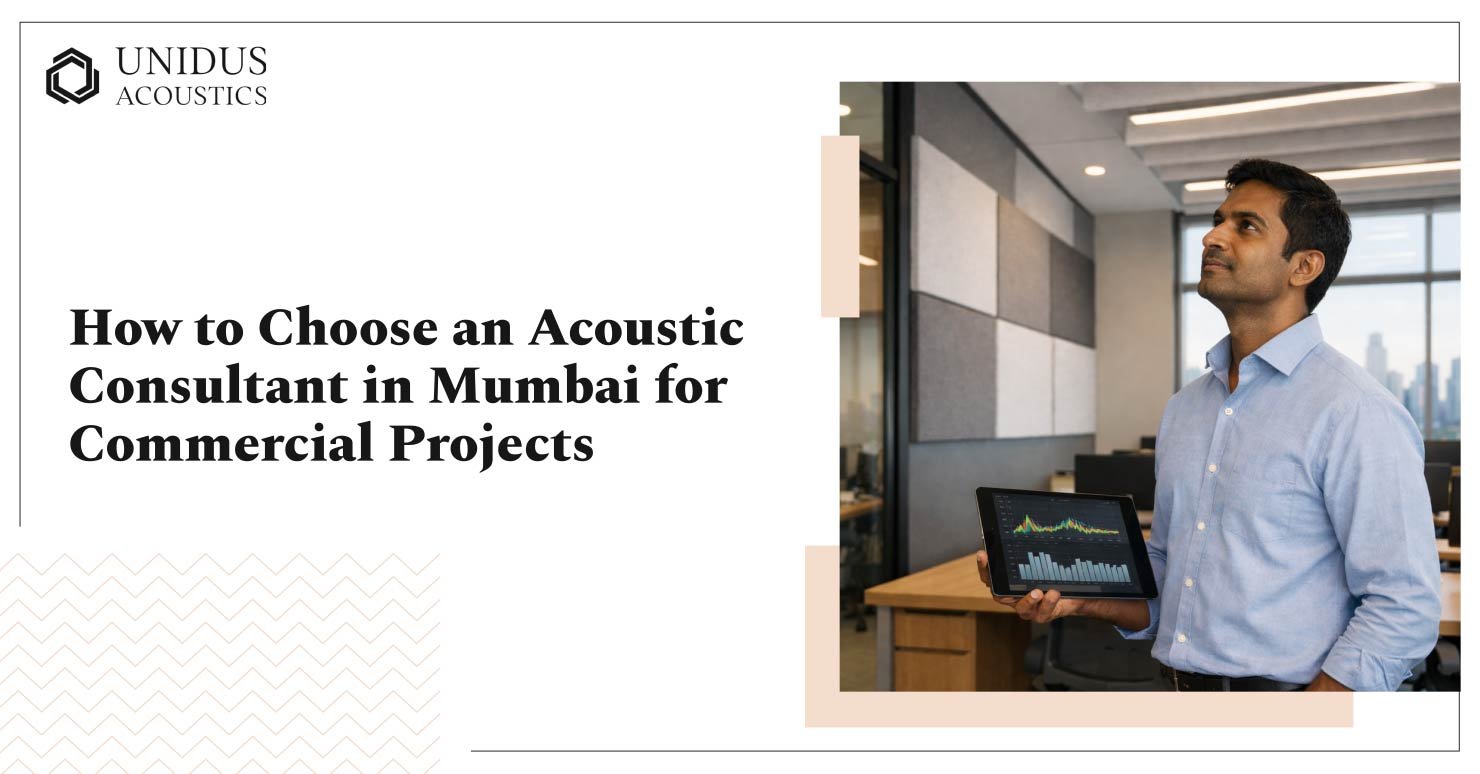
Finding a good acoustic consultant in Mumbai for commercial work comes down to this: they need to understand design, not just decibels. The technical side matters, but so does their ability to work within your vision, hit your timelines, and make the paperwork easy rather than painful.
If you’re working on a commercial project in Mumbai and want to explore acoustic solutions tailored to your design brief, the Unidus Acoustics team is available for product recommendations and technical support. Contact us now to partner with us for your next project.