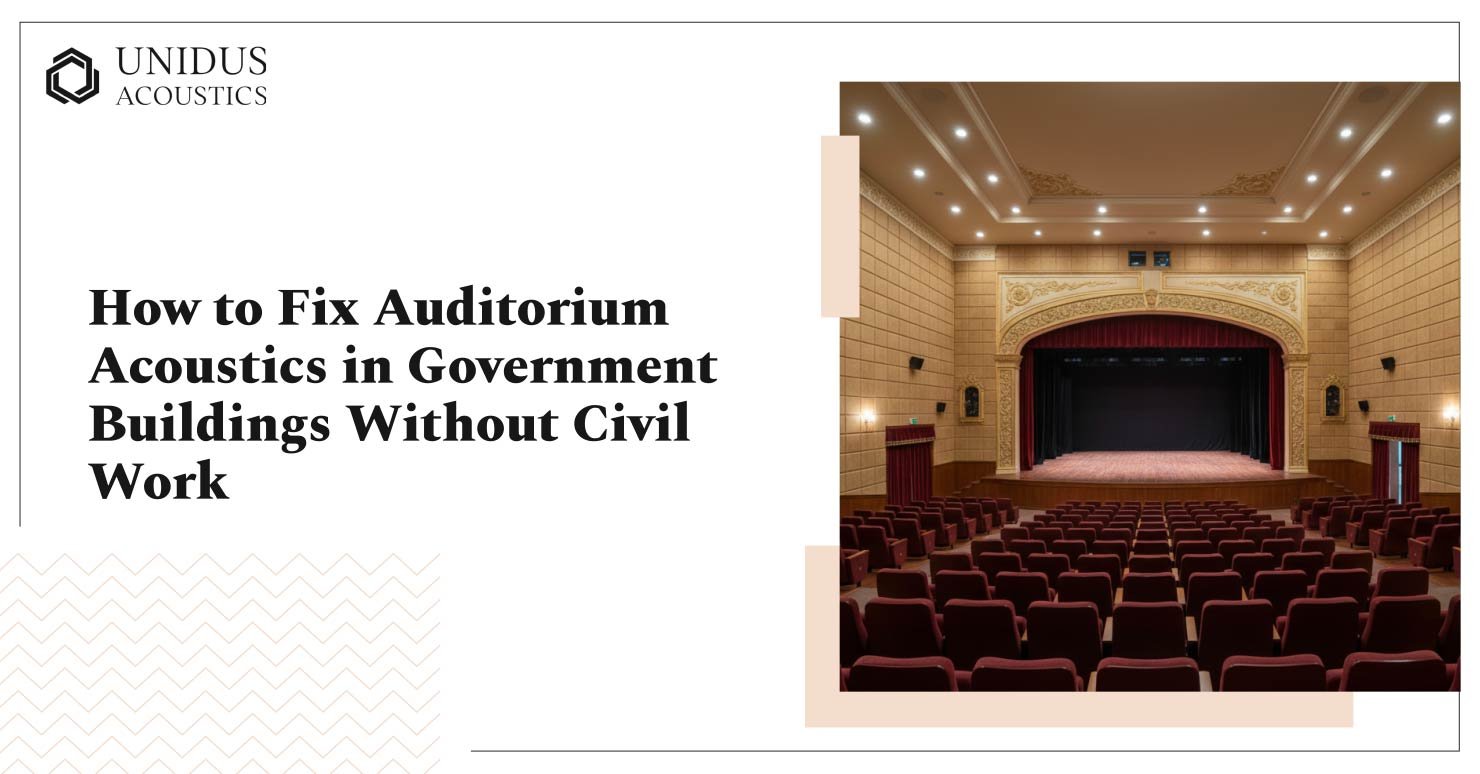
Have you noticed attendees in back rows struggling to hear clearly during official functions, even after installing expensive sound systems? This happens because large auditoriums need acoustic treatment to improve speech clarity, not better equipment.
If you’re specifying solutions for government projects, you already know the constraints: tight approvals, zero tolerance for operational disruption, and strict compliance requirements. The good news? Fixing auditorium acoustics in government buildings rarely requires the civil work that complicates project timelines.
Why Government Auditoriums Need More Than Sound Systems for Better Acoustics
Here’s what happens in most government auditoriums: large volumes, hard surfaces (marble floors, glass windows, painted walls), and high ceilings. Sound waves bounce repeatedly between these surfaces, creating reverberation that makes speech unintelligible. No amount of amplification fixes this because you’re just amplifying the echoes along with the voice.
This is an acoustic treatment challenge, not an equipment problem. At Unidus Acoustics, we’ve spent 40 years providing acoustic solutions for government institutions where these constraints matter most. The space needs sound-absorbing surfaces to control reverberation and improve speech clarity.
The Case for Surface-Applied Acoustic Treatment
Unlike structural modifications that require approvals, contractors, shutdowns, and months of work, surface-applied acoustic solutions install quickly with minimal disruption. These systems work by:
- Absorbing excess sound energy before it creates problematic reflections.
- Reducing reverberation time, making speech clearer and more intelligible.
- Maintaining the visual integrity of the space when properly specified.
Most importantly, they install without touching the building’s structure. No demolition, no concrete work, no lengthy approval processes.
4 Proven Solutions for Auditorium Acoustics in Government Buildings
Different spaces call for different strategies, but these four approaches cover most government auditorium scenarios:
1. Ceiling-Based Solutions
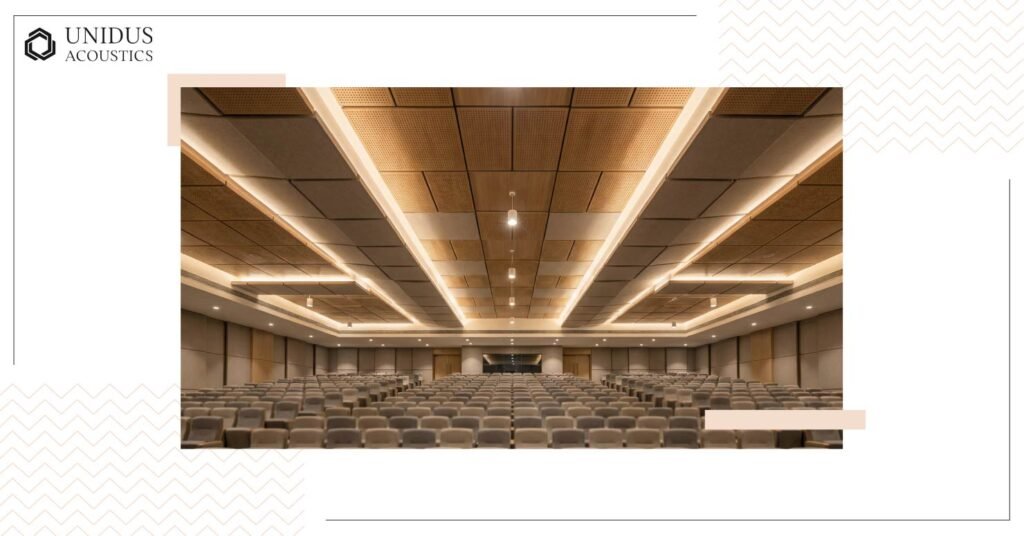
Acoustic ceiling tiles, baffles, or clouds suspended from the existing ceiling provide significant absorption with minimal visual impact. Ceiling-based systems work particularly well in auditoriums because they address the largest reflective surface where sound naturally travels.
Modern acoustic ceiling systems come in various materials (mineral fibre, polyester, wood wool) and can integrate with existing lighting and HVAC without modification. When specified early, they fit seamlessly into technical drawings and MEP coordination.
2. Wall-Mounted Panels
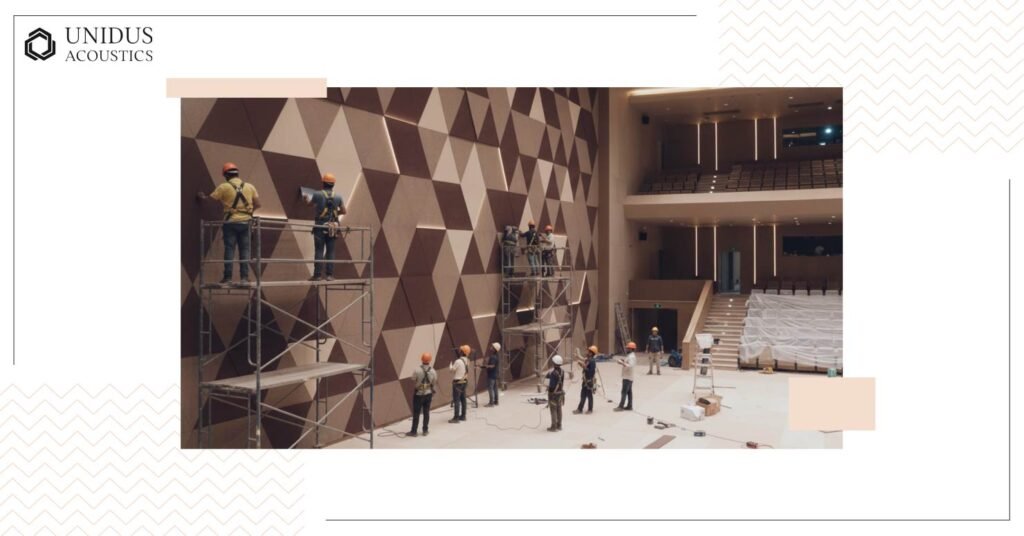
Acoustic wall panels install directly onto existing walls without structural fasteners that penetrate the building envelope. These panels serve double duty by absorbing sound while adding visual interest through customised colours, patterns, or even printed graphics that align with the institution’s branding.
For government spaces, wall panels in fabric-wrapped or perforated wood finishes maintain a formal aesthetic while delivering serious acoustic performance (NRC ratings of 0.70-0.90 depending on thickness and backing).
3. Rear Wall Treatment
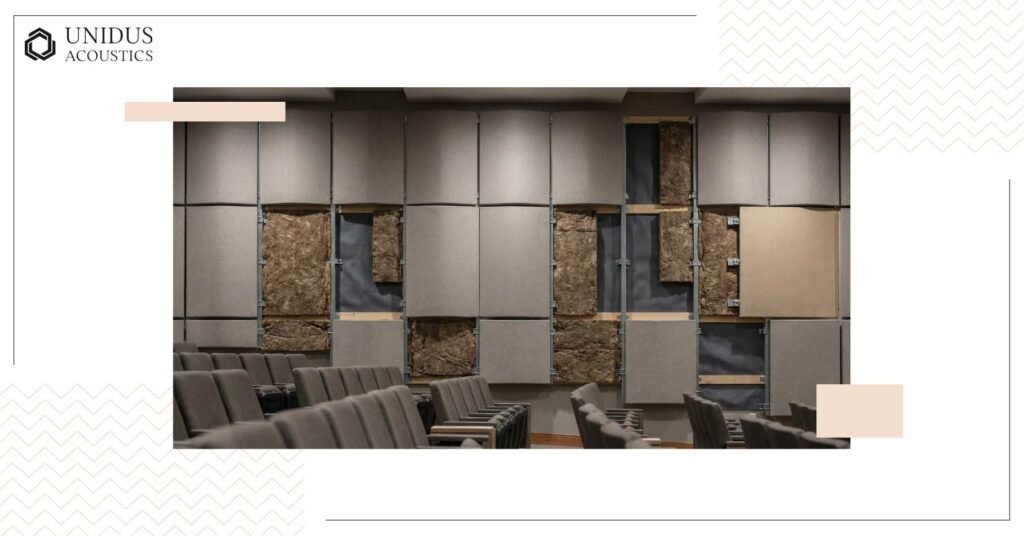
In auditoriums, the rear wall is where sound from the stage travels and reflects back, creating the most problematic echoes. Treating this single surface often delivers disproportionate acoustic improvement for the coverage area involved.
Rear wall solutions can include:
- Thick acoustic panels with high absorption coefficients.
- Diffuser panels that scatter sound instead of reflecting it directly back.
The choice depends on the room’s specific dimensions and intended use.
4. Upper Wall and Soffit Applications
The transition zone between walls and ceiling often gets overlooked but provides excellent acoustic treatment opportunities. Acoustic baffles or shaped panels in this zone catch sound at its most energetic angles while staying above sightlines that might obstruct visibility.
While these four approaches address most government auditorium scenarios, successful implementation depends on proper specification.
Key Specifications for Government Building Acoustic Projects
When specifying acoustic treatment for government buildings, several factors beyond acoustic performance come into play:
Fire Safety Compliance
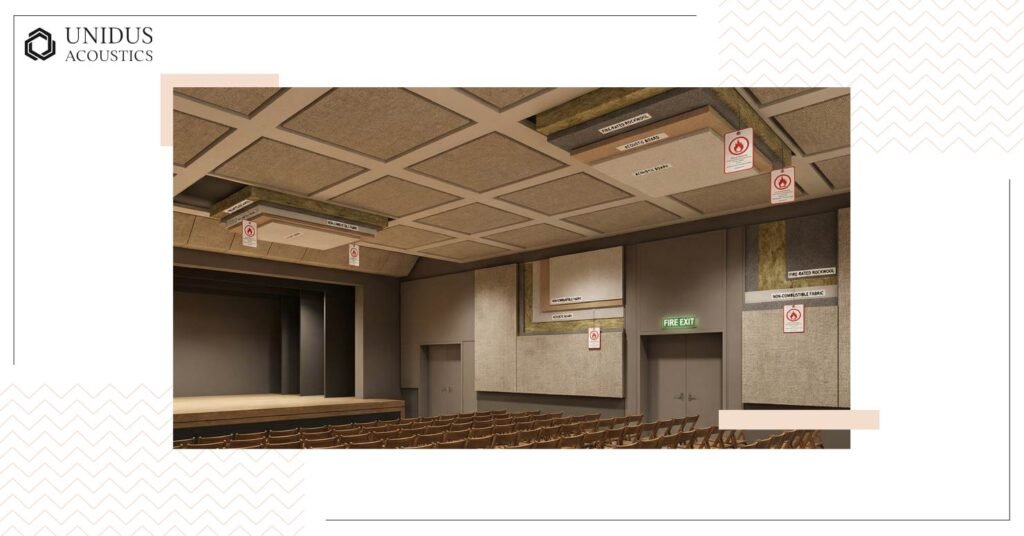
Government buildings typically require Class 1 fire-rated materials. All acoustic products should carry proper certifications and testing documentation for tender specification and approval processes.
Installation During Downtime
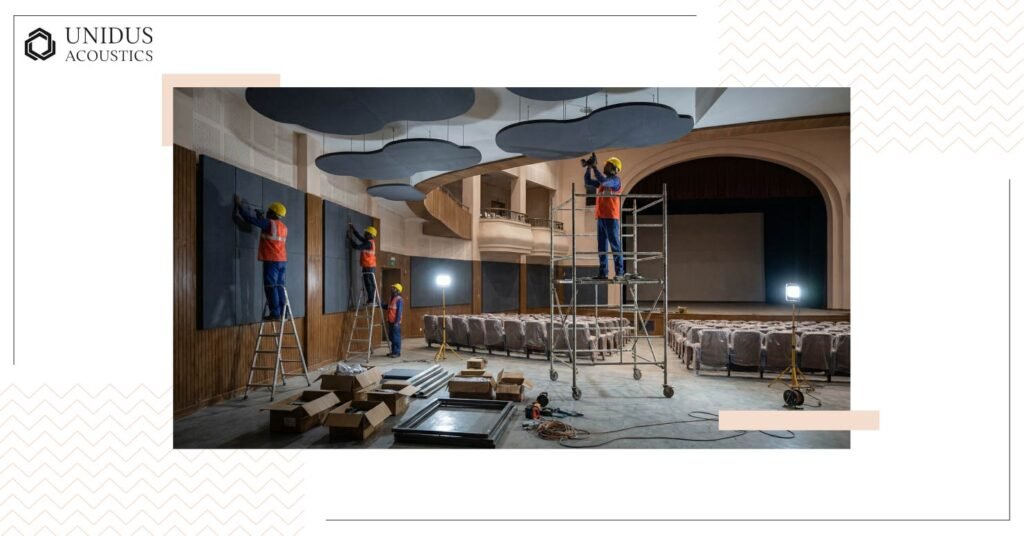
Government facilities can’t shut down for weeks. Most acoustic treatments are installed during non-operational hours (evenings, weekends) without disrupting daily functions. A typical 500-seat auditorium treatment can be installed in 3-5 days of work.
Durability for Institutional Use
Government spaces see heavy use and need materials that withstand it. Commercial-grade acoustic solutions designed for high-traffic environments outlast residential-grade alternatives while maintaining performance.
Documentation and Testing
Government procurement often requires:
- Performance testing reports.
- Manufacturer certifications.
- Acoustic consultant verification.
Specify products that come with complete technical documentation to smooth the approval process.
Maintenance Access
Acoustic materials should allow access to ceiling infrastructure (lights, HVAC, fire safety systems) for routine maintenance without replacement. Modular systems or accessible ceiling designs prevent future complications.
Performance Expectations: What Changes After Treatment
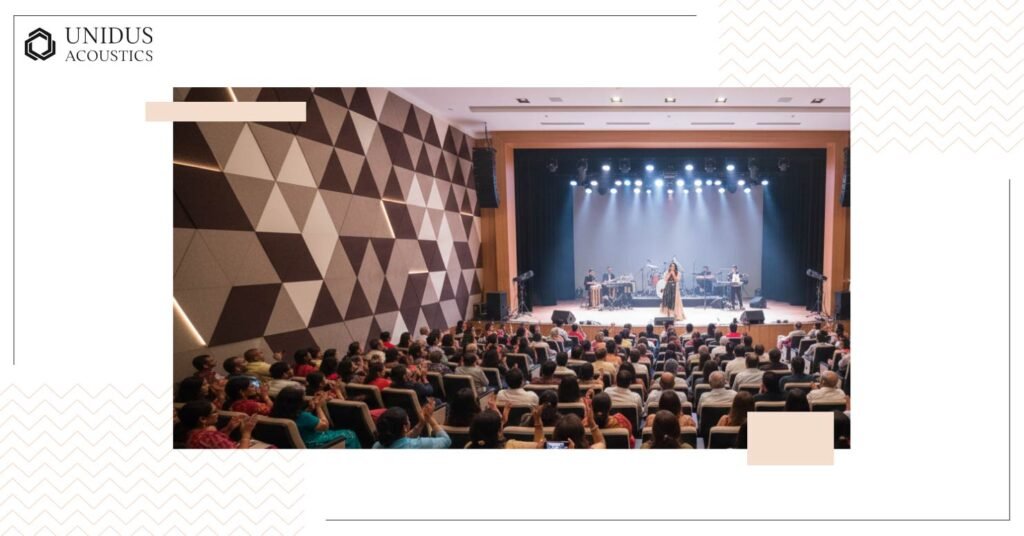
Properly specified acoustic treatment dramatically changes how a government auditorium functions.
Speech clarity improves to the point where attendees in back rows hear comfortably without straining. This happens because reverberation time drops from 2-3 seconds (typical for untreated hard-surface spaces) down to 0.8-1.2 seconds (optimal for speech intelligibility).
Public address systems work more effectively because they’re amplifying clear sound instead of fighting room reverb. Volume levels can often decrease while intelligibility increases.
The space feels calmer and more controlled because background noise doesn’t build up and echo the way it does in reverberant spaces.
Integration With Your Technical Specifications
Acoustic treatment works best when considered during the design phase, but government auditoriums rarely have that luxury. Most require retrofit solutions that integrate with existing conditions.
For architects and consultants working on government projects, acoustic product manufacturers can provide NRC ratings, fire certificates, and CAD details for inclusion in tender documents. Early coordination ensures acoustic solutions align with electrical, mechanical, and architectural requirements without conflicts.
Moving Forward With Acoustic Solutions
Fixing auditorium acoustics in government buildings without civil work isn’t just possible; it’s often the only practical approach given institutional constraints. Surface-applied acoustic treatment delivers measurable performance improvement while respecting budget limitations, approval processes, and operational continuity.
At Unidus Acoustics, we’ve spent 40+ years providing custom acoustic solutions for institutional projects where these constraints matter most. Our acoustic ceiling systems, wall panels, and specialised treatments are designed for spaces that can’t afford disruption but can’t tolerate poor acoustics either.For government projects requiring acoustic treatment that works within institutional constraints, we can provide product specifications, performance documentation, and technical support for your tender requirements.
Contact us now to partner with us for your next project.