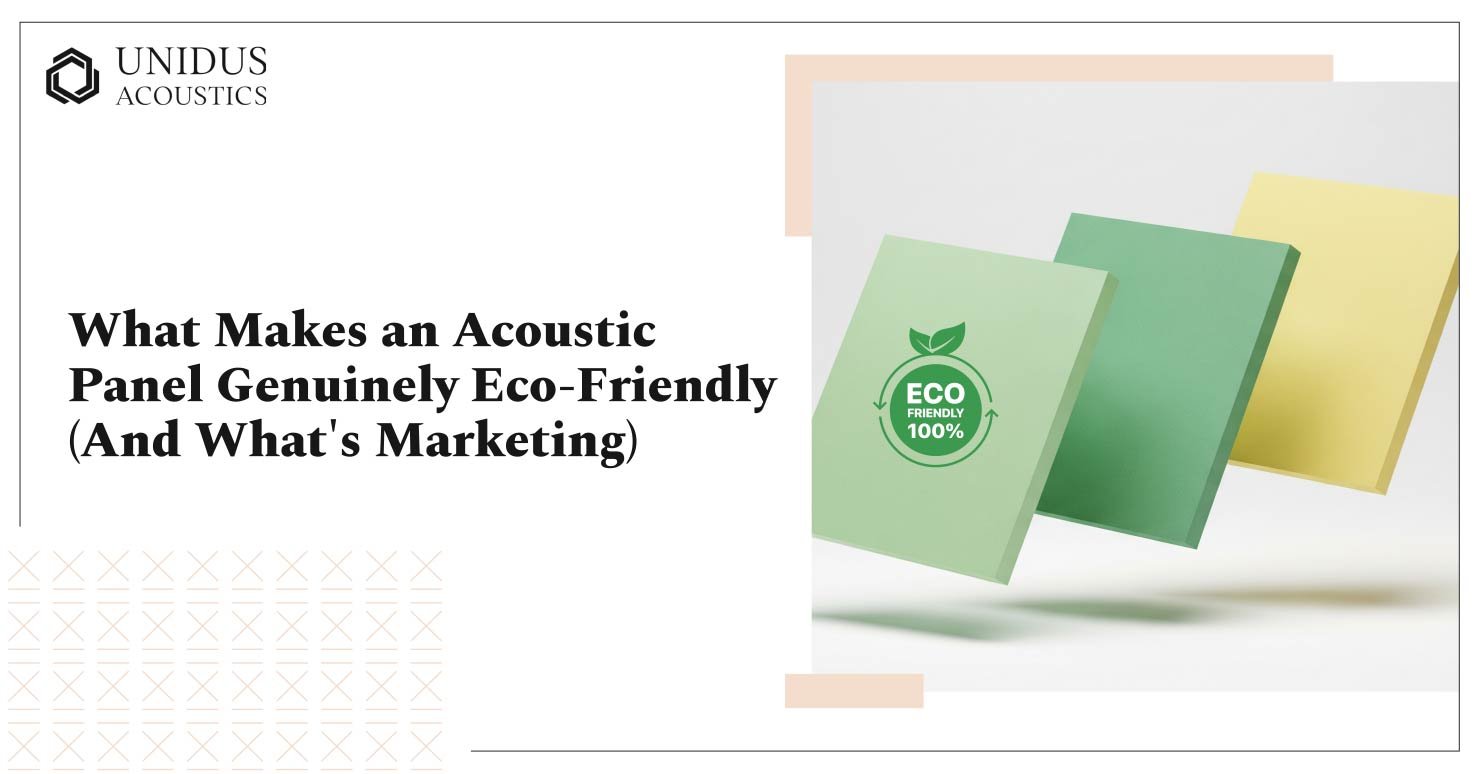
The word “eco-friendly” has been doing a lot of heavy lifting in building product marketing for years. Acoustic products are no exception. Manufacturers routinely describe their acoustic panels as green, sustainable, or environmentally responsible, and the evidence behind these claims varies enormously. For architects and interior designers specifying materials for commercial projects, this matters more than it might seem. When something ends up on a specification sheet, you’re implicitly vouching for it.
Knowing what to look for, and what to be sceptical of, is less about cynicism and more about protecting your work.
Why the Eco-Friendly Label on Acoustic Panels Gets Used Loosely
Sustainability in building products isn’t one thing. It spans raw material sourcing, energy used in manufacturing, recyclability at end of life, and indoor air quality impact. A product can score well on one of these and poorly on others, yet still carry an eco-friendly badge without any scrutiny.
This is particularly common in the acoustic category. NRC ratings, fire classification, and installation ease tend to dominate specification conversations, and sustainability gets treated as a footnote with little documentation behind it.
What Greenwashing Looks Like When Buying Acoustic Panels

The patterns worth recognising are fairly consistent: vague language like “natural materials” or “environmentally conscious production” without any third-party certification; recycled content claims with no mention of what standard was used to verify the percentage; and references to green building compatibility that don’t actually link to a recognised rating system or active membership.
The test is straightforward: ask for documentation. Certified claims come with paperwork.
Acoustic Panel Materials That Actually Earn the Eco-Friendly Label
The material composition of an acoustic panel tells you a great deal about its environmental footprint, from how it’s sourced through to what happens when the building gets refurbished fifteen years later. Two categories in particular have a credible story to tell, provided the manufacturer can back it up with evidence.
Understanding these materials in detail also helps when you’re writing specifications that need to hold up to a green building audit.
PET Acoustic Panels: Recycled Content with Real Credentials

PET acoustic panels are made from polyester fibre, a material increasingly manufactured from post-consumer recycled content, particularly recycled plastic bottles. When sourced responsibly, this represents a meaningful diversion of waste from landfills rather than a marginal environmental improvement. The material is also free of harmful Volatile Organic Compound (VOC), which is worth noting when you’re specifying for occupied commercial spaces, and it’s inherently lightweight, which reduces the energy impact of transportation and installation.
One performance dimension that’s easy to overlook in sustainability discussions is indoor air quality. For occupied commercial spaces – offices, healthcare facilities, education buildings – the VOC emissions profile of any installed material matters. PET panels produced from quality recycled polyester fibres are inherently low in VOC emissions, and independent VOC testing from laboratories like TÜV Rheinland can confirm this. When a manufacturer can produce that test report alongside their recycled content certification, the sustainability claim is significantly stronger.
From a design perspective, PET panels are among the more versatile options: they can be cut into custom shapes, printed with custom graphics, and deployed across wall and ceiling applications. Acoustic performance sits in a solid range, generally mid-to-high NRC depending on thickness and configuration.
The sustainability value of a PET panel, however, depends on whether the manufacturer can certify the recycled content. This is where the Global Recycled Standard (GRS) becomes relevant. GRS certification independently verifies recycled content from source material through to the finished product, giving specifiers something concrete to reference.
Wood Wool Acoustic Panels: A Naturally Renewable Option

Wood wool is one of the older materials in acoustic treatment and, when sourced correctly, one of the more credible. It’s made from fine wood shavings bound together with a mineral binder, resulting in a dense, durable panel with a natural surface texture that translates well into institutional, educational, and corporate environments.
Beyond sound absorption, wood wool also offers a degree of thermal performance, which gives it dual-purpose value in certain project types. Because wood is a renewable resource, products in this category can contribute to green building ratings when sourced from certified forests. Look for this explicitly in any product documentation you receive – eco-friendly and sustainability credentials should be stated clearly, not implied.
Certifications to Check When Specifying Eco-Friendly Acoustic Panels
Taken together, both PET and wood wool give specifiers a credible starting point. The question then becomes whether the manufacturer behind the product can substantiate the environmental claim with independent documentation. That’s where certifications do the practical work.
The right certifications function as independent verification for what would otherwise be a claim on a brochure. They’re worth requesting early in the specification process, before a shortlist is finalised rather than after.
When the products you’re selecting form part of a rated green building project, the certifications attached to each material can directly affect your point tally. This makes the documentation conversation a practical one, not just a due diligence exercise.
Fire Safety and Green Building Credentials
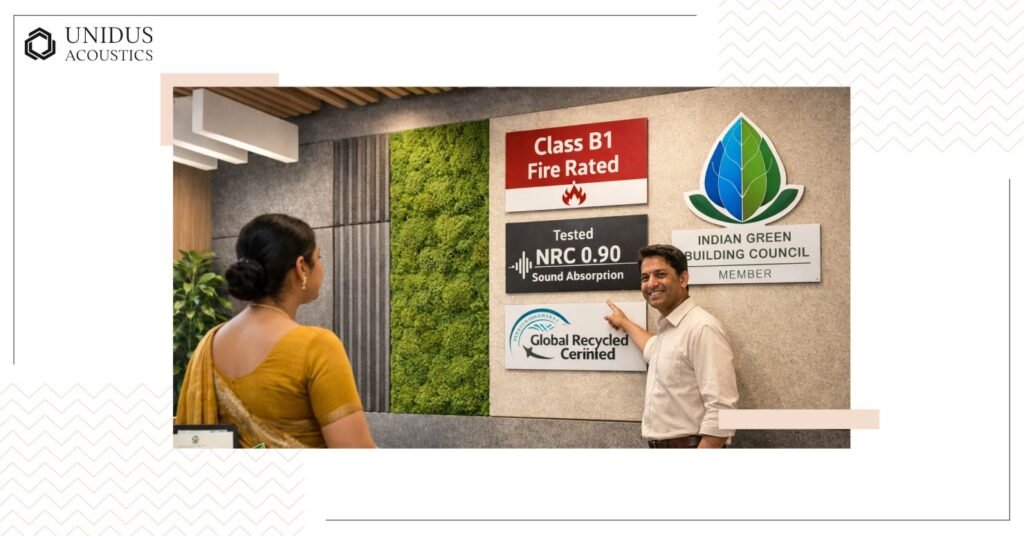
Eco-friendly and fire-safe are not mutually exclusive, though you’ll encounter products where the sustainability focus comes at the cost of performance documentation. What a well-specified project needs to see together: a verified fire classification (Class B1 is the relevant standard for interior applications in India), an NRC rating from a recognised independent test laboratory, and certification for any recycled content claims such as GRS.
Membership in bodies like the Indian Green Building Council (IGBC) can also signal that a manufacturer treats green building as a continuing commitment rather than a one-time credential.
Where Unidus Acoustics Stands on This
With 40 years of expertise in commercial acoustic solutions, Unidus Acoustics have worked across 635+ projects in 16 cities, serving over 10,500 customers from corporate offices to healthcare facilities. Our products are independently tested by SGS, TÜV Rheinland, and Intertek. The range includes materials certified under the Global Recycled Standard, including our PET acoustic panels. Our wood wool boards carry documented eco-friendly and sustainability credentials, consistent with the principles covered in this article.
Our custom acoustic solutions are matched to the specific demands of each project – whether a green-rated office fit-out, an educational campus, or an institutional space where material transparency matters to the procurement process.
If you’re at the specification stage and need NRC test data, certification documents, or product information to support your submission, reach out to us.