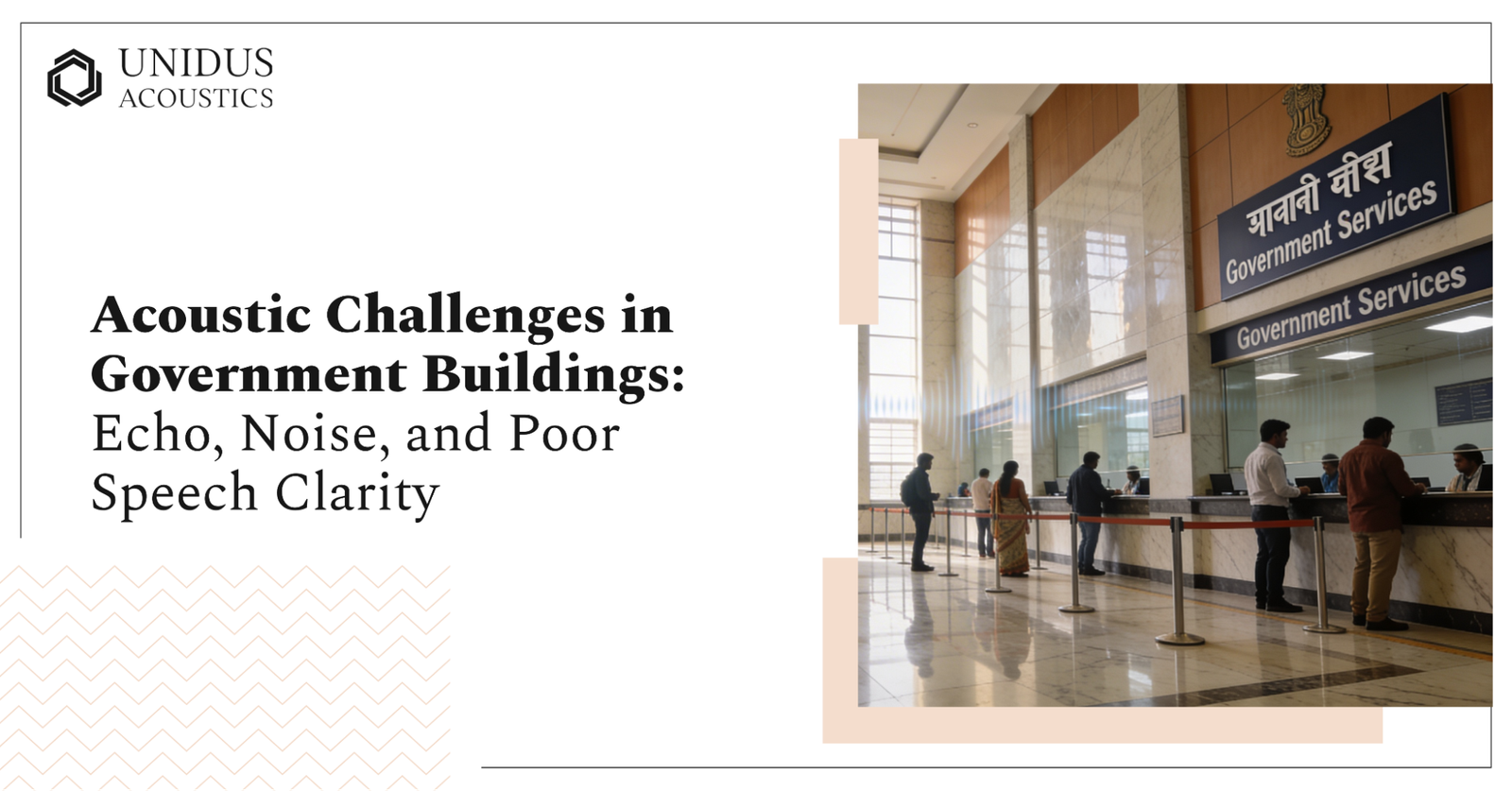
Walk into most government auditoriums, assembly halls, or conference rooms, and you notice it fairly quickly. Voices trail into echoes. Announcements blur before they reach the back rows. Even with a capable sound system running, the room itself seems to work against clarity.
This isn’t a surprise to anyone who works on institutional projects. Government buildings are designed to make a statement, with high ceilings, marble floors, stone facades, and large open volumes that project authority and permanence. Those same qualities create some of the most demanding acoustic challenges in government buildings. Understanding what’s happening in these spaces, and why, is often the first step toward specifying the right solution.
The Architecture Itself Sets the Stage
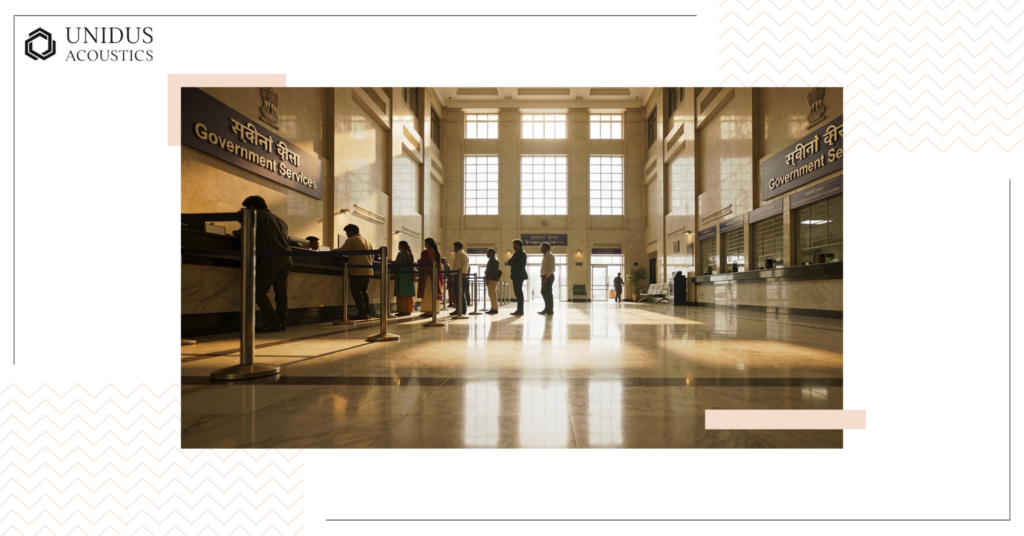
The acoustic challenges in government buildings don’t come from poor planning. They come from the nature of the typology itself. District collectorates, state secretariats, government auditoriums, public assembly halls, these spaces are built for ceremony, volume, and longevity. The materials chosen for those reasons, concrete, glass, marble, gypsum with hard finishes, are among the most acoustically reflective surfaces that exist.
Sound bounces off hard, parallel surfaces and keeps going. In a room with a 9-metre ceiling and 500 square metres of floor space, that bounce becomes reverberation, and reverberation is what turns a speaker’s voice into an unintelligible blur for anyone seated more than a few rows back.
Add to that the sheer scale of government spaces. A district court or a government conference hall isn’t sized like a corporate boardroom. The distances involved mean that sound loses energy before it reaches the listener, and if the room isn’t absorbing reflections along the way, what arrives is muddled. These aren’t edge cases. They’re predictable acoustic consequences of how these buildings are designed and built.
3 Acoustic Challenges in Government Buildings That Come Up Most Often
Most institutional spaces, regardless of their specific function, tend to share a cluster of recurring acoustic problems. Understanding each one separately helps in selecting the right treatment, since the fix for reverberation isn’t always the same as the fix for noise bleed.
1. Echo and Reverberation in Large Halls
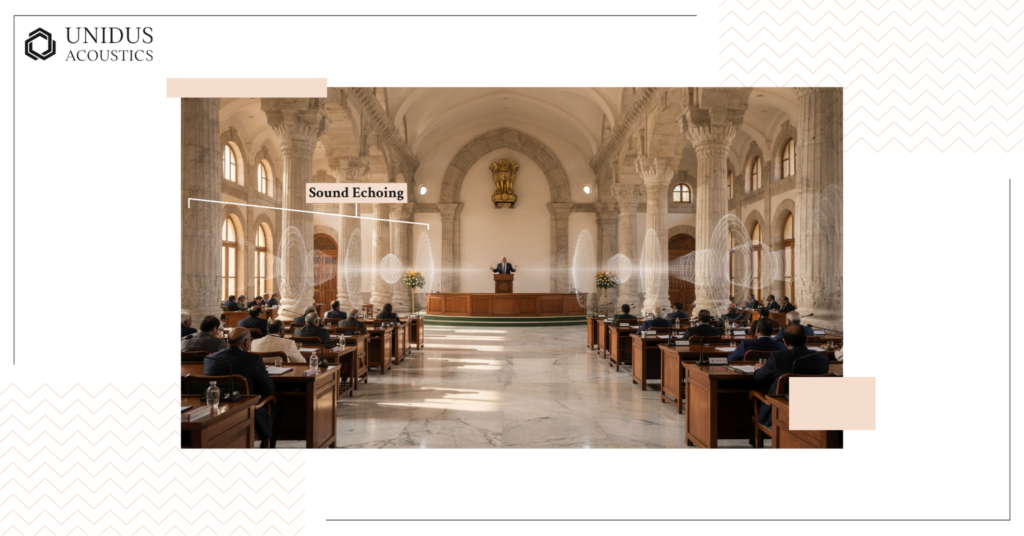
This is the most visible problem in large government halls. Reverberation time, the time it takes for sound to decay after a source stops, can run well above 2–3 seconds in untreated spaces of significant volume. For speech, anything above 0.8–1 second starts affecting intelligibility. In ceremonial halls with high vaulted ceilings, that number can be considerably higher.
The result is that two sounds overlap. The direct sound from the speaker and the reflected sound from the walls and ceiling arrive at slightly different times, and the listener’s ear cannot separate them cleanly. In formal settings like assembly halls or auditoriums, this is what makes extended sessions exhausting for an audience.
2. Poor Speech Clarity in Conference Rooms and Courtrooms
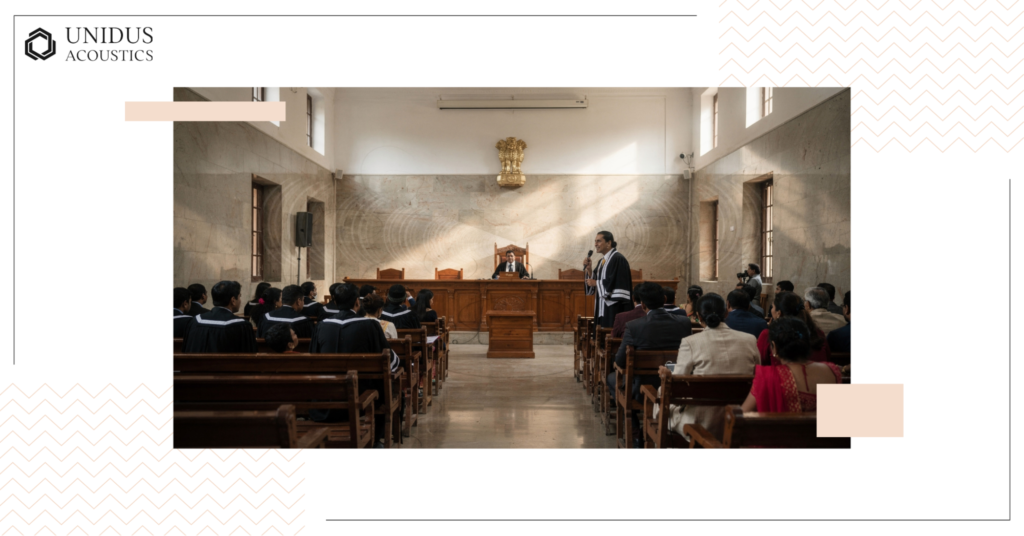
Often connected to reverberation, but worth treating as a separate concern, because the fix is slightly different. Even in rooms with modest reverberation, speech clarity can suffer if the room geometry creates flutter echoes, which are rapid, repetitive reflections between two hard parallel walls, or focusing effects from curved surfaces.
Government conference rooms and courtrooms are particularly prone to this. A speaker at one end of a rectangular hall with hard walls on both sides will generate flutter that makes proceedings difficult to follow and forces listeners to work harder than they should to catch every word.
3. Noise Transmission Between Spaces
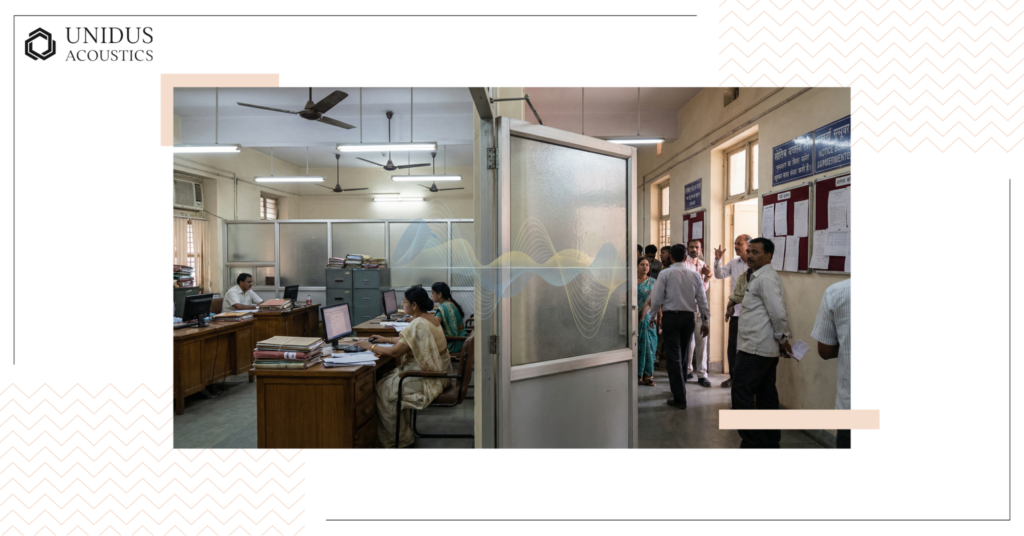
Government buildings house a lot of simultaneous activity. Waiting areas, corridors, multiple meeting rooms, HVAC systems running continuously, and foot traffic. Noise bleeds between spaces in ways that disrupt focused work, formal proceedings, and public-facing interactions alike.
This is where acoustic treatment has to go beyond absorption inside a room and consider how sound travels through walls, floors, and ceiling plenums. The acoustic challenges in government buildings are less about reverberation and more about isolation and attenuation, which calls for a different category of materials altogether.
What Effective Acoustic Treatment Looks Like in These Spaces
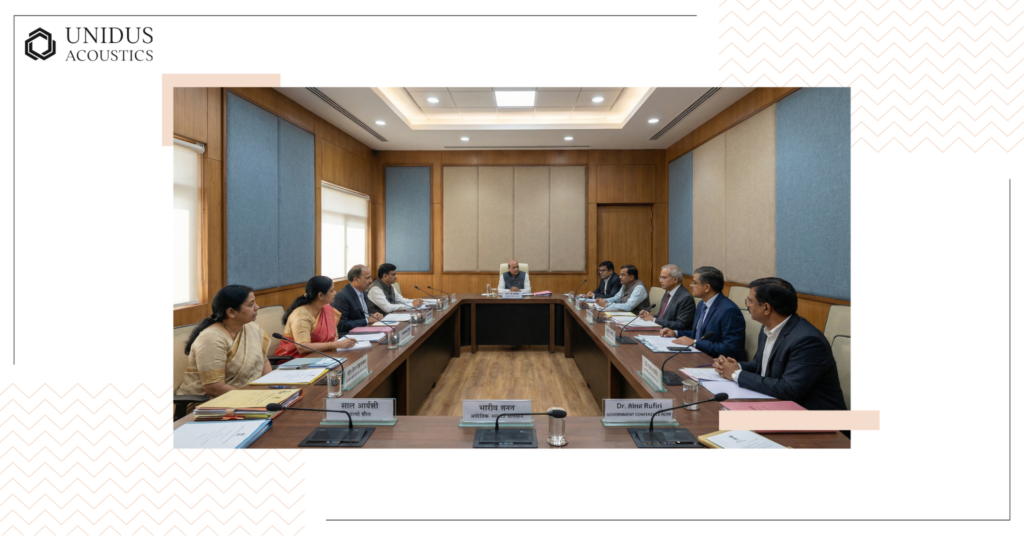
The good news is that most of the acoustic challenges in government buildings can be addressed without structural interventions, which matters significantly in government buildings where civil work is disruptive, time-consuming, and often constrained by approvals.
Acoustic wall panels and acoustic ceiling systems introduce sound-absorbing surface area into spaces that currently have almost none. Strategically placed, they reduce reverberation time to within the acceptable range for speech without altering the room’s layout or load-bearing structure. For large auditoriums, ceiling baffles positioned between lighting rigs and HVAC runs can absorb a significant proportion of ceiling reflections while remaining largely invisible from the audience’s sightline. Wall panels along the rear and side walls handle flutter and lateral reflections. The combination brings reverberation time down meaningfully, and speech clarity follows.
Custom acoustic ceiling tiles and fabric-wrapped wall panels can be specified to match the aesthetic requirements of formal government interiors, so treatment doesn’t read as an afterthought against the architecture. NRC ratings and fire safety compliance documentation are available for these products, which simplifies institutional procurement.
For rooms with noise transmission issues, sound-deadening membranes such as Mass Loaded Vinyl (MLV) and high-density insulation materials like glasswool and rockwool within wall cavities address the problem at the source, rather than treating symptoms inside the room.
Material selection carries particular weight in institutional settings. Panels need to hold up in high-traffic environments, meet fire safety standards, and come with the technical documentation that government procurement processes require. These aren’t optional considerations. They’re part of the specification from the beginning.
At Unidus Acoustics, we’ve worked on acoustic treatment across a range of government and public-sector facilities in India. Our solutions for these spaces typically draw from fabric-wrapped acoustic wall panels, ceiling clouds, U-TONE acoustic baffles, and insulation materials, including glasswool and MLV, all meeting institutional-grade compliance requirements. With 40 years of expertise in custom acoustic solutions, we understand how to balance acoustic performance with the durability and documentation standards that government projects demand.
Getting the Specification Right
The acoustic challenges in government buildings are predictable once you know what to look for. Large volumes with hard surfaces will almost always produce reverberation problems. Parallel hard walls will produce flutter. Shared walls between active spaces will produce noise bleed. Each of those problems has established solutions, and most can be implemented without touching the building’s structure. The earlier acoustic treatment enters the specification process, the more options are available in terms of integration, aesthetics, and cost.
Working on a Government or Institutional Project?
Share your layout with us and we’ll suggest acoustic solutions that fit your design intent and meet institutional compliance requirements. From ceiling baffles to acoustic wall panels and insulation materials, Unidus Acoustics provides product recommendations and technical specifications, including NRC ratings and fire safety documentation, ready for your tender submissions.