

When an architect or interior designer starts specifying for a commercial project, the conversation around acoustics usually begins at a familiar point: what panels go on the walls, what the ceiling should look like, how the space should feel. Acoustic insulation materials, on the other hand, get treated as a behind-the-scenes decision. Something the contractor figures out. Something that happens inside the wall.
That’s where the problems start.
Choosing the wrong acoustic insulation material, or misunderstanding what it actually does, can compromise the entire acoustic performance of a space, regardless of how well the visible treatments are designed. This guide breaks down the primary acoustic insulation materials used in Indian commercial projects, what each one does best, and how to think about specifying them correctly.
Acoustic Insulation vs. Acoustic Treatment: Understanding the Difference
These two terms get confused constantly, and the confusion leads to poor specifications.
Acoustic treatment refers to the visible, surface-level solutions: wall panels, ceiling clouds, baffles, diffusers. Their job is to manage sound after it’s already in the room, reducing echo, reverberation, and flutter. Acoustic insulation, by contrast, sits inside walls, floors, ceilings, and structural voids. It stops sound from travelling between spaces or prevents external noise from entering in the first place.
A meeting room with well-designed fabric-wrapped panels on the walls will still leak conversation into the adjacent boardroom if the partition wall has no soundproof insulation for walls or the wrong kind. Both layers matter, and they work differently. Specifying one without understanding the other is where acoustic design breaks down.
Also Read: How to Choose the Right Acoustic Wall Panels for Your Commercial Space
Types of Acoustic Insulation Materials Used in Commercial Projects
No two acoustic insulation materials are interchangeable. Each has a distinct composition, a specific performance profile across frequency ranges, and application scenarios where it genuinely excels. Here’s how the main categories compare.
1. Glasswool (Glass Mineral Wool)
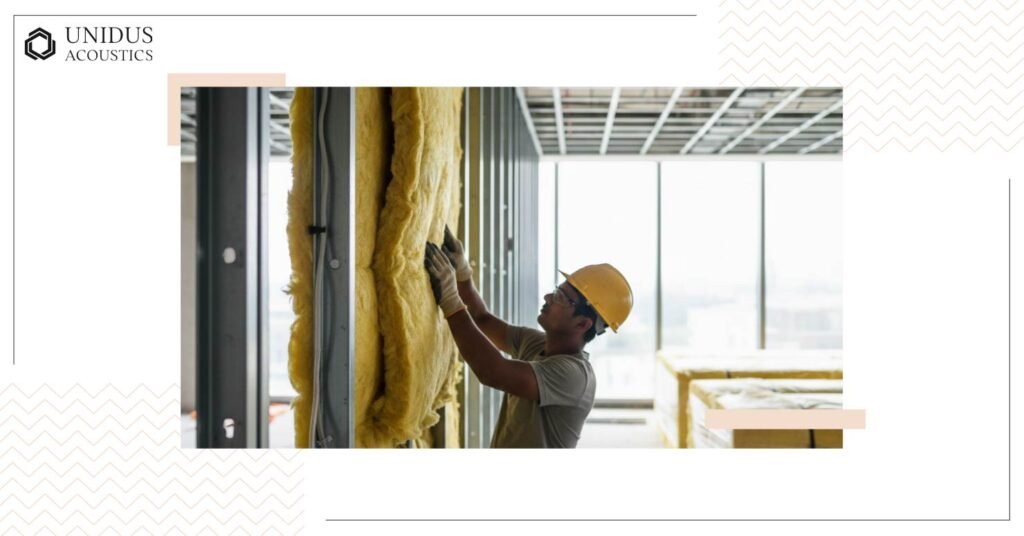
Glasswool is made from recycled glass spun into fine fibres, then bonded into batts, rolls, or rigid glasswool tiles and boards. It’s the most widely used acoustic insulation material in Indian commercial construction, and for good reason.
Its open-fibre structure is particularly effective at absorbing mid-to-high frequency sounds. In practical terms, this means it handles speech frequencies well, which is why it’s a go-to choice for offices, conference rooms, call centres, and any space where speech intelligibility or speech privacy is a priority.
Glasswool is available in various densities, typically ranging from 16 kg/m³ on the lighter end to 48 kg/m³ and above for higher-performance applications. Density matters: denser glasswool provides better sound absorption in a thinner profile, which becomes relevant when wall or ceiling cavity depth is limited. It’s also relatively lightweight, which keeps dead loads manageable and simplifies installation in suspended ceiling systems and partition walls.
One practical consideration for Indian projects: glasswool is sensitive to moisture. In high-humidity environments or coastal locations, specifying appropriate vapour barriers and moisture-resistant facings is important. Ignoring this leads to performance degradation over time.
Best suited for:
- Office partition walls and false ceilings.
- Duct lining and HVAC applications.
- Conference rooms, call centres, and recording studios.
- Suspended ceiling assemblies where weight is a concern.
2. Rockwool (Stone Mineral Wool)
Rockwool is produced from volcanic basalt rock melted at extremely high temperatures and spun into fibres. It shares some characteristics with glasswool but differs in two critical ways: it’s denser by nature, and it’s significantly more fire-resistant.
In commercial construction, rockwool’s fire performance is a major specification driver. It’s non-combustible and can withstand temperatures above 1000°C without melting, making rockwool acoustic panels a preferred choice where fire safety ratings are required. For projects where the material needs to serve dual roles, simultaneously delivering acoustic performance and contributing to a fire-rated partition or ceiling assembly, rockwool is often the more appropriate specification.
The higher density also means rockwool sound panels handle lower-frequency sound better than glasswool at comparable thicknesses. In spaces with significant mechanical noise, like server rooms, plant rooms, or buildings near heavy traffic, this low-frequency attenuation becomes relevant. Rockwool boards are also more rigid and structurally stable than glasswool batts, which simplifies handling during installation.
The trade-off is cost. Rockwool typically sits at a higher price point than glasswool, so specifications should be deliberate: use it where its specific properties justify the cost, not as a blanket substitute.
Best suited for:
- Fire-rated partition walls and ceiling assemblies.
- Plant rooms, server rooms, and mechanical spaces.
- Auditoriums and buildings in high-noise environments.
- Projects requiring combined thermal and acoustic performance.
3. Woodwool (Wood Wool Board)
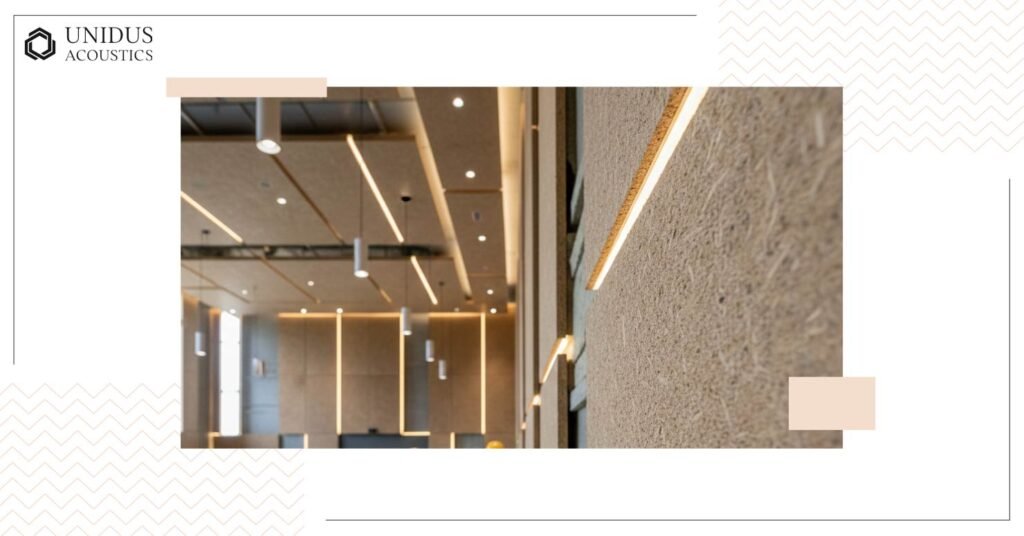
Woodwool panels are made from wood shavings bonded together with cement or magnesite binders, resulting in a rigid, textured woodwool board that can serve as both a structural insulation layer and an exposed architectural finish. This dual functionality makes woodwool interesting for projects where the insulation layer itself becomes part of the visible design intent, particularly in auditoriums, multipurpose halls, or educational institutions where a raw, industrial aesthetic works well.
Wood wool panels have decent sound absorption properties across mid frequencies and are often used in combination with other insulation materials to address a broader frequency range. Their resistance to moisture, impact, and even rodents makes them a practical choice for projects with more demanding environmental conditions, an advantage worth considering in many Indian contexts.
Best suited for:
- Auditoriums and performance spaces.
- Educational institutions and multipurpose halls.
- Spaces where the insulation serves as an exposed finish.
- Environments with higher humidity or impact exposure.
4. Polywool (Polyester Fibre Board / PFB)
Polywool takes a different approach entirely. Made from recycled polyester fibres, it’s completely non-irritant and safe to handle without protective equipment. For designers and contractors who have dealt with the skin irritation that comes with installing glasswool or rockwool, this is a meaningful advantage, particularly on complex or constrained sites.
Polyester fibre board is also lighter than mineral wool, doesn’t absorb moisture, and is available in a range of colours. This makes it suitable for applications where the material might be partially visible or where installation conditions make mineral wool impractical. The acoustic performance of PFB board is good in mid-to-high frequency ranges, though it generally doesn’t match dense rockwool or high-density glasswool for low-frequency applications.
Best suited for:
- Commercial fitouts and open-plan offices.
- Healthcare interiors where clean installation is essential.
- Spaces requiring partially visible acoustic insulation panels.
- Projects where handling safety is a site constraint.
5. Mass Loaded Vinyl (MLV) / Sound Deadening Membrane
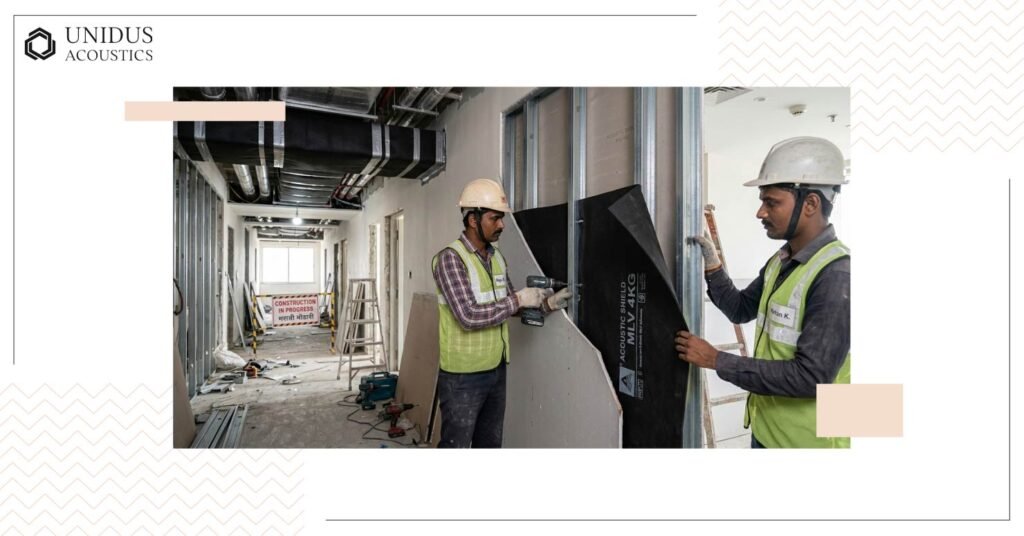
MLV is a different category altogether from the fibrous materials above. It doesn’t absorb sound; it blocks it. Made from a dense, flexible vinyl material, typically loaded with barium sulphate or calcium silicate, mass loaded vinyl adds mass to a wall or floor assembly without adding significant thickness. And mass, in acoustics, is one of the most reliable barriers to airborne sound transmission.
This distinction is critical. Glasswool and rockwool absorb sound energy by converting it into heat through friction within their fibre structure. The sound deadening membrane works differently: it stops sound from passing through a surface by making it too heavy for sound waves to vibrate effectively. Both mechanisms are necessary in a well-designed acoustic assembly; they address different parts of the problem.
In practice, MLV is often used as an additional layer within a wall or floor build-up: sandwiched between gypsum boards, wrapped around ductwork to reduce HVAC noise, or installed under flooring to address impact sound transmission between floors. In commercial fitouts with open ceilings or complex services routes, a sound deadening membrane can address acoustic problems that fibrous insulation alone cannot solve.
For hotel projects, hospitals, residential-commercial mixed-use developments, and any building where floor-to-floor sound transmission is a concern, MLV deserves a place in the specification conversation early, not as a retrofit after occupants complain.
Best suited for:
- Floor-to-floor sound transmission in multi-storey buildings.
- Duct wrapping to control HVAC noise.
- High-performance wall assemblies combined with fibrous insulation.
- Hospitality, healthcare, and mixed-use developments.
Also Read: Acoustic Solutions for Offices: What Architects and Designers Need to Know
NRC, STC, and What to Verify Before Specifying
Getting material selection right also means knowing how to read and verify supplier performance claims. NRC and STC are the two metrics you’ll encounter most often, and understanding what they actually measure helps you evaluate those claims with more confidence.
NRC (Noise Reduction Coefficient)
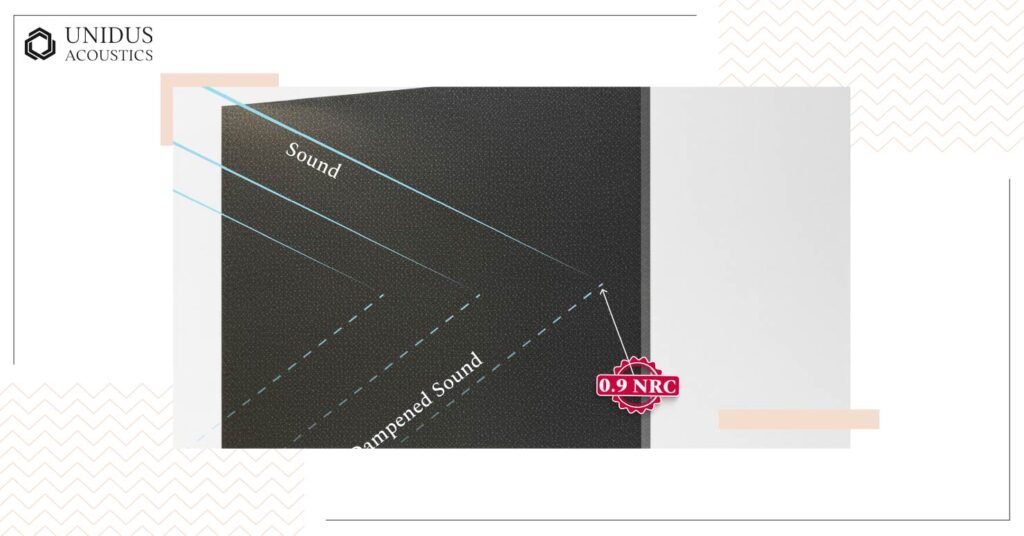
NRC measures how much sound a material absorbs, on a scale from 0 to 1. An NRC of 0.85 means the material absorbs 85% of sound energy that hits it, reflecting just 15% back into the room. This metric is most relevant for materials used in acoustic treatment applications, surface-mounted panels, ceiling tiles, and baffles, but it’s also useful when evaluating fibrous insulation materials like glasswool and polywool for their contribution to room acoustics.
STC (Sound Transmission Class)
STC measures how well a wall, floor, or ceiling assembly blocks sound from passing through. The higher the STC rating, the better the barrier. This is the more relevant metric when evaluating acoustic insulation materials used inside partition walls and floor assemblies. A standard stud partition with no insulation typically achieves STC 33–35. Add a high-density glasswool batt and that can rise to STC 45–50. Add an MLV layer and it can push further still.
The important caveat: both NRC and STC values should be verified against tested data from suppliers, not assumed from product category alone. A glasswool batt specified at 32 kg/m³ performs differently from one at 48 kg/m³ in the same cavity, and the difference matters in high-performance applications. Always ask for third-party test reports.
How to Choose the Right Acoustic Insulation Material for Your Project
The best specifications usually combine materials to address different frequency ranges and transmission paths. Here’s a practical framework for making those decisions.
Choose Acoustic Insulation Materials Based on the Problem You’re Solving
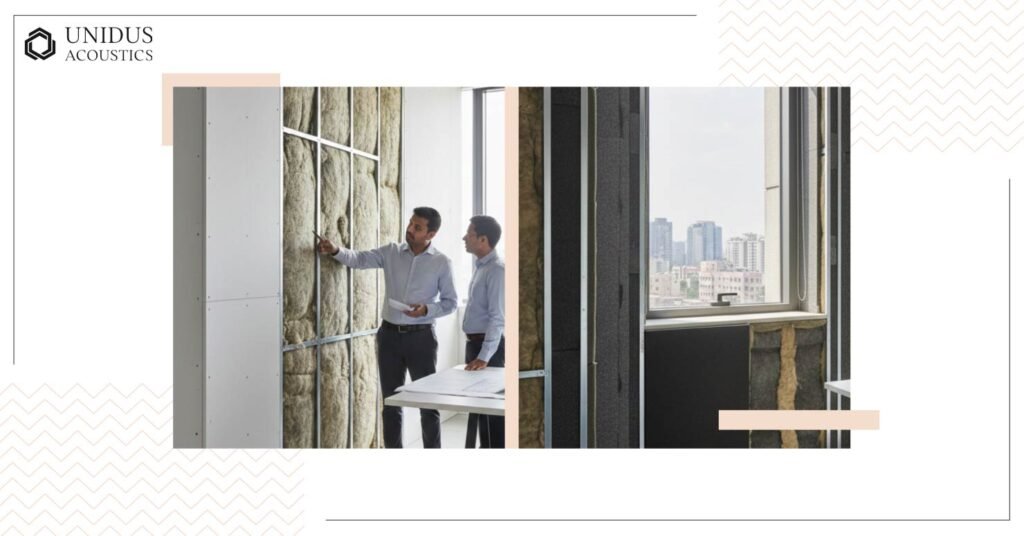
Is the goal speech privacy between adjacent spaces? Reduction of external noise intrusion? Managing reverberation within a large volume? Each problem points toward different solutions. Speech privacy between offices typically needs a well-sealed partition with adequate mass and absorption inside the cavity. External traffic noise attenuation needs both mass (MLV or dense rockwool) and absorption working together.
Match the Material to the Frequency Range
Low frequencies, like traffic rumble and mechanical systems, need mass and density. Mid-to-high frequencies, like speech and office equipment, respond well to fibrous absorption. Most real-world acoustic problems involve a mix, which is why combining materials, for example, a dense rockwool batt inside a wall cavity with a sound deadening membrane layer, often outperforms any single soundproof insulation board on its own.
Don’t Separate Fire Performance from Acoustic Performance
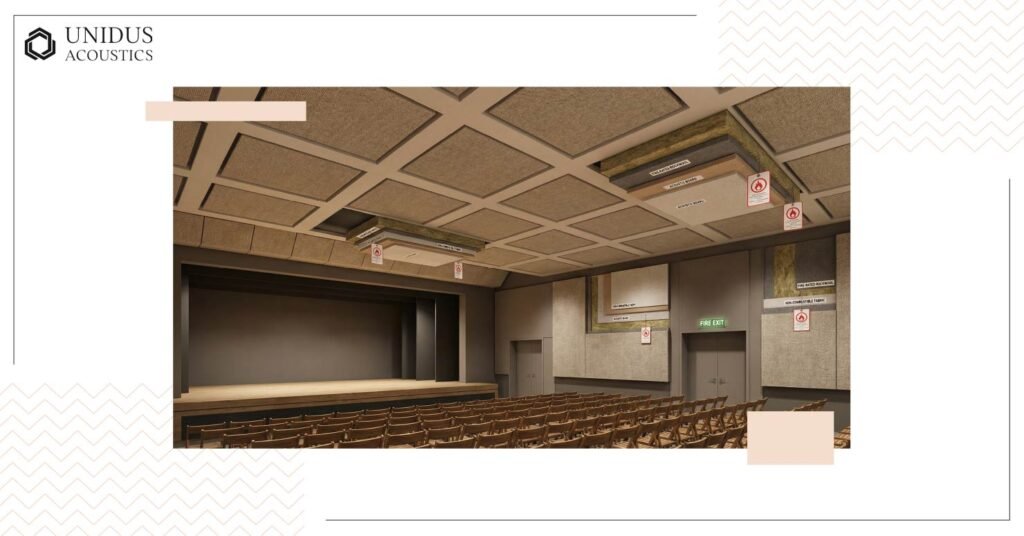
In Indian commercial projects, building regulations increasingly require fire-rated assemblies for partitions and ceiling systems. Choosing a material purely for acoustic performance and later discovering it compromises the fire rating creates problems downstream. Rockwool’s non-combustible nature and high-temperature resistance makes it particularly valuable in projects where both requirements need to be satisfied simultaneously.
Factor in Installation Conditions
A high-density glasswool batt is acoustically excellent, but if a project involves complex installation geometry, tight spaces, or workers without respiratory protection, polywool may be the more pragmatic choice even if it means slightly lower performance in some frequency ranges.
If you’re working on a project where acoustic performance is a significant concern, whether it’s a corporate campus, a government building, a healthcare facility, or a hospitality project, getting material selection right early in the design process saves significant time and cost downstream. At Unidus Acoustics, we’ve spent 40 years specifying acoustic insulation materials across all of these project types. We can help you think through material selection and assembly design before the walls go up and the decisions become harder to reverse.
Acoustic Insulation in the Indian Commercial Context
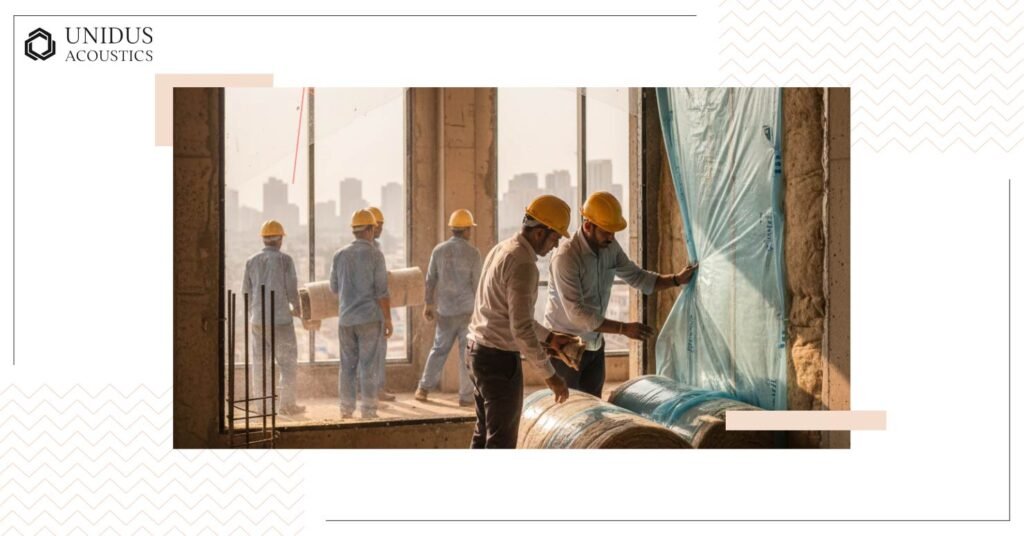
A few factors make the Indian commercial context distinct from international specifications, and they’re worth thinking through carefully.
Humidity and temperature variation across Indian climates affects material performance and longevity. Coastal and high-humidity environments require moisture-resistant materials or appropriate vapour management in the assembly. Rockwool and polywool handle moisture better than standard glasswool tiles over time, which should influence specifications in cities like Mumbai, Chennai, or Kochi.
Construction quality variability matters too. Gaps in wall assemblies, unsealed penetrations, and flanking paths through structure can render even the best-specified acoustic insulation materials ineffective. Good acoustic insulation specification should account for this by prioritising materials that maintain performance even with moderate installation inconsistencies, and by clearly communicating sealing requirements to contractors.
The awareness gap between acoustic treatment and acoustic insulation also remains wide among clients in India. As the design professional, educating clients on why insulation decisions need to be made early, before walls are built and services are run, is part of the job. Retrofitting acoustic insulation panels into an already-built commercial space is significantly more expensive and disruptive than getting the specification right at the design stage.
Also Read: When to Invest in Acoustic Consultancy: Key Project Stages for Maximum Benefit
Common Acoustic Insulation Specification Mistakes to Avoid
Even experienced design professionals run into the same avoidable errors when specifying acoustic insulation materials. These are the ones that show up most often in commercial projects.
Treating Insulation as an Afterthought
This is the most common and the most costly mistake. Acoustic insulation needs to be specified during the design stage, before partition layouts are finalised, before services are coordinated, and before builders start work. Once walls are up and ceilings are closed, retrofitting insulation is disruptive and significantly more expensive. Treating it as something to sort out during construction, or worse, after handover, almost always leads to compromises. By that point, the options for acoustic insulation panels are limited and the cost of installation increases substantially.
Specifying by Material Name Rather Than Performance

Saying “use glasswool” in a specification is not the same as saying “use 48 kg/m³ glasswool batts achieving STC 48 in this assembly.” The product category alone tells you very little. Two glasswool products from different manufacturers at different densities can perform entirely differently in the same wall cavity. Specifications should always state the required density, the target performance metric (STC or NRC), and the assembly in which the material will be used.
Ignoring Flanking Paths
A flanking path is any route sound takes to travel between spaces other than directly through the partition. Common flanking paths include structural slabs, shared ceiling plenums, ductwork, and pipe penetrations. It’s possible to specify excellent acoustic insulation materials for a partition wall and still have a meeting room that leaks conversation, simply because the ceiling plenum above it is shared with the adjacent space and has no acoustic separation. Flanking is often the reason a completed building underperforms its specification on paper.
Confusing Absorption with Blocking
This comes back to the treatment vs. insulation distinction covered earlier, but it’s worth repeating because it leads to real specification errors. Fibrous materials like glasswool and polywool absorb sound within a space. They don’t block sound transmission between spaces on their own. If sound transmission between rooms is the problem, mass is what you need: dense rockwool, MLV, or a combination. Using a lightweight acoustic insulation panel where a high-mass material is required will not deliver the expected result, regardless of how high its NRC rating is. Acoustic insulation wall panels work differently from surface-mounted acoustic treatment, and the distinction matters in specification.
The right acoustic insulation materials, specified correctly from the outset, are what separate a space that performs from one that merely looks the part. Glasswool, rockwool, wood wool panels, polywool, and mass loaded vinyl each have distinct performance profiles, installation characteristics, and appropriate applications. Getting this right means understanding what acoustic problem you’re actually solving, specifying for the frequency ranges that matter in that space, and integrating fire safety requirements from the outset.
The visible acoustic design of a space gets the attention. The insulation is what makes it work.
Working on a project where acoustic insulation needs to be specified early?
Share your layout with us and we’ll suggest the right materials for your space. Contact us now!