
Pick any commercial building that went up in the last decade (a corporate campus, a hospital wing, a university block, a co-working facility) and the chances are high that multiple layers of sound insulation materials are hidden inside its walls, above its ceilings, and behind its partitions. You wouldn’t know they’re there. That’s exactly the point.
But when those layers are missing, or when the wrong material gets specified for the wrong application, the results are hard to ignore. Conference rooms where every conversation bleeds through to the next. Open offices that never feel quiet. Auditoriums where speech turns muddy before it reaches the back rows.
The challenge is that most specification decisions get made relatively early in a project, at a stage when architects are still working through floor plans and finish schedules. Material selection for acoustic insulation can feel like an afterthought; something the MEP contractor or fit-out vendor will figure out later. The results rarely meet expectations when that’s the case.
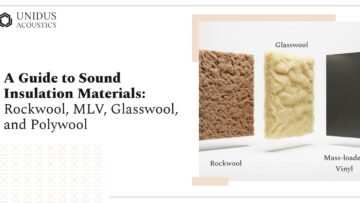
This guide covers the four sound insulation materials most commonly specified in commercial construction in India: glasswool, stone wool, MLV (Mass-Loaded Vinyl), and polywool. Each behaves differently, performs differently, and suits different applications. Understanding what they are and what they actually do makes the specification decision a great deal simpler.
Sound Absorption vs Sound Blocking: Two Different Problems
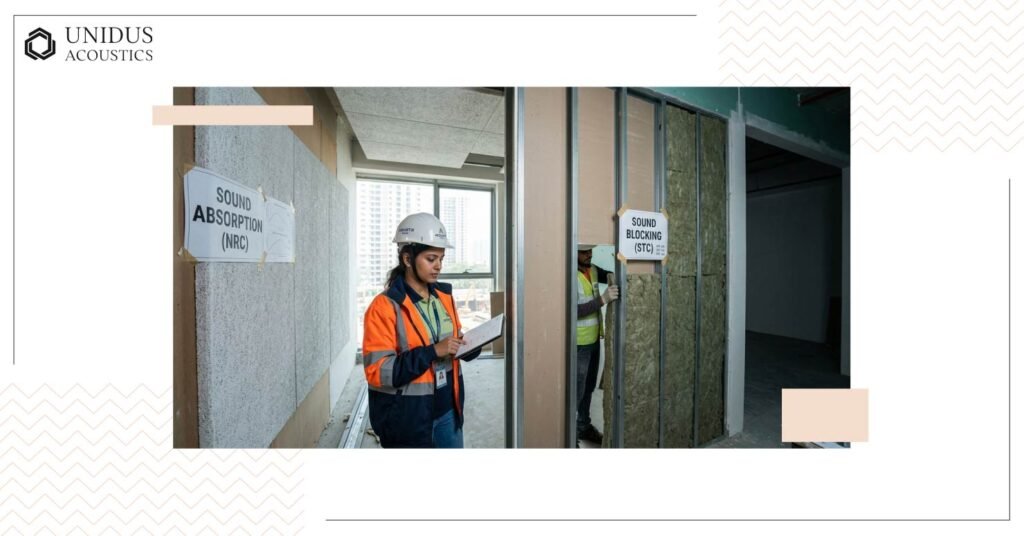
Sound insulation materials serve two fundamentally different functions, and confusing the two leads to projects that don’t perform as expected.
Sound absorption reduces reverberation inside a room. When a material absorbs sound, it converts acoustic energy into a small amount of heat, preventing sound waves from bouncing around the room and building up into echo or muddiness. The performance metric here is NRC (Noise Reduction Coefficient), rated on a scale of 0.0 (no absorption) to 1.0 (complete absorption).
Sound blocking reduces how much sound passes from one space into another. This is about mass and density. A material that blocks sound adds resistance to transmission through walls, floors, and ceilings. The metric is STC (Sound Transmission Class). A standard interior partition without insulation typically has an STC of around 33, which means a normal conversation in the adjacent room is clearly audible. Commercial projects generally target STC values between 50 and 65 for spaces that require serious acoustic separation.
Most sound insulation materials do both to some degree, but they’re rarely equally good at each. Knowing which problem you’re solving first is the only sensible way to begin.
The Four Sound Insulation Materials Explained
Each of the five sound insulation materials below has a distinct composition, a distinct set of performance strengths, and a distinct range of applications. None of them is universally the right answer; the correct choice depends on what the space needs to achieve acoustically, what fire performance is required, and what the installation conditions actually allow.
1. Glasswool
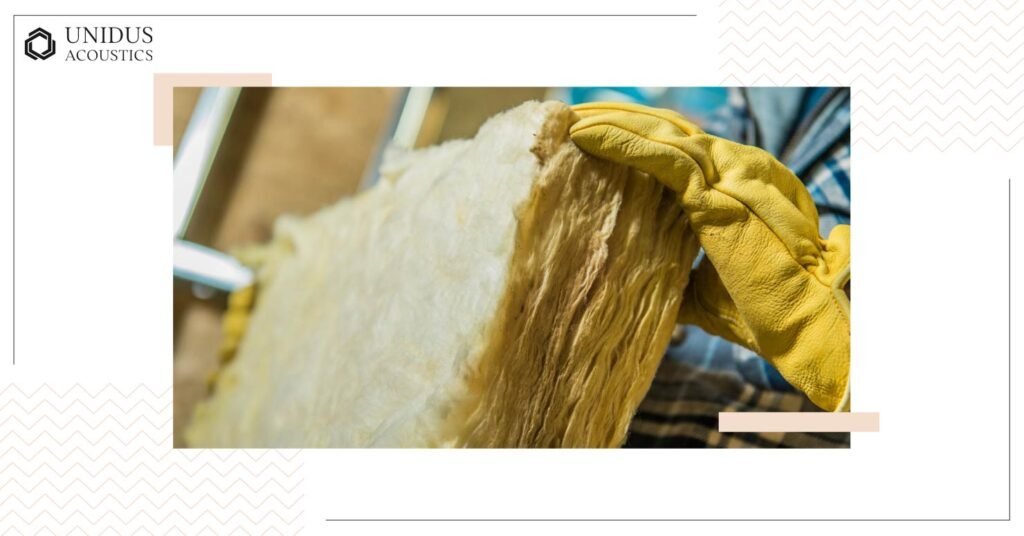
Glasswool is made from recycled glass that is melted and spun into fine fibres. The resulting material is lightweight, flexible, and relatively straightforward to work with on site, though it requires protective gear during handling because the fibres can cause skin and respiratory irritation.
Its acoustic performance is solid across most commercial applications. The NRC rating of glasswool typically ranges from 0.70 to above 0.95, depending on thickness and density. Thinner boards absorb mid and high frequencies well; thicker boards extend that absorption into the lower frequency range. It’s a reliable choice for wall cavities, false ceiling plenums, and under-deck insulation across a wide range of building types, including corporate offices, hospitals, educational institutions, and government facilities.
Glasswool also provides thermal insulation alongside its acoustic performance, which is useful in buildings where both comfort and energy efficiency are design priorities. Its fire resistance is reasonable for most commercial applications, typically achieving a Class B fire rating in standard batt formats, though it doesn’t match the performance of stone wool-based materials in high-risk zones.
One thing to account for: glasswool performs differently depending on whether it’s loose-fill, batt, or rigid board. The density and facing (foil, fabric, or plain) affect both acoustic and thermal properties considerably. A 48 kg/m³ glasswool batt in a partition cavity will behave very differently from a 24 kg/m³ roll used in an underdeck application. Specifying density and form type, not just the material name, is what separates a precise specification from a vague one.
2. Stone Wool
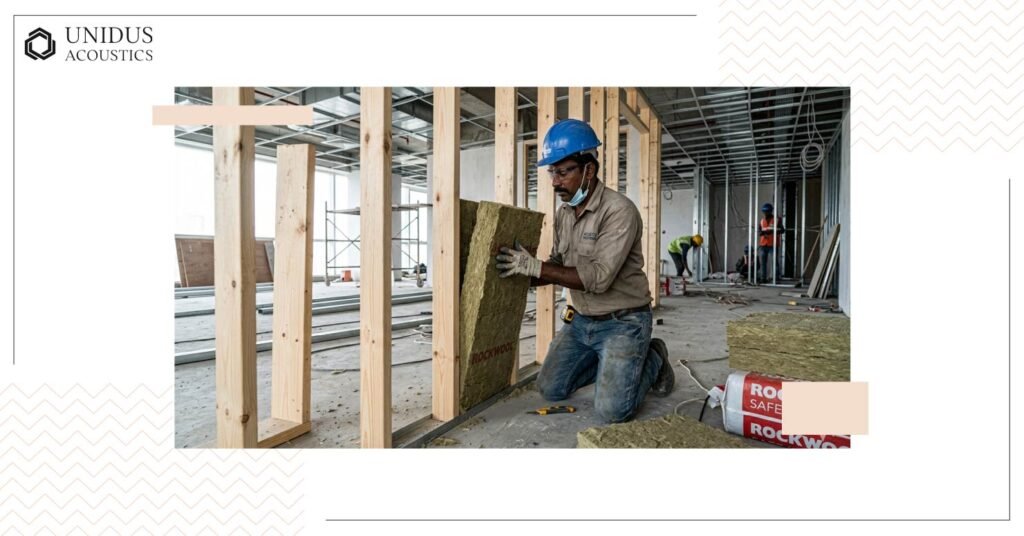
Stone wool is made from volcanic rock (typically basalt) and recycled slag, melted at temperatures exceeding 1,500°C and spun into dense fibres. It is frequently referred to in the market as “rockwool,” though Rockwool is actually a proprietary brand name. The correct generic term for the material category is stone wool or mineral wool.
The higher density compared to glasswool gives stone wool a meaningful edge in sound blocking applications. Its STC rating in wall assemblies typically reaches 45 to 52, which is among the highest achievable with insulation alone.
The NRC of stone wool is also strong, generally falling between 0.90 and 1.0, making it effective both at absorbing sound within a space and at blocking transmission between spaces.
Where stone wool consistently outperforms other sound insulation materials is its fire resistance. Its melting point exceeds 1,000°C, significantly higher than fibreglass alternatives, and it typically achieves a Class A non-combustible classification. This makes it the material of choice in high-risk commercial environments: server rooms, stairwells, corridors with stringent passive fire protection requirements, and any space where acoustic and fire performance are both non-negotiable. In India’s commercial construction sector, where fire compliance requirements have become increasingly specific across institutional, hospitality, and high-occupancy office projects, stone wool’s dual acoustic and fire performance profile is difficult to replace with a single alternative.
The trade-off is weight and cost. Stone wool is denser, heavier to handle on site, and typically more expensive than glasswool. For large-scale commercial projects, that cost difference adds up across the full scope. But for applications where both performance criteria genuinely matter, it’s difficult to justify a lower-spec alternative.
3. MLV
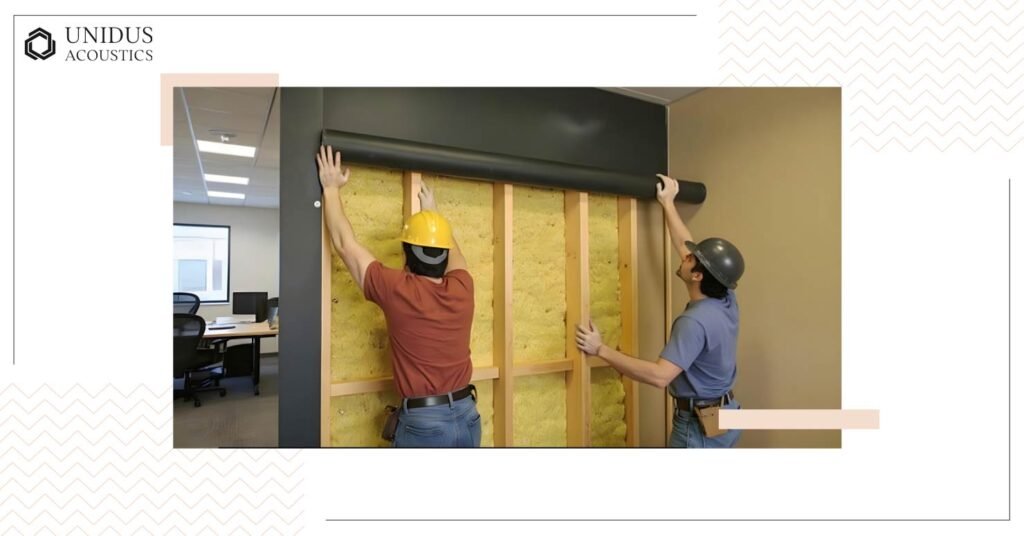
MLV operates on a completely different principle from fibre-based insulation. It’s a dense, flexible vinyl sheet that works by adding mass to a surface, which increases the assembly’s resistance to sound transmission. Unlike glasswool or stone wool, MLV doesn’t trap or absorb sound through a fibrous structure. It stops sound by being heavy.
This makes MLV the go-to solution in retrofit situations where you can’t add significant thickness to a wall or ceiling. A single layer of MLV applied to an existing partition, or sandwiched between gypsum board layers in a new partition, increases the assembly’s STC without requiring significant structural modification. As a standalone membrane, a 3.5mm MLV layer achieves an STC of around 35. In a layered assembly, that contribution compounds with the insulation and board layers around it to deliver meaningfully higher overall transmission loss.
Common applications include ductwork wrapping to reduce mechanical noise from HVAC systems, pipe lagging, partition upgrades in commercial fit-outs, and flooring underlays in multi-storey buildings where impact noise from upper floors is a concern. MLV is also widely used in recording studio builds and broadcast facilities where transmission loss needs to be maximised within a minimal footprint.
A note on installation: MLV is most effective when there are no gaps at all. Sound finds the path of least resistance, and even small unsealed openings at joints or edges significantly undercut the material’s performance. This applies to any sound insulation system, but is especially true for mass-based solutions where the entire mechanism depends on continuity.
4. Polywool
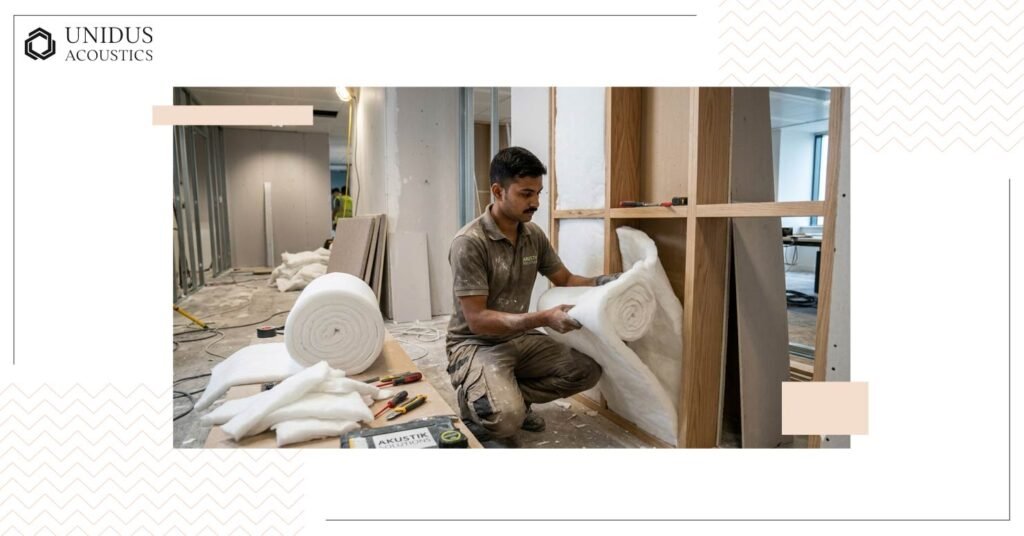
Polywool is the newest of the five sound insulation materials and the one most frequently misunderstood. It’s a non-woven insulation made from polyester fibres, often from recycled PET plastic, bonded thermally into a soft, lightweight roll or slab.
The NRC of polywool ranges from 0.70 to 0.90, depending on thickness and density, making it genuinely capable as an acoustic absorber. What sets it apart from glasswool and stone wool is its handling safety profile: polywool doesn’t contain the fine mineral fibres that cause skin irritation or respiratory risk, so it can be cut, installed, and handled without the protective equipment that mineral wool requires on site.
It’s also significantly lighter and, being made from recycled polyester, carries a lower environmental footprint than virgin mineral-based materials. Polywool typically qualifies for green building credits under IGBC and LEED rating systems, which is increasingly relevant in Indian commercial construction. The number of projects actively targeting IGBC Gold or Platinum ratings has grown substantially over the last several years, and polywool is seeing greater specification uptake as sustainable material choices become part of the design brief from the outset rather than being added at certification stage.
Where polywool currently falls short is density. It doesn’t match stone wool for mass-based sound blocking, which means it’s better suited to applications where absorption is the priority rather than transmission loss through partitions. False ceiling infill, underdeck insulation in open offices, acoustic treatment within lightweight partition systems where the structural assembly handles the blocking — these are polywool’s natural territory.
5. Wood Wool as a Sound Insulation Material
Wood wool occupies a category of its own among sound insulation materials. It’s made from long, fine wood strands (typically shaved from soft timber) bonded together with cement or mineral binders into rigid boards. The result is a dense, textured panel with an NRC of up to 0.90 and a density of around 400 kg/m³, available in thicknesses of 15mm, 20mm, and 25mm.
What makes wood wool genuinely different from the other materials in this guide is that it’s both an insulation layer and a finished surface product. Glasswool, polywool, and stone wool are almost always hidden inside an assembly, behind cladding or board. Wood wool can be left exposed. Architects regularly specify it as an acoustic ceiling or wall finish where the rough-hewn texture and natural material character work with the design intent, rather than against it. Auditoriums, lecture theatres, libraries, school corridors, and restaurant ceilings are all applications where wood wool earns its place as much for how it looks as for how it performs.
The material is also eco-friendly by nature. It’s made from a renewable resource, contributes to thermal insulation alongside acoustic absorption, and fits naturally into projects with sustainability credentials. Where polywool earns green building credits through its recycled content, wood wool earns them through its renewable material base and low processing intensity.
The practical limitation is worth noting: wood wool is a strong absorber, but it’s not a blocking material in the way stone wool or MLV are. Specifying it as the sole acoustic layer in a partition that needs serious STC performance would miss the point. Where it excels is in controlling the acoustic character of a room (reducing reverberation, improving speech clarity) while simultaneously functioning as the visible finish on the ceiling or wall. In that specific role, few sound insulation materials can match it.
Comparing Types of Acoustic Insulation Material
| Material | Primary Mechanism | Frequency Strength | Fire Performance | Moisture Resistance | Best Application |
|---|---|---|---|---|---|
| Glasswool | Sound absorption | Mid to high (speech range) | Moderate | Low (needs vapour barrier) | Office partitions, false ceilings, HVAC lining |
| Stone Wool | Absorption and mass | Mid to low (handles low-freq better than glasswool) | High (non-combustible, 1000°C+) | Moderate | Fire-rated partitions, plant rooms, auditoriums |
| Wood Wool | Moderate absorption | Mid frequency | Moderate | Good | Auditoriums, schools, exposed architectural finishes |
| Polywool (PFB) | Sound absorption | Mid to high | Moderate | Good | Office fitouts, healthcare, partially visible applications |
| Mass Loaded Vinyl (MLV) | Sound blocking (mass law) | Broad, especially low to mid | Verify by product | Good | Floor-ceiling assemblies, ductwork wrapping, high-performance walls |
How to Choose the Right Sound Insulation Material for Your Project
Specifying sound insulation materials correctly comes down to two questions before reaching for a catalogue: what is the acoustic problem, and what are the other project constraints (fire performance, green rating, budget, installation environment)?
When Glasswool Is the Right Sound Insulation Material
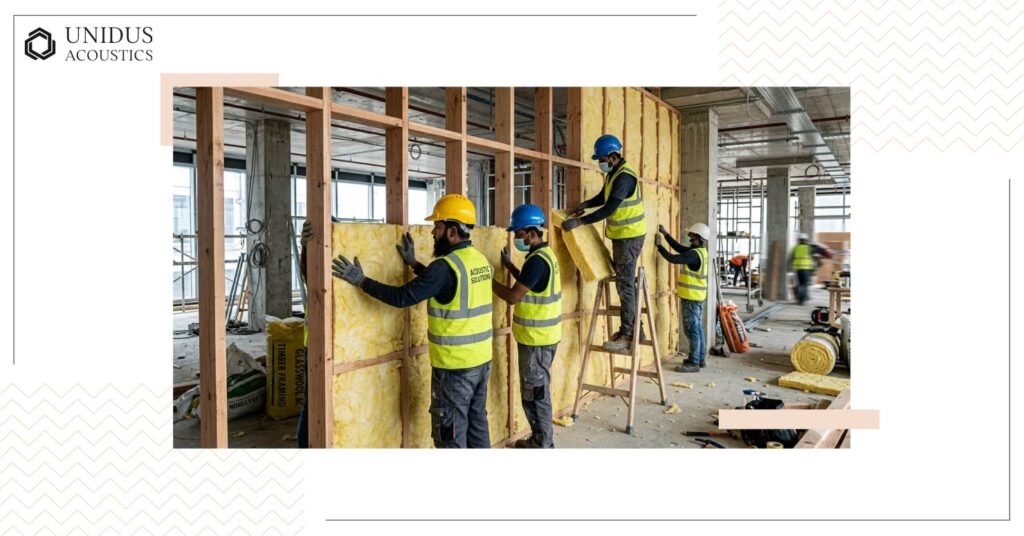
Glasswool is a strong default for most commercial applications where the priority is sound absorption in walls and ceilings, fire performance requirements are moderate, and the project needs a cost-effective solution across a large footprint. A hospital with 200-plus rooms, a corporate campus spanning multiple floors; these are projects where glasswool across most zones makes practical sense, with stone wool reserved for areas that carry a specific fire or acoustic brief. Large-scale institutional projects benefit from this combination because it allows the specification to allocate higher-cost materials precisely where they earn their place, rather than across the full scope.
When Stone Wool Is the Better Sound Insulation Specification
Stone wool earns its specification in environments where fire resistance and acoustic blocking are both critical requirements. Any space that carries a specific fire rating or where the wall assembly needs to achieve STC 50 and above is a candidate for stone wool over fibreglass alternatives. This comes up consistently in server rooms, stairwells, high-occupancy corridors, and meeting rooms where confidentiality is a functional requirement. A law firm’s conference floor, a financial institution’s boardroom, or a government facility’s sensitive discussion rooms are all stone wool applications. The material’s Class A fire rating is often a compliance requirement in these environments, which means the acoustic benefit comes alongside a regulatory one.
When MLV Is the Right Sound Insulation Call
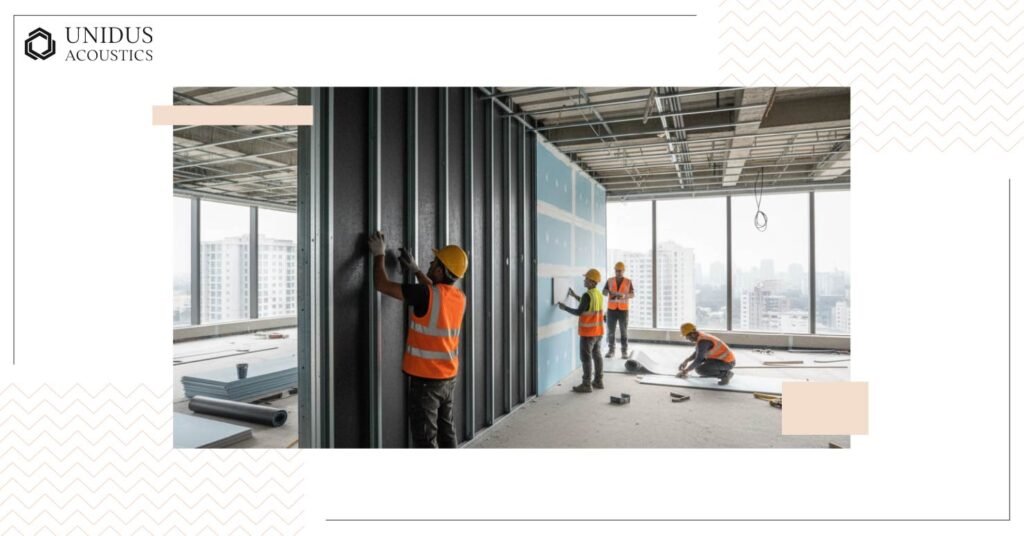
MLV is not a substitute for bulk insulation. It’s a complementary layer in high-performance assemblies, or the primary solution in retrofit projects where adding structural depth to a wall or ceiling isn’t viable. If the problem is mechanical noise from ducts and pipes, or if a partition needs STC improvement without being rebuilt, MLV is often the most practical choice. It’s also regularly specified in multi-storey commercial buildings where impact noise from upper floors needs to be managed at the floor-ceiling assembly level. The key advantage over other sound insulation materials in this context is that it adds meaningful performance without adding meaningful bulk.
When to Specify Polywool as Your Sound Insulation Material
Polywool makes sense on projects with green building targets, specifically IGBC Gold or Platinum and LEED certification, where material sustainability contributes to rating points. It’s also a practical option for schools, healthcare facilities, and libraries, where the safety profile of installation materials matters alongside acoustic performance. On sites where handling conditions make mineral wool difficult to work with safely (particularly in occupied or partially occupied buildings during fit-out), polywool is often the pragmatic call for the acoustic insulation layer. The constraint to keep in mind: it’s an absorber first, not a blocker, so the partition assembly itself needs to carry the STC load.
When to Specify Wood Wool as Your Sound Insulation Material
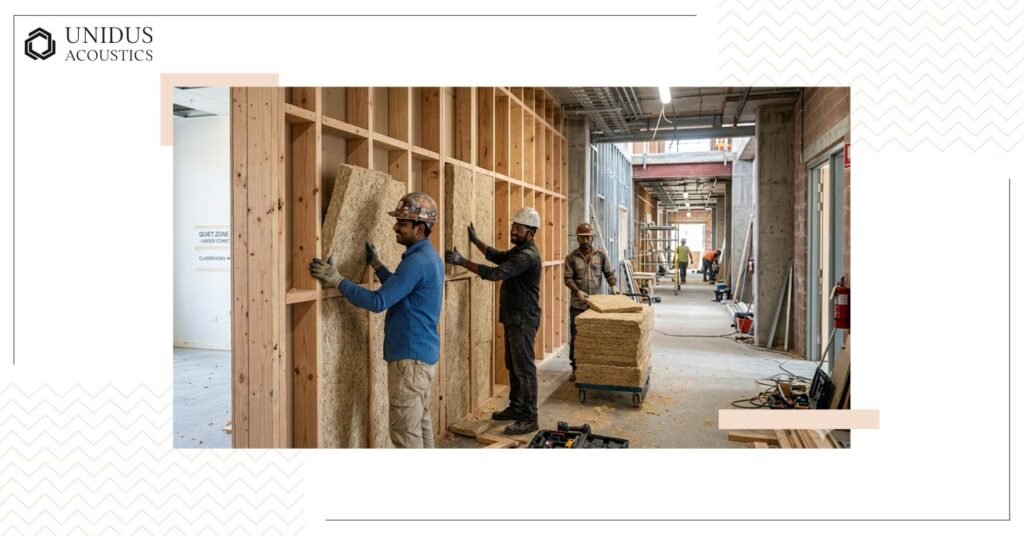
Wood wool is the right specification when absorption performance and finished appearance need to be achieved with a single material. If the design brief calls for a ceiling or wall that controls reverberation and looks good without an additional cladding layer on top, wood wool is likely the answer.
It’s particularly well-suited to auditoriums, lecture theatres, school corridors, libraries, and hospitality spaces where exposed texture works with the interior design language. It’s also a strong choice for projects with sustainability requirements, given its renewable material base. The one scenario where it shouldn’t be specified as the primary acoustic layer is a high-STC partition: wood wool handles the room-side absorption problem well, but the assembly behind it still needs a blocking layer (stone wool, MLV, or both) to manage transmission loss between spaces.
Not sure which combination of sound insulation materials suits your project? Reach us at hi@unidusindia.com or connect at +91-9625332290. We’re happy to advise on specifications before you finalise.
Sound Insulation in Practice: What the Data Sheets Don’t Tell You
No single sound insulation material solves every acoustic problem in a building. A high-performance commercial project almost always uses at least two materials in combination: stone wool or polywool in the wall cavity, MLV laminated to the board face, and then a separate acoustic treatment layer on the room-facing surface. Each layer targets a different part of the problem, and the combined effect is almost always greater than what any individual material achieves on its own.
The acoustic performance of an assembly depends as much on how it’s built as on the materials themselves. A stone wool cavity with poorly sealed edges, unsealed conduit penetrations, and flanking paths through the floor or ceiling structure will underperform a more modest material assembly that’s been installed with care. The specification document and the installation quality need to be thought of as a single system. Getting one right and neglecting the other is one of the most common reasons real-world acoustic performance falls short of what the design intended.
The NRC and STC figures in manufacturer data sheets are measured under controlled lab conditions. Real-world performance typically falls somewhat short of those figures, which is why acoustic consultants generally design to a target with a margin, rather than to the exact specification threshold. When reviewing manufacturer data, it’s worth asking whether the figures account for the specific assembly configuration you’re actually building.
What 40 Years in Commercial Acoustics Looks Like in Practice
With 40 years of expertise in commercial acoustic solutions, we at Unidus Acoustics have worked with architects, interior designers, and project consultants to understand what each project needs acoustically and then recommend the right combination of sound insulation materials and systems to achieve it.
We supply all five sound insulation materials covered in this guide: glasswool, stone wool, MLV (Sound Deadening Membrane), polywool, and wood wool. Each is available in formats suited to the full range of commercial applications, from large institutional builds to corporate fit-outs. Our product range also includes acoustic wall panels, ceiling baffles and clouds, space division systems, and integrated acoustic lighting, which means it’s possible to address the complete acoustic environment in a single project partnership rather than coordinating across multiple suppliers.
We’ve completed 635+ projects across 16+ cities, working with 10,500+ customers that include AIIMS, Air India, TCS, Infosys, and SBI, to name a few. Our products are certified by SGS, Intertek, and TÜV Rheinland. Our approach is built around on-time delivery, value for money, and custom acoustic solutions that turn noise into harmony.
For specifications, samples, or project advice, connect with us. You can also visit unidusindia.com to explore our full product range and request a sample.
Every acoustic project starts with the right material in the right place. Getting that combination right from the beginning saves high cost and rework downstream.